1953 Bowman Color Baseball Cards Value: Raw vs Graded Guide
1953 Bowman Color baseball cards value explained: Mantle #59, Musial, Berra, high numbers, raw vs PSA 10 gaps, and which cards are worth grading.

Estimated reading time: 11 min
Key Takeaways
- 1953 Bowman Color baseball cards value depends on three things: the player, the card number (the scarcer high series #113-160 carries a premium), and condition.
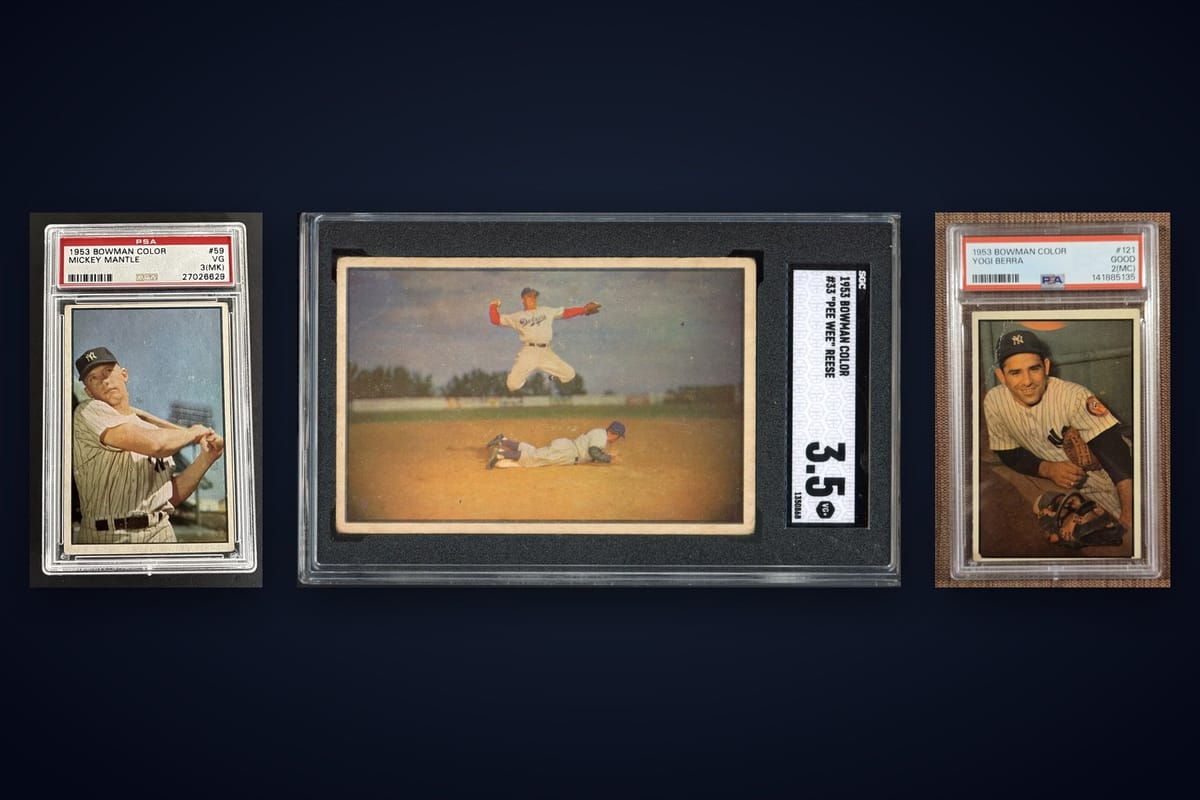
- Mickey Mantle #59 is the headline card, followed by Stan Musial #32, Yogi Berra #121 and Warren Spahn #99.
- The gap between a mid-grade card and a gem is the biggest lever in the set, so a PSA 10 is a different market from everything below it.
- Centering, print defects, wax and gum stains, and trimming drive grades on these larger-format cards. Measure before you submit.
- Exact sold values for specific cards are in the data table in this post (as of 2026-11-22). Check it before you decide what to grade.
Card values — live data from Midpoint's card database, as of 2026-11-22. Prices move; Midpoint refreshes these daily.
| Card | Raw | PSA 10 | Gem premium | |
|---|---|---|---|---|
 |
Mickey Mantle #59 1953 Bowman Color |
$1,849 | $437,994 | 236.9× |
 |
Pee Wee Reese #33 1953 Bowman Color |
$598.69 | $91,771 | 153.3× |
 |
Yogi Berra #121 1953 Bowman Color |
$84.45 | $63,181 | 748.2× |
 |
Hank Bauer, Mickey Mantle, Yogi Berra #44 1953 Bowman Color |
$161.23 | $34,143 | 211.8× |
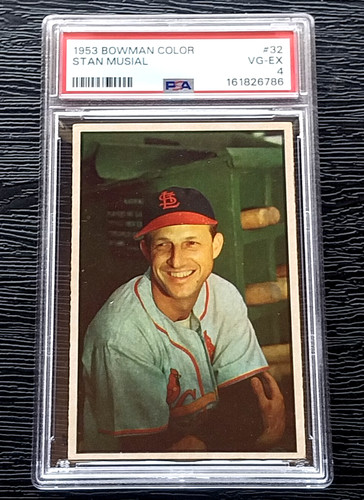 |
Stan Musial #32 1953 Bowman Color |
$143.04 | $24,733 | 172.9× |
 |
Bob Feller #114 1953 Bowman Color |
$70.52 | $20,076 | 284.7× |
 |
Warren Spahn #99 1953 Bowman Color |
$70.47 | $17,615 | 250× |
 |
Early Wynn #146 1953 Bowman Color |
$17.49 | $13,680 | 782.2× |
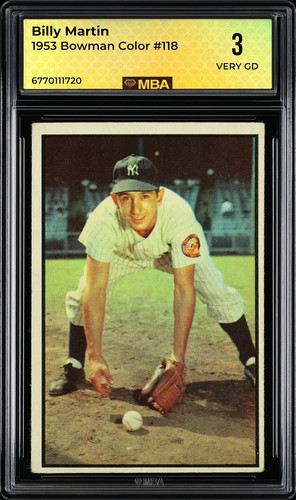 |
Billy Martin #118 1953 Bowman Color |
$40.00 | $10,931 | 273.3× |
 |
Eddie Mathews #97 1953 Bowman Color |
$35.00 | $8,892 | 254.1× |
 |
Roy Campanella #46 1953 Bowman Color |
$31.17 | $8,641 | 277.2× |
 |
Cal Abrams #160 1953 Bowman Color |
$18.02 | $8,280 | 459.5× |
Look up any card's current raw and graded value in Midpoint — and get an estimated grade before you pay to submit.
Table of Contents
- Section 1: What the 1953 Bowman Color Set Is (and Isn't)
- Section 2: Most Valuable 1953 Bowman Color Cards
- Section 3: 1953 Bowman Color Price Guide by Raw Condition
- Section 4: PSA, SGC and Other Grades: The Gem-Premium Gap
- Section 5: High-Number Cards #113-160 and Why They Cost More
- Section 6: What Moves Value: Centering, Surface, Color and Trimming
- Section 7: Which 1953 Bowman Color Cards Are Worth Grading
- Conclusion
- FAQ
Section 1: What the 1953 Bowman Color Set Is (and Isn't)
Before you price anything, make sure you know what you are holding. The 1953 Bowman Color set is one of the most admired postwar issues. Every 1953 Bowman Color baseball cards value discussion starts with how the set is built.
Set Basics
- 160 cards in the complete set.
- Larger-than-standard size: roughly 2.5 by 3.75 inches, noticeably taller than the standard-size cards that followed.
- Color fronts that look like tinted portraits, which collectors compare to small works of art.
- Player-stat backs with biographical details and career information.
The size matters. Taller cards are harder to store, easier to ding, and tougher to center cleanly. That is part of why high-grade examples carry such a strong premium.
Don't Confuse It With the Black-and-White Issue
Bowman also released a separate 1953 Bowman black-and-white set. It is a different, smaller issue with its own checklist and its own value structure. Sellers sometimes blur the two in listings. Always confirm that the card has a color front and carries a number within the 160-card Color checklist before you compare it to any price guide.
How This Guide Uses Prices
Values move with every sale. Rather than quoting stale numbers from memory, this post uses figures from Midpoint's own database, dated as of 2026-11-22. They appear in the table that follows this section. Use them as a reference point and cross-check recent sold listings, because one strong auction can shift a thin market.
The rest of this guide explains why those numbers differ so much from card to card and grade to grade.
Section 2: Most Valuable 1953 Bowman Color Cards
If you are hunting the most valuable 1953 Bowman Color cards, the answer starts with one name and then splits into stars versus scarcity.
Mickey Mantle #59: The Centerpiece
Mantle's #59 is the card most people mean when they search this set. It combines the most popular player of the era with one of the great color designs in the hobby. It sells across every format: raw, PSA, SGC and other graders. Even low-grade copies are meaningful purchases, and the spread from a creased raw copy to a sharp slab is enormous.
Compare Mantle's raw and graded rows in the data table. The pattern across the set holds: the same card can sit in entirely different price tiers depending on grade.
Other Key Stars and Hall of Famers
- Stan Musial #32: a perennial star-card pick and one of the strongest names in the set after Mantle.
- Yogi Berra #121: part of the high-number run, so you pay for both the player and the scarcity.
- Warren Spahn #99: a Hall of Fame pitcher whose card holds steady demand.
Other Hall of Famers in the set also sell well, particularly in sharp condition. Check the card number against a full checklist, since some commons in the scarcer series can outsell stars from the early series.
Value Is Not Just Fame
The highest-value cards are usually a mix of star power, scarcity and condition. A commoner from the high series can sell for more than a recognizable name from the lower numbers, especially in a high grade. That surprises new collectors and creates opportunity for informed buyers.
When you scan the table, look at each entry's card number first, then the grade, then the player name. That order explains most of the price differences.
Section 3: 1953 Bowman Color Price Guide by Raw Condition
A 1953 Bowman Color price guide is only useful if you can place your card on the condition ladder. Raw cards, meaning ungraded, are typically described in these tiers.
The Raw Condition Ladder
- Good / Poor: heavy wear, rounded corners, possible creases or paper loss. Priced as budget display copies.
- VG (Very Good): noticeable wear and softened corners, but a complete, clean-looking card. This is where many affordable star cards live.
- EX (Excellent): mild corner wear and a decent surface. The color still pops.
- EX/NM: light wear only visible up close. A strong middle ground for collectors who want eye appeal without gem prices.
- NM (Near Mint): sharp corners, strong color and only minor flaws. Here the market starts to price steeply.
How the Price Curve Behaves
Values do not climb in a straight line. In general, the jump from VG to EX is meaningful, the jump from EX/NM to NM is larger, and beyond NM, into true high-end grades, the step becomes very steep.
That curve is why the raw vs graded question matters. A raw card described as "Near Mint" by a seller is a claim, not a grade. Third-party grading turns the claim into a verified number, and the market pays for that certainty.
Using the Table With This Ladder
- Find your card number in the data table (as of 2026-11-22).
- Compare the raw entry to the graded entries at the closest grade.
- Adjust for eye appeal: centering, color and surface can move a card up or down within its tier.
Raw buying works best when you can inspect the card in hand. For online purchases, insist on sharp front and back scans, and ask about trimming and stains before you pay.
Section 4: PSA, SGC and Other Grades: The Gem-Premium Gap
Graded cards are where the biggest price differences appear. Understanding the 1953 Bowman Color PSA 10 value relative to lower grades is the key to this whole set.
Why Top Grades Cost So Much More
A 70-plus-year-old, larger-format card with richly tinted color is difficult to preserve. Print defects, off-center borders, gum or wax stains, and edge chipping are common. Very few survive in gem condition, so a PSA 10 often sells in a different league from a PSA 8 or 9. That difference is the gem-premium gap.
The practical effect: when the premium between two adjacent grades is large, a single point of grade can account for a big share of a card's value. This is the main reason pre-grading matters.
PSA vs SGC vs Other Companies
- PSA: the most liquid market for vintage. PSA slabs usually command the strongest resale recognition.
- SGC: widely respected for vintage, often priced slightly differently at the same numeric grade. Buyers value its clean presentation.
- Other graders: pricing varies by reputation and demand. Compare sold listings for the same grader before assuming a number carries over.
Scale definitions also differ between companies, which can change how a similar-looking card lands. Our guide to grading scale differences by company explains what top grades truly mean at each one.
Reading the Data Table
Look at how the same card changes from raw to PSA 8 to PSA 9 to PSA 10 in the table (as of 2026-11-22). Then compare against SGC entries if listed. The size of those steps tells you whether grading is likely to pay for itself.
Section 5: High-Number Cards #113-160 and Why They Cost More
The set was issued in series, and the later cards are generally considered scarcer. That is why high-number cards tend to be more valuable than comparable early-series cards.
The Scarcer Series
Cards #113-160 make up the high-number run. Within it, the lower end of the run (around #113-128) is often described as especially tough and can carry the strongest premium. Collectors often build a complete set by buying the early numbers cheaply and then chasing the hard ones.
- Lower numbers (#1-112): more available, so condition drives price.
- #113-128: tougher to find and typically priced accordingly in every grade.
- #129-160: still part of the high series, with premiums that vary by card and player.
Stars Inside the High Series
Yogi Berra #121 sits in this high-number range, so his card benefits from both Hall of Fame demand and scarcity. This is the kind of crossover that pushes a card well above neighbors in the checklist.
What This Means for Set Builders
Complete-set value is dominated by the high series and the handful of stars. Two sets with the same average grade can differ widely if one has stronger copies of Mantle and the high numbers. When estimating a complete set, price it in tiers:
- Mantle #59 and the other stars.
- High numbers #113-160, especially #113-128.
- The remaining commons, which are the cheapest but still add up across 160 cards.
If you are tracking a growing collection or a set build, a portfolio view helps you see where you are exposed. Midpoint's collection tracking shows your holdings' value over time, which is handy when a few key cards make up most of a set's worth. See Midpoint for details.
For thin, low-population cards in particular, read our guide to grading low-population cards.
Section 6: What Moves Value: Centering, Surface, Color and Trimming
Two cards with the same number and player can differ massively in price. These are the factors that do it.
Centering
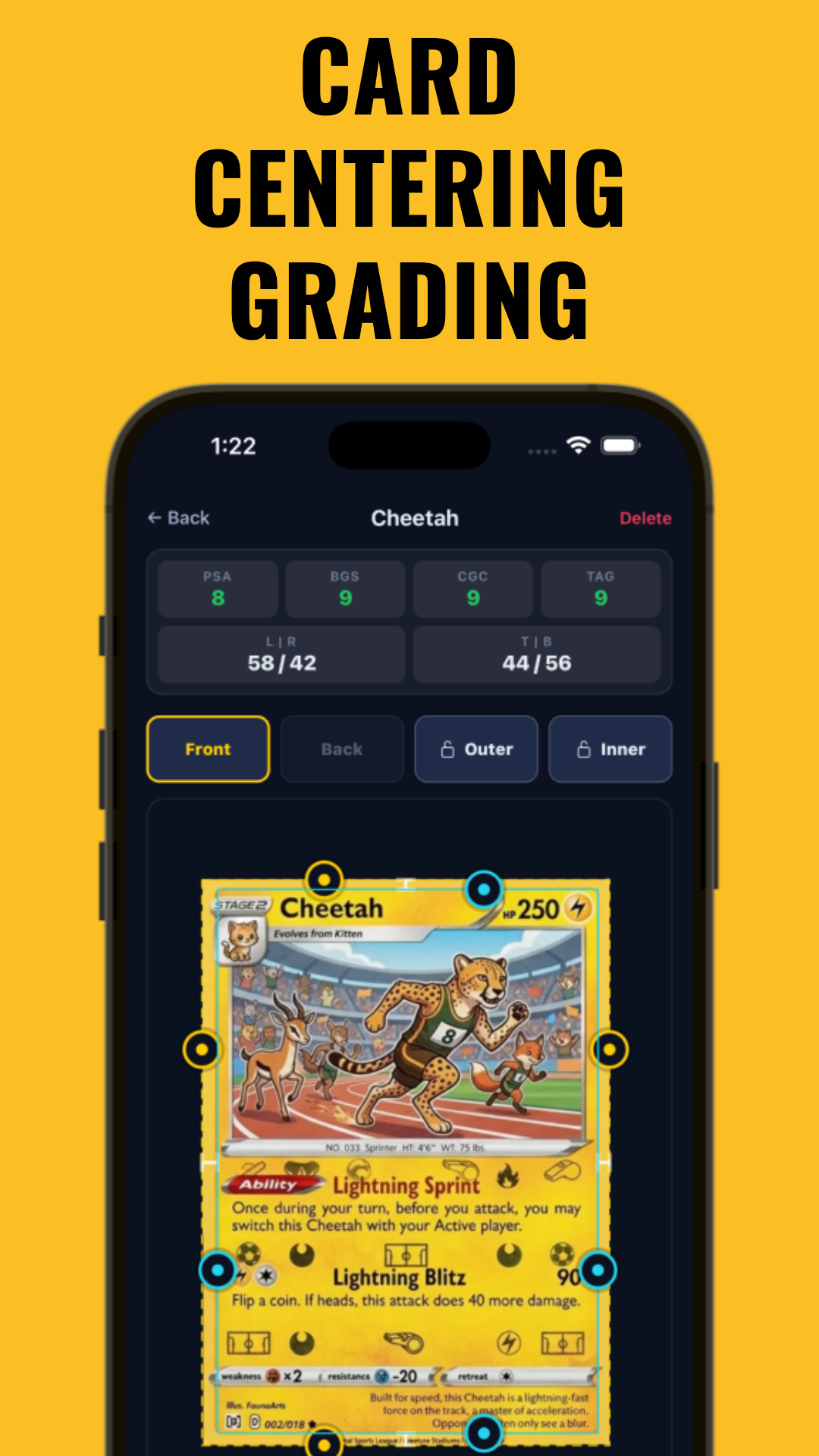
Bowman Color borders are often uneven, and the larger format can magnify it. A card that looks "fine" can have a heavy left-right or top-bottom shift that caps its grade. Centering is measurable, so there is no reason to guess. Our explainer on how centering impacts card value shows how much it can matter.
Corners, Edges and Surface
- Corners: rounding or fraying is the classic sign of handling.
- Edges: chipping shows up fast against the colored areas.
- Surface: print spots, scratches, gloss loss and wax or gum staining are all common in this era.
- Color: fading or toning reduces eye appeal, while rich saturated color is a premium trait.
Creases, Stains and Trimming
A crease is a major value hit and often restricts a card to a low numeric grade. Stains matter too, especially on the front. The most serious problem is trimming, where someone cuts a card down to sharpen the edges. Major graders will typically reject or flag altered cards, and altered cards trade at a deep discount.
How to Spot a Trimmed or Questionable Card
- Measure the card against the expected dimensions of about 2.5 by 3.75 inches. A noticeably smaller card is suspicious.
- Compare borders to other known genuine copies. Overly sharp, perfectly even edges on an old card deserve scrutiny.
- Check for rough or unnaturally straight cut marks under magnification.
- Buy slabbed copies from reputable graders when the stakes are high.
Store your cards properly once you own them. Our guide on how to store valuable cards covers the basics for protecting these larger cards.
Section 7: Which 1953 Bowman Color Cards Are Worth Grading
Not every card justifies a submission. The question of whether 1953 Bowman Color cards are worth grading comes down to simple math: expected graded value minus raw value minus grading and shipping costs.
A Practical Decision Framework
- Check the table: look at the raw value for your card and the graded values at each realistic grade (as of 2026-11-22).
- Estimate the grade honestly, based on centering, corners, edges and surface.
- Subtract costs: the grading fee, insurance, shipping and your time.
- Decide: submit only if the likely graded outcome beats the raw price with room to spare.
Good Candidates
- Star cards like Mantle #59, Musial #32, Berra #121 and Spahn #99 in clean condition. A slab adds authentication and liquidity.
- High numbers #113-128 that look sharp. The scarcity premium is amplified by a strong grade.
- Cards that appear well-centered with strong color and no creases.
Poor Candidates
- Creased or heavily stained cards, where the grade will be low and the fee may exceed the gain.
- Low-value commons with visible wear.
- Cards you suspect are trimmed. Don't pay to learn that.
Pre-Grade Before You Pay
This is where a pre-grading workflow earns its keep. Midpoint measures centering down to the millimeter and gives estimated PSA, BGS, CGC and TAG grades from centering, corners, edges and surface, before you spend $30 or more on a submission. You can also try the free centering calculator for a quick check. For a full walkthrough, see our step-by-step guide to pre-grading.
Use estimates as a filter, not a guarantee. They help you avoid the expensive mistakes while leaving the final call to the grader.
Conclusion
The 1953 Bowman Color baseball cards value picture is simple once you separate its drivers. Mantle #59 anchors the set, with Musial #32, Berra #121 and Spahn #99 close behind. The scarcer high series, especially the lower end around #113-128, adds a premium that can rival star power. Condition then multiplies everything, with the biggest jump at the top of the grading scale.
Before you buy, sell or submit, do three things: confirm you have the Color set and not the black-and-white issue, compare your card to the data table (as of 2026-11-22), and measure centering and condition honestly. Then decide whether a grade is likely to repay its cost.
If you want a faster way to do that, Midpoint is free on iOS and Android and helps you pre-grade, look up raw vs graded values and track your collection in one place.
FAQ
Q: How much is a 1953 Bowman Color Mickey Mantle card worth?
A: Mantle #59 is the most valuable and most traded card in the set, and its price varies enormously by grade. Raw and low-grade copies sit in a far lower tier than PSA, SGC or other graded copies, with steep steps at the top. See the data table above for current figures (as of 2026-11-22) and compare it to recent sold listings.
Q: What is the most valuable 1953 Bowman Color baseball card?
A: Mickey Mantle #59 is generally the headline card. Stan Musial #32, Yogi Berra #121 and Warren Spahn #99 follow among the stars, while scarce high-number cards can also be very valuable in top grades.
Q: How much is a complete 1953 Bowman Color set worth?
A: It depends on the average grade and especially on the quality of Mantle, the other stars, and the high numbers. A complete 160-card set in lower grades is worth far less than one with strong, high-grade key cards. Price it in tiers rather than using a single average.
Q: Are 1953 Bowman Color high-number cards more valuable?
A: Generally yes. Cards #113-160 are considered scarcer than the early series, and the lower end of that run (around #113-128) is often described as especially tough. They tend to carry a premium over comparable early-series cards in the same condition.
Q: How can you tell if a 1953 Bowman Color card is authentic or trimmed?
A: Measure it against the expected size of about 2.5 by 3.75 inches, compare borders to genuine examples, and look for unnaturally straight or rough cut edges under magnification. For high-value cards, a copy graded by a reputable company is the safest option.
Q: What are 1953 Bowman Color cards worth in different grades?
A: Values generally rise gradually from Good through EX, then sharply from EX/NM to NM and into gem grades, where a PSA 10 is in a class of its own. Check the data table for specific entries (as of 2026-11-22) and compare raw, PSA and SGC values for the same card number.
Free to start
Try the Midpoint app
Grade any card from a photo, see its raw and PSA 10 value, and track what your collection is worth — free.
Get it on iPhoneGet it on Android