1983 Star Basketball Cards Value: Raw vs Graded Guide
1983 Star basketball cards value explained: the most valuable cards, the gem-premium gap, PSA 10 value, and which cards are worth grading.

Estimated reading time: 11 min
Key Takeaways
- 1983 Star basketball cards value is driven by a handful of rookies and stars: Dominique Wilkins, Clyde Drexler, Isiah Thomas, James Worthy and Kareem Abdul-Jabbar.
- The gap between raw and gem-grade copies is the biggest story in this set, because Star cards are widely reported to be hard to find well-centered and clean.
- Only submit a card when the expected graded value, minus grading fees, clearly beats the raw price. Pre-check centering first.
- Always compare completed sales, not asking prices, and be careful with high-dollar cards that have no authentication.
Card values — live data from Midpoint's card database, as of 2026-09-04. Prices move; Midpoint refreshes these daily.
| Card | Raw | PSA 10 | Gem premium | |
|---|---|---|---|---|
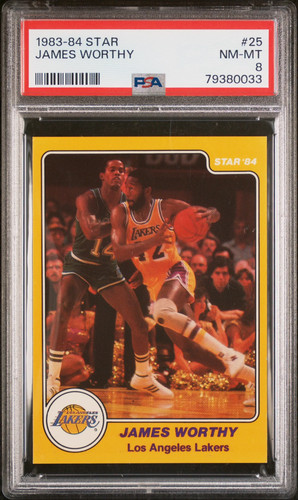 |
James Worthy #25 1983 Star |
$42.25 | $19,999 | 473.4× |
 |
Clyde Drexler #100 1983 Star |
$430.83 | $19,867 | 46.1× |
 |
Isiah Thomas #94 1983 Star |
$383.00 | $17,050 | 44.5× |
 |
Dominique Wilkins #263 1983 Star |
$1,053 | $11,944 | 11.4× |
 |
Rolando Blackman #50 1983 Star |
$150.00 | $10,189 | 67.9× |
 |
Magic Johnson #13 1983 Star |
$200.00 | $9,907 | 49.5× |
 |
Kurt Nimphius #56 1983 Star |
$109.50 | $7,606 | 69.5× |
 |
Mark Aguirre #49 1983 Star |
$102.50 | $7,116 | 69.4× |
 |
Bill Garnett #54 1983 Star |
$92.50 | $6,425 | 69.5× |
 |
Pat Cummings #51 1983 Star |
$82.54 | $5,646 | 68.4× |
 |
Kareem Abdul Jabbar #14 1983 Star |
$60.63 | $4,872 | 80.4× |
 |
Danny Ainge #27 1983 Star |
$59.90 | $2,706 | 45.2× |
Look up any card's current raw and graded value in Midpoint — and get an estimated grade before you pay to submit.
Table of Contents
- Section 1: The 1983-84 Star Set and How to Read a Price Guide
- Section 2: The Most Valuable 1983 Star Cards
- Section 3: All-Rookies and All-Star Game Subsets
- Section 4: Raw vs Graded and the 1983 Star PSA 10 Value Gap
- Section 5: Condition Factors That Change Value
- Section 6: Which 1983 Star Cards Are Worth Grading
- Section 7: Authenticity, Sealed Sets and Reading the Market
- Conclusion
- FAQ
Section 1: The 1983-84 Star Set and How to Read a Price Guide
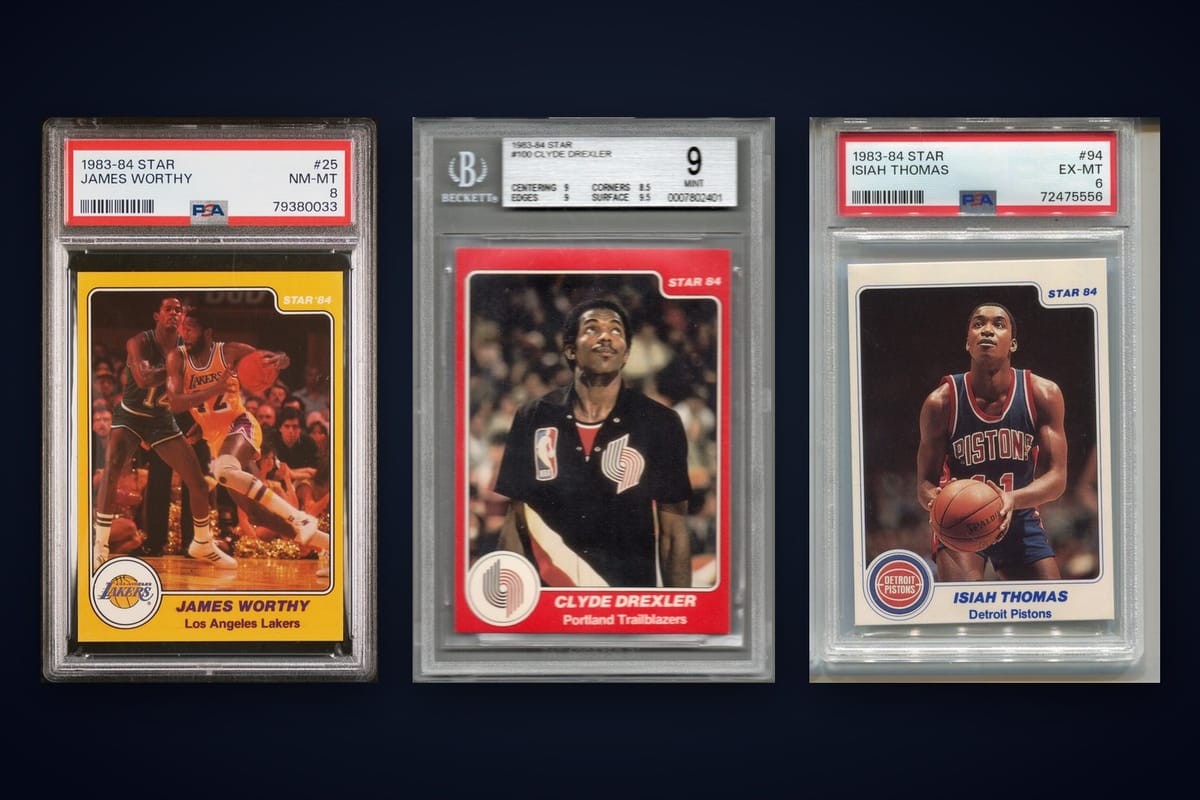
If you are researching 1983 Star basketball cards value, start with what the set actually is. Star Company produced its 1983-84 basketball issues before Fleer's modern NBA era began in 1986. That makes it one of the earliest widely collected NBA card sets of the 1980s, and it includes early cards of several Hall of Fame-caliber players.
Star issues are loved by vintage collectors, but they are also frustrating. Collectors commonly report inconsistent cutting and printing, so clean examples can be harder to find than the set's age alone would suggest.
What to know before you price anything
- Set structure matters. The 1983 Star issues include separate sets and subsets, notably All-Rookies and All-Star Game cards. Always confirm which set or subset your card belongs to before comparing prices.
- Card counts and print runs are debated. Check a reputable checklist for exact numbering rather than trusting a single listing, and treat any claimed production figures as estimates.
- Same player, different cards. A base Star card and an All-Star subset card of the same player can sell very differently.
How a 1983 Star price guide should be used
A 1983 Star price guide is a starting range, not a promise. Values shift with population reports, new auction results and player-specific demand. The data table above shows raw versus graded values for the cards Midpoint tracks, as of 2026-09-04. Use it to see the shape of the market: which cards carry a large premium for grade, and which barely move.
Two habits will keep you accurate. First, price your exact card and exact grade. Second, always separate completed sales from what sellers merely hope to get.
Section 2: The Most Valuable 1983 Star Cards
The most valuable 1983 Star cards share two traits: a Hall of Fame name and a clear rookie or star-moment identity. Collectors consistently chase the same short list.
Dominique Wilkins
Wilkins is one of the headline rookies of the era. His 1983 Star card is widely treated as a rookie-era card and is a core target for collectors of Hawks history, high-flying dunkers and early-80s basketball. Because many copies reportedly suffer from soft centering and rough edges, a sharp example commands real attention. If you want a single card to anchor a collection, this is a frequent pick.
Clyde Drexler
Drexler's early Star card is another pillar. A Hall of Famer with a deep fan base in Portland and Houston, he gives buyers a reason to pay up for quality. Condition-sensitive buyers tend to pay the largest premium here.
Isiah Thomas, James Worthy and Kareem
- Isiah Thomas: a Pistons icon with strong demand, including in the All-Star Game subset.
- James Worthy: a Lakers dynasty player, popular among Showtime-era collectors.
- Kareem Abdul-Jabbar: the scoring legend gives the set a veteran superstar anchor, and his cards hold steady demand regardless of rookie status.
Worth noting: Michael Jordan does not appear in the 1983 Star issue, so do not pay a Jordan premium for anything labeled as one. Verify the year and set on any listing.
When you look at the data table, pay attention to the spread between raw and graded values for these names. The wider the spread, the more a grade changes your return. For more on how scarcity affects the decision, see our guide to card grading for low population cards.
Section 3: All-Rookies and All-Star Game Subsets
A lot of confusion about 1983 Star value comes from the subsets. The issue is not just one flat checklist, and the set or subset a card belongs to often explains its price.
The All-Rookies subset
The All-Rookies cards spotlight young players, and they are where collectors often look for Dominique Wilkins and James Worthy early material. Confirm exactly which players appear against a reliable checklist. These are natural targets for anyone who cares about early-career NBA cards.
- Compare the exact card number and subset name before buying.
- Treat rookie subset cards as condition-driven: a tiny change in centering can swing the price.
- Remember that other players in the subset can be inexpensive by comparison, so the value is concentrated in a few names.
The All-Star Game subset
The All-Star Game cards feature some of the biggest names of the early 1980s, including Magic Johnson, Isiah Thomas, Julius Erving and Larry Bird. These players have broad crossover demand beyond set collectors, which supports prices even when the cards are not rookies.
That broad demand creates a useful pattern. Superstar names with huge fan bases can hold value in lower grades, while players with narrower followings depend more on high-grade scarcity.
Why subsets matter for grading decisions
A subset card with a strong name can justify grading even at modest premiums, because the buyer pool is large. A minor name in a rookie subset usually does not. Before submitting, check the table for the specific card and look at the raw-to-graded difference, not the player's fame alone.
Midpoint's card lookup covers raw versus graded values for a large database of cards, so you can check each subset card in seconds rather than hunting through scattered listings.
Section 4: Raw vs Graded and the 1983 Star PSA 10 Value Gap
The defining feature of this set is the gem-premium gap: the jump in price between a typical raw card and a top-grade copy. Because Star cards are often described as off-center or roughly cut, a true gem is a rarity, and the market tends to pay for that.
Understanding the grades
- Raw (ungraded): prices vary wildly because buyers must judge condition from photos. Expect discounts for visible flaws.
- PSA 8 and PSA 9: the realistic target for many sharp copies. These grades often capture much of the premium without requiring perfection.
- PSA 10: the 1983 Star PSA 10 value is typically a large multiple of lower grades when copies exist at all. Scarcity is the reason.
Check the data table, as of 2026-09-04, to see how each tracked card prices raw versus graded. The pattern to look for is a steep staircase: modest steps between mid grades, then a big leap at the top.
Other grading companies
PSA dominates resale for vintage basketball, but BGS, CGC and TAG also appear. Their scales differ, and a "10" does not mean the same thing everywhere. Our breakdown of grading scale differences by company explains why a BGS 9.5 and a PSA 10 are priced differently.
Do not assume a 10 is attainable
The biggest mistake collectors make is pricing a raw card as if it will come back a PSA 10. Treat PSA 10 as a bonus outcome, not your base case. Build your math around the grade you can realistically expect.
Section 5: Condition Factors That Change Value
Several issues commonly push 1983 Star cards down a grade. Knowing them lets you evaluate a card in hand before you ever think about submitting.
Centering
Centering is a leading reason Star cards miss high grades. Borders can be visibly lopsided left-to-right or top-to-bottom. PSA's gem standard allows only modest off-centering on the front, so a card that looks "fine" at a glance can still fall short. Read more in our guide on how centering impacts card value.

Print and cutting defects
- Miscuts: cards trimmed unevenly, sometimes showing part of an adjacent card's border.
- Print defects: ink dots, snow, registration issues or dull color.
- Rough edges: fraying or chipping from poor cutting, not just handling.
Graders generally treat print defects differently from handling damage, but they can still cap the grade and affect buyer appetite.
Corners, edges and surface
Soft corners, edge wear and surface scratches all matter. Vintage cards are often stored loosely or handled for decades, so inspect under bright, angled light.
Scarcity within the set
Some cards in the set may be scarcer than others, and checklist research can reveal which numbers are harder to find in clean condition. Treat unverified "short print" claims cautiously and rely on population data and completed sales instead of listing descriptions.
Good storage keeps what you have. Our guide on how to store valuable cards covers sleeves, holders and humidity.
Section 6: Which 1983 Star Cards Are Worth Grading
Deciding which 1983 Star cards are worth grading comes down to arithmetic, not hope. Grading often costs $30 or more per card before shipping and insurance, and fees vary by company and service tier, with vintage and higher-value tiers costing more.
A simple decision framework
- Find the raw value of your card in the data table, as of 2026-09-04.
- Find the graded values for the grades you can realistically achieve.
- Subtract fees: grading, shipping, insurance and any selling costs.
- Weight by probability: if you think a PSA 7 is most likely, price it as a PSA 7.
If the realistic graded value does not beat raw value plus costs, keep the card raw.
Strong candidates
- Dominique Wilkins, Clyde Drexler, James Worthy and Isiah Thomas cards with sharp corners and good centering.
- Kareem, Magic, Erving and Bird cards where broad demand supports resale at mid grades.
- Any card where the raw-to-graded spread in the table is wide.
Weak candidates
- Role players and minor names, where grading fees can exceed the upside.
- Cards with obvious creases, heavy wear, or severe miscuts.
- Badly off-center copies that will not clear the grade you need.
Pre-grade before you pay
Measure the centering first. Midpoint's free centering calculator shows border ratios, and the Midpoint app adds estimated PSA, BGS, CGC and TAG grades from centering, corners, edges and surface. For a manual process, follow our step-by-step pre-grading guide.
Section 7: Authenticity, Sealed Sets and Reading the Market
Value is only real if the card is real and the price is real. This final section covers the traps.
Counterfeits and reprints
Valuable vintage cards attract fakes and reprints. High-dollar Star cards, especially those of Wilkins, Drexler, Worthy and Thomas, deserve extra caution.
- Compare print texture, color and cut against a known genuine copy.
- Be suspicious of perfect-looking cards sold with poor photos or no returns.
- For expensive purchases, buy cards already authenticated by a major grader, or have them professionally authenticated.
Completed sales vs asking prices
A listing is an opinion; a completed sale is evidence. On eBay, filter to sold items, and compare the same card and same grade. Ignore outliers, and be wary of best-offer listings where the final price is hidden.
Complete sets, sealed material and opened sets
Complete-set value depends on completeness and condition. A set with the key cards in strong shape is worth far more than one stuffed with damaged commons, and an incomplete set trades at a discount to the sum of its parts. Sealed material adds a different question: authenticity and provenance of the packaging. Treat sealed claims with caution unless verified, and price opened sets by the condition of their key cards rather than the box or bag alone.
Track your results
Once you own several cards, tracking values over time helps you decide when to hold, sell or grade. The Midpoint portfolio feature shows your collection's value over time, so you are not relying on memory.
Conclusion
1983 Star basketball cards value comes down to three things: who is on the card, which set or subset it belongs to, and how clean the copy is. Wilkins, Drexler, Thomas, Worthy and Kareem anchor the set, while the All-Star Game subset adds crossover names like Magic, Erving and Bird.
The gem-premium gap is the key insight. Star cards are hard to find sharp, so top grades tend to carry steep premiums, but a PSA 10 should never be your assumption. Check the data table, price your realistic grade, subtract fees, and only submit when the math works.
Before you spend on grading, measure centering and estimate the grade with Midpoint, free on iOS and Android.
FAQ
Q: What is the most valuable 1983 Star basketball card?
A: The most valuable cards typically come from the Hall of Fame names in the set: Dominique Wilkins, Clyde Drexler, Isiah Thomas, James Worthy and Kareem Abdul-Jabbar. The exact ranking changes with grade and recent sales, so check the data table for current raw and graded values.
Q: How much is a 1983 Star basketball card worth ungraded?
A: It depends heavily on the player and condition. Stars and key rookies are worth much more than commons, and visible centering or cutting flaws lower raw prices. Use the table, as of 2026-09-04, and compare completed sales.
Q: How much are 1983 Star basketball cards worth in PSA 9 or PSA 10?
A: Graded prices rise sharply with grade, and PSA 10 usually carries the biggest premium because gem copies are scarce. Check the table for the specific card, and do not assume your copy will reach a 10.
Q: Is the 1983 Star Dominique Wilkins card a valuable rookie card?
A: It is widely considered one of the set's best-known rookie-era cards and a frequent target for collectors, especially in strong condition with good centering.
Q: What are the key cards in the 1983-84 Star Basketball set?
A: The key cards are generally Wilkins, Drexler, Thomas, Worthy and Kareem, plus All-Star Game subset cards of Magic Johnson, Julius Erving and Larry Bird. Confirm exact card numbers against a reliable checklist.
Q: How much is a complete 1983 Star basketball set worth?
A: Complete-set value depends on the condition of the key cards and stars, not just the card count. Price the major cards individually, then adjust for completeness and overall condition.
Free to start
Try the Midpoint app
Grade any card from a photo, see its raw and PSA 10 value, and track what your collection is worth — free.
Get it on iPhoneGet it on Android