2003 Ultimate Collection PSA 9 vs PSA 10 Value Gap
2003 Ultimate Collection PSA 9 vs PSA 10 value: how to size the premium, which cards jump most from 9 to 10, and when a PSA 9 is the smarter buy.

Estimated reading time: 9 min
Key Takeaways
- Bottom line: For 2003 Ultimate Collection, a PSA 10 almost always carries a large premium over a PSA 9, but that premium only pays off on the big rookie and autograph cards where the 10 population is genuinely thin.
- On thick, serial-numbered, patch-and-autograph cards, a PSA 9 is often the smarter buy. It is still a high grade and costs far less per slab.
- The 9→10 jump is biggest where centering and corners decide everything. Heavy foil, thick card stock and patch windows make a true 10 hard to get.
- Only compare real sold prices with the same card number, parallel, serial number and grade. Price-guide estimates are not transactions.
- Check the dated figures in this post (as of 2026-11-08) and re-verify before you buy or sell. High-end pricing for this set moves with few sales.
This guide compares 2003 Ultimate Collection PSA 9 vs PSA 10 value for the 2003-04 Upper Deck Ultimate Collection basketball set. It covers what the price gap looks like, why it exists, and when paying for a 10 makes sense. Quick answer: pay up for a 10 on a top rookie only when the population and your exit plan support it. Otherwise a clean PSA 9 is usually the better value.
Card values — live data from Midpoint's card database, as of 2026-11-08. Prices move; Midpoint refreshes these daily.
| Card | Raw | PSA 10 | Gem premium | |
|---|---|---|---|---|
 |
LeBron James [Autograph] #127 2003 Ultimate Collection |
— | $281,968 | — |
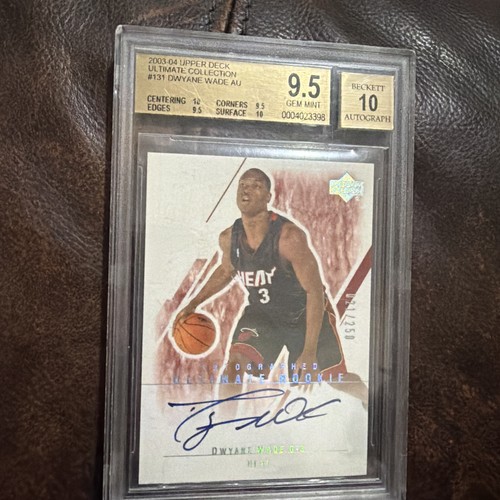 |
Dwyane Wade Autograph #131 2003 Ultimate Collection |
— | $7,655 | — |
 |
Kobe Bryant [Limited] #45 2003 Ultimate Collection |
$84.99 | $1,475 | 17.4× |
 |
Kobe Bryant [Limited] #174 2003 Ultimate Collection |
$449.99 | $1,125 | 2.5× |
 |
Michael Jordan #10 2003 Ultimate Collection |
$121.40 | $600.00 | 4.9× |
 |
Michael Jordan #167 2003 Ultimate Collection |
$159.06 | $571.63 | 3.6× |
 |
Kobe Bryant #174 2003 Ultimate Collection |
$89.99 | $311.49 | 3.5× |
 |
Allen Iverson #82 2003 Ultimate Collection |
$7.82 | $228.50 | 29.2× |
 |
Kobe Bryant #45 2003 Ultimate Collection |
$53.00 | $208.23 | 3.9× |
 |
Tim Duncan #98 2003 Ultimate Collection |
$8.89 | $73.00 | 8.2× |
 |
Yao Ming #33 2003 Ultimate Collection |
$12.98 | $65.49 | 5.1× |
Look up any card's current raw and graded value in Midpoint — and get an estimated grade before you pay to submit.
Quick Comparison: PSA 9 vs PSA 10 for 2003 Ultimate Collection
| Dimension | PSA 9 (Mint) | PSA 10 (Gem Mint) |
|---|---|---|
| Typical price | Substantially lower entry cost | Carries the 2003 Ultimate Collection PSA 10 premium, often a multiple of the 9 |
| Scarcity | More copies in the population report | Usually far fewer copies, especially on thick autograph and patch cards |
| Centering tolerance | Slightly more forgiving | Needs near-perfect centering on the front |
| Corners and edges | One minor flaw can be allowed | Sharp corners and clean edges; chipping on dark borders is disqualifying |
| Surface and foil | Light imperfections may be tolerated | Clean foil, no scratches or print lines |
| Liquidity | More frequent sales, easier price discovery | Fewer sales, bigger swings between comps |
| Best for | Collectors and value-minded buyers | Registry builders, investors, trophy rookies |
The 2003 Ultimate Collection Set in Brief
The set is a premium release. It mixes serial-numbered cards with autograph, memorabilia, rookie, patch and parallel subsets. That variety matters for grading because the cards are thick, shiny and full of components that can go wrong.
- Serial-numbered cards: a low print run caps supply, so even a PSA 9 can be scarce.
- Autographs: authentication and signature quality affect value as much as the slab number.
- Patches and memorabilia: patch quality, window placement and edge integrity all factor in.
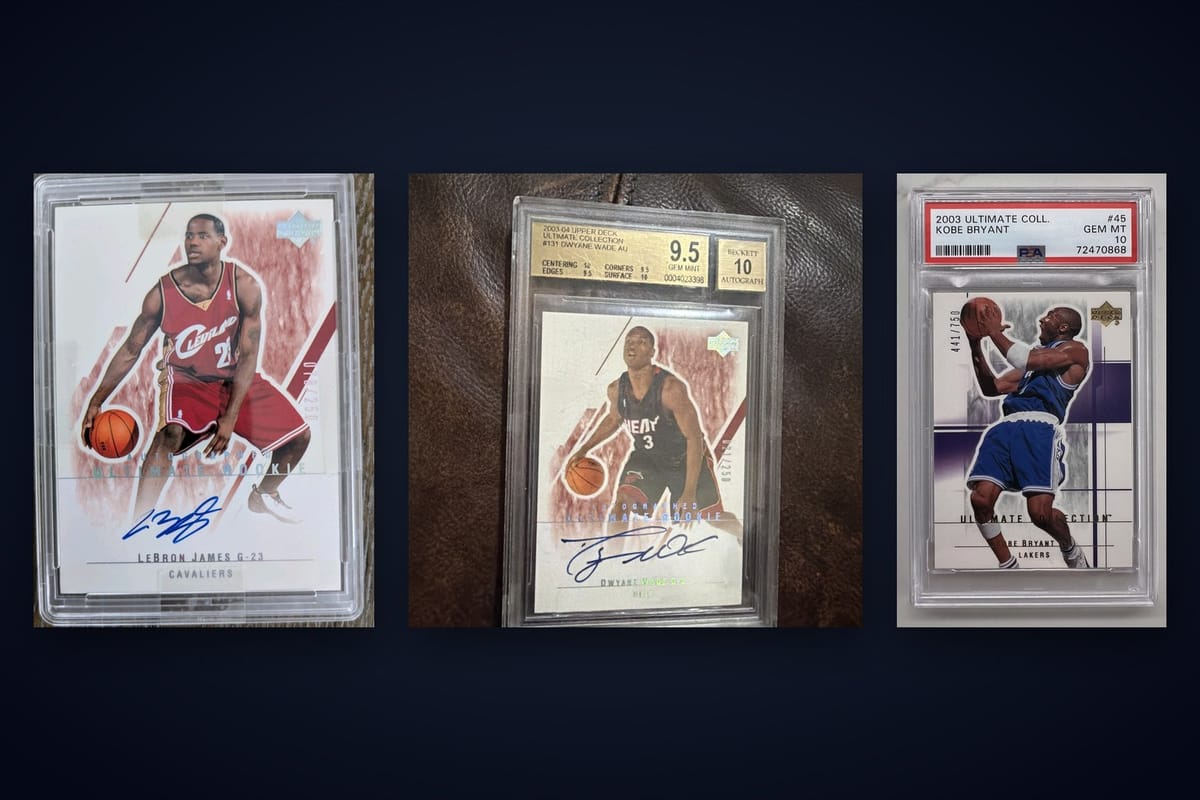
- Rookies: the LeBron James autograph rookie is the headline card, and the other top rookies of the class sit behind it in demand.
Demand concentrates in a few names. The gap between a 9 and a 10 on a star rookie is typically far larger, in dollars, than the gap on a role-player card. Percentages can be high on both.
Price Gap: How Big Is the 9→10 Jump?
The value table in this post shows PSA 9 and PSA 10 figures for specific cards from Midpoint's database, as of 2026-11-08. Use it as a snapshot, not a guarantee. Always measure the gap three ways:
- Dollar difference: PSA 10 price minus PSA 9 price. This is your real upgrade cost.
- Multiplier: PSA 10 price divided by PSA 9 price. A multiplier of 3x means a 10 costs three times a 9.
- Percentage premium: (PSA 10 − PSA 9) ÷ PSA 9. A 3x multiplier is a 200% premium.
For the LeBron James autograph rookie and other major rookies, the dollar gap is the number that matters. Even a modest multiplier turns into a large cash difference on an expensive card. On cheaper cards in the set, the multiplier can look dramatic while the dollar difference stays small. That is often the best place to pay for a 10 if you want one.
Real sales versus price-guide estimates
Do not mix the two. Price guides smooth out sparse data. On a thin market like this one, a single auction can reset the picture, so treat an estimate as a hint and a sold listing as evidence.
- Look at the most recent completed sales, not asking prices.
- Note the sale date. A sale from a hot market is not a sale from a cold one.
- Discard outliers such as best-offer listings with unclear terms, or lots mixing multiple cards.
Scarcity: Population Reports and the PSA 10 Premium
The premium exists mostly because of supply. Pull PSA's population report for the exact card and compare the PSA 9 count with the PSA 10 count.
- Low 10 count, higher 9 count: a wide gap is justified. Gem copies are the true rarity.
- Both counts tiny: prices are driven by just a few sales. Expect volatility and be cautious about a single comp.
- Healthy 10 count: the premium tends to be harder to defend, and a 9 offers better value.
Serial numbering adds a ceiling to total supply, so even a high-pop 9 on a low-print card is limited. That is why a 9 of a short-printed rookie can outprice a 10 of a common card in the set. Population is also a moving number: new submissions can change the ratio, so check it close to the time of purchase. If you are weighing grading a scarce card yourself, our guide to card grading for low population cards explains the trade-offs.
Condition: What Separates a 9 from a 10 on Thick Cards
Ultimate Collection cards are thick, often with foil, embedded patches and on-card or sticker autographs. That makes a gem grade harder than it is on a standard base card.
- Centering: the most common reason a good-looking card lands at a 9. Even small shifts show on cards with defined borders. See how centering affects value in this detailed guide.
- Corners: thick stock shows tiny dings and softness quickly.
- Edges and chipping: dark borders reveal white flecks, which is a frequent 10-killer.
- Surface and foil: scratches, print lines and clouding on reflective areas.
- Patch windows: a patch that sits unevenly or shows glue or cut marks can pull the grade down.
- Autograph: a faded or smeared signature affects appeal even when the grade is fine.
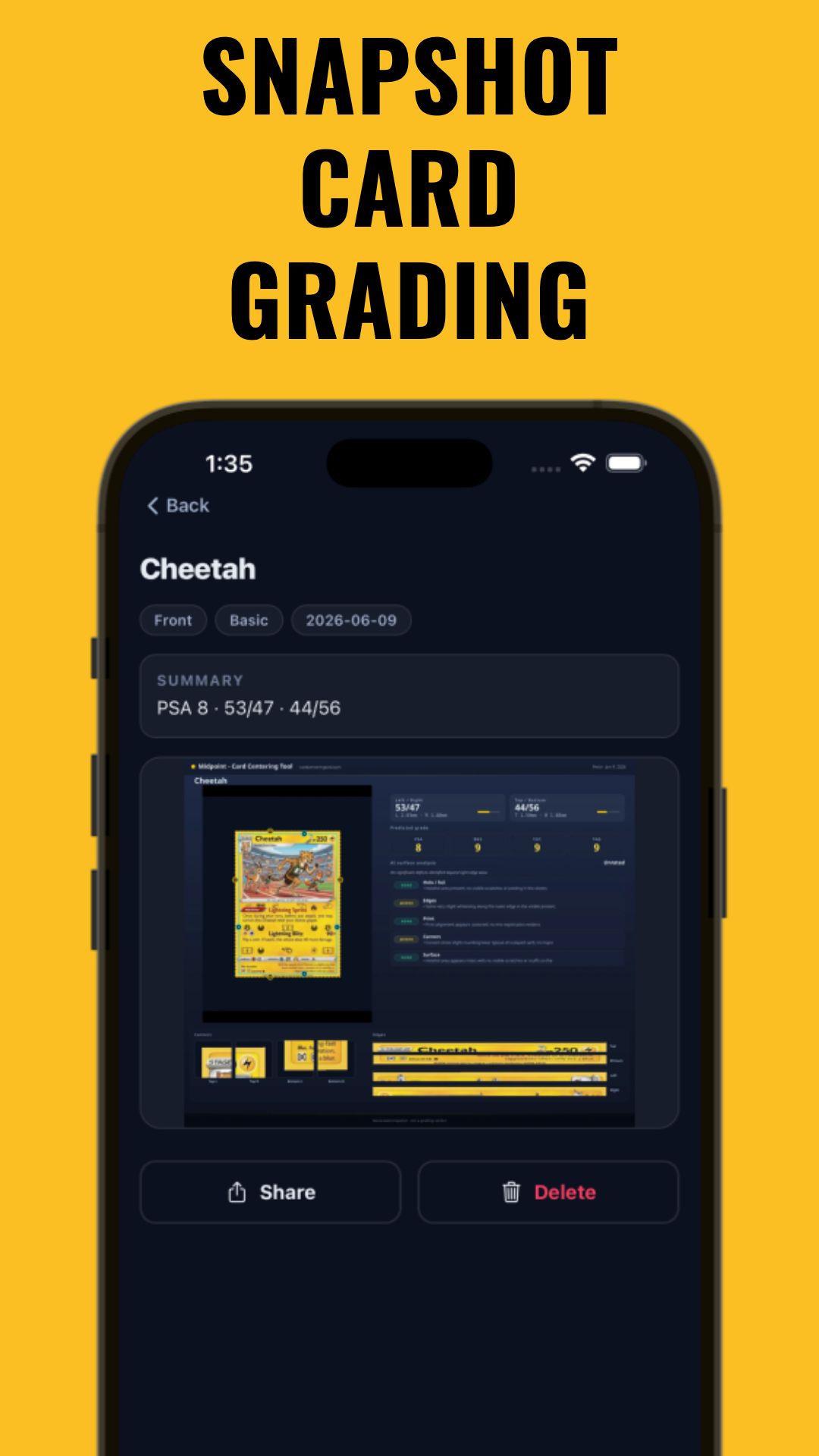
Before you submit a raw copy, measure it. Midpoint's free centering calculator shows how close your front and back centering are to PSA 10 territory, and the app gives an estimated PSA grade before you pay to submit.
Buying and Selling: Is a PSA 9 Worth It?
The question "is a PSA 9 worth it for 2003 Ultimate Collection?" comes down to what you want from the card.
Why a 9 often wins
- Lower cash outlay, which leaves less downside if the market dips.
- More comparable sales, so you can tell if you are overpaying.
- Still a strong grade that is accepted by serious collectors.
Why a 10 can be worth the premium
- Few gem copies exist, and registry collectors compete for them.
- Top rookies tend to hold the 10 premium when demand for the player stays high.
- Better long-run trophy status if you plan to hold.
Practical buying and selling checks
- Verify the cert: check the number on PSA's site and match it to the card number, serial number and grade on the label.
- Look at the slab: inspect for tampering, cracks or poor-quality holders.
- Count fees: buyer premiums and seller fees can change your real price by a meaningful amount.
- Time your sale: auctions that end at peak viewing hours tend to attract more bidders. Illiquid 10s especially benefit from a well-timed listing.
- Insure it: the grade changes replacement value, as covered in our guide on card grade and insurance value.
How to Verify Comparable Sales
Use a consistent checklist so your numbers are apples to apples:
- Match the card number and the parallel.
- Match the serial number if it matters, since low numbers such as #1 can sell above the rest.
- Match the grade and the grading company.
- Check PSA's auction prices realized, other auction archive results and eBay sold listings, then compare dates.
- Throw out sales with unclear descriptions or damaged slabs.
Midpoint's card lookup shows raw versus graded values so you can see the cost of each grade tier. You can also track the card afterward in your portfolio to see how its value changes over time.
Value Outlook and Risks
- Player demand: prices follow the player. A star rookie can hold up when others fade.
- Condition sensitivity: a 10 depends on small details, and re-grading risk is real if you buy raw.
- Limited sales volume: few sales means a single transaction can distort perceived value.
- Volatility at the high end: expensive cards can move sharply in either direction.
- Population drift: new submissions can erode scarcity over time.
Nothing here is a price prediction. Use dated sold data and reassess often.
Which Should You Choose?
- You want the best value for money: buy the PSA 9. It captures most of the card's appeal at a much lower price.
- You are buying a top rookie such as the LeBron James autograph rookie as a long-term hold: consider a 10 only if the population is thin, the comps are recent and you can afford the volatility.
- You own a raw copy: measure centering and check corners first. If it looks like a likely 9, the grading fee may not be justified. Our guide to pre-grading your card walks through the steps.
- You are building a registry set: pay for the 10s on the key cards and take 9s on the rest.
- You flip cards: 9s have more buyers and faster exits, while 10s demand patience.
Want to see how a raw card might grade before you commit? Try Midpoint, which is free on iOS and Android.
FAQ
How much is a 2003 Ultimate Collection card worth in PSA 9?
It depends on the card. Star rookies and low-numbered autograph or patch cards sit at the top, while most other cards in the set are far cheaper. Check the dated values in this post (as of 2026-11-08), then confirm with recent sold listings for the exact card number, serial number and grade.
How much is a PSA 10 2003 Ultimate Collection card worth?
A PSA 10 usually sells at a significant premium to the same card in a 9, particularly when few gem copies exist. Use sold results with matching card number, parallel and serial number rather than price-guide estimates, because sales are infrequent.
What is the price difference between a PSA 9 and PSA 10 2003 Ultimate Collection card?
Calculate it as the PSA 10 price minus the PSA 9 price for the dollar gap, and divide the 10 by the 9 for the multiplier. The gap is largest in dollars on big rookies and often largest in percentage terms where the 10 population is tiny.
Is a PSA 10 worth paying more for than a PSA 9 on 2003 Ultimate Collection cards?
Sometimes. It makes sense on top rookies with a thin 10 population and strong recent comps. For most other cards, a PSA 9 gives better value and easier resale.
Which 2003 Ultimate Collection cards are the most valuable in PSA 9 or PSA 10?
The LeBron James autograph rookie is the headline card, followed by the other major rookies and low-print autograph and patch cards. Rankings can shift, so check the dated table and recent sales.
How do PSA population reports affect the value of 2003 Ultimate Collection cards?
Lower populations support higher prices, especially for a PSA 10. When the 10 count is small relative to the 9 count, the premium is easier to justify. When both counts are tiny, prices can swing on a single sale.
Free to start
Try the Midpoint app
Grade any card from a photo, see its raw and PSA 10 value, and track what your collection is worth — free.
Get it on iPhoneGet it on Android