Ashton Jeanty Cards Worth Money? Top Rookies to Grade
Are Ashton Jeanty cards worth money? See which rookies, parallels and autographs lead, raw vs PSA 10 gaps, and which cards are worth grading.

Estimated reading time: 11 min
Key Takeaways
- Yes, Ashton Jeanty cards can be worth money, but value is concentrated in scarce cards: numbered parallels, case hits, and rookie patch autographs. Common base cards trade at a small fraction of those.
- The most valuable Ashton Jeanty cards are usually autographed and patch cards from premium products, followed by low-numbered Prizm and Optic parallels.
- A PSA 10 premium tends to be largest in percentage terms on mass-produced rookies, where gem-mint copies are the ones many collectors chase. Check it against sold comps, not asking prices.
- Centering is one of the most common reasons a Jeanty rookie misses a 10. Measure it before paying grading fees.
- A young player's market is volatile. Buy for the long term, size positions carefully, and track your collection's value over time.
Card values — live data from Midpoint's card database, as of 2026-09-04. Prices move; Midpoint refreshes these daily.
| Card | Raw | PSA 10 | Gem premium | |
|---|---|---|---|---|
 |
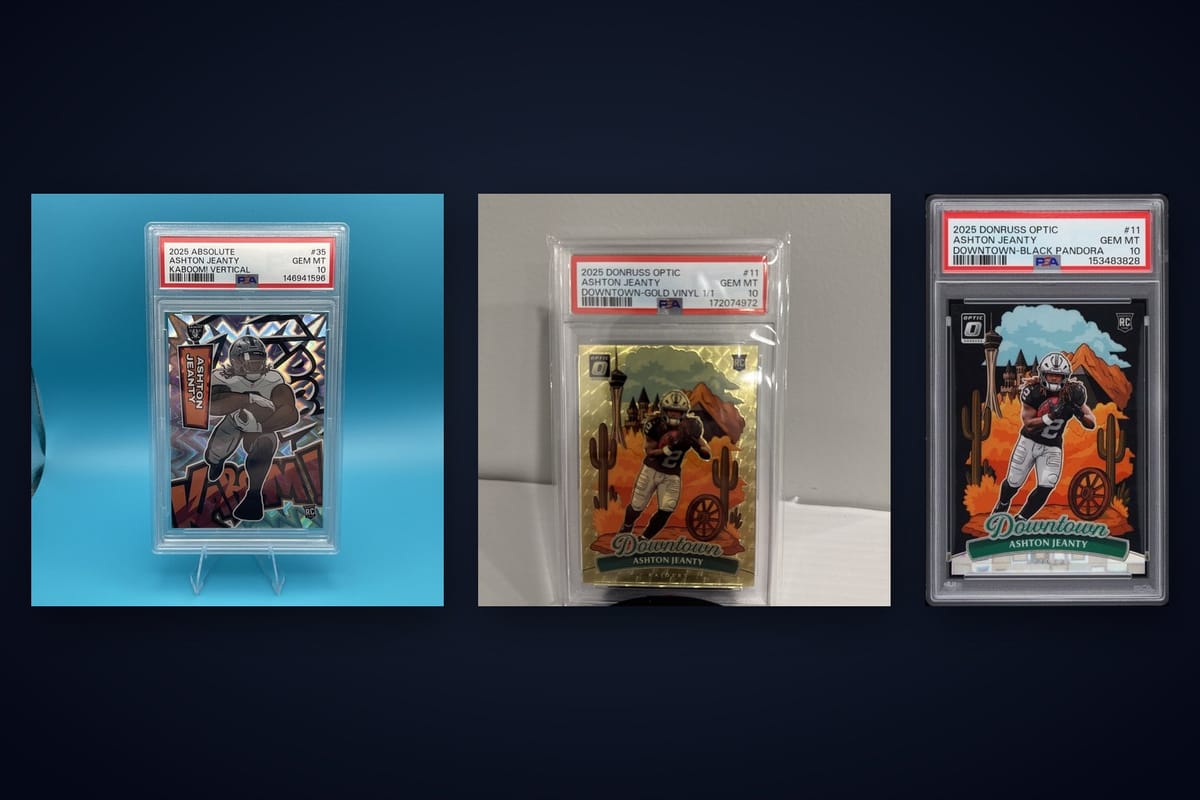
Ashton Jeanty #35 2025 Panini Absolute Kaboom Vertical |
$1,516 | $6,154 | 4.1× |
 |
Ashton Jeanty [Gold] #11 2025 Panini Donruss Downtown |
— | $4,500 | — |
 |
Ashton Jeanty [Black Pandora] #11 2025 Panini Donruss Optic Downtown |
$3,450 | $3,839 | 1.1× |
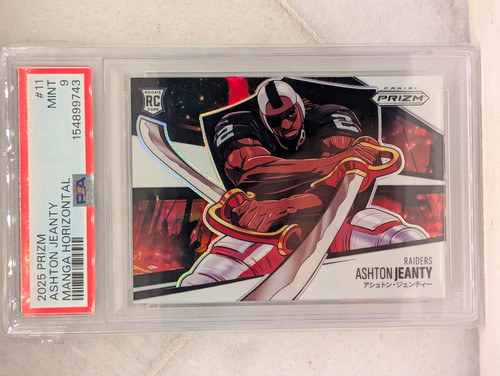 |
Ashton Jeanty #11 2025 Panini Prizm Manga Horizontal |
$1,789 | $3,696 | 2.1× |
 |
Ashton Jeanty #4 2025 Panini Prizm Draft Picks Manga |
$825.00 | $3,236 | 3.9× |
 |
Ashton Jeanty / Marcus Allen #3 2025 Panini Donruss Optic Downtown Duo |
$513.10 | $2,246 | 4.4× |
 |
Ashton Jeanty #H-9 2025 Topps Finest Headliners |
$1,100 | $1,768 | 1.6× |
 |
Ashton Jeanty #5 2025 Panini Flawless Rookie Dual Patch Autograph |
$374.99 | $1,661 | 4.4× |
 |
Ashton Jeanty #33 2025 Panini Absolute Kaboom Horizontal |
$650.00 | $1,547 | 2.4× |
 |
Ashton Jeanty #6 2025 Panini Flawless Rookie Patch Autograph |
$328.00 | $1,490 | 4.5× |
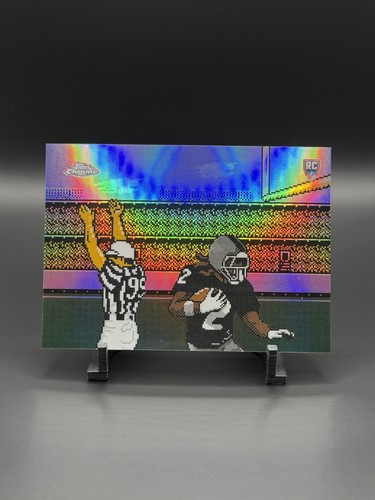 |
Ashton Jeanty #TECMO-18 2025 Topps Chrome Tecmo |
$772.58 | $1,444 | 1.9× |
 |
Cam Skattebo / Ashton Jeanty #5 2025 Panini Luminance Year One Dual Signature |
$357.76 | $1,429 | 4× |
Look up any card's current raw and graded value in Midpoint — and get an estimated grade before you pay to submit.
Table of Contents
- Section 1: Are Ashton Jeanty Cards Worth Money? Reading the Market
- Section 2: Most Valuable Ashton Jeanty Cards, Ranked by Tier
- Section 3: Ashton Jeanty Rookie Card Value by Set
- Section 4: Rare Parallels, Inserts and Case Hits
- Section 5: Raw vs PSA 10 and Other Graded Values
- Section 6: Best Ashton Jeanty Cards to Grade
- Section 7: Checking Real Value and Deciding to Buy or Hold
- Conclusion
- FAQ
Section 1: Are Ashton Jeanty Cards Worth Money? Reading the Market
Are Ashton Jeanty cards worth money? For the right cards, yes. The Boise State standout was a Heisman finalist and went sixth overall to the Las Vegas Raiders in 2025, so demand for his rookies is real. But "worth money" depends entirely on which card you hold.
The market splits into a thin top and a wide bottom. A serial-numbered autograph or patch card is a different asset from a base rookie pulled from a retail pack.
Sold prices vs asking prices
The first rule of valuing any Jeanty card is to ignore the asking price. Active listings show what sellers hope to get. Sold listings show what buyers actually paid.
- Asking prices are often inflated, especially on hyped rookies.
- Sold prices reflect real demand and move with game performance and news.
- The gap between them tells you how speculative a card is.
The data table above shows raw and graded figures from Midpoint's database, as of 2026-09-04. Treat those as a snapshot, not a guarantee. Rookie prices can shift quickly after a big game, an injury, or a contract headline.
What drives value on any Jeanty card
Five factors decide where a card lands:
- Scarcity: print run, serial numbering, and PSA population.
- Card type: base, parallel, insert, autograph, or patch auto.
- Set prestige: Prizm, National Treasures, and Topps Chrome carry more weight than entry-level products.
- Condition: centering, corners, edges, and surface.
- Player trajectory: performance, health, and role in the Raiders' offense.
Understand those five and you can size up almost any Jeanty card in a minute.
Section 2: Most Valuable Ashton Jeanty Cards, Ranked by Tier
Rather than chase a single "best" card, it helps to rank the most valuable Ashton Jeanty cards by tier. Exact prices move constantly, so the tier structure is more useful than any one number.
Tier 1: Rookie patch autographs and low-numbered autos
At the top sit rookie patch autographs (RPAs) from premium products. National Treasures, Flawless, and Immaculate are the usual suspects, along with premium Topps autograph cards where available. These combine three value drivers: an on-card or sticker autograph, a game-worn or event-used patch, and a tight serial number.
- Low serial numbers (such as /10, /5, or a 1/1) command the biggest premiums.
- Logoman or NFL shield patches, where they exist, trade above plain jersey swatches.
- Clean autograph placement and an on-card signature help.
Tier 2: Numbered Prizm and Optic parallels
Next come scarce parallels from flagship products. Think Prizm color parallels with short print runs and Donruss Optic Rated Rookie parallels such as Gold or Black. These are the sweet spot for many collectors: scarce enough to hold value, cheaper than premium autos.
Tier 3: Case hits and key inserts
Inserts like Kaboom!, Downtown, Color Blast, and Urban Legends can be some of the most visually striking and sought-after cards. Their pull rates are extremely low, which is a big reason they trade at large multiples of the base rookie.
Tier 4: Base rookies and common parallels
Base Prizm, Optic, and Topps Chrome rookies are the most affordable, and the most plentiful. These are the cards most vulnerable to a market cooldown, since supply is huge. Their value leans heavily on grade, which is where a PSA 10 premium comes into play.
Check the table above for how these tiers line up in Midpoint's database as of 2026-09-04.
Section 3: Ashton Jeanty Rookie Card Value by Set
Your Ashton Jeanty rookie card value starts with the set. Each major 2025 football product plays a different role in the market.
Panini Prizm: the market benchmark
Prizm is the flagship football product, and the Prizm Silver is the parallel most collectors treat as the default "rookie card." It's the card most buyers search for, so it tends to have the deepest pool of sold comps. That liquidity is valuable: you can sell quickly and price confidently.
When people ask how much a Jeanty Prizm rookie is worth, always ask which parallel. Base Prizm, Silver, and numbered colors are separate markets.
Donruss Optic Rated Rookie
The Optic Rated Rookie is a staple for rookie collectors. Optic's chrome-style finish and a wide range of parallels give you options at nearly every budget. Holo and numbered variants are where values separate from the pack.
Topps Chrome
Topps Chrome football brings a familiar brand with a different aesthetic and a loyal following. Chrome rookies, refractors, and autograph cards each find their own audience, and some collectors pay up simply to own a Topps rookie of a top-10 pick.
National Treasures, Flawless, and Immaculate
These high-end products are about autographs, patches, and tight print runs. They carry high price tags even raw, and a graded copy can multiply that.
- National Treasures: widely regarded as the gold standard for RPAs.
- Flawless: diamond-themed, with extremely low print runs.
- Immaculate: a premium, numbered-heavy product.
Pick a set based on how you plan to use the card: liquidity (Prizm), variety (Optic), brand preference (Chrome), or top-end scarcity (premium products).
Section 4: Rare Parallels, Inserts and Case Hits
Scarcity is the engine behind a card's price. For Jeanty, the best rare finds fall into three buckets: numbered parallels, color variations, and case-hit inserts.
Serial-numbered parallels
Serial numbering is the clearest signal of scarcity. A card stamped /25 is, by definition, one of only 25 copies. Lower numbers generally mean higher prices, and the premium often accelerates sharply as you approach /10 and below.
- /99 to /50: accessible, collectible, and often liquid.
- /25 to /10: scarce, with clear premiums.
- /5 and 1/1: trophy territory. Few comps exist, so pricing is less predictable.
Color variations
Color parallels like Gold, Black, Green, or Neon variants help collectors build themed sets. A few colors, such as Black (often a 1/1 in its product) and Gold, hold a special place. Always verify the print run for the specific product, since the same color can have different numbering across brands.
Case hits: Kaboom!, Downtown, Color Blast, Urban Legends
Case hits are inserts so rare that a retailer may see only a few per case, or even fewer. Kaboom! features comic-style artwork. Downtown is known for a city-skyline look. Color Blast offers a burst of vivid color. Urban Legends uses illustrated, graffiti-style art. These cards often trade at a hefty multiple of a base rookie, and gem-mint copies can stand far apart from lower grades.
One caution: for ultra-rare cards, comps may be months apart. When there's no recent sale, price from the closest comparable and be willing to wait for the right buyer.
Section 5: Raw vs PSA 10 and Other Graded Values
The Ashton Jeanty PSA 10 question comes down to one thing: how much more is a gem-mint slab worth than the same card raw? The answer varies by card, and you should read it directly from sold data. Midpoint's database tracks both raw and graded values, as of 2026-09-04, in the table above.
Why the PSA 10 premium exists
A PSA 10 signals near-perfect centering, sharp corners, clean edges, and a flawless surface. Because modern chrome-style cards can be tricky to produce perfectly, a 10 can be hard to get. Collectors pay for certainty and for the liquidity that comes with the most recognized label.
- Mass-produced rookies: the gap between raw and a PSA 10 is often widest in percentage terms, since many copies exist and only the best stand out.
- Numbered and premium cards: the premium is often smaller in percentage terms, since the card is already scarce.
PSA vs BGS vs SGC vs CGC
Each company has its own market. PSA typically commands the strongest resale for sports cards. BGS is respected for subgrades and its Black Label. SGC and CGC are often cheaper and faster, but may sell at a discount to PSA for the same nominal grade. For a deeper look, read our breakdown of grading scale differences by company.
Don't forget the downside of a 9
A PSA 9 often sells for far less than a PSA 10, so a miss hurts. That's why pre-grading matters: you're really betting on the difference between a 10 and a 9, net of fees and shipping.
Section 6: Best Ashton Jeanty Cards to Grade
Not every card deserves a slab. The best Ashton Jeanty cards to grade are those where a high grade adds more value than it costs. Grading fees commonly start around $30 or more per card once shipping and insurance are included, so the math matters.
Cards that usually justify grading
- Prizm Silver and key Prizm parallels: deep demand and strong PSA 10 liquidity.
- Optic Rated Rookie parallels: clean chrome surfaces make 10s achievable if centering is right.
- Numbered cards: a slab protects and authenticates a scarce card.
- Case hits: low population plus high demand. See our guide to grading low population cards.
Cards that often don't
Common base rookies with a small raw-to-graded gap are usually a poor bet. If the PSA 10 premium doesn't cover fees plus the risk of a 9, keep the card raw.
Pre-grade before you submit
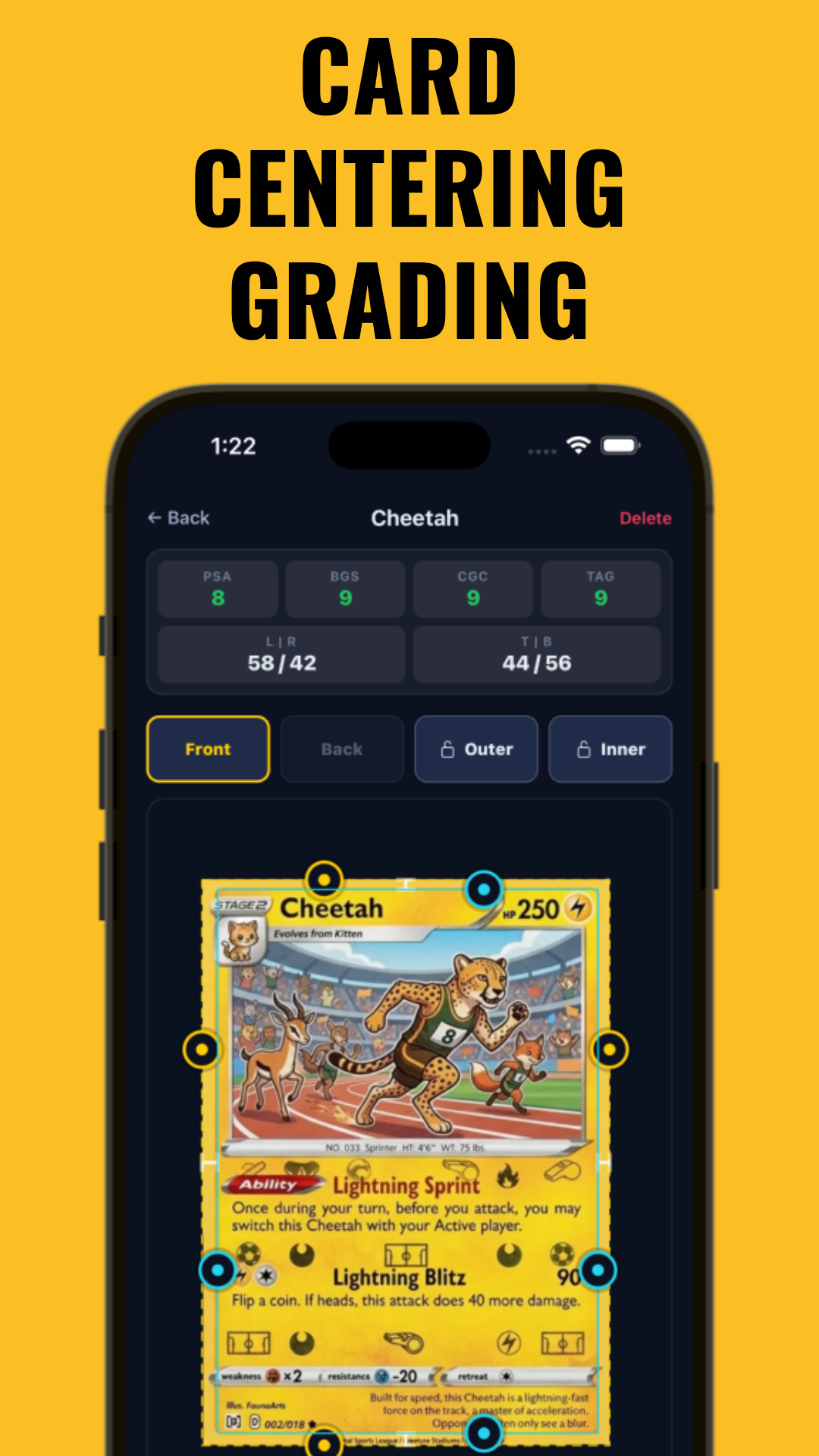
Centering is one of the most common reasons a rookie misses a 10. Measure it first. PSA's published guidelines allow roughly 55/45 to 60/40 on the front for a 10, depending on the card, so a card that looks fine to the eye may fail under a ruler. Learn the basics in how centering impacts card value.
Midpoint measures centering to the millimeter and gives an estimated PSA, BGS, CGC, and TAG grade from corners, edges, and surface, before you pay for submission.
Section 7: Checking Real Value and Deciding to Buy or Hold
Once you know the tiers, you need a repeatable way to price a specific card and decide what to do with it.
How to check sold listings and comps
- Search the exact card: year, set, player, parallel, and serial number.
- Filter eBay to Sold Items, not active listings.
- Match the grade: compare raw to raw, PSA 10 to PSA 10.
- Use several recent sales, ideally within the last few weeks, and discard outliers.
- Check auction house results for high-end cards, where private sales and auctions can differ from eBay.
For numbered cards, remember the serial matters: a /10 with a favorite number or a 1/1 can sell above comps.
Condition adjustments
Two cards with the same label can sell very differently. Centering, corners, surface scratches, and print lines all affect price, even within one grade. Eye appeal on a PSA 10 can swing the sale price.
Buy, hold, or sell?
A second-year or rookie player's card market is volatile. Prices can run on hype and fall on a quiet stretch or an injury. A sensible approach:
- Buy scarce, high-quality cards rather than flooding yourself with base copies.
- Diversify across a few tiers instead of one hot card.
- Set a plan for when you'd sell, such as after a strong stretch of games.
- Protect your cards. See our guide on how to store valuable cards.
- Track value over time with a portfolio tool such as Midpoint, which shows your collection's value as prices change.
No one can predict a player's career. Only spend what you're comfortable holding through ups and downs.
Conclusion
Ashton Jeanty cards are worth money, but not all equally. The value sits in scarce cards: premium RPAs, low-numbered Prizm and Optic parallels, and case hits like Kaboom!, Downtown, Color Blast, and Urban Legends. Base rookies are affordable entry points whose value depends heavily on grade.
Before you buy or grade, compare sold listings, match the grade, and measure centering. A PSA 10 can add a real premium, but only if the card earns it. Pre-grading helps you avoid paying fees for a 9.
Ready to check your own Jeanty rookies? Measure centering, estimate your grade, and track your collection in Midpoint, free on iOS and Android.
FAQ
Q: How much are Ashton Jeanty cards worth?
A: It depends on the card. Base rookies sit at the affordable end, while numbered parallels, case hits, and rookie patch autographs sit far higher. Check Midpoint's database values (as of 2026-09-04) and confirm them against recent eBay sold listings.
Q: What is the most valuable Ashton Jeanty rookie card?
A: Generally, low-numbered rookie patch autographs from premium products like National Treasures, Flawless, and Immaculate. Very rare 1/1 parallels and case hits can also rank near the top, depending on recent sales.
Q: Are Ashton Jeanty cards worth money?
A: Yes, particularly scarce and high-grade cards. Because he is a young player, prices can swing with performance and news, so buy with a long-term view.
Q: How much is an Ashton Jeanty Prizm rookie card worth?
A: It depends on the parallel and grade. Base Prizm, Prizm Silver, and numbered colors all trade at different levels. Look up the exact parallel and compare raw to raw or PSA 10 to PSA 10 sold comps.
Q: How much more is a PSA 10 Ashton Jeanty card worth than a raw card?
A: The premium varies by card and is often widest in percentage terms on mass-produced rookies. Compare raw and graded values in Midpoint's card lookup and verify with sold listings before you submit anything.
Q: What is the best Ashton Jeanty card to buy?
A: For liquidity, many collectors choose the Prizm Silver rookie. For scarcity, consider numbered parallels, case hits, or an RPA. The best pick depends on your budget and how long you plan to hold.
Free to start
Try the Midpoint app
Grade any card from a photo, see its raw and PSA 10 value, and track what your collection is worth — free.
Get it on iPhoneGet it on Android