Beckett BGS Subgrades: Centering, Corners, Edges, and Surface Explained
Unlock BGS grading: learn how Beckett evaluates centering, corners, edges, and surface subgrades. Get tips for Black Label and maximize your card's value.


Estimated reading time: 14 min
Key Takeaways
- BGS subgrades—centering, corners, edges, and surface—are critical to a card’s final grade and value.
- Front and back centering tolerances differ and have strict requirements for Beckett Black Label eligibility.
- Corners and edges are examined under magnification, with colored borders revealing flaws more readily.
- Surface grading detects print defects, scratches, dimples, and flaws that may be invisible to the naked eye.
- Careful self-evaluation before submitting to BGS can help avoid grading fees on cards unlikely to receive high grades.
Table of Contents
- Section 1: Understanding Beckett BGS Subgrades
- Section 2: Centering—The Foundation of BGS Grading
- Section 3: Corners—Sharpness, Wear, and Colored Borders
- Section 4: Edges—Chipping, Whitening, and Layer Separation
- Section 5: Surface—Detecting Print Defects and Imperfections
- Section 6: How BGS Calculates Final Grades from Subgrades
- Section 7: Practical Self-Evaluation Tips for BGS Subgrades
- Section 8: The Impact of Subgrades on Value and Black Label Eligibility
- Conclusion
- FAQ
Section 1: Understanding Beckett BGS Subgrades
What Are BGS Subgrades?
Beckett Grading Services (BGS) sets itself apart by publishing four distinct subgrades on every slab: centering, corners, edges, and surface. Unlike some other grading companies that issue a single number, each BGS card displays these four scores (from 1 to 10, including half grades), offering transparency into where a card excels—or falls short.
- Centering: Measures how evenly the card image is positioned on the cardboard.
- Corners: Evaluates the sharpness and integrity of all four corners, under magnification.
- Edges: Assesses the condition of the card's periphery, looking for chips, nicks, or whitening.
- Surface: Checks for print defects, scratches, stains, and other flaws on card faces.
Why Publish All Four?
This approach helps collectors and buyers understand exactly why a card received its grade. If a card earns an overall 9.0 but the corners subgrade is 8.5, you know where it fell short. This is especially important for high-end cards where a single subgrade can affect value and desirability.
Comparing to Other Graders
BGS is notable for displaying all four subgrades. PSA and CGC, for example, typically only provide a single overall score, though CGC sometimes lists subgrades for premium submissions. This transparency gives BGS-graded cards an advantage for collectors who want to know the story behind the grade.
Section 2: Centering—The Foundation of BGS Grading
How Beckett Measures Centering
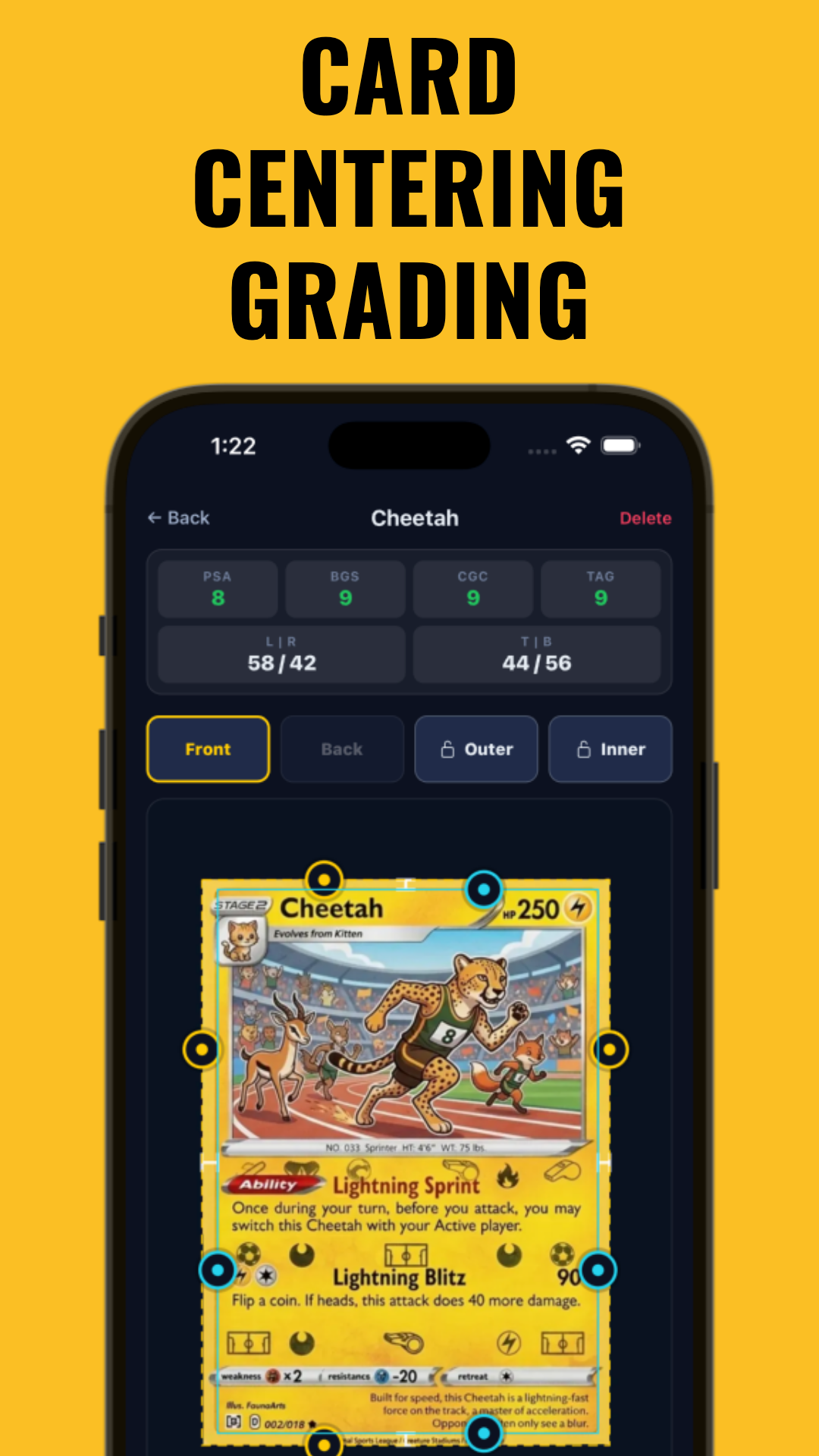
Beckett centering is perhaps the most discussed subgrade. Centering refers to how well the card’s image is positioned between the left/right and top/bottom borders. BGS uses measurements to determine if a card is off-center. For most modern cards, even slight misalignments can drop the centering grade.
Front and back centering are evaluated separately. The stricter standard is applied to the front, while the back is allowed greater tolerance.
Centering Ratios Explained
- BGS 10 (Pristine): Front must be 50/50 (perfect) to 55/45 at worst. Back can be up to 60/40.
- BGS 9.5 (Gem Mint): Front up to 60/40, back up to 65/35.
- BGS 9.0: Front up to 65/35; as centering drifts further, the grade drops accordingly.
Any centering that falls outside these tolerances will see a subgrade deduction. For the coveted Beckett Black Label centering (all four subgrades at 10), the front must be 50/50 to 55/45.
How Drift Lowers the Score
Even a card that appears well-centered to the naked eye can fall short under digital or manual measurement. This is why using a tool like Midpoint or referencing guides like How to Measure Card Centering: Step-by-Step Precision Guide can be helpful before submitting to BGS. Slight drift—just a millimeter or two—can mean the difference between a 10 and a 9.5 subgrade.
Section 3: Corners—Sharpness, Wear, and Colored Borders
What BGS Looks for in Corners
BGS graders use magnification to closely inspect all four card corners. They’re looking for sharp points—any rounding, fraying, whitening, or fuzziness will lead to subgrade deductions. The closer to mint, the higher the grade; even a tiny nick can drop a corner subgrade from 10 to 9.5 or lower.
Why Colored Backs Expose Wear
Cards with colored backs or borders (such as Topps Chrome, Prizm, or vintage sets with bold colors) show wear more readily than white-bordered cards. Even minimal handling or pack wear can cause the color to chip or the underlying white stock to show through. This makes it especially hard to secure a BGS 10 on corners for these cards.
- Pack-fresh cards can still have micro-wear if they slide against each other in production.
- Magnification reveals: Fuzzing, minor bends, or whitening that aren’t visible to the naked eye.
Common Corner Pitfalls
Some common reasons corners subgrades drop:
- Slight dings from factory cutting or collation
- Whitening from handling, even in-pack
- Softening from storage or sleeve insertion
Colored-border cards are particularly vulnerable, so always inspect corners under bright light and magnification before submitting.
Section 4: Edges—Chipping, Whitening, and Layer Separation
How BGS Grades Edges
Edge condition is another important BGS subgrade. Graders check every edge for chipping, whitening, and notching, using side-lighting and loupes. Clean, sharp edges are required for a 10 subgrade; any visible imperfection will reduce the grade. Even thin layer separation—where the card’s layers start to peel—can be detected.
Chrome and Refractor Edge Issues
Modern chrome and refractor cards are known for edge flaws:
- Chipping: Tiny bits of the colored coating flake off, exposing white underneath.
- Whitening: Cardboard core shows through when edges are bumped or cut poorly.
- Layer separation: Multiple layers of modern cards can peel, especially on thicker stock.
- Notching or fraying: Can occur during factory cutting or from being dropped.
Edge defects on chrome-type cards are often visible under strong side light, but some require magnification or careful touch to detect.
Detecting Edge Problems Before Submitting
Many collectors miss edge flaws on pack-fresh cards, only to discover them after grading. Always run your finger gently along the edges, use a loupe, and check under multiple light angles. For more guidance, see the tips in How to Pre-Grade Your Card: A Step-by-Step Guide.
Section 5: Surface—Detecting Print Defects and Imperfections
What Surface Grading Evaluates
The surface subgrade is often the trickiest for collectors to self-assess. BGS scrutinizes the front and back for a wide range of flaws:
- Scratches and scuffs: Especially visible on high-gloss and foil cards
- Dimples: Small indentations from manufacturing or handling
- Print lines: Horizontal or vertical lines from the printing process
- Stains: Water spots, fingerprints, residue
- Creases and bends: Even micro-creases can be caught under raking light
Modern refractor and chrome cards are especially prone to revealing surface flaws. High gloss exposes even hairline scratches or tiny dimples. Vintage cards may have print defects that are considered factory flaws, but these still count against the surface subgrade.
How BGS Detects Hidden Defects
BGS graders use bright, angled lighting and magnification. Many pack-fresh cards have print defects or roller marks that only appear under the right conditions. For example, silvering along the edge of a chrome card can be missed until a grader spots it under a loupe.
AI and Digital Tools for Surface Analysis
Apps like Midpoint and others are increasingly using AI to scan for surface flaws. These tools can sometimes reveal subtle scratches, print lines, or dimples you might miss. For a discussion of how AI is being used in card analysis, see How AI Transforms Card Centering Analysis.
Section 6: How BGS Calculates Final Grades from Subgrades
The BGS Grading Formula
BGS uses a defined approach to calculate the final grade from the four subgrades. The overall grade is typically the lowest subgrade rounded down, with a possibility of a half-grade bump if three subgrades are equal or higher. For centering, BGS applies the “worst-of-two” rule—the lower of front and back centering is considered.
- All subgrades 10 → Black Label (Pristine 10)
- One subgrade 9.5, others 10 → Final grade 10 (not Black Label)
- One subgrade 9, rest 9.5+ → Final grade 9.5
- Half-point increments are used throughout the 1–10 scale
Black Label Requirements
BGS Black Label is the highest accolade—a Pristine 10 with all four subgrades at 10. Even a single 9.5 drops the card to a standard BGS 10. This makes Black Label difficult to achieve, especially for centering and surface.
Subgrades and Value Transparency
Subgrades provide transparency: buyers can immediately see which flaw held a card back. For example, a card with 10/10/10/9.5 subgrades (corners being 9.5) tells you it's nearly perfect except for that one detail. This transparency is unique to BGS and is often cited in collector discussions and value debates. For more, see How Centering Impacts Card Value: A Detailed Guide.
Section 7: Practical Self-Evaluation Tips for BGS Subgrades
Measuring Centering Accurately
Before submitting, measure centering with precision tools or apps. A ruler and loupe can work, but digital tools like Midpoint measure centering down to the millimeter, providing instant BGS and PSA estimates. This can help avoid expensive surprises—especially since grading fees often exceed $30 per card.
For a step-by-step guide, see Card Centering Tool: Accurate Card Grading Estimates.
Inspecting Corners and Edges
- Use a loupe (10x magnification) to check all corners for dings, fuzzing, or whitening.
- Run a finger gently along each edge to feel for chips or separation.
- Pay close attention to colored-border cards—wear shows up faster on these.
Checking Surface Flaws
- Hold the card at multiple angles under a strong light to spot scratches, print lines, or dimples.
- Use a microfiber cloth to gently remove dust or fingerprints—never use chemicals.
- Consider AI or digital tools for a more thorough pre-screen.
For a full walkthrough, see Estimate Your Card: A Practical Guide Before Grading.
Section 8: The Impact of Subgrades on Value and Black Label Eligibility
How Subgrades Affect Card Value
Subgrades play a significant role in determining a card’s value. Collectors often pay premiums for cards with high subgrades across the board, particularly for modern, high-end releases. A card with 10 subgrades for centering, corners, edges, and surface generally commands more attention and higher prices than a card with an overall 9.5 and a single 9 subgrade.
- Black Label premium: Some cards sell for substantially more in Beckett Black Label holders, due to the rarity of all 10 subgrades.
- Subgrade transparency: Buyers can identify cards with weak corners, edges, or surface, and price accordingly.
Black Label Eligibility
To qualify for BGS Black Label, every subgrade—centering, corners, edges, and surface—must score a perfect 10. The centering must be 50/50 to 55/45 on the front, and no worse than 60/40 on the back. Even the tiniest flaw disqualifies a card from Black Label, making it one of the hobby’s most sought-after distinctions.
Common Weakest Links
On modern cards, centering or surface is often the weakest BGS subgrade. For vintage, corners and edges tend to be the limiting factors. For heavily skewed modern cards (e.g., Prizm, Chrome), centering often holds the score back—even when the rest of the card is flawless.
Conclusion
Understanding Beckett BGS subgrades—centering, corners, edges, and surface—is important for maximizing the value of your trading cards and increasing your odds of achieving a high grade. Use digital tools like Midpoint for precise centering measurement before you submit, and always inspect corners, edges, and surfaces under magnification and strong lighting. By understanding what BGS looks for and self-evaluating each subgrade, you can save on grading fees, set realistic expectations, and achieve the best possible grades for your collection.
FAQ
Q: What are the four BGS subgrades and what does each measure?
A: The four BGS subgrades are centering (alignment of card image), corners (sharpness and condition of corners), edges (condition of card borders), and surface (scratches, print defects, stains, and other flaws). Each is graded on a 1–10 scale and appears on every BGS slab.
Q: What centering ratio does BGS require for a 10 on front and back?
A: For a BGS 10 centering subgrade, the front must be 50/50 to 55/45, and the back can be up to 60/40. Anything outside these tolerances will not receive a 10.
Q: Why do BGS corners often drop below 10 on colored-border cards?
A: Colored-border cards reveal wear, chips, or whitening more easily than white-border cards. Even minor handling or factory issues can show on colored edges, making flawless corners very difficult to achieve and lowering the subgrade.
Q: What edge issues are most common on chrome and refractor cards in BGS grading?
A: Chrome and refractor cards often suffer from chipping, whitening, and layer separation due to their construction. These issues are easily spotted by BGS graders and frequently lower the edge subgrade.
Q: How does BGS Surface grading detect hidden print defects not visible in a sleeve?
A: BGS graders use magnification and angled lighting to spot dimples, print lines, roller marks, and scratches. Many flaws are invisible in a sleeve or to the naked eye but show up under close inspection.
Q: Which BGS subgrade is typically the weakest on heavily skewed modern cards?
Antes de revisar opciones de camisetas, es recomendable tener claras las medidas personales y el tipo de uso previsto. Dentro de esa comparación, camisetas para aficionados del Paris Saint-Germain mantiene la consulta centrada en la prenda indicada por el propio enlace. La decisión final resulta más clara cuando se comparan datos concretos y no solo la apariencia general.
A: On heavily skewed modern cards, centering is usually the weakest subgrade, as manufacturing misalignments are common even on pack-fresh cards.
Free to start
Try the Midpoint app
Grade any card from a photo, see its raw and PSA 10 value, and track what your collection is worth — free.
Get it on iPhoneGet it on Android