Best 1953 Hockey Cards: Rookies, Stars & Gem Premiums
The best 1953 hockey cards ranked: Béliveau and Plante rookies, Howe, Richard and more, plus what the PSA 10 premium means and what to grade.

Estimated reading time: 9 min
Key Takeaways
- The best 1953 hockey cards come mostly from the 1953-54 Parkhurst set, a 100-card issue loaded with Hall of Famers.
- Jean Béliveau and Jacques Plante are the headline 1953 hockey rookie cards. Gordie Howe and Maurice Richard are the star-power anchors.
- The gap between a raw, off-center card and a PSA 10 is enormous, because gem-quality 1953 hockey cards are scarce.
- Centering and print defects decide most grades on these cards, so pre-grade before you pay to submit.
- Check current raw vs graded prices in a live database, never a stale list.
If you want to know which are the best 1953 hockey cards, start with one set: 1953-54 Parkhurst. It is the main cardboard issue from that hockey season and it holds most of the 1953 hockey cards worth money. This guide ranks the most valuable 1953 hockey cards, explains the PSA 10 premium, and covers what is worth grading today.
A note on prices: this guide doesn't quote dollar figures, because vintage hockey prices move with every auction. Look up current raw and graded values for any card in the Midpoint card lookup before you buy, sell or submit.
Card values — live data from Midpoint's card database, as of 2026-11-08. Prices move; Midpoint refreshes these daily.
| Card | Raw | PSA 10 | Gem premium | |
|---|---|---|---|---|
 |
Jean Beliveau #27 1953 Parkhurst |
$462.26 | $191,647 | 414.6× |
 |
Gordie Howe #50 1953 Parkhurst |
$212.29 | $49,970 | 235.4× |
 |
Maurice Richard #24 1953 Parkhurst |
$163.18 | $38,667 | 237× |
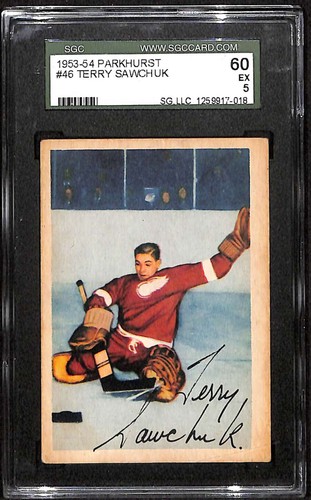 |
Terry Sawchuk #46 1953 Parkhurst |
$76.94 | $20,980 | 272.7× |
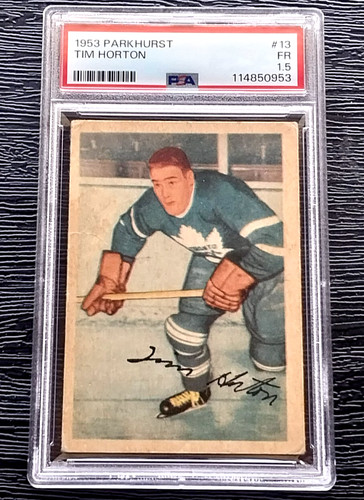 |
Tim Horton #13 1953 Parkhurst |
$77.80 | $18,403 | 236.6× |
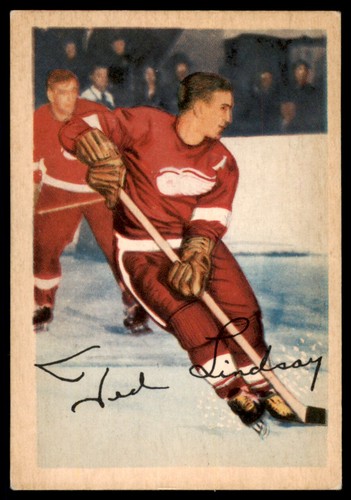 |
Ted Lindsay #52 1953 Parkhurst |
$57.59 | $13,469 | 233.9× |
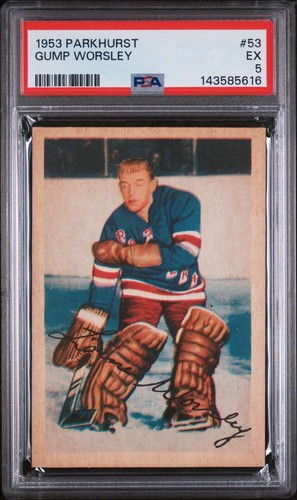 |
Gump Worsley #53 1953 Parkhurst |
$53.97 | $12,720 | 235.7× |
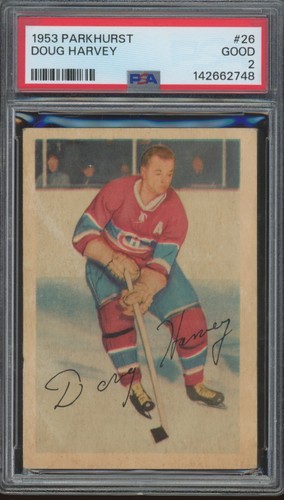 |
Doug Harvey #26 1953 Parkhurst |
$38.10 | $8,962 | 235.2× |
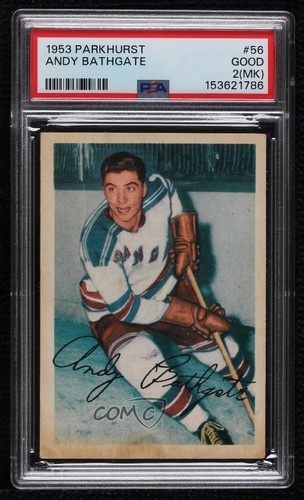 |
Andy Bathgate #56 1953 Parkhurst |
$35.62 | $8,444 | 237.1× |
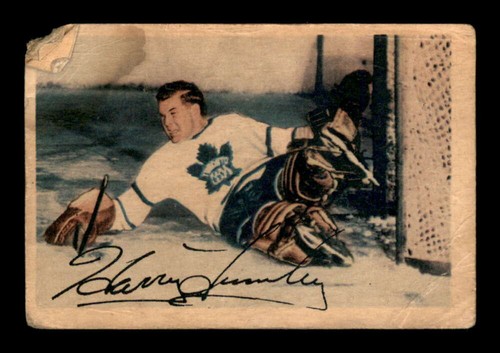 |
Harry Lumley #1 1953 Parkhurst |
$50.98 | $8,225 | 161.3× |
 |
Harry Howell #57 1953 Parkhurst |
$32.99 | $7,790 | 236.1× |
 |
Boom Boom Geoffrion #29 1953 Parkhurst |
$29.61 | $7,208 | 243.4× |
Look up any card's current raw and graded value in Midpoint — and get an estimated grade before you pay to submit.
1. Jean Béliveau Rookie (1953-54 Parkhurst)
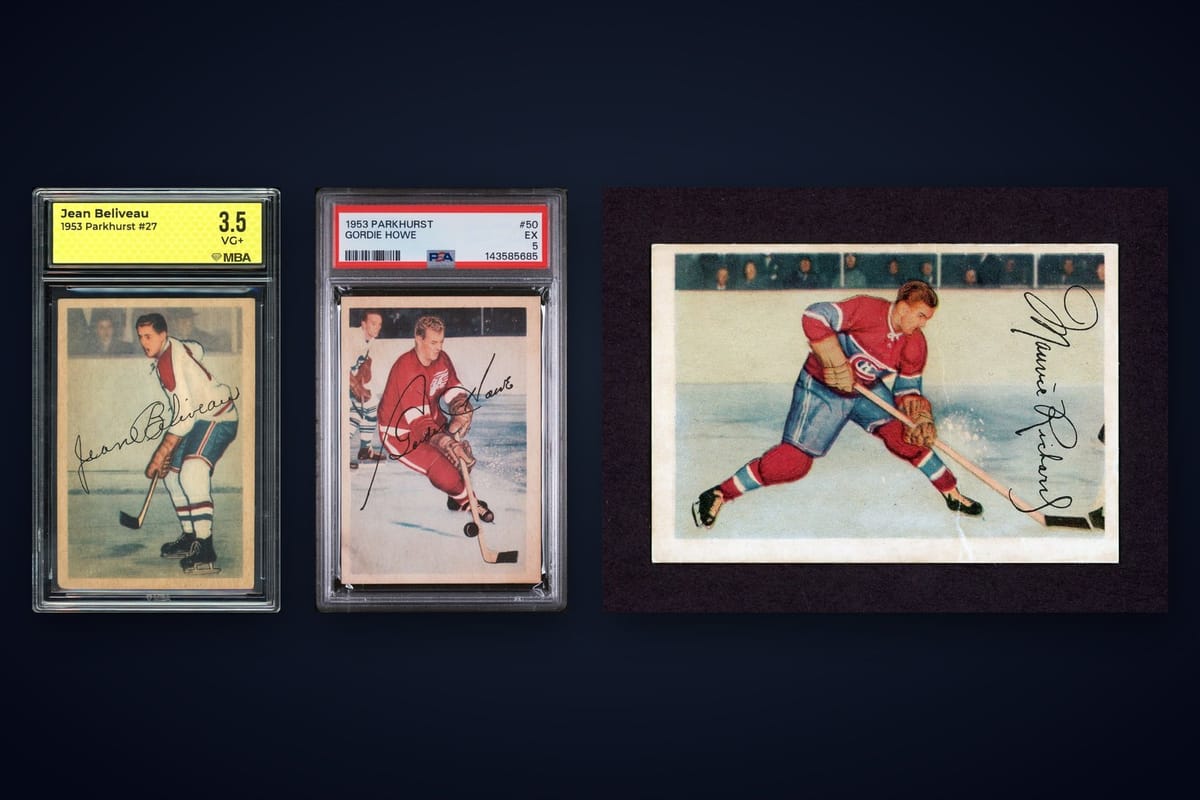
Béliveau is the card most collectors mean when they say 1953 hockey rookie cards. He is a Hall of Fame center and a legendary Montreal Canadiens captain, and his Parkhurst card is widely treated as his key rookie. It is among the most valuable cards in the set and a frequent headline in auction results.
Why it commands a premium:
- Rookie status for one of the sport's all-time greats.
- Montreal Canadiens demand, which is strong across vintage hockey.
- A tough condition profile: Parkhurst borders show wear quickly, and centering is often loose.
For a rookie like this, the grade-to-grade price steps are steep. Moving up even one grade level can change the value dramatically, so every point of condition matters.
2. Gordie Howe (1953-54 Parkhurst)
"Mr. Hockey" is the other pillar of the set. Howe's 1953-54 Parkhurst card is not a rookie, but he is arguably the most recognizable name in vintage hockey, which keeps demand constant from both set builders and player collectors.
If you are researching "How much is a 1953-54 Parkhurst Gordie Howe card worth?", the honest answer is that it depends heavily on grade. A well-centered, sharp-cornered copy sells in a completely different tier from a soft-cornered one. Compare completed sales for the exact grade, not just the player name.
- Raw copies: the cheapest entry point, but often with centering or surface issues.
- Mid-grade slabs: the sweet spot for most collectors.
- Top-end slabs: priced as trophy cards.
3. Jacques Plante Rookie (1953-54 Parkhurst)
Plante is the second big rookie in the set and a prime target among the best 1953 hockey cards. He was a Hall of Fame goaltender who won multiple Stanley Cups with Montreal and later popularized the goalie mask.
Goalie cards from this era have their own appeal. Collectors love the story, and Plante's cardboard debut sits alongside Béliveau's as a cornerstone of any Canadiens collection.
When evaluating a Plante rookie, look for:
- Clean, even borders on all four sides.
- Sharp corners, since Parkhurst's soft stock rounds quickly.
- Print marks or stains on the image area, which hurt eye appeal.
4. Maurice Richard (1953-54 Parkhurst)
"The Rocket" is one of the most iconic figures in hockey history. His Parkhurst card appeals to Canadian collectors and international vintage buyers alike. It is not a rookie, but few players carry more cultural weight.
Richard's card tends to behave like Howe's in the market: broad demand, a big spread between low and high grades, and strong results whenever a well-preserved copy appears. If you are building a short list of 1953 hockey cards worth money, this belongs near the top.
5. Terry Sawchuk (1953-54 Parkhurst)
Sawchuk, the legendary Detroit Red Wings goaltender, is a Hall of Famer and a staple of every vintage goalie collection. His 1953-54 Parkhurst card is not his rookie (that came earlier), but it is a core star card from the year.
Photo composition can sit differently inside the frame on some cards, so centering can look deceptive. Measure before you assume a card is well-centered.
6. Doug Harvey, Red Kelly and Ted Lindsay
Beyond the big five, the set is stacked with Hall of Fame defensemen and forwards. Doug Harvey, Red Kelly and Ted Lindsay are strong second-tier targets: real legends with more accessible price points than the headliners.
- Doug Harvey: a multi-time Norris-winning defenseman and a Canadiens pillar.
- Red Kelly: a Hall of Famer who won Cups with Detroit and later Toronto.
- Ted Lindsay: a fiery Red Wings star known as "Terrible Ted."
These cards can offer good value per grade in the set. A high-grade Hall of Famer who isn't a mega-name can be a smarter buy than a lower-grade headliner.
7. High-Grade Commons
Not every valuable card is a superstar. In a set this old, a sharp, centered common can carry a real premium simply because so few survive in top condition. Condition rarity can matter as much as name recognition at the top of the grading scale.
If you are building a full set, expect to spend more time on the commons than you might think. Population reports for each grade level will show you which are truly scarce, so check PSA, SGC and BVG populations for any card before paying up.
8. The Complete 1953-54 Parkhurst Set
The full checklist runs 100 cards. Finishing a set in a consistent grade is a serious project, and a graded set with matching slabs is its own category of collectible.
Tips for set builders:
- Pick a target grade range early and stick to it.
- Buy the stars last, since they are the priciest and most condition-sensitive.
- Confirm each card against a trusted checklist to avoid gaps or substitutions.
Also watch for variations and errors. Verify any claimed variation or short print against a reputable reference before paying a premium for it.
9. Understanding the PSA 10 Gem Premium
Searches for 1953 hockey cards PSA 10 are common, but a true gem on cards this old is extremely rare. Print quality, cutting and paper stock on vintage issues like Parkhurst often made centering and corners difficult, and seven decades of handling made things worse.
That scarcity creates the "gem premium gap": the price jump from a mid-grade slab to the top of the scale can be many multiples. It is a major factor in valuing these cards. Read our breakdown of grading scale differences by company to understand what top grades truly mean at PSA, BGS and CGC.
Centering is often what separates grades on vintage. Our guide on how centering impacts card value shows just how much it moves the needle.
10. What Is Worth Grading Today
Not every raw 1953 card deserves a slab. Grading fees can outweigh the upside on low-end cards, so be selective.
Usually worth grading:
- Béliveau and Plante rookies in clean, sharp condition.
- Howe, Richard and Sawchuk with good centering and solid corners.
- Hall of Fame commons that look genuinely crisp.
Usually not worth it: cards with creases, heavy staining, trimmed edges or badly rounded corners. Those are better sold raw.
Before submitting, pre-grade. Measure the borders, check corners and edges under light, and estimate the likely grade. Our step-by-step pre-grading guide walks through the process.

Midpoint measures centering to the millimeter and gives estimated PSA, BGS, CGC and TAG grades before you spend $30 or more on a submission. It is free on iOS and Android.
11. How to Spot Authentic Cards vs Reprints and Altered Copies
Vintage hockey attracts reprints and doctored cards, so authenticity matters as much as grade.
- Examine the print: original Parkhurst cards show an authentic vintage print pattern under magnification, while many reprints look too clean or digital.
- Check the card stock: modern paper often looks brighter or feels different from aged original stock.
- Inspect the edges: trimmed cards may measure slightly small or show unnaturally clean cuts.
- Look for alterations: re-colored borders, filled-in corners and touched-up surface damage are common.
- Prefer third-party slabs: PSA, SGC and BVG authenticate as well as grade.
For high-value cards, buy slabbed or from a specialist dealer or major auction house with a return policy.
12. Where to Buy, Sell and Track Value
Valuing 1953 cards well comes down to completed sales, not asking prices.
- Auction houses and major online auctions: best for high-end cards and rookies.
- Specialist vintage dealers: useful for authenticated, curated inventory.
- Online marketplaces: good for finding raw candidates, but verify every card carefully.
Compare completed sales at the exact grade and track your holdings over time. Once you own these cards, store them properly with our guide to storing valuable cards.
Conclusion
The best 1953 hockey cards are the Béliveau and Plante rookies, backed by Howe, Richard, Sawchuk and a deep bench of Hall of Famers. Condition drives value, and the PSA 10 gem premium dwarfs everything else. Pre-grade carefully, verify authenticity, and look up current raw vs graded values in Midpoint before you buy, sell or submit.
FAQ
Q: What are the most valuable 1953 hockey cards?
A: The most valuable 1953 hockey cards come from the 1953-54 Parkhurst set. The Jean Béliveau rookie and the Jacques Plante rookie lead, followed by Gordie Howe, Maurice Richard and Terry Sawchuk. Grade is the biggest value driver.
Q: What rookies are in the 1953-54 Parkhurst hockey card set?
A: The key rookies are Jean Béliveau and Jacques Plante, both Hall of Famers and the headline 1953 hockey rookie cards.
Q: How much is a 1953-54 Parkhurst Gordie Howe card worth?
A: It depends on condition. Value varies widely between raw, mid-grade and top-grade copies, so compare completed sales at the exact grade and check current figures in a card lookup tool.
Q: How can you tell if a 1953 Parkhurst hockey card is authentic?
A: Check print pattern under magnification, card stock, edge cuts and signs of alteration like re-coloring or trimming. For valuable cards, buy third-party authenticated slabs from PSA, SGC or BVG.
Q: What is the complete checklist for the 1953-54 Parkhurst hockey cards?
A: The set has 100 cards featuring many Hall of Famers. Confirm against a trusted checklist and verify any claimed variations or short prints before paying a premium.
Free to start
Try the Midpoint app
Grade any card from a photo, see its raw and PSA 10 value, and track what your collection is worth — free.
Get it on iPhoneGet it on Android