Derek Jeter Cards Worth Money: Rookies to Grade First
Which Derek Jeter cards are worth money? See the most valuable rookies, PSA 10 vs raw logic, scarce parallels, and the best cards to grade before you submit.

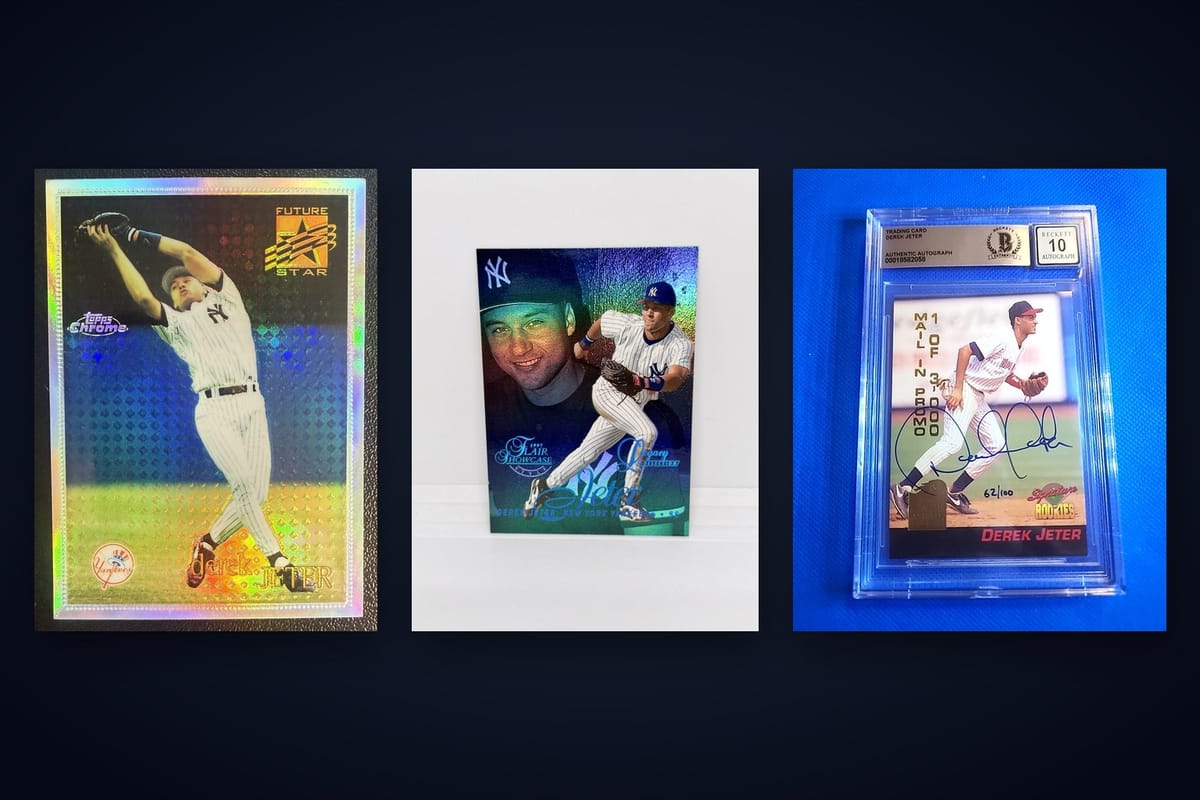
Estimated reading time: 12 min
Key Takeaways
- Derek Jeter cards worth money start with his 1993 rookies, led by the 1993 SP Foil #279, followed by Topps, Upper Deck and Bowman issues.
- The gap between raw and Derek Jeter PSA 10 prices is the biggest value driver, especially on foil cards that chip and scratch easily.
- Centering, corners and surface decide whether a card is worth grading. Check them before you pay a grading fee.
- Price guides lag the market. Compare them with recent verified sold listings before you buy, sell or submit.
Card values — live data from Midpoint's card database, as of 2026-10-28. Prices move; Midpoint refreshes these daily.
| Card | Raw | PSA 10 | Gem premium | |
|---|---|---|---|---|
 |
Derek Jeter [Refractor] #80 1996 Topps Chrome |
$1,167 | $29,902 | 25.6× |
 |
Derek Jeter [Row 2] #2 1997 Flair Showcase Legacy Collection |
— | $8,999 | — |
 |
Derek Jeter #S4 1994 Signature Rookies |
$8.89 | $7,575 | 852.1× |
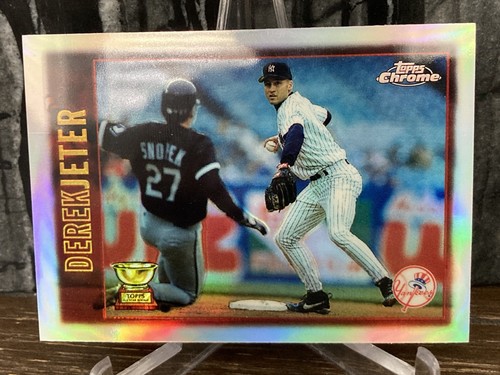 |
Derek Jeter [Refractor] #7 1997 Topps Chrome |
$225.00 | $5,892 | 26.2× |
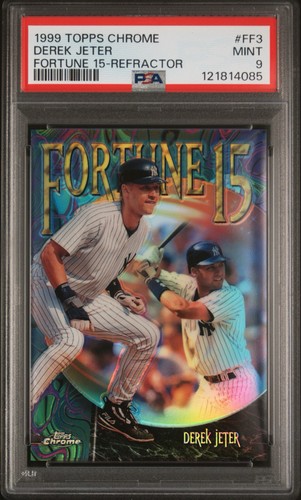 |
Derek Jeter [Refractor] #FF3 1999 Topps Chrome Fortune 15 |
$4.99 | $4,583 | 918.5× |
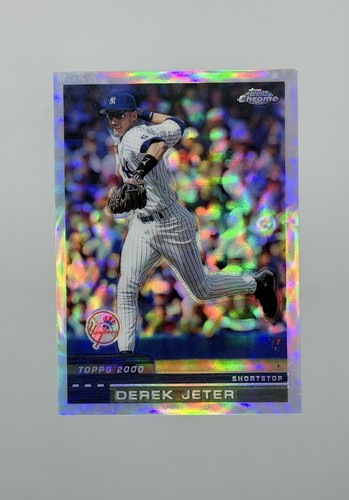 |
Derek Jeter [Refractor] #15 2000 Topps Chrome |
$228.25 | $4,202 | 18.4× |
 |
Derek Jeter [Gold Hologram] #449 1993 Upper Deck |
$15.00 | $4,102 | 273.5× |
 |
Derek Jeter [Refractor] #85 1999 Topps Chrome |
$187.95 | $4,020 | 21.4× |
 |
Derek Jeter [Black] #FD-1 2026 Bowman Final Draft |
$761.00 | $3,509 | 4.6× |
 |
Derek Jeter [Gold Signature] #644 1994 Collector's Choice |
$125.25 | $3,408 | 27.2× |
 |
Derek Jeter #AK-17 2026 Topps Series 2 All Kings |
$675.00 | $3,166 | 4.7× |
 |
Derek Jeter [Row 1] #2 1997 Flair Showcase Legacy Collection |
$599.99 | $3,085 | 5.1× |
Look up any card's current raw and graded value in Midpoint — and get an estimated grade before you pay to submit.
Table of Contents
- Section 1: Which Derek Jeter Cards Are Worth Money
- Section 2: Derek Jeter Rookie Card Value
- Section 3: Scarce Variations and Parallels
- Section 4: How Condition Drives Derek Jeter PSA 10 Value
- Section 5: Best Derek Jeter Cards to Grade
- Section 6: Spotting Fakes and Altered Cards
- Section 7: Notable Non-Rookie Derek Jeter Cards
- Section 8: Price Guides, Sold Listings and How to Sell
- Conclusion
- FAQ
Section 1: Which Derek Jeter Cards Are Worth Money
If you are asking which Derek Jeter cards are worth money, the short answer is that value concentrates in a small group of early cards. Jeter was a first-round pick in 1992 and debuted on cards in 1993, and the rookies from that year are the foundation of nearly every serious Jeter collection.
The most valuable Derek Jeter cards usually share three traits: they are true rookies or early issues, they are scarce in high grade, and they are hard to find sharp. Much of that scarcity comes from the 1990s production style, which often meant loose cutting, soft corners and fragile foil.
The tiers of Jeter value
- Tier 1 – the headline rookie: the 1993 SP Foil #279, the card most collectors mean by "the Jeter rookie."
- Tier 2 – other 1993 rookies: 1993 Topps #98, 1993 Upper Deck #449 and the 1993 Bowman rookie.
- Tier 3 – scarce variations: Topps Gold, factory-set stamped cards, Topps Micro and Platinum-style parallels.
- Tier 4 – popular non-rookies: Topps Chrome, Topps Gallery, Metal Universe, Ultra and Donruss Elite issues from the mid-to-late 1990s.
Why Jeter holds demand
Jeter is a Yankees icon, a Hall of Famer and one of the most recognizable names in the hobby. That broad appeal keeps buyers active across every tier, from raw commons in a shoebox to slabbed gems. It also means condition matters more than the name: a worn Jeter is common, a pristine one is not.
The data table below shows raw versus graded values for several Jeter cards as of 2026-10-28. Read it as a map of where the gaps are widest, then use the sections that follow to decide what your own copy is likely to be worth.
Section 2: Derek Jeter Rookie Card Value
Derek Jeter rookie card value depends first on which rookie you hold. Collectors treat several 1993 cards as rookies, but they do not trade at the same level, and mixing them up is a common pricing mistake.
1993 SP Foil #279: the flagship
The 1993 Upper Deck SP Foil #279 is the card that tops most lists. It has a foil-style front that looks striking but shows every flaw: white chipping along the edges, tiny surface scratches and corner dings. Because of that, a clean copy is harder to find than the card's reputation suggests, and the premium for top grades reflects it.
1993 Topps #98, Upper Deck #449 and Bowman
- 1993 Topps #98: his flagship Topps draft-pick issue. It is widely available, so the spread between raw and graded matters a lot.
- 1993 Upper Deck #449: a well-known Upper Deck rookie with glossy stock that shows fingerprints, print lines and edge wear.
- 1993 Bowman: a popular rookie-era option, often a good entry point for collectors who want a recognizable Jeter without SP pricing.
How to use the numbers
Check the table above for the raw, PSA 9 and PSA 10 figures as of 2026-10-28. Notice that the gap between a mid-grade copy and a PSA 10 is often far larger than the gap between raw and mid-grade. That is the hobby's classic grade premium: the top grade is priced for rarity, not just quality.
Before you assume your rookie is a PSA 10, remember that a card can look perfect at arm's length and still fall short. We cover the specific flaws in Section 4.
Section 3: Scarce Variations and Parallels
Beyond the base rookies, certain variations carry extra weight. These are the cards where research pays off, because a variation can be worth meaningfully more than the base version sitting next to it.
Topps Gold
Topps Gold parallels are marked with a gold foil element that distinguishes them from the standard card. Check the foil stamp carefully, since the gold treatment is what makes the card a parallel rather than a base copy. Always verify against the checklist and a trusted reference image.
Factory-set stamps
Some cards came in factory sets carrying a special stamp or logo. They are worth identifying because collectors seek them out as distinct variations. Stamps can be subtle, so compare yours side by side with a confirmed example before listing it as one.
Topps Micro and Platinum-style parallels
Topps Micro cards are miniature versions of the regular issue, and Platinum-style parallels are premium treatments that sit apart from the base set. Both are easy to overlook in a bulk lot, which is why dealers and flippers hunt for them.
Variation checklist
- Confirm the exact set, card number and year on the back.
- Compare the finish, stamp or foil pattern against a verified example.
- Check sold listings for that specific variation, not the base card.
- Decide whether grading adds authenticity as well as a grade.
Scarce variations are often smaller markets, so fewer sales means more price swing. A single high sale can distort a guide, which is why recent sold data matters more here than anywhere else (see Section 8).
Section 4: How Condition Drives Derek Jeter PSA 10 Value
A Derek Jeter PSA 10 is a card that grades as a Gem Mint, and for 1990s cards that is a high bar. The grade commands a large premium because so few survive without a flaw. Understanding the specific flaws helps you judge your own copy honestly.
Centering
Centering compares the border widths left to right and top to bottom. Many 1990s cards, including some Jeter issues, were cut off-center, and a card that looks fine can still have a lopsided border that holds back the grade. For a deeper dive, read how centering impacts card value.
Foil scratches and surface
On the SP Foil, the reflective surface exposes hairline scratches and print lines. Tilt the card under a single light source and look for fine lines, dents or cloudiness. Any of these can pull a candidate PSA 10 down a full grade.
Chipping, corners and edges
- Chipping: small white flecks on dark borders, common on glossy and foil stock.
- Corners: look for softness, fraying or tiny dings under magnification.
- Edges: check for rough cuts, nicks or whitening along all four sides.
- Print defects: ink spots, snow, registration problems and dull spots on the factory print.
Why one flaw matters so much
A single weak attribute can hold back the whole grade. A sharp card with one soft corner or noticeable off-centering can land a grade or two lower. That is why a mid-grade copy and a PSA 10 can sit worlds apart in price, and why honest pre-assessment saves money.
For a reminder of how the top grades differ between companies, see this guide to grading scale differences by company.
Section 5: Best Derek Jeter Cards to Grade
The best Derek Jeter cards to grade are the ones where the potential graded value comfortably exceeds the raw value plus fees. That math differs card by card, and it only works if the card has a real shot at a high grade.
Cards that usually justify grading
- 1993 SP Foil #279: the biggest upside, and grading also helps buyers trust authenticity.
- 1993 Topps #98 and Upper Deck #449: worth submitting when centering and corners look clean.
- Scarce variations: Topps Gold and other parallels, where a slab helps confirm what the card is.
- Standout non-rookies: sharp copies of premium 1990s inserts and chrome-style issues.
Cards to leave raw
Heavily off-center cards, copies with visible chipping, creased cards and common later-year base cards rarely repay the cost. If the raw card and a probable mid-grade slab are close in value, grading usually loses money once fees and shipping are counted.
Pre-grade before you pay
Grading fees add up fast, so estimate the grade first. Our walkthrough on how to pre-grade your card covers the process step by step. With Midpoint, you can measure centering and get an estimated PSA, BGS, CGC or TAG grade from centering, corners, edges and surface before you submit.

Run the numbers: raw value, expected graded value at a realistic grade, fees, shipping and your time. If the result is only marginally positive, the risk of a disappointing grade usually outweighs the upside.
Section 6: Spotting Fakes and Altered Cards
High-value rookies attract counterfeits and alterations, and Jeter's 1993 cards are no exception. Raw cards bought online or at shows are the most exposed, so build a verification habit before you spend serious money.
Counterfeit red flags
- Wrong print pattern: under magnification, genuine cards show a rosette dot pattern, while reprints often look blurry or have a different screen.
- Off foil or finish: a foil that looks too bright, too flat or oddly textured compared with a verified copy.
- Wrong card stock: unusual thickness, gloss or stiffness.
- Text and logo errors: fuzzy copyright lines, misaligned logos or inconsistent fonts on the back.
Alterations
Altered cards are real cards that have been modified to look better. Common tricks include trimming edges to sharpen borders, recoloring chipped edges, and pressing out dents. Inspect the edges closely: a freshly sharp edge that is slightly smaller than a known-good copy is a warning sign.
Practical safeguards
- Compare any raw card side by side with a confirmed genuine example.
- Ask sellers for high-resolution images of front, back and all four edges.
- Buy high-value rookies already graded by a major company when possible.
- Check that the slab label and the card match, and verify the certificate number on the grader's website.
- Walk away from deals that seem too good for the card's condition.
Once you own an authentic card, protect it. Our guide to storing valuable cards covers sleeves, top loaders and humidity so condition does not slip after you buy.
Section 7: Notable Non-Rookie Derek Jeter Cards
Not every valuable Jeter card is a rookie. Mid-to-late 1990s issues from premium and chrome-style sets have a loyal following, especially in high grade. If you have older Jeter cards in a binder, these are the sets worth checking first.
Sets to check
- Topps Chrome: the shiny refractor-style finish makes clean copies popular, and the surface shows scratches readily.
- Topps Gallery: an artwork-style design that appeals to collectors who like a distinct look.
- Metal Universe: a metallic, high-gloss issue that is fragile and often found with surface wear.
- Ultra: a glossy mainstream set with solid demand for sharp copies.
- Donruss Elite: a limited-feel insert-style product with collector appeal.
Are old Jeter cards worth anything?
Yes, but with a big caveat. Many old Jeter cards were mass-produced, and a typical ungraded copy with some wear is usually modest in value. The cards that carry real money are scarce versions, premium inserts and copies that could grade near the top. A binder full of base cards from the late 1990s and 2000s is more likely a fun collection than a payday.
How to triage a bulk lot
- Pull anything from 1993 first and identify the exact set and number.
- Separate premium, foil, chrome-style and numbered cards from base cards.
- Inspect the best candidates for centering, corners and surface.
- Look up the shortlist and compare raw versus graded values.
You can scan and look up cards quickly in Midpoint, which covers over 1.5 million cards across baseball and other sports, to see raw versus graded values without guessing.
Section 8: Price Guides, Sold Listings and How to Sell
Knowing a card's value is only half the job. You also need to read the market correctly and choose the right place to sell.
Price guides versus verified sold listings
Price guides are estimates, often smoothed or delayed. Sold listings are what real buyers actually paid. For scarce cards, a guide can be far off the true market, so use both and weigh sold listings more heavily.
- Filter for sold or completed sales, not asking prices.
- Match the exact grade, grader and variation.
- Look at several recent sales to spot trends rather than relying on one outlier.
- Note the date: values move with news, anniversaries and overall market sentiment.
Where to sell
- eBay: the widest audience and strong price discovery, but fees and shipping apply.
- Card shows: quick cash and face-to-face negotiation, though dealers expect to buy below market.
- Auction houses: best for top-grade, high-value rookies that attract serious bidders.
- Local dealers: convenient and fast, usually at a discount for the convenience.
Selling tips
Photograph the card sharply, show all four corners and edges, and describe flaws honestly. If a card is high value, graded copies generally build more buyer confidence. Track your collection's value over time in Midpoint's portfolio view so you can sell when the market suits you rather than reacting to a single price.
Insurance matters once a collection gets valuable. Read our guide on how card grade impacts insurance value to understand how grades support coverage.
Conclusion
Derek Jeter cards worth money are concentrated in a short list: the 1993 SP Foil #279 at the top, then the 1993 Topps, Upper Deck and Bowman rookies, then scarce variations such as Topps Gold, factory-set stamps, Topps Micro and Platinum-style parallels. Premium 1990s non-rookies fill out the next tier.
Across all of them, condition decides the outcome. A Derek Jeter PSA 10 earns its premium because centering, corners, edges and surface all have to line up. Before you submit anything, estimate the grade honestly, compare guide prices with recent sold listings, and decide whether the likely graded value beats the cost.
If you want a faster way to check, try Midpoint to measure centering, estimate PSA, BGS, CGC and TAG grades, and look up raw versus graded values before you spend on grading.
FAQ
Q: What Derek Jeter cards are worth money?
A: The 1993 rookies lead the list, especially the SP Foil #279, followed by 1993 Topps #98, Upper Deck #449 and Bowman. Scarce variations such as Topps Gold, factory-set stamps, Topps Micro and Platinum-style parallels, plus premium 1990s inserts, can also carry real value in high grade.
Q: How much is a 1993 Upper Deck SP Derek Jeter rookie card worth?
A: It depends heavily on condition. Raw, PSA 9 and PSA 10 copies trade at very different levels, with the top grade priced at a large premium. Check the raw versus graded figures as of 2026-10-28 in the data table, and compare them with recent sold listings.
Q: How much is a Derek Jeter rookie card worth in mint condition?
A: Mint and Gem Mint copies are worth much more than worn ones because few survive without chipping, scratches or centering problems. The exact figure varies by card and grade, so look up the specific rookie and grade in the data table or recent sold sales.
Q: Which Derek Jeter rookie card is the most valuable?
A: The 1993 SP Foil #279 is generally regarded as the most valuable and most sought-after Jeter rookie, with other 1993 rookies sitting below it in most grades.
Q: Are old Derek Jeter baseball cards worth anything?
A: Some are, but many were mass-produced, so typical worn base cards are modest in value. Scarce variations, premium inserts and copies that could grade at the top are the ones that carry real money.
Q: Should I get my Derek Jeter card graded?
A: Grade it if the card is a valuable rookie or scarce variation and looks sharp in centering, corners, edges and surface. If it is off-center, chipped or creased, or the likely graded value barely exceeds the raw value plus fees, leave it raw. Pre-grading with a tool like Midpoint helps you decide first.
Free to start
Try the Midpoint app
Grade any card from a photo, see its raw and PSA 10 value, and track what your collection is worth — free.
Get it on iPhoneGet it on Android