
Card Grading Tool: How AI Tools Revolutionize Card Grading in 2026
Discover the best card grading tool for precision, AI-powered grading, and pre-screening. Compare AI tools vs. PSA, BGS, CGC. Learn to grade cards online.

Estimated reading time: 13 min
Key Takeaways
- AI-powered card grading tools like Midpoint offer instant, objective estimates for PSA, BGS, CGC, and TAG grades.
- Modern card grading tools analyze centering, corners, edges, and surface using advanced image processing.
- AI pre-screening may help reduce failed submissions, potentially optimizing ROI for collectors and dealers.
- Online grading and calculators let collectors self-evaluate cards before paying costly grading fees.
- Comparisons with traditional grading suggest AI tools are improving in accuracy and reliability.
Table of Contents
- Section 1: The Rise of AI-Powered Card Grading Tools
- Section 2: How AI Card Grading Tools Evaluate Condition
- Section 3: AI Grading Tools vs. PSA, BGS, CGC, SGC, and TAG
- Section 4: Instant Online Card Grading & Image-Based Assessment
- Section 5: Card Grading Calculators: Centering, Value & Condition Analysis
- Section 6: Self-Evaluation, Verification, and Submission Strategies
- Section 7: Pricing, Guarantees, and Choosing the Right Tool
- Section 8: Maximizing ROI with AI Pre-Screening
- Conclusion
- FAQ
Section 1: The Rise of AI-Powered Card Grading Tools
What Is a Card Grading Tool?
A card grading tool is a digital solution—often powered by artificial intelligence (AI)—designed to evaluate the condition of trading cards such as sports cards, Pokémon, Magic: The Gathering, and more. These tools analyze various grading criteria (centering, corners, edges, surface) to estimate the likely grade a card would receive from major grading companies like PSA, BGS, CGC, SGC, or TAG.
- AI tools provide instant, objective analysis from a simple photo or scan.
- They help collectors, dealers, and flippers pre-screen cards before investing in professional grading.
Why AI Now Dominates Card Grading Tools
The trading card market’s growth has increased demand for fast, accurate card grading. Manual self-grading is subjective and slow. AI-driven tools, using computer vision and machine learning, offer:
- Consistent, repeatable grading estimates.
- Scalability for bulk collections—grade many cards quickly.
- Objective centering, edge, and surface measurements.
- Integration with databases for quick population and value estimates.
Leading Examples in 2026
Apps like Midpoint are among the companies offering AI-powered pre-grading. By leveraging high-resolution image analysis, they provide instant PSA, BGS, CGC, and TAG grade predictions, helping users save money and maximize value. See also this deep dive on card centering tool accuracy for more insights.
Section 2: How AI Card Grading Tools Evaluate Condition
Centering Analysis: The Heart of Card Grading
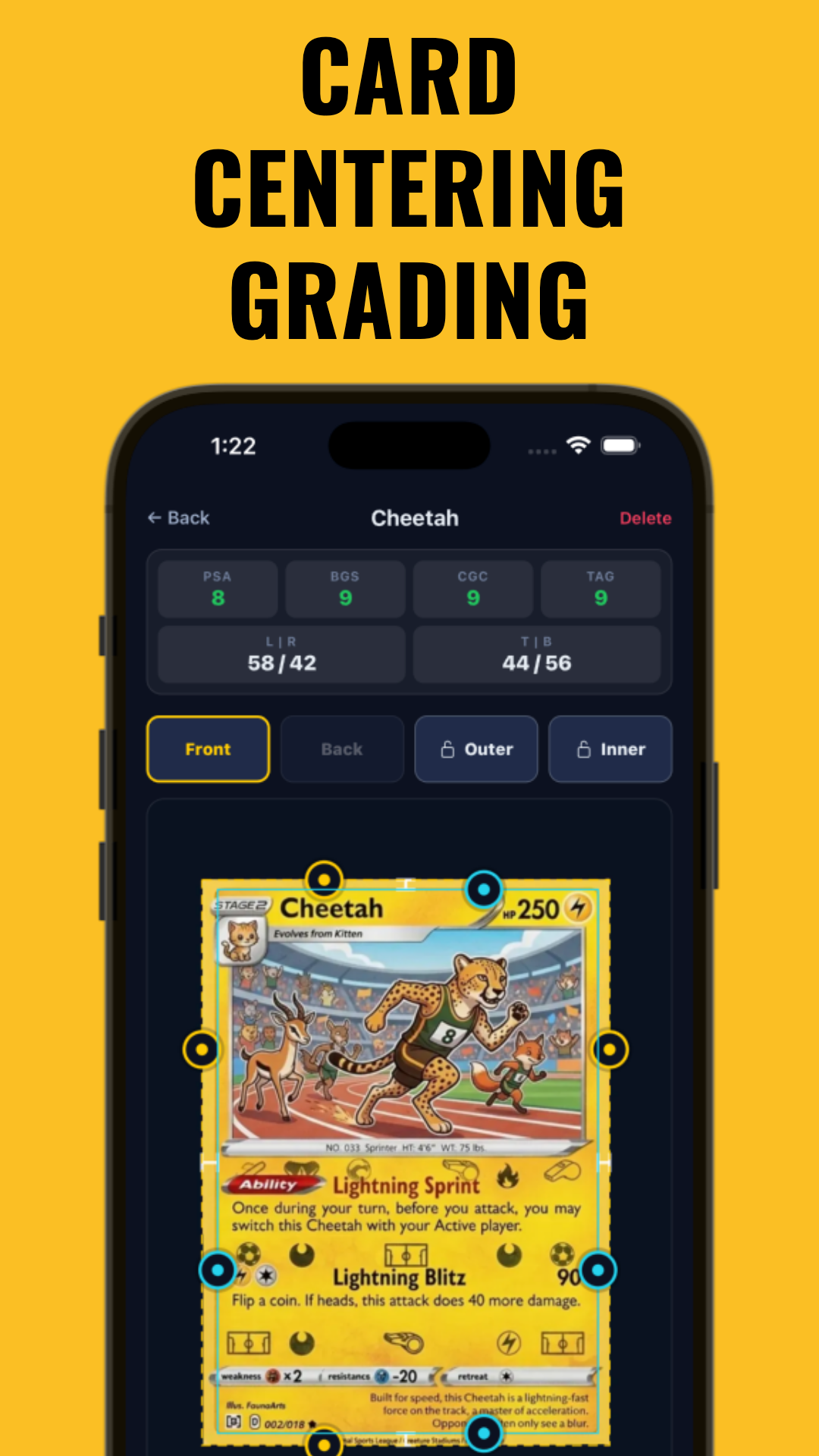
The centering of a card—the alignment of the printed image relative to the card’s physical borders—is a fundamental grading criterion. AI tools use edge detection, cropping, and pixel-level measurements to determine centering ratios (e.g., 55/45 left-right).
- Precision: Can be accurate to within tenths of a millimeter, depending on image quality.
- Visual overlays: Users see how their card is measured.
- Bulk analysis options: Grade multiple cards for centering in a single session.
Corners, Edges, and Surface: Beyond Centering
While centering is crucial, AI grading tools also assess corners, edges, and surface. Using high-res imaging and pattern recognition, they may identify:
- Corner rounding, dings, or whitening
- Edge chipping, indentations, or warping
- Surface scratches, stains, print defects, or gloss loss
Some AI tools can spot flaws that may be difficult to see with the naked eye, giving collectors a better expectation before submitting cards for grading.
Consistency and Repeatability
Unlike manual grading, AI tools aim to reduce human error and bias. Each card is measured by the same digital standard every time, supporting fairness and transparency.
Section 3: AI Grading Tools vs. PSA, BGS, CGC, SGC, and TAG
Traditional Grading: Pros and Limitations
Professional grading services like PSA, Beckett (BGS), CGC, SGC, and TAG set the standard for card authentication and encapsulation. Their process involves physical examination by multiple experts, often with magnification and strict checklists. Benefits include:
- Market trust: Slabs from top graders command premium resale value.
- Authenticity: Detects fakes and alterations.
- Population tracking: Adds to official census data.
Drawbacks:
- Expensive: Grading fees can range from $20 to $300+ per card.
- Slow: Wait times may exceed several months.
- Subjectivity: There can be inconsistencies between human graders.
AI Tools: Closing the Gap
AI card grading tools are improving in their ability to estimate grades similar to those given by human graders. State-of-the-art apps analyze cards under consistent lighting and magnification, providing rapid results. Some reports and user tests suggest that top AI tools can predict PSA/BGS outcomes within 0.5 grade points on a significant portion of cards, though results may vary depending on the tool and card type.
- Speed: Results in seconds, not months.
- Cost: Free or low-cost compared to traditional grading.
- Objectivity: No grader fatigue or subjectivity.
Complementing, Not Replacing, Traditional Grading
While AI tools are not a substitute for official authentication and slabbing, they can be a useful pre-screening step. Collectors can filter out cards unlikely to achieve target grades, potentially saving time and money. For a detailed comparison, see How AI Transforms Card Centering Analysis.
Section 4: Instant Online Card Grading & Image-Based Assessment
How Instant AI Grading Works
Modern card grading tools allow users to upload a photo or scan of their trading card. The AI processes the image, detects borders, and analyzes centering, corners, edges, and surface. Within seconds, the tool displays a predicted grade for each major grading company.
- No shipping required: Get an unbiased grade estimate from home.
- Bulk uploads: Process multiple cards at once (ideal for large collections or sellers).
- Mobile-friendly: Many tools work directly from your phone’s camera.
Online Grading vs. In-Person Evaluation
Online AI tools offer convenience, but image quality matters. For best results:
- Use high-resolution scans or clear photos with good lighting.
- Avoid glare, shadows, or obstructions.
- Ensure the entire card is visible within the frame.
Some tools, like Midpoint, offer manual cropping and adjustment features to help the AI focus on the correct card area.
AI Grading for All Major Card Types
AI grading tools now support a wide range of cards, including:
- Sports cards (baseball, basketball, football, hockey)
- Pokémon and other TCGs
- Vintage and modern non-sports cards
For more details on using centering tools for Pokémon cards, check out this step-by-step guide.
Section 5: Card Grading Calculators: Centering, Value & Condition Analysis
What Are Card Grading Calculators?
Card grading calculators are digital tools that break down the grading process into measurable components. They allow users to input or auto-detect centering percentages, edge quality, corner sharpness, and surface state. The calculator then estimates an overall grade and, in some cases, likely market value.
- Centering calculators: Measure left-right, top-bottom ratios (e.g., 55/45, 60/40).
- Value calculators: Combine grade estimate with recent sales data.
- Edge/surface analyzers: Quantify flaws using AI algorithms.
How to Use a Centering Calculator
Simply upload your card image, and the tool will mark the borders, calculate centering ratios, and even show overlays for visual comparison. For a step-by-step guide, see How to Measure Card Centering.
Advanced Features of Grading Calculators
- Bulk processing: Grade batches of cards with one upload.
- Grade prediction for PSA, BGS, CGC, and others.
- Exportable reports: Download grading summaries for your records or sales listings.
These calculators can be valuable for sellers who need to quickly assess and price large inventories.
Section 6: Self-Evaluation, Verification, and Submission Strategies
Self-Evaluating Your Cards with AI Tools
Before submitting cards to a grading company, self-evaluation is important. AI card grading tools help you objectively determine:
- If a card meets your target grade threshold (e.g., PSA 9 or 10).
- Which flaws (centering, corners, etc.) might lower the grade.
- Whether it’s worth the submission fee for each card.
Verifying Certification Numbers
Some AI tools now integrate with grading company databases, allowing users to verify certification numbers and cross-check populations. This can be useful for:
- Ensuring slabbed cards are genuine.
- Checking population reports and grade rarity.
Always double-check certification numbers on official PSA, BGS, CGC, or TAG sites before making high-value purchases.
Submission Strategies for Best ROI
- Pre-screen with AI: Only submit cards that are likely to achieve the desired grade.
- Batch submissions: Save on shipping and per-card fees by sending cards in bulk.
- Document condition: Keep AI-generated grading reports for your records.
For full details, see How to Pre-Grade Your Card: A Step-by-Step Guide.
Section 7: Pricing, Guarantees, and Choosing the Right Tool
Free vs. Paid Card Grading Tools
The market offers a mix of free and premium AI card grading tools. Free tools provide basic centering and grade prediction; paid versions may unlock advanced features, bulk processing, and exportable reports.
- Free: Single-card analysis, basic overlays, limited grade prediction.
- Paid: High-res image support, bulk uploads, edge/surface analysis, collection management.
- Typical pricing: $5-20/month for unlimited grading; $1-2 per card for pay-per-use.
Accuracy, Reliability, and Guarantees
Some tools like Midpoint claim high accuracy—sometimes within 0.5 grade points of PSA results. Some provide a credit-back guarantee if their prediction is off by more than a specified margin, minimizing user risk.
- Always check the tool’s published accuracy rates, if available.
- Look for transparent refund or credit-back policies.
What to Look for When Choosing a Tool
- Support for your card type and grading standard (PSA, BGS, CGC, TAG).
- Bulk processing if you have a large collection.
- Transparent pricing and guarantees.
- Easy-to-use interface with clear visual feedback.
Try the leading options and choose the one that fits your grading workflow. For collectors focused on centering, Midpoint is one option to consider.
Section 8: Maximizing ROI with AI Pre-Screening
Why Pre-Screening Matters
Professional grading fees are significant—often $30+ per card for standard submissions. Submitting cards that miss target grades can be a costly mistake, reducing potential resale profits or personal collection value.
- AI pre-screening may help you submit only your best candidates.
- Can reduce failed submissions and wasted fees.
- May improve your average profit per graded card.
Real-World Impact of AI Grading Pre-Screening
Some dealers and collectors using AI pre-screening report reductions in failed (subpar) submissions, higher average grades on submitted cards, and faster inventory turnover, though results can vary depending on workflow and tool accuracy.
- Potential for fewer low-grade submissions.
- Possible improvement in average grades on submitted cards.
- May support faster inventory turnover and improved customer trust.
For a practical example, see Estimate Your Card: A Practical Guide Before Grading.
Integrating AI Grading into Your Workflow
- Scan or photograph cards as soon as you acquire them.
- Run the batch through your AI grading tool.
- Set a grade cutoff (e.g., only submit cards likely to score 9+).
- Track results to refine your submission strategy over time.
Conclusion
Card grading tools in 2026—especially those powered by AI—are changing how collectors, dealers, and investors approach trading card submissions. With instant, objective analysis of centering, corners, edges, and surface, these tools can help users maximize their ROI and avoid costly mistakes. Whether you’re grading a single card or managing a bulk collection, leveraging an advanced card grading tool like Midpoint may offer a competitive edge. As AI accuracy continues to improve, integrating these tools into your workflow is increasingly valuable for anyone serious about card grading in today’s market.
FAQ
Q: What is the most accurate AI card grading tool in 2026?
A: Some of the most accurate AI card grading tools in 2026 are platforms like Midpoint, which report the ability to predict PSA, BGS, and CGC grades within 0.5 grade points for many cards. These tools leverage computer vision and machine learning, offering precision in centering, edge, and surface analysis, though results may vary by card and tool.
Q: How do AI card grading tools work and are they reliable?
A: AI card grading tools use high-resolution image analysis, edge detection, and pattern recognition to evaluate centering, corners, edges, and surface. Top platforms aim for high reliability, sometimes matching human grader outcomes, but reliability depends on image quality and the tool’s algorithm sophistication. Official grading is still required for authentication and encapsulation.
Q: Can I get my trading card graded online without shipping it?
A: Yes, instant online AI card grading tools let you upload photos or scans to get an estimated grade without shipping your card. While these estimates aren’t official, they can be useful for pre-screening before submitting to PSA, BGS, CGC, or other grading companies.
Q: What are the best free card grading tools for collectors?
A: The best free card grading tools offer basic centering analysis, grade predictions, and sometimes limited edge or surface assessment. For more advanced features or bulk processing, paid plans are usually required. Always check if the tool supports your card type and grading standard.
Q: How does AI grading compare to PSA, BGS, and CGC grades?
A: AI grading tools are improving in consistency with PSA, BGS, and CGC, and may predict grades within half a point of the final result in some cases. However, only official graders can authenticate and encapsulate cards for maximum market value. AI tools are best for pre-screening and self-evaluation.
Q: Is it safe to use AI tools to predict my card's grade before submitting?
A: Yes, it’s generally safe and can be helpful. AI tools provide an objective, data-driven estimate, helping you decide which cards to submit. Using AI pre-screening may save grading fees by avoiding low-grade submissions, especially when paired with a reputable platform.
Free to start
Try the Midpoint app
Grade any card from a photo, see its raw and PSA 10 value, and track what your collection is worth — free.
Get it on iPhoneGet it on Android