Centering Guidelines for Star Wars Cards: Complete Grading Guide
Master centering guidelines for Star Wars cards with PSA, BGS, CGC standards. Compare with Pokémon, sports, MTG, and more. Accurate pre-grading tips.

Estimated reading time: 14 min
Key Takeaways
- Centering is a significant factor in the grade and value of Star Wars, Pokémon, sports, and other trading cards.
- PSA requires 55/45 front and 75/25 back centering for a Gem Mint 10 on Star Wars cards; other graders use similar but subtly different standards.
- Measuring centering accurately involves border measurements on both axes; the worst axis determines your centering ratio.
- Common mistakes—like camera tilt and glare—can skew centering assessments, so use reliable tools.
- Tools like Midpoint and manual methods can help collectors check centering before grading.
Table of Contents
- Section 1: Why Centering Matters for Star Wars Cards
- Section 2: PSA Centering Standards for Star Wars & Other Cards
- Section 3: Measuring Centering—Math, Tools, and Techniques
- Section 4: Comparing Centering Standards—PSA vs BGS vs CGC
- Section 5: Centering Guidelines Across Card Types (Pokémon, Sports, MTG, Vintage, One Piece)
- Section 6: Visual Clues & Common Centering Mistakes
- Section 7: How Centering Affects Grades—Gem Mint, Mint, and NM
- Section 8: Pre-Submission Centering Checklist for Star Wars Cards
- Conclusion
- FAQ
Section 1: Why Centering Matters for Star Wars Cards
The Role of Centering in Card Grading
In the world of trading card grading, centering refers to how evenly the printed card image is positioned within the card’s physical borders. For Star Wars cards—especially vintage sets like the 1977 Topps series—centering is one of the most critical factors in determining grade and value. Misaligned images or uneven borders can downgrade both aesthetics and market desirability.
- Grading companies like PSA, BGS, and CGC explicitly define centering standards for each grade tier.
- Centering can be the difference between a PSA 10 (Gem Mint) and a PSA 8 (NM-MT), often affecting value by a significant amount.
Why Centering Is a Key Value Driver
Collectors and investors scrutinize Star Wars cards for visual balance. Poor centering is immediately noticeable, especially on cards with colored borders or prominent white edges. For high-end cards, even a minor centering flaw can mean the difference between a showpiece and a bulk card.
- Star Wars, Pokémon, and sports card centering all follow similar logic—collectors favor cards with balanced borders, which display better in cases and portfolios.
- For vintage card centering, manufacturing quirks mean well-centered examples are less common, creating premiums for top-graded specimens.
Centering vs. Other Grading Factors
While surface, corners, and edges matter, centering is unique in its immediate visual impact. A card can be pack-fresh and still miss a top grade if centering is off.
Section 2: PSA Centering Standards for Star Wars & Other Cards
PSA Gem Mint 10 Centering Guidelines
For a Star Wars card to achieve a PSA 10, centering must meet specific requirements. As of 2024, the standards for non-sports cards—including Star Wars—are:
- Front: Centering must be 55/45 or better on both axes (left-right and top-bottom).
- Back: Centering must be 75/25 or better.
This means the narrowest border can be no less than 45% of the widest on the front, and 25% on the back. Anything outside these limits usually caps the card at a PSA 9 or lower.
PSA 9 (Mint) and PSA 8 (NM-MT) Centering
- PSA 9: Front centering 60/40 or better; back 90/10 or better.
- PSA 8: Front centering 65/35 or better; back 90/10 or better.
Star Wars collectors should note that vintage card centering—especially 1977-1983 Topps—often shows more print era quirks, but the technical standards remain fixed.
Why Back Centering Leeway Exists
Back centering is less critical since most display cases show the front. PSA and other graders apply looser tolerances (75/25 vs. 55/45) as minor back misalignments are less visually disruptive. However, extremely off-center backs can still limit maximum grade.
- For back centering Pokémon and MTG cards, standards are similar, but always check the latest grader guidelines.
Section 3: Measuring Centering—Math, Tools, and Techniques
Step-by-Step Centering Math
To measure centering, you need the width of the left/right or top/bottom borders. Calculate the centering ratio using:
- Formula: (Smaller border / Larger border) × 100 = %
- A 55/45 front centering means the smaller border is at least 45% the size of the larger one.
Example: If the left border is 2mm and the right is 2.4mm, the centering = (2 / 2.4) × 100 = 83.3%. Subtract from 100 to get the offset (16.7% off-center), then compare to grader standards.
Measuring Both Axes: The Worst Axis Rules
You must check both the left-right and top-bottom axes. The axis with the larger disparity is the "worst axis" and sets the grade limit. If your left/right centering is 55/45 but top/bottom is 60/40, your card is only as good as the 60/40 measure—likely a PSA 9 at best.
Tools for Measuring Centering
- Physical rulers or calipers (down to 0.1mm)
- Scanners and digital photo editors (for precise pixel measurement)
- Midpoint: Upload a photo, and the app measures centering and estimates PSA/BGS/CGC grades.
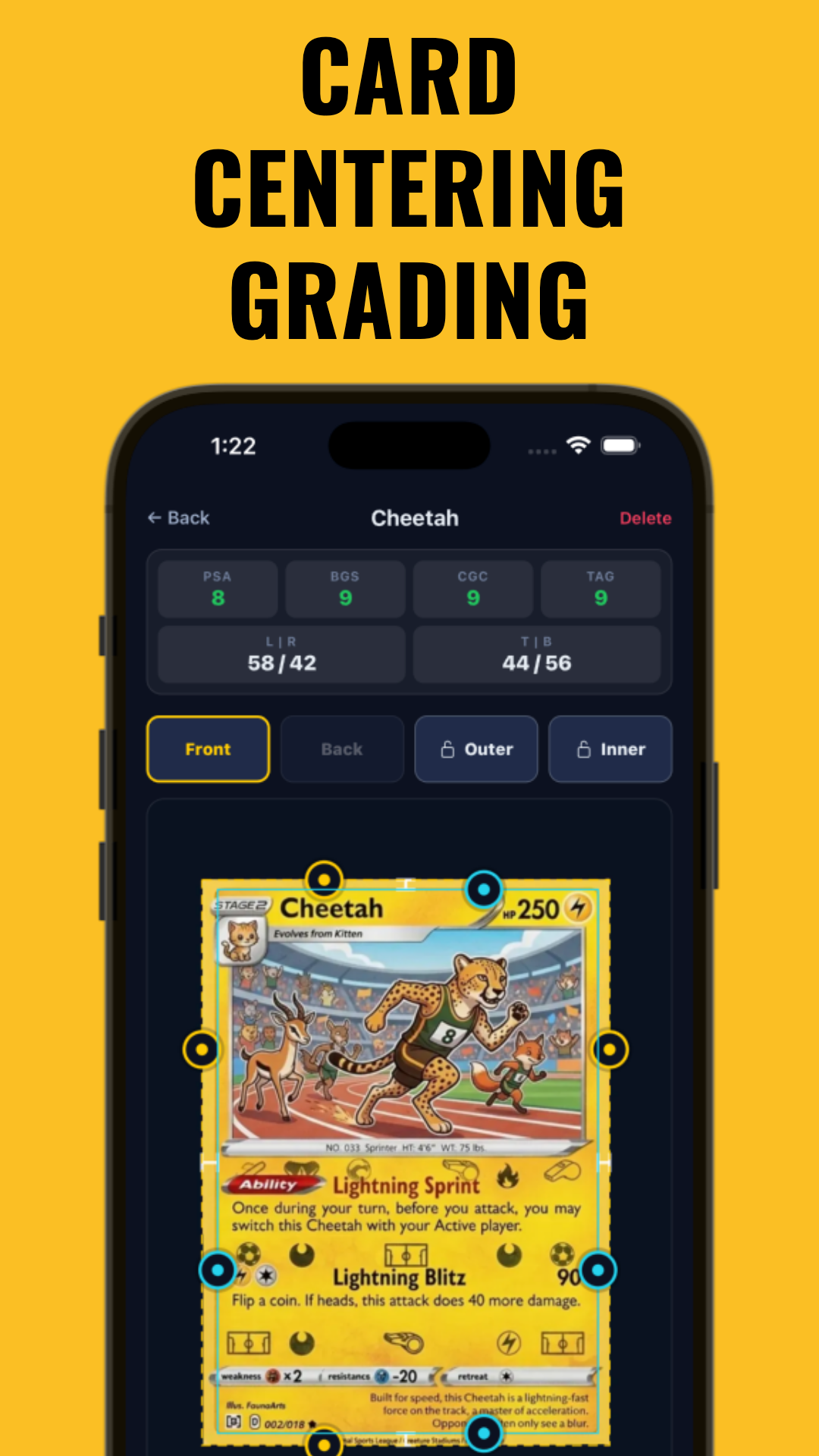
Midpoint quickly calculates Star Wars card centering and predicts grade outcomes.
- Try the free centering calculator for manual checks.
- Bulk upload options can speed up pre-grading for large collections.
Section 4: Comparing Centering Standards—PSA vs BGS vs CGC
PSA, BGS, and CGC Centering Tolerances
While PSA is the most referenced grader for Star Wars cards, collectors sometimes cross over to BGS (Beckett) and CGC (Certified Guaranty Company), especially for Pokémon, sports, and MTG card centering.
- PSA 10: 55/45 front, 75/25 back
- BGS 10: 50/50 to 55/45 front, 60/40 back
- CGC 10: 55/45 front, 75/25 back (similar to PSA)
BGS is stricter on back centering, which can surprise submitters. CGC aligns closely with PSA for non-sports cards, including Star Wars and Pokémon.
Which Grader Is Toughest on Centering?
- BGS is often considered the most demanding, especially for Pristine or Black Label 10s (closer to 50/50 required).
- PSA is consistent but allows minor leeway for vintage card centering in practice, though official standards do not change.
- CGC is strict for new cards but sometimes more understanding with older issues.
Always check the latest standards, as graders occasionally update guidelines. For a deep dive on grading scale differences, see Grading Scale Differences by Company.
Submitting to Multiple Graders
If you plan to cross-grade, aim for your card’s centering to meet the most stringent standard among the companies you’re considering. This can maximize your chance of top grades and higher resale or insurance value.
Section 5: Centering Guidelines Across Card Types (Pokémon, Sports, MTG, Vintage, One Piece)
Pokémon Card Centering
- Similar to Star Wars, Pokémon card centering for PSA 10 is 55/45 front and 75/25 back.
- Back centering Pokémon: Dark blue borders make flaws stand out, but graders still allow more leeway on the back.
- For vintage WOTC Pokémon, slight centering quirks are common and can affect pop reports.
Sports Card Centering
- Sports cards—especially pre-1980—are known for poor centering, making Gem Mint examples less common.
- Grading standards match Star Wars: 55/45 front, 75/25 back for modern; some leeway for vintage.
- Topps, Fleer, and Donruss issues are frequently reviewed for centering by eye and tool.
MTG Card Centering
- MTG card centering uses the same calculations, with colored borders and print run variations impacting grades.
- For Magic: The Gathering, back centering is similar to Pokémon as both share rounded corners and colored backs.
One Piece & Yu-Gi-Oh! Card Centering
- Modern One Piece card centering and Yu-Gi-Oh! generally follow 55/45-75/25 standards for PSA 10, but print runs are often better controlled.
- Collectors should still check both axes and use tools for accuracy.
Vintage Card Centering (Star Wars and Beyond)
- Vintage Star Wars and other non-sports cards (1970s-80s) often have miscuts or slanted images.
- Grading companies do not relax the official standards, but note print quirks in the population reports.
For a step-by-step card pre-grading process, see How to Pre-Grade Your Card.
Section 6: Visual Clues & Common Centering Mistakes
How to Spot Centering by Eye
- Look for equal-width borders on all sides—especially top vs bottom and left vs right.
- Use the card’s design elements (logos, text boxes) as a visual "ruler" for gross misalignment.
- For Pokémon and MTG, the colored border highlights flaws quickly.
Common Mistakes When Checking Centering
- Tilted or rotated photos: Even a few degrees off can skew border measurements.
- Sleeve or case glare: Reflections can obscure true border width, especially on dark edges.
- Camera angle: Shooting from above (not directly overhead) causes perspective distortion.
- Uneven cropping: Cropping too close or at an angle can change relative border width.
How to Avoid These Pitfalls
- Use a scanner or flatbed for best accuracy.
- Take photos directly overhead, with even lighting and no sleeve glare.
- Compare multiple tools (rulers, apps, digital overlays) for consistency.
- Apps like Midpoint automate error correction and border detection using AI.
For a deeper dive on how AI can transform your centering analysis, see this comparison of AI grading tools.
Section 7: How Centering Affects Grades—Gem Mint, Mint, and NM
Grade Outcomes by Centering Ratio
- PSA 10 (Gem Mint): 55/45 or better (front), 75/25 (back). Virtually perfect, strong visual impact.
- PSA 9 (Mint): 60/40 (front), 90/10 (back). Minor centering flaws, but still strong collector appeal.
- PSA 8 (NM-MT): 65/35 (front), 90/10 (back). Moderate miscentering, noticeable to collectors.
For BGS, a "Pristine 10" may require 50/50 centering, making such grades very rare. CGC aligns with PSA but may be stricter on modern printings.
Market Value Impact
- Price gaps can be significant: A PSA 10 Star Wars card may command a multiple of the value of a PSA 9, primarily due to centering.
- This pattern holds for Pokémon card centering, sports card centering, and vintage card centering as well.
Insurance and Resale Considerations
- For high-value cards, insurance depends on certified grade, which is closely linked to centering.
- See this insurance and value guide for more about centering’s financial role.
Section 8: Pre-Submission Centering Checklist for Star Wars Cards
Essential Steps Before Grading Submission
- Inspect card under bright, even lighting—remove from sleeve for best results.
- Measure borders on both axes (left/right and top/bottom) using ruler, app, or scanner.
- Check against PSA, BGS, and CGC standards for your target grade.
- Photograph or scan card flat, from directly above, to avoid distortion.
- Double-check worst axis—if either is below the grade cutoff, your grade will drop.
- For bulk submissions, use digital tools like Midpoint or a centering calculator to save time.
What to Watch For
- Look for print quirks (tilt, miscut, diamond cut) that affect centering but may be treated differently by graders.
- Re-examine card backs—don't overlook back centering, especially for PSA 10 and BGS 10 targets.
Final Pre-Submission Questions
- Is the card’s centering truly within the top grade’s limits on both axes?
- Are you satisfied with the centering relative to the card’s era and print run?
- Would a slightly lower grade still satisfy your collection or resale goals?
For a full, practical walkthrough, see this guide to pre-grading with centering tools.
Conclusion
Centering is a key factor for Star Wars card grading, and the same principles apply across Pokémon, sports, MTG, and One Piece cards. Understanding the centering guidelines for Star Wars cards—especially the 55/45 (front) and 75/25 (back) thresholds for PSA 10—can help you make informed grading decisions and maximize your collection’s value. Always measure both axes, avoid common errors, and consider digital tools like Midpoint to streamline your pre-submission process. By mastering card centering, you can save on grading fees, avoid disappointment, and help ensure your favorite cards shine in any collection.
FAQ
Q: What is the centering requirement for a PSA 10 on Star Wars cards?
A: For a PSA 10, Star Wars cards must have centering of 55/45 or better on the front and 75/25 or better on the back. Both axes (left-right and top-bottom) must meet these standards.
Q: How do you measure card centering correctly on the front and back?
A: Measure the width of both borders on each axis (top/bottom, left/right). Use the formula: (Smaller border / Larger border) × 100 to get the percentage. The worst axis determines your centering ratio.
Q: Is 60/40 centering good enough for a PSA 10?
A: No, 60/40 is not sufficient for a PSA 10 on Star Wars cards. 60/40 is the minimum for a PSA 9. PSA 10 requires 55/45 or better centering on the front.
Q: What centering ratio do BGS and CGC require compared with PSA?
A: BGS requires 50/50 to 55/45 centering on the front and 60/40 on the back for a Pristine 10, which is stricter than PSA. CGC generally matches PSA with 55/45 front and 75/25 back for a 10.
Q: How can you tell if a Star Wars card is off-center without a tool?
A: Visually inspect for uneven borders—if one side is notably thinner than the other, it's off-center. For more accuracy, compare border widths using a ruler or overlay.
Q: Does the back of a trading card matter as much as the front for grading?
A: The back is less critical than the front and has looser centering standards (75/25 for PSA 10). However, severely off-center backs can prevent top grades.
Free to start
Try the Midpoint app
Grade any card from a photo, see its raw and PSA 10 value, and track what your collection is worth — free.
Get it on iPhoneGet it on Android