CGC 10 Centering Standards: Complete Guide for Card Graders
Understand CGC 10 centering standards, key thresholds, Gem Mint vs Pristine, and how centering is measured for flawless trading card submissions.


Estimated reading time: 13 min
Key Takeaways
- CGC 10 centering standards require very precise alignment, especially for Pristine 10 grades.
- Gem Mint 10 and Pristine 10 have different front and back centering thresholds.
- CGC uses subgrades for centering, corners, edges, and surface; all affect the final grade.
- CGC centering criteria differ in some respects from PSA and BGS, which can impact grade outcomes.
- Tools like Midpoint can help collectors pre-measure centering to maximize grading results.
Table of Contents
- Section 1: Introduction to CGC 10 Centering Standards
- Section 2: CGC Gem Mint 10 vs Pristine 10 Centering Requirements
- Section 3: How CGC Measures Centering on Trading Cards
- Section 4: CGC 10 Centering Standards—Front and Back Ratios Explained
- Section 5: CGC 10 Centering vs PSA and BGS Standards
- Section 6: Other Subgrades That Impact a CGC 10
- Section 7: Real-World Centering Examples and Ratio Interpretation
- Section 8: Tools and Strategies for Measuring Centering Accurately
- Conclusion
- FAQ
Section 1: Introduction to CGC 10 Centering Standards
Why Centering Matters in Card Grading
Centering is one of the most critical aspects of trading card grading. For collectors and investors alike, a card's centering—the evenness of its image and borders—directly impacts its eye appeal and value. CGC (Certified Guaranty Company) uses strict centering standards, especially for their highest 10 grades, making it important for submitters to understand these thresholds.
- Gem Mint 10 and Pristine 10 are the top CGC grades, each with distinct centering tolerances.
- Subpar centering can lower a card from a 10 to a 9.5 or lower, even if all other aspects are flawless.
What Are CGC 10 Centering Standards?
CGC grades trading cards (Pokémon, sports, TCGs, and more) using a set of guidelines for centering. These standards specify the allowable ratio of border widths (left/right, top/bottom) on both the front and back of the card. Understanding these specifications before submitting can help avoid disappointment.
Impact on Value and Collectability
A well-centered card in a CGC 10 holder can sell for more than a poorly centered 9.5. As demand for high-end slabs grows, knowledge of centering thresholds is a key edge for collectors. If you want to maximize your card's value, understanding these standards is important.
Section 2: CGC Gem Mint 10 vs Pristine 10 Centering Requirements
Gem Mint 10 vs Pristine 10—What's the Difference?
CGC offers two different 10 grades: Gem Mint 10 and Pristine 10. Both are high grades, but Pristine 10 is the absolute pinnacle, with even tighter centering (and overall condition) requirements.
- CGC Gem Mint 10: Allows for slightly more variance in centering than Pristine.
- CGC Pristine 10: Demands near-perfect centering, making it much less common.
Front Centering Thresholds
- Gem Mint 10: The front must be centered at least 55/45 (meaning one border can be up to 55% width and the opposite as low as 45%).
- Pristine 10: Requires 50/50 to 52/48 centering—essentially perfect, with only a 2% variance allowed.
Back Centering Thresholds
- Gem Mint 10: The back must be centered at least 75/25.
- Pristine 10: The back must be at least 60/40.
It's important to note that while the front centering is the primary focus for eye appeal, CGC does not ignore the back. For both grades, both front and back must meet their respective minimums.
Why the Difference Matters
The rarity of Pristine 10s is due in large part to these very tight tolerances. Even a card that looks perfect to the naked eye may only meet Gem Mint 10 standards upon precise measurement. For more on how these standards compare to other grading companies, see Section 5 below.
Section 3: How CGC Measures Centering on Trading Cards
CGC's Measurement Process
CGC uses precise tools and trained graders to measure the distance from the image edge to each card border (left, right, top, bottom). These measurements are compared as ratios to evaluate centering.
- Measurement is typically done in millimeters (mm).
- For example, if the left border is 2 mm and the right border is 3 mm, the centering ratio is 40/60.
Understanding Border Ratios (e.g., 55/45, 60/40, 75/25)
Centering is expressed as a percentage split. A 55/45 front means the wider border is at most 55% of the total width, while the narrower is at least 45%. This holds for both horizontal (left/right) and vertical (top/bottom) measurements.
- Front: Must meet the stricter threshold for Gem Mint or Pristine.
- Back: Slightly looser, but still important.
Digital Tools for Measuring Centering
Manual measurement can be tricky and prone to error. Digital tools like Midpoint allow collectors to upload a scan or photo, automatically measure borders, and instantly calculate front and back ratios to the decimal. This accuracy can be helpful when aiming for a CGC 10.
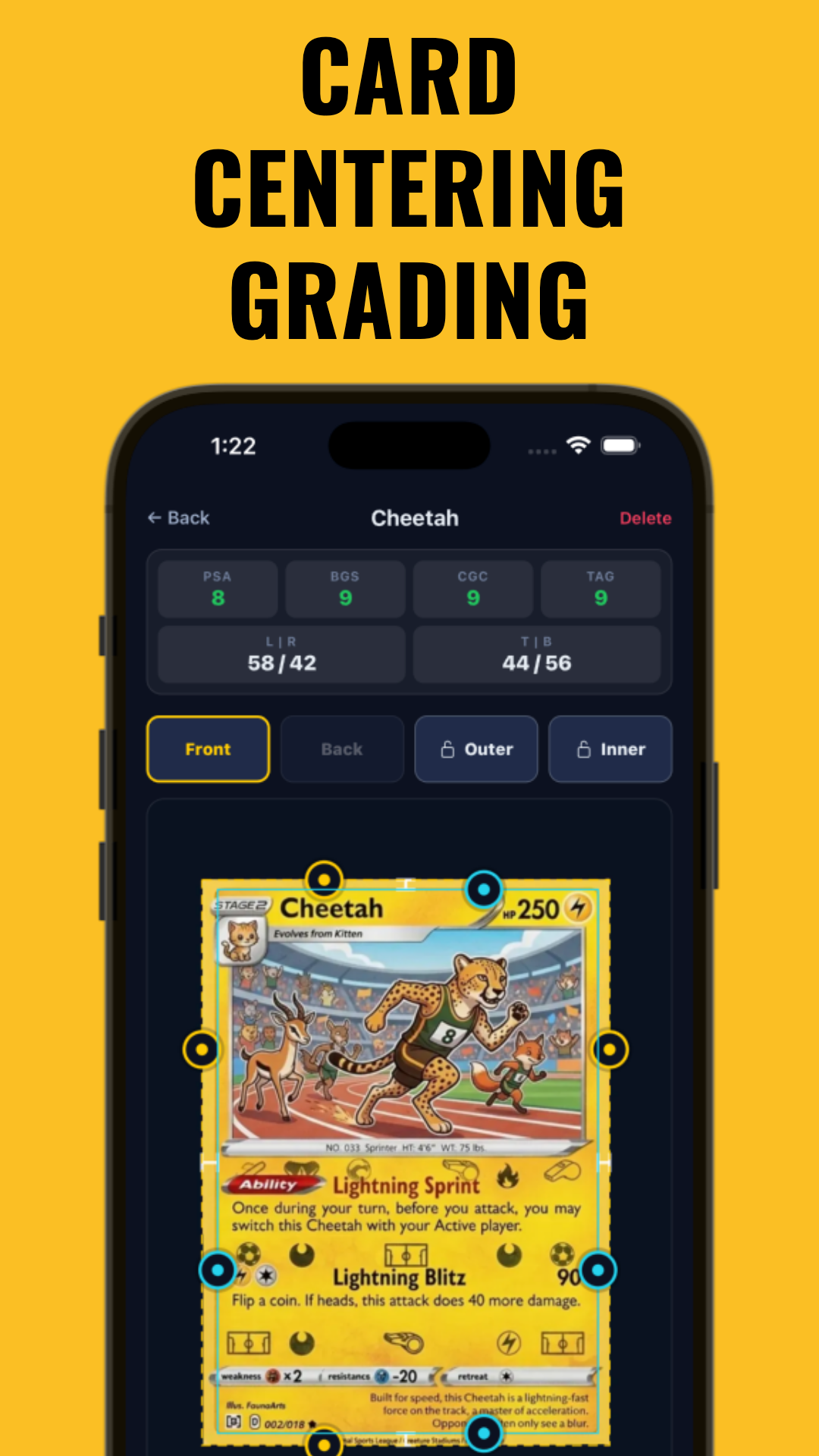
For a guide on how to measure manually (including step-by-step visuals), see How to Measure Card Centering: Step-by-Step Precision Guide.
Section 4: CGC 10 Centering Standards—Front and Back Ratios Explained
Front Centering Standards for CGC 10
- Gem Mint 10: Minimum 55/45 centering (both directions).
- Pristine 10: Minimum 52/48, ideally 50/50.
This means for Gem Mint 10, if the left border is 3.3 mm and the right is 2.7 mm on a 6 mm total width, you have 55/45 centering—just barely acceptable.
Back Centering Standards for CGC 10
- Gem Mint 10: Minimum 75/25 centering (either direction).
- Pristine 10: Minimum 60/40 centering (either direction).
Back centering is more forgiving, but a card with a border split worse than 75/25 cannot receive a CGC 10, no matter how perfect the front.
Interpreting Centering Ratios
- 50/50: Perfect centering; both borders equal.
- 55/45: Slightly off-center but within Gem Mint 10 range.
- 60/40: Would not qualify for Gem Mint 10 front, but is the Pristine 10 back minimum.
- 75/25: The loosest allowed for Gem Mint 10 back.
Practical Tips
Always measure both axes (horizontal and vertical). If either dimension falls outside the minimum, the card cannot earn a CGC 10. For a hands-on walkthrough, see Card Centering Tool: Accurate Card Grading Estimates.
Section 5: CGC 10 Centering vs PSA and BGS Standards
How CGC Compares to PSA and BGS
Understanding the differences between grading companies is important, especially for high-value submissions.
- PSA Gem Mint 10: Requires 55/45 or better on the front, 75/25 or better on the back—similar to CGC Gem Mint 10.
- BGS Gem Mint 9.5: Allows 60/40 or better on the front for a 10 subgrade, 75/25 on the back.
- BGS Pristine 10: Requires 50/50 to 55/45 on the front and 60/40 on the back.
Key Differences
The biggest distinction comes at the Pristine level. CGC Pristine 10's centering requirements are generally considered slightly stricter than BGS's, with a smaller margin for error (especially on the front).
- Both PSA and CGC allow the same for Gem Mint 10.
- CGC Pristine 10 demands a narrower centering window.
Why It Matters for Submission Strategy
Collectors seeking a "black label" or Pristine 10 should measure centering carefully before submitting. If your card is 54/46, it won't make Pristine 10 at CGC, but might at BGS. For pre-grading strategies, see Estimate Your Card: A Practical Guide Before Grading.
Section 6: Other Subgrades That Impact a CGC 10
The Four Subgrades: Centering, Corners, Edges, Surface
CGC evaluates cards using four subgrades:
- Centering
- Corners
- Edges
- Surface
A CGC 10 (Gem Mint or Pristine) generally requires every subgrade to be at or very near 10. If even one subgrade is lower, the overall grade drops accordingly.
Minimums for Each Subgrade
- Gem Mint 10: All subgrades must be 10, or three at 10 and one at 9.5 (no lower).
- Pristine 10: All four subgrades must be a perfect 10.
This means a card with perfect centering but a minor edge nick will not receive a Pristine 10.
Why Centering Can Be the Deciding Factor
Of all subgrades, centering is often misunderstood and can be difficult to judge by eye. It's also the subgrade that can most easily disqualify a card from a 10, even if corners, edges, and surface look flawless. For more on how centering affects value, see How Centering Impacts Card Value: A Detailed Guide.
Section 7: Real-World Centering Examples and Ratio Interpretation
Common Centering Scenarios
- Example 1: 54/46 front, 70/30 back—Eligible for Gem Mint 10, not Pristine 10.
- Example 2: 51/49 front, 62/38 back—Eligible for Pristine 10 (barely).
- Example 3: 58/42 front, 77/23 back—Not eligible for any CGC 10.
How to Calculate Ratios
Measure each border and add together for total width (or height). Divide each border's width by the total, then multiply by 100 to get percentage. For instance, left border 2.2 mm, right border 2.8 mm, total width 5 mm:
- Left: (2.2 / 5) × 100 = 44%
- Right: (2.8 / 5) × 100 = 56%
- Result: 56/44 centering
Visual Examples and Pitfalls
Sometimes a card can appear perfectly centered to the naked eye but fails the CGC 10 threshold when measured. Conversely, some cards with slightly uneven artwork but even borders may still qualify. For a more detailed, visual step-by-step, see How to Pre-Grade Your Card: A Step-by-Step Guide.
Section 8: Tools and Strategies for Measuring Centering Accurately
Digital Solutions for Precision
Manual measurement can be error-prone and time-consuming. Digital tools like Midpoint let collectors upload images and receive centering ratios to the decimal for both front and back—even before you spend money on grading fees. This can help avoid mistakes and help target cards most likely to achieve CGC 10.
- Upload a scan or photo
- Automatic border detection
- Immediate centering breakdown for PSA, BGS, CGC, TAG, and more
Manual Methods
For those who prefer analog methods, a digital caliper or millimeter ruler can work—but requires careful calculation and a steady hand. See How to Measure Card Centering: Step-by-Step Precision Guide for DIY tips.
Best Practices Before Submission
- Measure both axes (horizontal and vertical) on both front and back.
- Double-check your results using a digital tool to reduce human error.
- Consider only submitting cards that comfortably meet or exceed the CGC 10 thresholds.
Many collectors pre-screen their cards this way, maximizing their odds of a premium grade and higher resale value. For a look at how AI is transforming this process, check out How AI Transforms Card Centering Analysis.
Conclusion
CGC 10 centering standards are among the most exacting in the trading card industry. Achieving either a Gem Mint 10 or the even rarer Pristine 10 requires careful measurement and a clear understanding of the allowed front and back ratios. With centering so crucial to value and grade outcome, using a precise tool like Midpoint before submitting your cards can help save time and money. Take the time to measure, understand the standards, and submit only your best-centered cards to maximize your grading success.
FAQ
Q: What centering is needed for a CGC 10?
A: For a CGC Gem Mint 10, the front must be centered at least 55/45 and the back at least 75/25. For Pristine 10, front centering must be at least 52/48 (ideally 50/50) and back at least 60/40.
Q: What is the difference between CGC Gem Mint 10 and Pristine 10?
A: Gem Mint 10 allows slightly looser centering (55/45 front, 75/25 back) and permits one subgrade as low as 9.5. Pristine 10 requires tighter centering (52/48 front, 60/40 back) and all subgrades must be a perfect 10.
Q: Is CGC 10 centering 55/45 or 50/50?
A: For Gem Mint 10, 55/45 is acceptable. For Pristine 10, the standard is 52/48 or better—ideally 50/50.
Q: What centering is allowed on the back for a CGC 10?
A: The back must be at least 75/25 for Gem Mint 10, and at least 60/40 for Pristine 10.
Q: How does CGC centering compare to PSA 10 centering?
A: The CGC Gem Mint 10 centering standards are similar to PSA 10 (both require 55/45 or better on the front, 75/25 on the back). Pristine 10 is stricter than PSA's highest grade.
Q: Does CGC use subgrades for centering, corners, edges, and surface?
A: Yes, CGC uses four subgrades: centering, corners, edges, and surface. All must meet the required thresholds for Gem Mint or Pristine 10.
Free to start
Try the Midpoint app
Grade any card from a photo, see its raw and PSA 10 value, and track what your collection is worth — free.
Get it on iPhoneGet it on Android