Fifth Dawn MTG Cards Value: Price Guide & Grading Picks
Fifth Dawn MTG cards value explained: the most valuable cards, foil vs nonfoil, PSA 10 gem premiums, and which cards are worth grading.

Estimated reading time: 11 min
Key Takeaways
- Fifth Dawn MTG cards value is concentrated in a small group of artifact rares. Most of the 165 cards are cheap bulk.
- Demand from Commander, Modern-era artifact decks and combo players sets the price of the most valuable Fifth Dawn cards, not nostalgia alone.
- The gap between raw and a PSA 10 only pays off on cards with real raw demand and clean black-border condition.
- Centering, edge whitening and surface wear decide whether a 2004 black-border card is worth grading at all.
- Always check live comps. Prices in this guide are a snapshot as of 2026-10-30.
Card values — live data from Midpoint's card database, as of 2026-10-30. Prices move; Midpoint refreshes these daily.
| Card | Raw | PSA 10 | Gem premium | |
|---|---|---|---|---|
 |
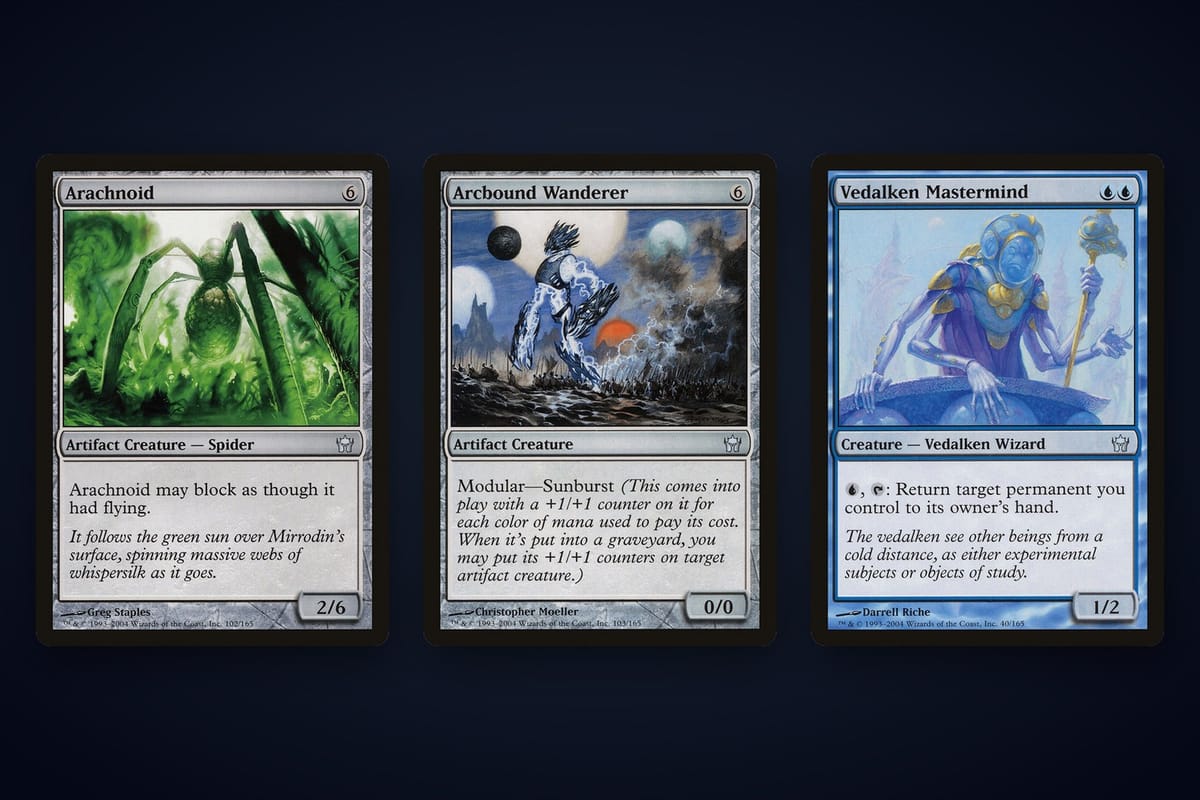
Arachnoid #102 Fifth Dawn (2004) |
$0.20 | — | — |
 |
Arcbound Wanderer #103 Fifth Dawn (2004) |
$0.32 | — | — |
 |
Vedalken Mastermind #40 Fifth Dawn (2004) |
$0.30 | — | — |
 |
Avarice Totem #104 Fifth Dawn (2004) |
$26.78 | — | — |
 |
Goblin Cannon #125 Fifth Dawn (2004) |
$0.24 | — | — |
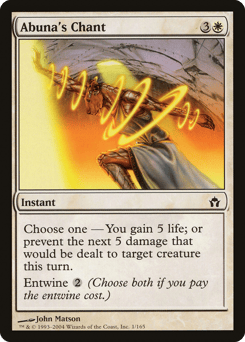 |
Abuna's Chant #1 Fifth Dawn (2004) |
$0.38 | — | — |
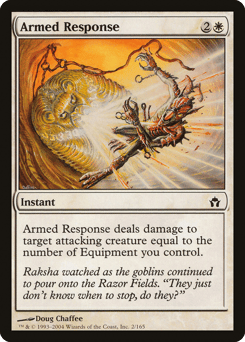 |
Armed Response #2 Fifth Dawn (2004) |
$0.37 | — | — |
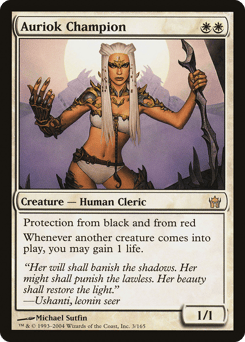 |
Auriok Champion #3 Fifth Dawn (2004) |
$72.74 | — | — |
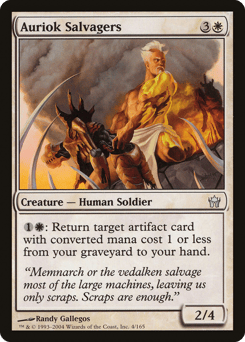 |
Auriok Salvagers #4 Fifth Dawn (2004) |
$25.67 | — | — |
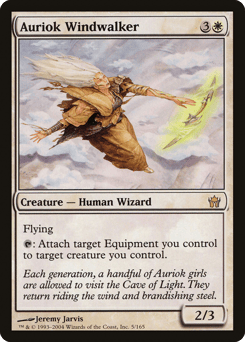 |
Auriok Windwalker #5 Fifth Dawn (2004) |
$0.53 | — | — |
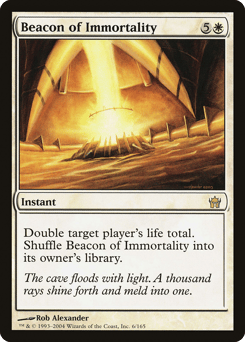 |
Beacon of Immortality #6 Fifth Dawn (2004) |
$149.69 | — | — |
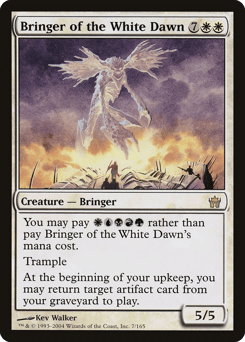 |
Bringer of the White Dawn #7 Fifth Dawn (2004) |
$1.75 | — | — |
Look up any card's current raw and graded value in Midpoint — and get an estimated grade before you pay to submit.
Table of Contents
- Section 1: Fifth Dawn MTG Cards Value at a Glance
- Section 2: The Most Valuable Fifth Dawn Cards
- Section 3: Fifth Dawn Price Guide by Rarity, Format and Reprints
- Section 4: Foils, Alternate Printings and Fifth Dawn PSA 10 Value
- Section 5: Fifth Dawn Cards Worth Grading
- Section 6: Condition, Authenticity and How to Identify Valuable Cards
- Section 7: Sealed Product, Selling Channels and Price Movement
- Conclusion
- FAQ
Section 1: Fifth Dawn MTG Cards Value at a Glance
Understanding Fifth Dawn MTG cards value starts with the set itself. Fifth Dawn released in 2004 as the closing set of the Mirrodin block. It has 165 cards, a heavy artifact theme, the sunburst mechanic and the black card border of that era.
That black border matters for pricing. It also matters for grading, as covered later.
How the set's value is distributed
Like most older sets, Fifth Dawn follows a steep curve. A handful of cards carry most of the total value, a middle tier trades for modest amounts, and the majority of commons and uncommons are bulk.
- Top tier: a few artifact rares that see constant Commander and eternal-format play.
- Middle tier: playable rares, popular uncommons and foils of useful cards.
- Bulk tier: most commons, filler creatures and cards with no modern deck.
How to read the data table in this guide
The table in this guide comes from Midpoint's own card database and is dated as of 2026-10-30. It is a point-in-time snapshot of raw and graded values. Use it to compare cards against each other, then verify against current sold listings before you buy, sell or submit anything.
When you scan any Fifth Dawn price guide, look at four things:
- Raw (ungraded) value for a near-mint copy.
- Graded value, especially PSA 10, compared with raw.
- Whether the price reflects a recent sale or an asking price.
- Whether the listing is the Fifth Dawn printing or a later reprint.
Why the set still matters
Artifacts are colorless, so they fit in nearly any deck. That is a big reason Fifth Dawn staples keep selling years later. A card that fits every Commander deck has a much larger buyer pool than one that needs a specific color or archetype.
If you are sorting a binder or a bulk box, a tool like Midpoint can look up raw versus graded values across 250,000+ cards, including Magic: The Gathering.
Section 2: The Most Valuable Fifth Dawn Cards
The most valuable Fifth Dawn cards are mostly artifacts with a clear job in a deck. Below are the names that dominate value discussions, plus the reason each one holds demand. I am deliberately not quoting prices here. Check the table in this guide or live listings for current figures.
The usual headline cards
- Mycosynth Golem: a colorless artifact creature that gives your artifact creature spells affinity for artifacts. It is a long-time favorite in artifact decks and is frequently named among the set's top cards.
- Crucible of Worlds: lets you play lands from the graveyard. It is a Commander staple and a land-recursion engine, so it sells consistently.
- Mindslaver: an artifact that lets you control an opponent's turn. It has a long-standing following among Commander and combo players.
- Engineered Explosives: a flexible sweeper for cheap permanents that has seen play in competitive formats.
- Vedalken Orrery: lets you cast spells as though they had flash. It fits Commander decks that want surprise plays.
- Plunge into Darkness: a flexible black instant with niche appeal to some combo-minded players.
- Grinding Station: a combo piece for artifact-based engines.
Why these cards hold value
Three things drive their prices:
- Colorless flexibility: most of these can go in any deck.
- Repeatable demand: Commander players keep buying copies for new decks.
- Scarcity of clean copies: 2004 black-border cards are hard to find in pristine condition.
Cards that sneak up on you
Some mid-tier cards climb when a combo is discovered or a deck archetype gets popular. Tooth and Nail, Mycosynth Lattice, Cranial Plating and Sword of Light and Shadow are examples of Fifth Dawn names that attract players. Whether they sit above or below the headliners on any given day depends on the data, so check the table rather than assuming a ranking.
Do not assume the cheapest-looking rare is bulk. Run each rare through a lookup before it goes into a $0.25 box.
Section 3: Fifth Dawn Price Guide by Rarity, Format and Reprints
A good Fifth Dawn price guide explains why a card costs what it does. For this set, rarity is only part of the answer. Format demand and reprint history often matter more.
Rarity versus playability
Rare does not automatically mean valuable. Plenty of Fifth Dawn rares are unplayed and priced like bulk. Meanwhile, a few uncommons or commons are worth chasing because players need them in specific builds.
- Rares: carry most of the value, but only the ones with a deck.
- Uncommons: usually cheap, with occasional outliers tied to combos.
- Commons: almost always bulk, though foils of playable commons can carry a premium.
How format demand moves prices
Commander is a major price driver for colorless artifacts. A card that fits thousands of decks has constant demand. Modern and other eternal formats can add spikes when a deck becomes competitive. Artifact combo decks, land-recursion strategies and cost-reduction engines each support their own set of Fifth Dawn staples.
Watch for these triggers:
- A new commander that rewards artifacts or lands in the graveyard.
- A banned or unbanned announcement in a competitive format.
- A popular content creator building around an older card.
Reprint impact
Reprints are a major risk to old-card prices. A reprint in a modern set can pull the price of the original down, though the 2004 original may hold a collector premium. Black-border originals appeal to players who want the classic look.
When you price a card, always confirm you are looking at the Fifth Dawn printing. The set symbol and collector number settle it, as covered below. If a card has been reprinted several times, expect the original to behave differently from the playable-copy price.
Section 4: Foils, Alternate Printings and Fifth Dawn PSA 10 Value
Foils and graded copies are where Fifth Dawn values get interesting. The Fifth Dawn PSA 10 value of a card can differ enormously from its raw price, and the gap changes by card.
Foil versus nonfoil
Foils from 2004 are older than the modern foil era, and condition matters a lot. Early foils can curl or warp, and black borders show wear quickly. A foil of a popular card often carries a premium over its nonfoil, but a foil of a bulk card is usually still bulk.
- Foil premiums are strongest on cards that already have real demand.
- Curling and clouding on older foils can reduce the premium.
- Check the foil and nonfoil lines in the data table separately.
Promos and alternate printings
Some cards also exist in promotional or later-set versions. Never compare a Fifth Dawn price to a different printing's price. Confirm the set symbol, treatment and collector number every time.
The gem-premium gap
The gem premium is the difference between a raw near-mint copy and a PSA 10. For many Fifth Dawn cards, this gap can look dramatic on paper. But a high PSA 10 price only matters if your copy can realistically earn that grade.
Compare these numbers for each card in the table:
- Raw price: what a clean ungraded copy sells for.
- PSA 9 and PSA 10: how steeply the price rises at the top.
- Grading cost: fees and shipping vary by service level, but can easily reach $30 or more per card, so the premium has to clear that with room to spare.
For a deeper look at how top grades differ between companies, read grading scale differences by company. A PSA 10, BGS 10 and CGC 10 are not interchangeable in the market.
Section 5: Fifth Dawn Cards Worth Grading
Not every valuable card is a good grading candidate. The Fifth Dawn cards worth grading are those where a high grade adds meaningful value over a raw copy, and where your specific card has a realistic shot at it.
A simple decision framework
- Step 1: Look up raw and PSA 10 values in the table.
- Step 2: Subtract grading fees and shipping from the premium.
- Step 3: Inspect your copy for centering, corners, edges and surface.
- Step 4: Estimate the likely grade, not the best-case grade.
- Step 5: Submit only if the expected return beats the cost.
Why black borders are tough
Black-border cards show every edge nick as white. Even a card pulled and sleeved in 2004 may have tiny whitening along the edges. Centering on early-2000s Magic is also inconsistent, so many copies lose points before anyone looks at the surface.
This is exactly why measuring first pays off. Centering has a direct effect on card value, and a poorly centered card can fall a full grade or more.
Pre-grade before you pay
Before you submit, run a pre-grade. Midpoint measures centering to the millimeter and returns an estimated PSA, BGS, CGC and TAG grade from centering, corners, edges and surface.
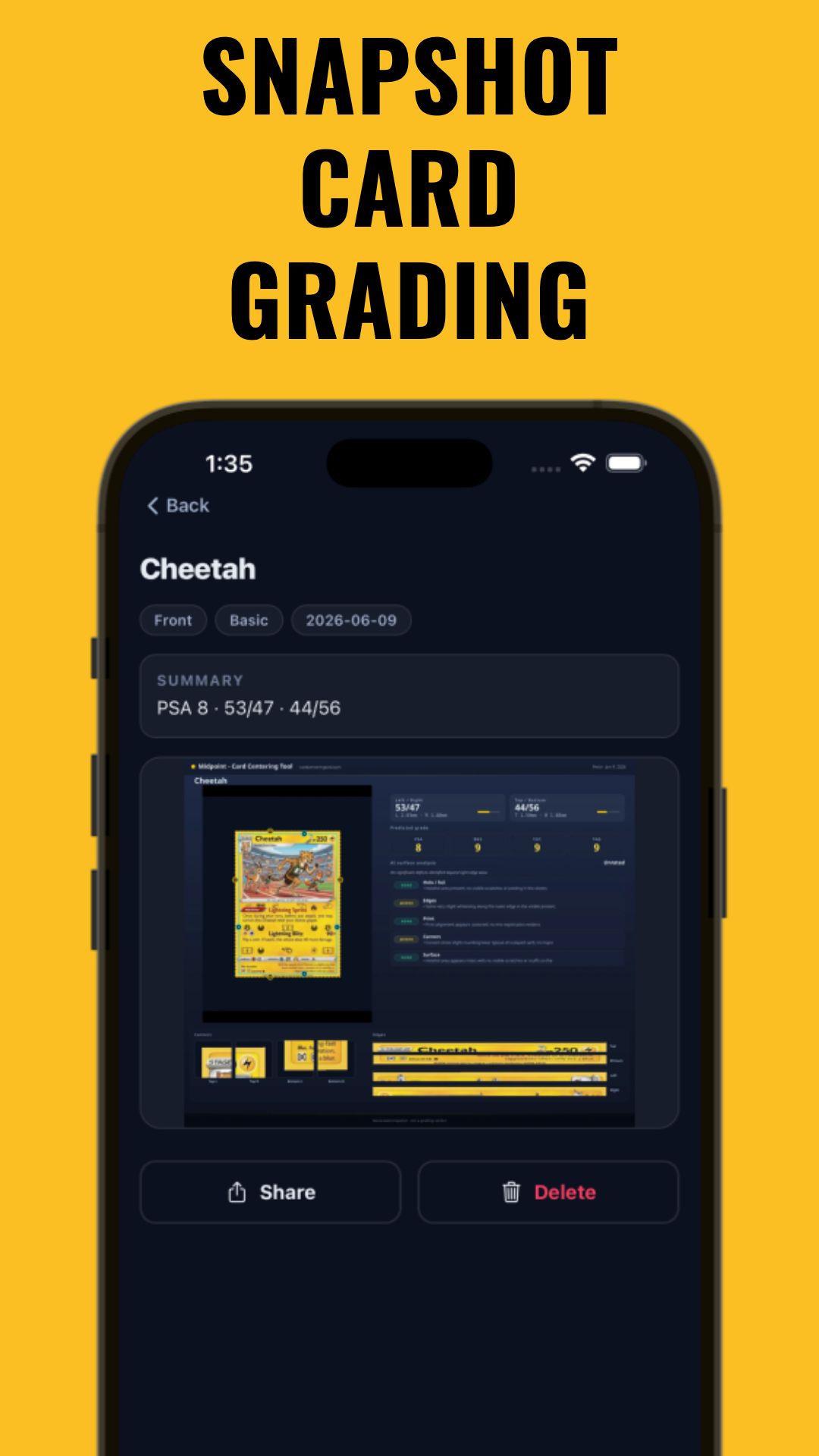
For a manual walkthrough, follow this step-by-step guide to pre-grading your card. If your estimate lands well below a 10, you may be better off selling raw.
Section 6: Condition, Authenticity and How to Identify Valuable Cards
Condition is the biggest price lever after the card itself. Identification and authenticity come next, because mistakes there are expensive.
Price by condition
The same card can sell at very different prices depending on condition:
- Near mint: the reference price in most guides.
- Lightly played and moderately played: typically discounted, with edge whitening as the main culprit on black borders.
- Heavily played and damaged: sold at a steep discount, mostly to players who just want a copy for a deck.
- Professionally graded: priced by the grade on the slab, with the biggest premium at the top.
Be honest when grading condition yourself. Buyers compare your photos against the listing, and disputes eat into profit.
Identify the set and number
To confirm a card is Fifth Dawn:
- Check the set symbol next to the type line.
- Look at the collector number at the bottom of the card. It should fall within the 165-card set.
- Confirm the black border and the copyright year in the fine print.
- Note whether the card is foil by tilting it under light.
Spotting fakes
Counterfeits target valuable older cards. Compare suspect cards side by side with a known real one.
- Check font weight, spacing and the symbol shape.
- Look at the card back for color and pattern differences.
- Feel the stock. Real cards usually have a consistent, slightly stiff snap.
- Be suspicious of prices far below the market.
If a high-value card is in doubt, professional grading also doubles as authentication. Once verified, protect it. Proper storage keeps edges and surfaces from degrading further.
Section 7: Sealed Product, Selling Channels and Price Movement
Singles are only part of the Fifth Dawn picture. Sealed product, selling venues and price timing all affect what you actually take home.
Sealed product
Fifth Dawn sealed product includes booster packs and booster boxes, and may include other products such as theme decks. Sealed prices depend on the product type and on whether the seal is verifiably original. Be careful, because resealed product is a known risk for older sets.
- Booster boxes and packs: priced largely on collectibility and sealed scarcity.
- Theme decks: usually cheaper, with value tied to the cards inside and the box condition.
- Expected value: opening packs rarely beats the sealed price, because most pulls are bulk.
Where to sell
Each channel prices differently:
- TCGplayer: a large marketplace with market-price references, good for mid-value singles.
- eBay: strong for graded cards and unusual items, but fees and shipping apply.
- Buylists: fast and convenient, but they pay a fraction of market price.
- Local game stores and shows: useful for quick sales and bundled deals.
Market price on a marketplace is not the same as what a buylist pays, and listed prices are not the same as sold prices. Always compare sold listings.
Price movement and updates
Prices on aggregators update frequently, but individual cards can sit stale if few copies sell. Look at recent sales and trends rather than a single number. Reprints, ban changes and new commanders are the usual causes of movement.
If you hold several cards, Midpoint's portfolio tracking shows how your collection's value shifts over time, so you can sell into strength.
Conclusion
Fifth Dawn MTG cards value comes down to a few dependable artifact staples, steady Commander demand and the condition of 2004 black-border cards. The most valuable Fifth Dawn cards, such as Mycosynth Golem, Crucible of Worlds, Mindslaver, Engineered Explosives, Vedalken Orrery, Plunge into Darkness and Grinding Station, earn their spots through playability and scarcity of clean copies.
Before you grade, compare raw and graded values from the table (as of 2026-10-30), measure centering, inspect the edges and estimate a realistic grade. Submit only when the premium clearly beats the cost. Midpoint can help with the lookup, the centering measurement and the pre-grade estimate, so you know what you have before you spend $30 or more on a submission.
FAQ
Q: What is the most valuable card in Fifth Dawn?
A: It depends on the day and the printing, but the usual contenders are Mycosynth Golem, Crucible of Worlds, Mindslaver, Engineered Explosives and Vedalken Orrery. Check the table in this guide and current sold listings for the live ranking.
Q: How much is a complete Fifth Dawn card set worth?
A: A complete 165-card set's value is dominated by a small number of rares, with the rest being bulk. Add up the individual card values in the price table for your condition, and expect foil sets and graded sets to be priced differently.
Q: What Fifth Dawn cards are worth money?
A: Mostly artifact rares with Commander or competitive demand, such as Crucible of Worlds, Mycosynth Golem and Mindslaver. Foils of playable cards can also carry a premium. Most commons and uncommons are bulk.
Q: Are Fifth Dawn foil cards worth more than regular cards?
A: Often yes for cards with real demand, but not always. Foils of bulk cards usually remain cheap, and older foils can curl, which reduces the premium. Compare the foil and nonfoil lines for each card.
Q: How much is a Fifth Dawn booster box or theme deck worth?
A: Sealed values depend on product type, condition and whether the seal is verifiably original. Check recent sold listings, and be cautious of resealed product. Opening packs rarely beats the sealed price.
Q: How do I check the value of my Fifth Dawn Magic cards?
A: Identify the set symbol and collector number, note foil status and condition, then compare against recent sold listings and a price database. Midpoint's card lookup shows raw versus graded values, and its pre-grade estimate helps you decide whether grading is worthwhile.
Free to start
Try the Midpoint app
Grade any card from a photo, see its raw and PSA 10 value, and track what your collection is worth — free.
Get it on iPhoneGet it on Android