Grading Standards for Thick Cards: The Ultimate Comparison Guide
Explore grading standards for thick cards, centering, and top grades like Gem Mint vs Pristine. Learn how PSA, BGS, and CGC handle thick card grading.

Estimated reading time: 15 min
Key Takeaways
- Thick card grading follows unique standards for centering, edges, corners, and surface compared to standard cards.
- Grading companies like PSA, BGS, and CGC have subtle but crucial differences, especially in how they handle thick cards and award top grades (Gem Mint vs Pristine).
- Card thickness is measured in points (pt), and knowing your card's thickness helps select the right holder, sleeve, and understand grading risks.
- Common thick card flaws include corner whitening, edge chipping, and surface scratches, which can impact grades more than on standard cards.
- Careful pre-grading inspection and proper protection are important for maximizing the grade of thick, premium, or memorabilia cards.
Table of Contents
- Section 1: What Are Thick Cards? Definitions and Types
- Section 2: Measuring Card Thickness in Points (pt)
- Section 3: Grading Standards for Thick Cards by Company
- Section 4: Centering Criteria and Tolerances for Thick Cards
- Section 5: Common Defects and Grading Challenges in Thick Cards
- Section 6: Pre-Grading, Protection, and Submission Tips
- Section 7: Value Impact and Top Grade Comparisons
- Section 8: Tools and Resources for Thick Card Grading
- Conclusion
- FAQ
Section 1: What Are Thick Cards? Definitions and Types
Understanding Card Thickness
When discussing grading standards for thick cards, it’s essential to define what makes a card “thick.” In the trading card hobby, “thick cards” (sometimes called oversized or premium cards) generally refer to cards that are substantially thicker than the standard 35pt card stock. While regular cards are about 0.012 inches (0.3mm) thick, thick cards may range from 55pt up to 360pt or more.
Typical Examples of Thick Cards
- Patch and memorabilia cards: Feature embedded jersey, bat, or other material swatches, often in sports products.
- Autograph cards: Especially when designed with a built-in window or frame for the signature.
- Premium sets: High-end products like National Treasures or Immaculate, where most cards are thick by default.
- Booklet cards: Cards that fold open, containing multiple panels or materials.
Thick cards are popular because they tend to be lower print, feature game-used memorabilia, or offer a premium feel. However, their size introduces unique challenges for grading, storage, and display.
How Thick is “Thick”?
Generally, any card thicker than 55pt is considered thick for grading purposes. Some graders have special procedures starting at 75pt or 100pt thickness. The exact threshold varies by company and slab type, but the higher the point (pt) value, the thicker and usually more valuable the card.
Section 2: Measuring Card Thickness in Points (pt)
What is a Point (pt) in Card Thickness?
The "point" (pt) system is the standard method for measuring trading card thickness. One point equals 1/1000th of an inch (0.001"). Thus, a 35pt card is 0.035 inches thick, while a 130pt card is 0.13 inches thick.
How to Measure Card Thickness
- Calipers: A digital caliper provides the most accurate measurement, especially for rare or valuable cards.
- Manufacturer guides: Many card companies publish thickness specs for each set. For example, Panini National Treasures cards are usually 130pt or 180pt.
- Sleeve and holder fit: Test-fitting the card into various sleeves or toploaders designed for known pt sizes offers a quick estimate.
It’s important to know your card’s thickness before grading so you can select the correct submission options and packaging materials, since grading companies may reject cards submitted in the wrong holders.
Why Thickness Matters in Grading
Grading standards for thick cards are influenced by the card’s physical properties. Thicker cards are heavier, less flexible, and more prone to certain types of damage. This affects how graders assess corners, edges, and surfaces in addition to centering. Understanding your card’s pt rating is crucial to anticipating grading outcomes and selecting the right supplies.
Section 3: Grading Standards for Thick Cards by Company
PSA, BGS, CGC: The Big Three
When it comes to thick card grading, the three dominant companies—PSA, BGS (Beckett Grading Services), and CGC (Certified Guaranty Company)—each have their own nuances. Their core grading criteria remain the same: centering, corners, edges, and surface. However, the way these standards are applied to thick cards can differ, especially at the highest grade levels.
- PSA: Accepts thick cards up to 360pt. Graders are aware of increased vulnerability on corners and edges, but the standards for Gem Mint 10 and Mint 9 remain strict. Some leniency may be acknowledged for certain manufacturer flaws, but not for post-production damage.
- BGS: BGS slabs cards up to 360pt and is known for explicit subgrades, including separate scores for centering, corners, edges, and surface. The BGS Black Label 10 is considered a very difficult grade, requiring 10 subgrades in all four categories—even on thick cards.
- CGC: Originally known for comics, CGC now grades trading cards and has quickly gained respect. CGC Pristine 10 (and the even harder CGC Perfect 10) require near-flawless cards, with centering and surface scrutinized closely, even for thick or premium stock.
Top Grade Comparisons: Gem Mint vs Pristine
- PSA 10 (Gem Mint) vs PSA 9 (Mint): PSA 10 demands sharp corners, clean surfaces, and strict centering. Any slight flaw usually drops a thick card to PSA 9.
- BGS Black Label vs Gold Label: Black Label requires 10 subgrades in all areas—extremely rare for thick cards. Gold Label allows a single 9.5 subgrade.
- CGC Pristine 10 vs Gem Mint 10: Pristine 10 is harder to achieve, requiring better centering and perfect surfaces, while Gem Mint 10 allows minor manufacturing flaws.
To dive deeper into the differences among grading scales and the true meaning of top grades, see this detailed grading scale comparison guide.
Which Grade Is Hardest to Get?
For thick cards, the BGS Black Label 10 and CGC Pristine 10 are generally considered among the rarest, as the physical properties of thick cards make it very difficult to avoid all minor flaws. PSA 10 is also tough, but may be somewhat more attainable. Collectors seeking perfection should be prepared for lower gem rates on thick stock.
Section 4: Centering Criteria and Tolerances for Thick Cards
Why Centering is Critical
Centering—the alignment of the card’s printed area versus its edges—is one of the most visible and quantifiable grading criteria. For thick cards, poor centering is often a factory issue, not the result of handling, but it still impacts grade as much or more than on standard cards.
Standard Centering Tolerances
- PSA: For a Gem Mint 10, front centering must be at least 55/45 or better; back centering can be as off as 75/25.
- BGS: Black Label requires 50/50 perfect centering; Gold Label allows 55/45 or better.
- CGC: Pristine 10 expects 50/50 to 55/45 front centering; back tolerance is slightly looser, but still critical.
Thick cards are not generally given extra leeway—if anything, graders may scrutinize them more closely because off-centering is so common. For an in-depth look at how centering impacts value, see this guide to centering and card value.
Measuring Centering on Thick Cards
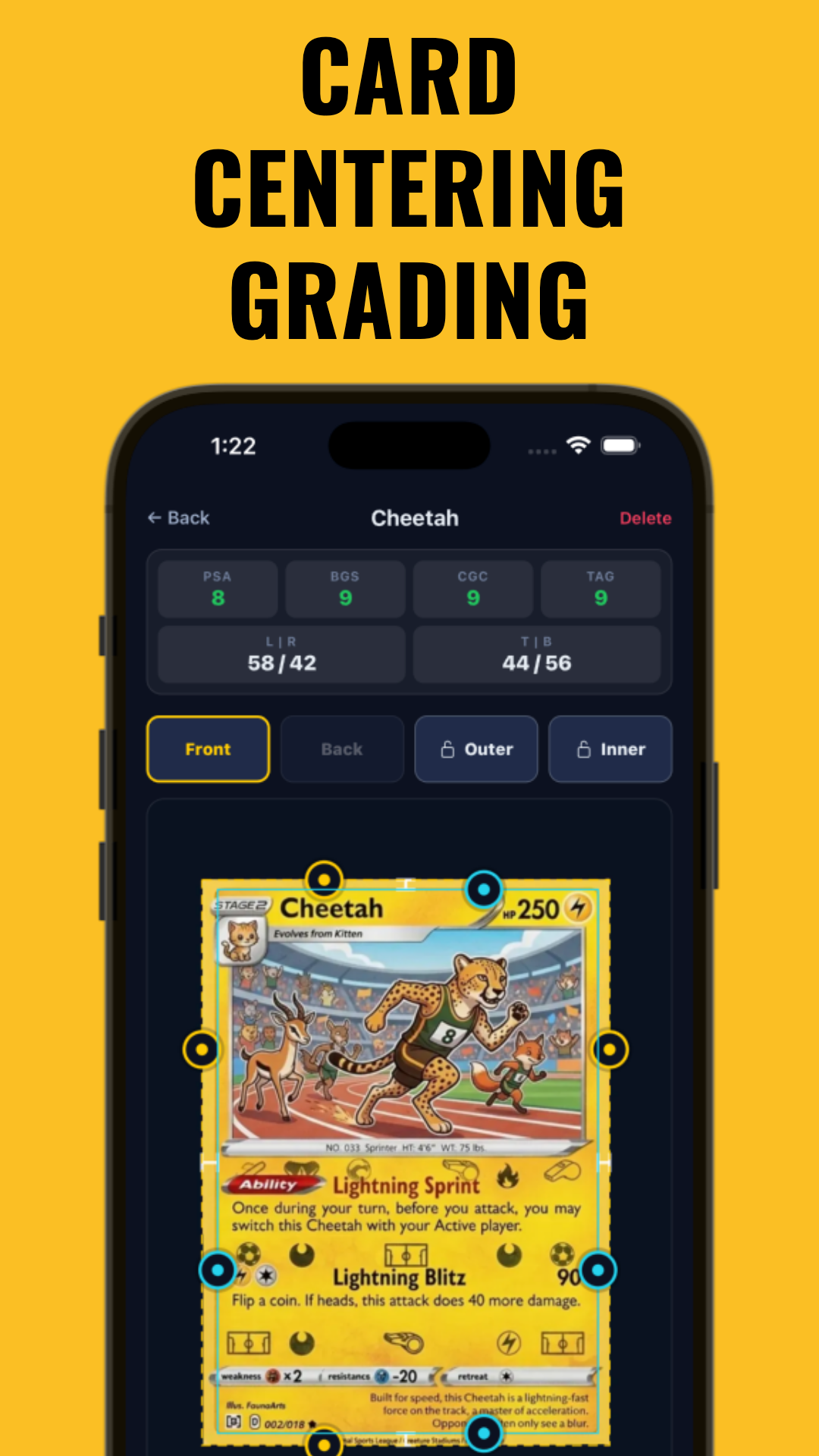
Because thick cards often have layered or framed borders, measuring centering by eye is tricky. Tools like Midpoint allow collectors to measure centering down to the millimeter, providing instant estimates for PSA, BGS, CGC, and TAG standards. This helps avoid costly grading fees on cards unlikely to earn a top grade.
Section 5: Common Defects and Grading Challenges in Thick Cards
Why Thick Cards Are Vulnerable
Thick cards are more susceptible to specific types of flaws, both from the factory and during handling. Their rigidity and exposed corners make them harder to keep in pristine condition compared to standard cards.
Most Common Flaws in Thick Cards
- Corner whitening: The sheer thickness exposes more surface area at each corner, and the layering can split or flake easily.
- Edge chipping: Especially common on foil or layered edge designs; even minor contact can cause visible chips.
- Surface scratching: Premium finishes or embedded materials are easily scuffed, sometimes even inside packs.
- Bending and warping: The weight and construction of thick cards make them more prone to bowing over time.
Grading Difficulty vs Standard Cards
Do thick cards grade harder than standard cards? In practice, thick cards often have a higher frequency of minor flaws, which can make pristine grades (BGS Black Label, CGC Pristine 10) extremely rare. Even PSA 10s are less common for thick or memorabilia cards than for standard base cards. Manufacturers may struggle to produce thick cards to the same tolerances as thin cards, and graders may be less likely to overlook minor flaws, especially on high-value cards.
Section 6: Pre-Grading, Protection, and Submission Tips
Pre-Grading Inspection Steps
- Use a magnifier and strong light to check for edge/corner defects and surface scratches on both front and back.
- Measure centering precisely using a digital tool or ruler—Midpoint’s Free Centering Calculator can help estimate likely grades before you submit.
- Check for bowing or warping by laying the card flat on a clean surface.
For a full pre-grading workflow, see this step-by-step pre-grading guide.
Packaging Thick Cards for Grading
- Sleeves: Use thick card sleeves (available in 55pt, 75pt, 130pt, 180pt, etc.) for a snug but not tight fit.
- Toploaders: Match the toploader pt size to the card’s thickness to avoid edge/corner damage.
- Card savers: Many grading companies require semi-rigid holders (e.g., Card Saver IV for 130pt+ cards).
Never force a thick card into a standard sleeve or holder—cracking, chipping, or whitening will almost certainly result. Always use new, clean supplies to prevent debris or surface scratches.
Submission Notes
On the submission form, clearly indicate if your card is thick, and select the appropriate service (some companies charge more for oversized items). Use extra padding and sturdy mailers to prevent shifting in transit, as even minor impacts can lower your card’s potential grade.
Section 7: Value Impact and Top Grade Comparisons
How Grading Affects Thick Card Value
Thick cards—especially low-numbered, autographed, or memorabilia cards—can see significant value increases with a high grade. However, Gem Mint or Pristine grades are much rarer for thick cards, making them even more desirable and valuable when they do occur.
- PSA 10 vs PSA 9: The gap in value between a PSA 10 and PSA 9 on thick cards can be wider than on standard cards due to their scarcity.
- BGS 10 vs BGS 9.5: The Black Label premium is highest for thick, high-end cards, but such grades are very rare and sales data is limited.
- CGC Pristine 10 vs Gem Mint 10: Pristine thick cards command top dollar but are exceptionally rare.
For an analysis of how grades impact insurance or resale value, see this insurance value guide.
Population Reports and Grade Rarity
Reviewing pop reports from PSA, BGS, and CGC shows that thick cards tend to have lower Gem Mint and Pristine percentages compared to standard cards. For example, it is uncommon for a significant percentage of a thick memorabilia card’s submissions to earn a PSA 10 or BGS Black Label, though exact percentages vary by set and year.
Choosing the Right Grader for Thick Cards
If your goal is maximum resale value, PSA slabs tend to command the highest prices overall, but BGS and CGC are preferred by some collectors for their detail and subgrades. For thick cards, the "toughest" grade is often considered to be the BGS Black Label, followed by CGC Pristine 10, with PSA 10 being the gold standard for many collectors.
Section 8: Tools and Resources for Thick Card Grading
Digital Tools for Centering and Inspection
- Midpoint: Instantly measures card centering for all major grading standards, minimizing risk before you submit expensive thick cards.
- Accurate grading estimate guides help you understand what to expect from your submission.
- Calipers, magnifiers, and high-quality sleeves/toploaders are must-have physical tools for thick card collectors.
Educational Resources
- How AI transforms centering analysis: Technology is making pre-grading more accurate for thick and standard cards alike.
- Manufacturer checklists and forums: Find thickness specs and collector feedback for specific sets or parallels.
Staying Informed
Follow grading company updates—PSA, BGS, and CGC occasionally revise their standards or expand their thick card capabilities. Pop reports and collector forums are valuable for tracking which grades are truly rare for your card type.
Conclusion
Grading standards for thick cards involve more complexity and stricter requirements than most collectors realize. Understanding how PSA, BGS, and CGC apply their criteria—especially on centering, corners, edges, and surface—can mean the difference between a valuable Pristine or Gem Mint grade and a lower grade. Measuring centering with a tool like Midpoint before submitting can help save money and maximize your thick card’s potential. With the right knowledge, protection, and preparation, even the thickest patch or memorabilia cards can achieve their highest possible grade.
FAQ
Q: What is considered a thick card in trading card grading?
A: Any card thicker than standard 35pt stock is considered thick. Most grading companies begin treating cards as thick or oversized at 55pt or higher, with special holders and procedures starting at 75pt or 100pt.
Q: Do thick cards grade harder than standard cards?
A: Thick cards are more prone to corner whitening, edge chipping, and surface flaws, making Gem Mint or Pristine grades less common compared to standard cards.
Q: How do you measure card thickness in points (pt)?
A: One point equals 0.001 inch. Use a digital caliper to measure card thickness and compare it to sleeve and toploader sizes (e.g., 55pt, 130pt, 180pt).
Q: What centering is acceptable for thick cards when grading?
A: PSA 10 requires 55/45 or better centering on the front. BGS Black Label and CGC Pristine 10 demand near-perfect 50/50 centering; back tolerances are slightly looser but still matter.
Q: What are the most common flaws that lower grades on thick cards?
A: Corner whitening, edge chipping, surface scratches, and bending/warping are among the most frequent issues that result in lower grades for thick cards.
Q: What size sleeves or holders do thick cards need before grading?
A: Use sleeves and toploaders or semi-rigid holders specifically labeled for your card’s point size (e.g., 130pt sleeve/toploader for a 130pt card). Never force a thick card into a standard holder.
Free to start
Try the Midpoint app
Grade any card from a photo, see its raw and PSA 10 value, and track what your collection is worth — free.
Get it on iPhoneGet it on Android