How to Interpret Half Point Card Grades: The Complete How-To Guide
Learn how to interpret half point card grades, compare PSA, BGS, CGC grading scales, and understand what separates Gem Mint, Pristine, and Black Label cards.


Estimated reading time: 10 min
Key Takeaways
- Half point grades like PSA 8.5 or 7.5 recognize cards that exceed the typical whole-number standard but don’t reach the next grade up.
- Not all grades can receive a half-point; most notably, there’s no PSA 9.5, while BGS and CGC use half grades above '9'.
- Centering is important—often a deciding factor for half-point eligibility, alongside corners, edges, and surface.
- Understanding differences between Gem Mint, Pristine, and Black Label grades is useful for collectors and investors.
- Tools like Midpoint can help you measure centering for accurate pre-grading.
Knowing how to interpret half point card grades is helpful for any collector, investor, or hobbyist navigating modern trading card grading. Half-point grades, such as PSA 8.5 or BGS 9.5, can spark confusion—especially when comparing grading scales like PSA vs BGS vs CGC and trying to understand what separates a Gem Mint from a Pristine or Black Label card. In this guide, you’ll learn what half-point grades mean, which cards qualify, how centering impacts eligibility, and how to compare the top grades across companies. Whether you’re prepping a card for submission or evaluating a slab, this is a resource to help you understand the process.
Step 1: Understand What Half Point Card Grades Mean
Half-point card grades (like PSA 8.5 or BGS 9.5) indicate a card that stands out within its grade bracket but doesn’t quite reach the full next grade. These are not "average" grades, but rather examples at the upper end of a grade’s standards. For example, a PSA 8.5 is not just halfway between PSA 8 and PSA 9—it’s a card that is almost PSA 9 quality, usually with one minor flaw holding it back.
Key points about half-point grades:
- PSA awards half-point grades for 1.5, 2.5, 3.5, up to 8.5—but not 9.5. There is no PSA 9.5.
- BGS and CGC use half grades through the entire scale, including BGS 9.5 Gem Mint and CGC 9.5 Gem Mint.
- A half-point grade signals a card that is better than average for its whole-grade bracket, but not quite perfect enough for the next step up.
Step 2: Learn Which Grades Can Receive Half Points (and Why No PSA 9.5)
Not all grades are eligible for half-point bumps. PSA, a widely recognized grading company, only issues half-point grades up to PSA 8.5. There is no PSA 9.5—making the 9 vs 10 gap particularly important. BGS and CGC, on the other hand, offer half grades up to and including 9.5, and even finer increments for subgrades.
- PSA: Half grades appear as 1.5, 2.5, ..., 8.5. No 9.5 exists.
- BGS: Half grades exist at every level, with BGS 9.5 Gem Mint and the BGS 10 Pristine. Subgrades for centering, corners, edges, and surface are used.
- CGC: Similar to BGS, offers half-points through the scale, including CGC 9.5 Gem Mint and Pristine 10.
This means the jump from PSA 9 to PSA 10 is the largest and most valuable, as there is no "midpoint" grade. To see a detailed breakdown of grading scale differences, check out Grading Scale Differences by Company: PSA, BGS, CGC & the True Meaning of Top Grades.
Step 3: Recognize Why a Half-Point Grade Means an Exceptional Example
Receiving a half-point grade is generally a mark of distinction, not mediocrity. For example, a PSA 8.5 is an example of a PSA 8 that meets or exceeds most criteria for the next grade, but falls short in one area—often centering, but sometimes corners, edges, or surface.
Common reasons for a half-point bump:
- Card is strong in all areas except for one minor flaw (e.g., slightly off-center, but good corners and surface).
- No qualifying flaws (creases, stains, major wear) are present.
- The card "presents" at a higher level than the base grade allows.
Step 4: Evaluate How Centering and Visual Attributes Affect Half-Point Eligibility
Centering is often an important factor for a card getting a half-point bump. For most grading companies, centering is measured as the ratio of border widths, and even a few millimeters off can mean the difference between a regular grade and a half-point.
For example, to earn a PSA 8.5, a card might be nearly perfect in corners, edges, and surface, but just outside the centering tolerance for a PSA 9. Using a card-centering tool like Midpoint can help you measure centering—so you know if your card is in half-point territory before you submit.
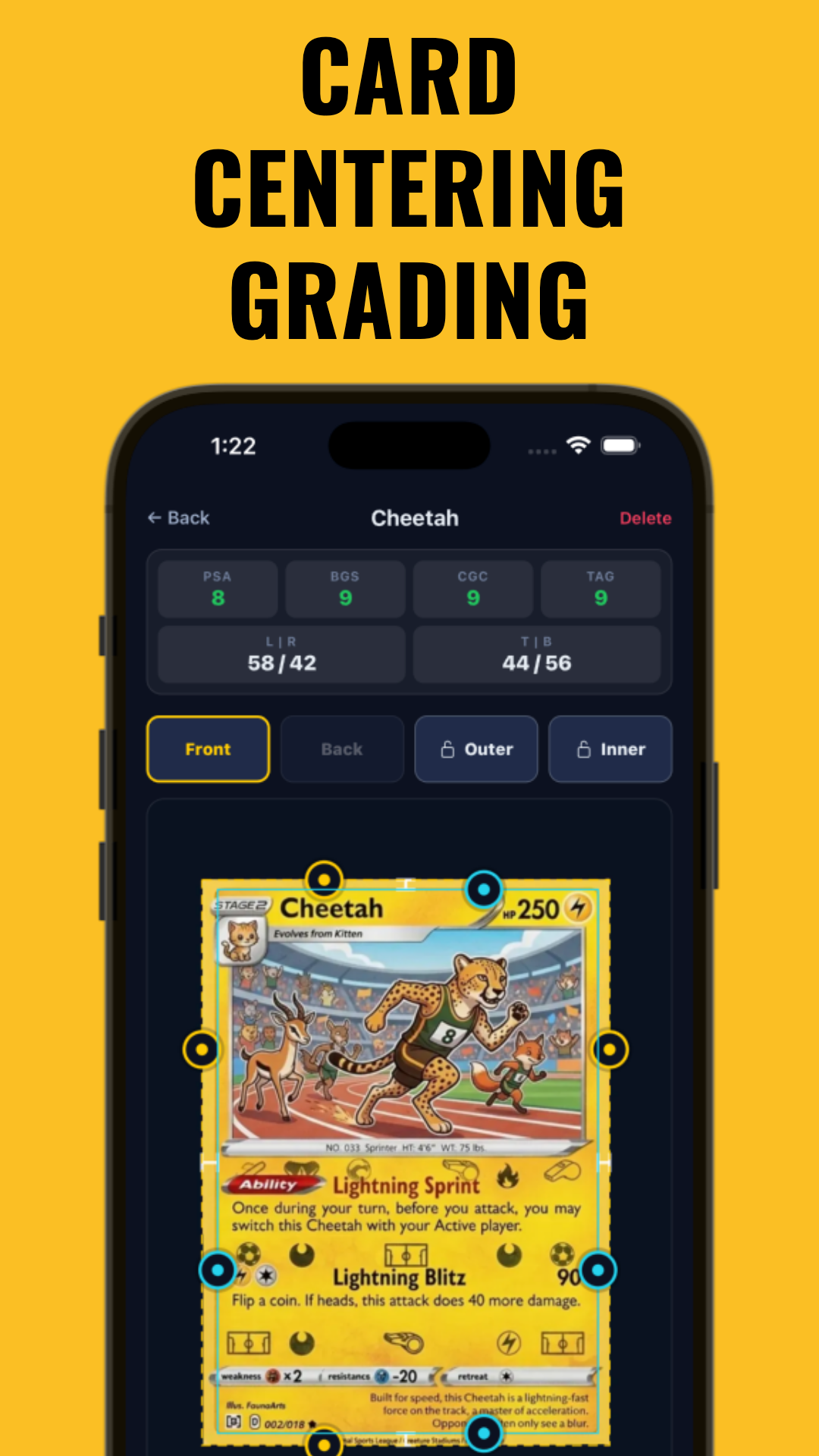
Learn more about how centering impacts card value and grading in How Centering Impacts Card Value: A Detailed Guide.
- Other attributes: Corners, edges, and surface must all meet the minimum for the next highest grade to be eligible for a half-point bump. Any major flaw or qualifier (like "OC" for off-center) disqualifies the card.
Step 5: Know Which Flaws Disqualify a Card From a Half-Point Grade
For a card to earn a half-point grade, it must not have major flaws or qualifiers. This means:
- No creases, stains, or significant print defects.
- No writing, marks, or residue.
- No qualifiers (like "OC" for off-center, or "ST" for stains) on the label.
Half-point grades are reserved for cards in strong condition relative to their bracket. If a card has a single, minor flaw—usually in centering—it may be eligible for a half-point bump. But major flaws will generally drop it to the base whole number grade or lower.
Step 6: Compare How Half-Point Grades Affect Card Value
The value impact of half-point grades varies by company and grade level. In general:
- PSA 8.5 vs PSA 8: PSA 8.5 usually commands a premium over PSA 8, but still falls short of PSA 9 prices.
- PSA 9 vs PSA 10: The largest value jump in PSA’s scale—because there is no 9.5, PSA 10s are less common and more valuable.
- BGS 9.5 Gem Mint: BGS 9.5 is highly sought after, sometimes considered equivalent to PSA 10 in the market, but BGS 10 Pristine or Black Label cards can command a larger premium.
- CGC 9.5 Gem Mint: Similar to BGS, CGC 9.5 is a top grade, but CGC Pristine 10 is even rarer.
To learn how grading affects insurance, see Card Grade Impact on Insurance Value: The Ultimate Guide.
Step 7: Compare PSA, BGS, and CGC Half Grades and Top Grades
The top grades across companies are not all equal. Here’s how they break down:
- PSA 10 vs BGS 10: PSA 10 is Gem Mint; BGS 10 is Pristine and generally considered harder to get.
- BGS Black Label: Requires four perfect 10 subgrades (centering, corners, edges, surface). Considered rarer and more valuable than Gold Label (Pristine 10 with at least one 9.5 subgrade).
- CGC Pristine 10 vs Gem Mint 10: Pristine 10 is a higher standard than Gem Mint 10 and is less common.
- Which grade is hardest to get? BGS Black Label 10 and CGC Pristine 10 are generally considered among the toughest, due to their strict grading on all subcategories.
- For a full comparison, read Grading Scale Differences by Company.
Centering is a decisive factor in all these top grades—often the difference between a regular Gem Mint and a Pristine or Black Label card. You can use the Free Centering Calculator from Midpoint to check your card’s centering before submission.
Step 8: Interpret Slab Labels and the Practical Meaning of Half Grades
When you see a slabbed card with a half-point grade, interpret it as a card that stands out within its grade—often one step away from a value jump. For example, PSA 8.5 is generally closer in quality to PSA 9 than PSA 8.
For collectors and investors:
- Half-point grades can be a "sweet spot" for value—better quality than the baseline, but not as expensive as the next grade up.
- Cards with a half-point grade but good eye appeal are sometimes considered smart buys, especially in older or low-population issues.
For a step-by-step on pre-grading your own cards, see How to Pre-Grade Your Card: A Step-by-Step Guide.
Tips & Common Mistakes
- Don’t assume a half-point grade means "average"—it’s usually better than most cards at that grade level.
- Check centering with a precise tool like Midpoint before submitting for grading.
- Remember that PSA does not issue 9.5 grades—so the gap between PSA 9 and 10 is the most valuable jump in modern grading.
- BGS and CGC half grades are not always valued the same as PSA’s, so research recent sales data before buying or selling.
- Don’t forget to check all four grading categories: centering, corners, edges, and surface. One flaw can make or break a half-point bump.
Conclusion
Half-point card grades are a sign of strong quality, not mediocrity. They recognize cards that almost reach the next grade, often due to good centering and overall eye appeal. Understanding how to interpret half point card grades—across PSA, BGS, and CGC—can help whether you’re buying, selling, or submitting cards for grading. Remember, centering is often an important factor, and using digital tools like Midpoint can help you make informed decisions before spending money on grading fees. For the most accurate grading outcomes, always check centering, corners, edges, and surface, and interpret half-point grades as high achievers within their bracket.
FAQ
- What does a half-point grade mean on a PSA card?
It means the card is better than the standard for that grade, but not quite good enough for the next full grade. For example, a PSA 8.5 is almost PSA 9 quality, usually missing by a minor flaw (often centering). - Why is there no PSA 9.5?
PSA only issues half-point grades up to 8.5. The jump from PSA 9 to 10 is intentionally the biggest leap, emphasizing the rarity and value of PSA 10 cards. - What makes a card qualify for PSA 8.5 or 7.5 instead of the whole-number grade?
The card must be exceptional for its grade, with only one minor flaw (usually centering) and no major defects or qualifiers. All other attributes must meet the higher grade’s standard. - Do half-point grades increase card value?
Cards with half-point grades usually command a premium over the lower whole-number grade, but still less than the next highest grade. The premium varies by card and grading company. - How are PSA half grades different from Beckett BGS half grades?
BGS offers half grades across the entire scale, including the key 9.5 Gem Mint. PSA only offers them up to 8.5, with no PSA 9.5 or higher half grades. - Does centering matter most for PSA half grades?
Often, yes. Centering is frequently the single attribute that determines whether a card gets a half-point bump. However, all four grading categories (centering, corners, edges, surface) are considered.
Free to start
Try the Midpoint app
Grade any card from a photo, see its raw and PSA 10 value, and track what your collection is worth — free.
Get it on iPhoneGet it on Android