Is It Worth Grading My Cards? The Definitive ROI & Grading Guide
Is it worth grading my cards? Learn the ROI formula, key thresholds, grading costs, and how to estimate your card's grade before submitting. Full 2026 guide.


Estimated reading time: 17 min
Key Takeaways
- Grading is usually worth considering only for cards with high raw value, strong condition, and significant PSA 10 premiums.
- Use real sales data to compare raw vs graded values and estimate ROI before paying grading fees.
- Condition factors—centering, corners, edges, surface—affect your likely grade and potential value bump.
- Tools like Midpoint can help you estimate your card’s grade and value upside before submitting.
- Consider grading costs, turnaround, market timing, and card rarity—grading isn’t always the best move.
Card values — live data from Midpoint's card database, as of 2026-08-09. Prices move; Midpoint refreshes these daily.
| Card | Raw | PSA 10 | Gem premium | |
|---|---|---|---|---|
 |
Tom Brady [Refractor] #236 2000 Bowman Chrome |
$10,353 | $3,500,000 | 338.1× |
 |
Ty Cobb [Portrait-Red] 1909 T206 Piedmont 350 |
$5,033 | $3,310,860 | 657.9× |
 |
Mickey Mantle #253 1951 Bowman |
$10,099 | $2,593,468 | 256.8× |
 |
Jackie Robinson #79 1948 Leaf |
$9,283 | $2,526,518 | 272.2× |
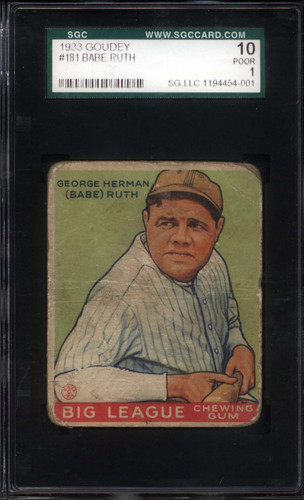 |
Babe Ruth #181 1933 Goudey |
$5,313 | $2,127,736 | 400.5× |
 |
Lou Gehrig #61 1934 Goudey |
$2,881 | $1,396,559 | 484.8× |
 |
Lou Gehrig #37 1934 Goudey |
$4,321 | $1,287,947 | 298.1× |
 |
Jackie Robinson #312 1952 Topps |
$5,259 | $1,281,142 | 243.6× |
 |
Lou Gehrig #160 1933 Goudey |
$3,116 | $1,257,795 | 403.7× |
 |
Lou Gehrig #92 1933 Goudey |
$2,952 | $1,187,868 | 402.4× |
 |
Ted Williams #92 1939 Play Ball |
$3,725 | $1,073,093 | 288.1× |
 |
Willie Mays #305 1951 Bowman |
$4,200 | $1,047,543 | 249.4× |
Look up any card's current raw and graded value in Midpoint — and get an estimated grade before you pay to submit.
Table of Contents
- Section 1: How Does Card Grading Work?
- Section 2: The ROI Formula—Is It Worth Grading My Cards?
- Section 3: Raw Value Thresholds—What Cards Are Worth Grading?
- Section 4: Assessing Condition—How to Know What Grade a Card Will Get
- Section 5: PSA vs BGS vs CGC—Grading Scale, Cost, and Turnaround
- Section 6: Advanced Grading Decisions—Investment, Personal, and Market Timing
- Conclusion
- FAQ
Section 1: How Does Card Grading Work?
Grading Basics—What Happens When You Submit a Card?
Card grading is the process of sending your trading card to a third-party company—like PSA, BGS, CGC, SGC, or TAG—for professional evaluation and encapsulation. The grader examines your card under magnification, checking four essential factors:
- Centering: Alignment of the card’s image within the borders.
- Corners: Sharpness and wear on each corner.
- Edges: Condition of the card’s perimeter.
- Surface: Scratches, print lines, stains, or other flaws.
After evaluation, the card receives a numeric grade (typically 1-10), is sealed in a tamper-proof holder (“slab”), and returned with a serial number and label.
Subgrades & Label Variations
While PSA provides a single overall grade, BGS and CGC break down the grade into subgrades for centering, corners, edges, and surface. SGC and TAG also use their own scale and labels.
- PSA 10: Gem Mint
- BGS 10: Pristine (Black Label is perfect)
- CGC 10: Pristine
- TAG: Numeric 1,000-point scale
The differences between grading scales matter—each company has its own standards for what counts as Gem Mint vs Pristine, and this can affect resale value.
Why Grade? Authentication, Value, and Protection
Grading is more than just a number:
- Authentication—can help verify the card isn’t fake or altered.
- Value—high grades may increase a card’s market worth.
- Protection—slabs shield your card from damage, and can help with insurance (see our insurance value guide).
Section 2: The ROI Formula—Is It Worth Grading My Cards?
Understanding the Grading Cost-Benefit Equation
The central question—Is it worth grading my cards?—comes down to return on investment (ROI). Because grading fees, shipping, and insurance can total $30-$100+ per card, you must weigh the expected value increase against the total cost.
- ROI = (Graded Value – Raw Value – Costs) / Costs
For example, if you own a Tom Brady [Refractor] #236 (2000 Bowman Chrome) with a raw value of $10,353 and a PSA 10 value of $3,500,000 (as of 2026-08-09), the potential upside is enormous—but only if your card is truly Gem Mint. For most modern cards, the difference is much smaller, and the risk of getting a lower grade is higher.
PSA 10 Premiums—Why Gem Mint Matters
On many classic cards, the Gem Mint premium can be extreme. For instance:
- Ty Cobb [Portrait-Red] (1909 T206): Raw $5,033 vs PSA 10 $3,310,860
- Mickey Mantle #253 (1951 Bowman): Raw $10,099 vs PSA 10 $2,593,468
But these cards almost never achieve a PSA 10 due to age and scarcity. For modern cards, the PSA 10 premium can vary, but demand is key. Always check recent completed sales for your card in both raw and graded states to estimate real-world upside.
Factoring in All Costs
- Submission Fee: As of 2026, PSA’s regular service starts at $30/card (bulk), $75 (standard), up to $600+ for express.
- Shipping Both Ways: Typically $10-$20 each way, plus insurance if valuable.
- Insurance: Protects against loss—cost depends on card value.
- Time: Turnaround ranges from 1 week (fast) to 4+ months (bulk/slow periods).
Before submitting, total these costs. If the added graded value doesn’t clearly exceed all expenses (and risk of a lower grade), grading may not be worthwhile.
Section 3: Raw Value Thresholds—What Cards Are Worth Grading?
Minimum Value: When Is Grading Worth It?
As a rule of thumb, grading is usually worth considering only if raw value exceeds $100–$200 and the card is in near-perfect condition. For cards under $100 raw, grading fees often eat all potential profit—unless the card is rare, low population, or unusually sought-after.
- Vintage, rookie, low-population, and scarce insert cards are most likely to benefit from grading.
- Base modern cards, mass-printed commons, and damaged cards are rarely worth the cost.
Examples from the Market
Let’s look at real-world data (as of 2026-08-09):
- Jackie Robinson #79 (1948 Leaf): Raw $9,283, PSA 10 $2,526,518
- Babe Ruth #181 (1933 Goudey): Raw $5,313, PSA 10 $2,127,736
- Willie Mays #305 (1951 Bowman): Raw $4,200, PSA 10 $1,047,543
These legends have massive raw value and even larger graded premiums. But commons or even star cards from recent sets (Pokémon, sports, TCGs) with raw values under $50 rarely deliver ROI after grading costs.
High-Risk, Low-Reward Cards
- Base rookies from overprinted sets (e.g., 2020s sports cards, Pokémon bulk)
- Cards with visible flaws (creases, whitening, print lines)
- Non-rookie, non-scarce modern cards with few sales above $100 in PSA 10
If your card falls into these categories, selling raw may be the smarter play. For more about rookie and low-pop cards, see grading low population cards and centering requirements for rookie cards.
Section 4: Assessing Condition—How to Know What Grade a Card Will Get
The Four Pillars: Centering, Corners, Edges, Surface
Your card’s likely grade depends on four key condition factors:
- Centering: Is the image perfectly aligned? Even a 60/40 split can drop from Gem Mint to Mint.
- Corners: Are all corners sharp, or are there signs of wear or fraying?
- Edges: Look for chipping, dings, or whitening around the border.
- Surface: Check for scratches, print lines, scuffs, or indentations—often missed by the naked eye.
Each grader weighs these differently based on their published standards. A single small flaw can drop a card from PSA 10 to PSA 9 or lower, reducing potential value.
Gem Mint vs Pristine—Grade Spread and Value Impact
The value gap between PSA 10 vs PSA 9 (or BGS 9.5/CGC 9.5) can be significant. For many modern cards, PSA 10 can fetch 2-10x the PSA 9 price. For vintage, the spread can be even more extreme (as seen in the Ty Cobb and Mickey Mantle examples above).
But the odds of getting a PSA 10 are low—on older cards, often under 1% of submissions. Most cards with minor flaws top out at PSA 8 or 9, which may not justify the grading fee.
How to Pre-Grade—Tools, Apps, and Strategies
- Use a card grading tool or free centering calculator to measure alignment precisely.
- Lighting and magnification help spot flaws invisible to the naked eye.
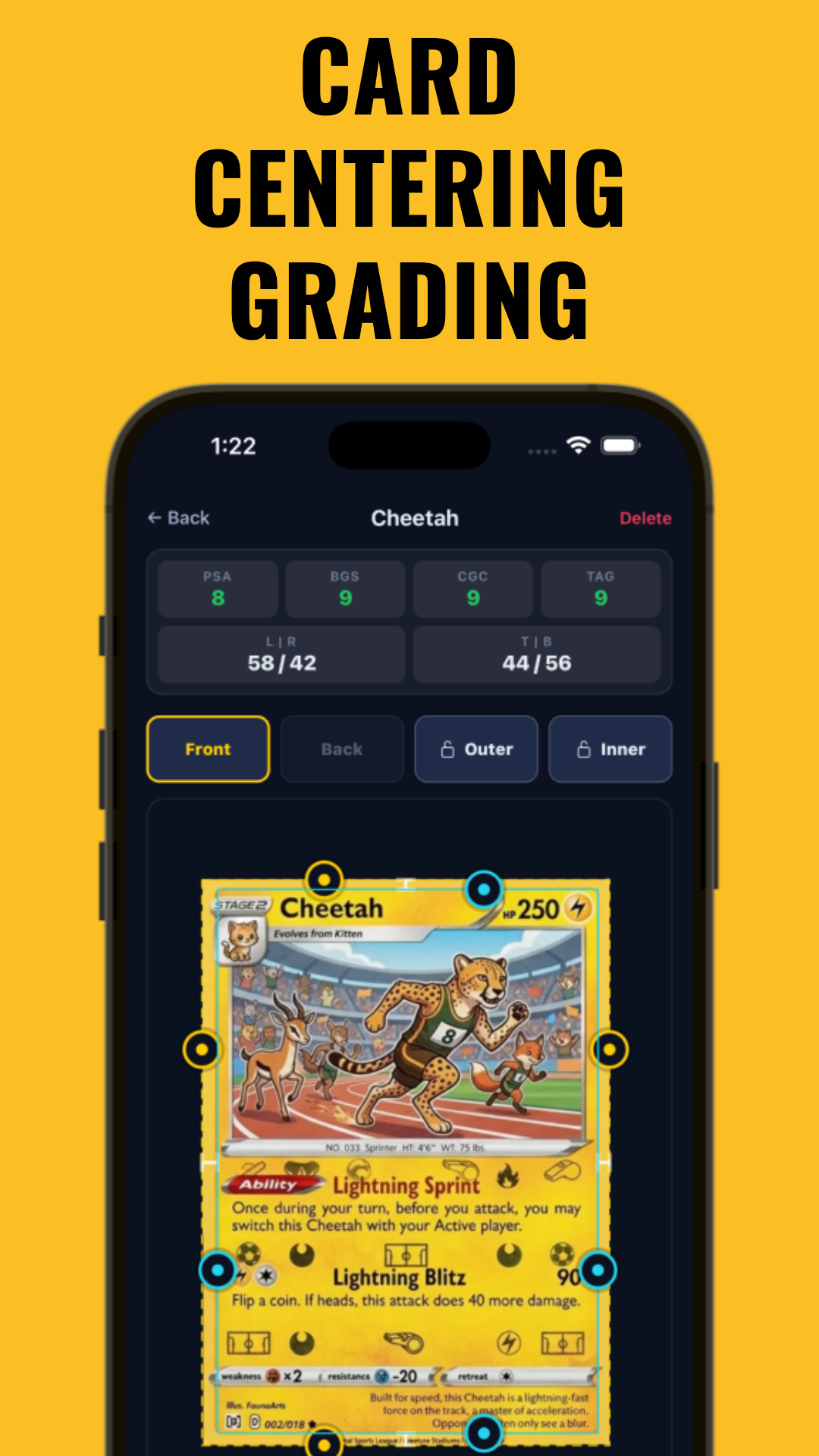
- Apps like Midpoint let you snap a photo and get instant AI-driven grade estimates for PSA, BGS, CGC, and TAG—so you can get an idea of your odds before spending on grading.
For a detailed walkthrough, check our step-by-step pre-grading guide or read about how AI transforms card centering analysis.
Section 5: PSA vs BGS vs CGC—Grading Scale, Cost, and Turnaround
Major Grading Companies—How They Differ
- PSA (Professional Sports Authenticator): Industry leader, especially for sports and Pokémon. Grading scale: 1–10, no subgrades.
- BGS (Beckett Grading Services): Known for subgrades, BGS 10 “Black Label” is top tier. Popular for modern sports and TCGs.
- CGC (Certified Guaranty Company): Fast-growing in the TCG space. Subgrades optional. Also uses 10-point scale.
- SGC: Black slab, vintage focus, 1–10 scale with half grades.
- TAG: AI-driven, detailed 1,000-point scale, digital transparency.
How Much Does PSA Grading Cost?
- PSA Bulk: $30/card (minimum 20 cards, value limit $499/card)
- PSA Value: $40-$50/card (faster, higher value cap)
- PSA Regular: $75/card (for cards up to $1,499)
- PSA Express: $150-$600+/card (faster, for high-value cards)
Prices can change—always confirm on the official site before submitting. Add shipping, insurance, and potential upcharges for high-value cards.
Turnaround Times in 2026
- PSA Bulk: 2–4 months
- PSA Regular: 2–4 weeks
- BGS, CGC: Similar, but can vary with demand spikes
Backlogs happen—during hobby booms, times can double. Always check current turnaround before shipping.
Submission Process—How to Submit Cards to PSA
- Create an account at the grading company’s website.
- Fill out the online submission form, select your service level, and print the paperwork.
- Package cards securely in card savers, use bubble wrap, and insure your shipment.
- Ship via tracked, insured mail (FedEx, USPS, UPS) and keep all receipts.
For a full walkthrough, see PSA’s official submission guide or use a card grading app to help organize your batch.
Section 6: Advanced Grading Decisions—Investment, Personal, and Market Timing
Investment vs Personal Collection—What’s Your Goal?
- Investment/Selling: Grade only cards with clear upside, strong condition, and high demand. Watch the gem premium and grade spread closely.
- Personal Collection/Authentication: Grading may be worthwhile for sentimental, rare, or favorite cards—even if ROI is low—especially for authentication and insurance.
Cards like the Lou Gehrig #61 (1934 Goudey) or Ted Williams #92 (1939 Play Ball) are often graded for both investment and legacy reasons, given their historical significance and market value jumps in Gem Mint.
Market Timing, Hype Cycles, and Liquidity
- Submitting during hobby booms can mean higher graded values, but also longer waits and higher fees.
- Off-season or market lulls may yield faster turnaround, but watch for demand drops.
- Selling raw can be faster and avoids grading risk if you need liquidity now.
For example, the 30-day price change for Willie Mays #305 (1951 Bowman) was +65.8% as of 2026-08-09—grading during a spike may yield a higher sale, but markets can cool quickly.
Risks—When to Avoid Grading
- Flawed or Damaged Cards: Even valuable cards may not recoup grading costs if they’ll only get PSA 8 or lower.
- Common Modern Cards: Unless population is low or demand is surging, grading often isn’t worth it.
- False ROI Calculations: Don’t assume your card will grade Gem Mint—use pre-grading tools to set realistic expectations.
For more on how centering specifically impacts value, see our centering value guide.
Conclusion
So, is it worth grading my cards? There’s no one-size-fits-all answer—it depends on your card’s raw value, condition, rarity, and market demand. Use real-world data to compare raw vs graded sales, and factor in every cost from submission to shipping and insurance. For most cards under $100 raw, grading is rarely profitable. But for vintage, rookie, and scarce cards—especially in top condition—grading can multiply value dramatically.
Always pre-grade your cards before submitting. Modern tools like Midpoint let you estimate likely grades and potential ROI instantly, helping you avoid costly mistakes. The hobby rewards preparation—use every tool at your disposal to make smart, informed decisions about grading.
FAQ
Q: What raw card value makes grading worth it?
A: Many collectors recommend grading only cards worth $100–$200+ raw, unless the card is extremely rare or low population. After grading fees and shipping, cards below this threshold often don’t deliver enough ROI.
Q: How do I know if my card will grade a 9 or 10?
A: Examine centering, corners, edges, and surface closely. Even small flaws can drop a card to PSA 8 or 9. Use tools like Midpoint’s AI grading app or a centering calculator to estimate your likely grade before submitting.
Q: Is it better to sell a card raw or graded?
A: For high-value, high-grade potential cards, grading can boost value. But if the card is common, lower grade, or you need fast cash, selling raw may be better—especially if grading fees eat up the profit.
Q: How much does grading cost after shipping and insurance?
A: Expect to pay $30–$100+ per card for grading, plus $10–$20 each way for shipping and extra for insurance (especially on high-value cards). Total costs can reach $50–$150 per card for premium services.
Q: What cards are not worth getting graded?
A: Avoid grading mass-produced modern cards, cards with visible damage, or any card whose graded value doesn’t clearly exceed all costs. Stick to rare, vintage, rookie, or low-population cards in top condition.
Q: Does grading increase value for vintage or modern cards?
A: Grading can increase value for vintage, rookie, and scarce cards—sometimes by a large margin in PSA 10. For modern cards, the value boost is usually smaller and hinges on demand, population, and condition.
Free to start
Try the Midpoint app
Grade any card from a photo, see its raw and PSA 10 value, and track what your collection is worth — free.
Get it on iPhoneGet it on Android