Ken Griffey Jr. Cards Worth Money: Values, Grades & Best Picks
Discover which Ken Griffey Jr. cards are worth money, key rookie card values, PSA 10 grades, and best cards to grade for collectors and investors.

Estimated reading time: 16 min
Key Takeaways
- Ken Griffey Jr. rookie card values vary widely by set, condition, and grading company, influenced by population reports and market demand.
- 1989 Upper Deck #1 rookie card PSA 10 values are among the highest, with market prices around $3,700 as of 2026-09-04, and some exceptional sales reported above $4,000.
- Donruss, Fleer, Bowman, and Topps Traded rookie cards also hold value but are generally lower priced; however, high-grade examples and low-population variants can command premiums.
- Low-population inserts, refractors, serial-numbered parallels, and premium print runs often command higher premiums among collectors.
- Autographed and premium-era variants like Desert Shield, Tiffany editions, and dual-signed memorabilia cards can fetch higher prices and are sought after by collectors and investors.
Card values — live data from Midpoint's card database, as of 2026-09-04. Prices move; Midpoint refreshes these daily.
| Card | Raw | PSA 10 | Gem premium | |
|---|---|---|---|---|
![Ken Griffey Jr. [Refractor] #101 1997 Topps Chrome card](https://i.ebayimg.com/images/g/91kAAeSwEoBqFLh1/s-l500.jpg) |
Ken Griffey Jr. [Refractor] #101 1997 Topps Chrome |
$1,280 | $9,462 | 7.4× |
![Ken Griffey Jr. [Class 2 Red Label] #100 1998 Topps Gold Label card](https://i.ebayimg.com/images/g/mg4AAeSwN9RqQp50/s-l500.jpg) |
Ken Griffey Jr. [Class 2 Red Label] #100 1998 Topps Gold Label |
$10.99 | $5,428 | 493.9× |
 |
Ken Griffey Jr. #336 1990 Topps Tiffany |
$94.00 | $5,072 | 54× |
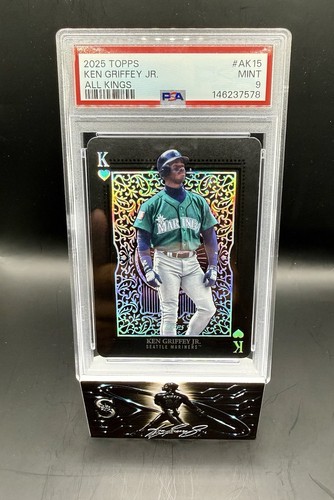 |
Ken Griffey Jr. #AK-15 2025 Topps All Kings |
$1,600 | $4,782 | 3× |
![Ken Griffey Jr. [Refractor] #SCC20 1999 Stadium Club Chrome card](https://i.ebayimg.com/images/g/rqoAAeSwBDppreCS/s-l500.jpg) |
Ken Griffey Jr. [Refractor] #SCC20 1999 Stadium Club Chrome |
$256.62 | $4,164 | 16.2× |
![Ken Griffey Jr. [Class 1 Gold Label] #100 1999 Topps Gold Label card](https://i.ebayimg.com/images/g/RXYAAeSwfE5qUvih/s-l500.jpg) |
Ken Griffey Jr. [Class 1 Gold Label] #100 1999 Topps Gold Label |
$25.25 | $3,815 | 151.1× |
 |
Ken Griffey Jr. #13 1992 Panini Donruss Elite |
$455.00 | $3,498 | 7.7× |
 |
Ken Griffey Jr. #PP9 1993 SP Platinum Power |
$17.75 | $3,477 | 195.9× |
![Ken Griffey Jr. [Refractor] #AE3 1999 Topps Chrome All Etch card](https://i.ebayimg.com/images/g/vMMAAeSwq~tqHem6/s-l500.jpg) |
Ken Griffey Jr. [Refractor] #AE3 1999 Topps Chrome All Etch |
$435.35 | $3,420 | 7.9× |
Look up any card's current raw and graded value in Midpoint — and get an estimated grade before you pay to submit.
Table of Contents
- Section 1: Understanding Ken Griffey Jr. Rookie Card Value
- Section 2: Comparing Raw vs PSA 10 Graded Card Prices
- Section 3: High-Value Ken Griffey Jr. Inserts and Parallels
- Section 4: Autographed and Premium Memorabilia Cards
- Section 5: Identifying Valuable 1990s Variants and Special Editions
- Section 6: Market Trends and Affordable Collecting Strategies
- Conclusion
- FAQ
Section 1: Understanding Ken Griffey Jr. Rookie Card Value
Key Rookie Cards from 1989 Sets
Ken Griffey Jr.’s rookie cards are central to his collectible baseball card market, and understanding the key issues from 1989 is important for collectors and investors. The 1989 Upper Deck #1 card is widely regarded as the most iconic and valuable rookie card, noted for its high-quality photography and print quality. As of 2026-09-04, a PSA 10 graded Upper Deck rookie card is reported to command prices around $3,700 on the secondary market, with some exceptional sales reportedly surpassing $4,000 at auction. Raw versions in excellent condition (sharp corners, glossy surfaces, and strong centering) often sell for hundreds of dollars, commonly between $300-$600 depending on eye appeal.
Other notable 1989 rookie cards include those from Donruss, Fleer, Bowman, and Topps Traded series. These cards generally sell for less than Upper Deck but remain important for collectors seeking variety or budget-friendly options. For example, 1989 Donruss Griffey rookie cards in raw mint condition typically range from $30 to $150 depending on centering and surface quality, with PSA 10 examples reported in the $500 to $1,000 range. The 1989 Fleer rookie card can fetch $400-$700 in PSA 9 or 10 condition. Bowman, with a smaller print run, sees PSA 10 Griffeys often selling for approximately $600 to $900, making it a viable alternative for collectors focused on value diversification.
Factors Influencing Rookie Card Value
- Condition and centering: Cards with sharp corners, clean surfaces, and near-perfect centering generally achieve higher prices. Centering is particularly important for the 1989 Upper Deck card, where PSA population reports indicate that perfectly centered PSA 10 cards may trade for a premium compared to off-center counterparts.
- Grading certification: PSA, BGS, and SGC graded cards influence value, with PSA 10 and BGS 9.5 or higher being highly sought after. BGS is known for detailed subgrades, and a BGS 9.5 with 10s on corners and surface can approach PSA 10 prices.
- Print runs and population: Cards with lower graded population counts tend to be more valuable due to rarity. For example, the 1989 Upper Deck Tiffany variant has fewer PSA 10 submissions, making it rarer and often more valuable than the base card.
- Market demand: Griffey remains a popular Hall of Famer, sustaining a collector base that supports prices. His popularity among nostalgic collectors and investors contributes to consistent demand, especially during anniversaries or Hall of Fame celebrations.
Midpoint’s Role in Pre-Grading Evaluation
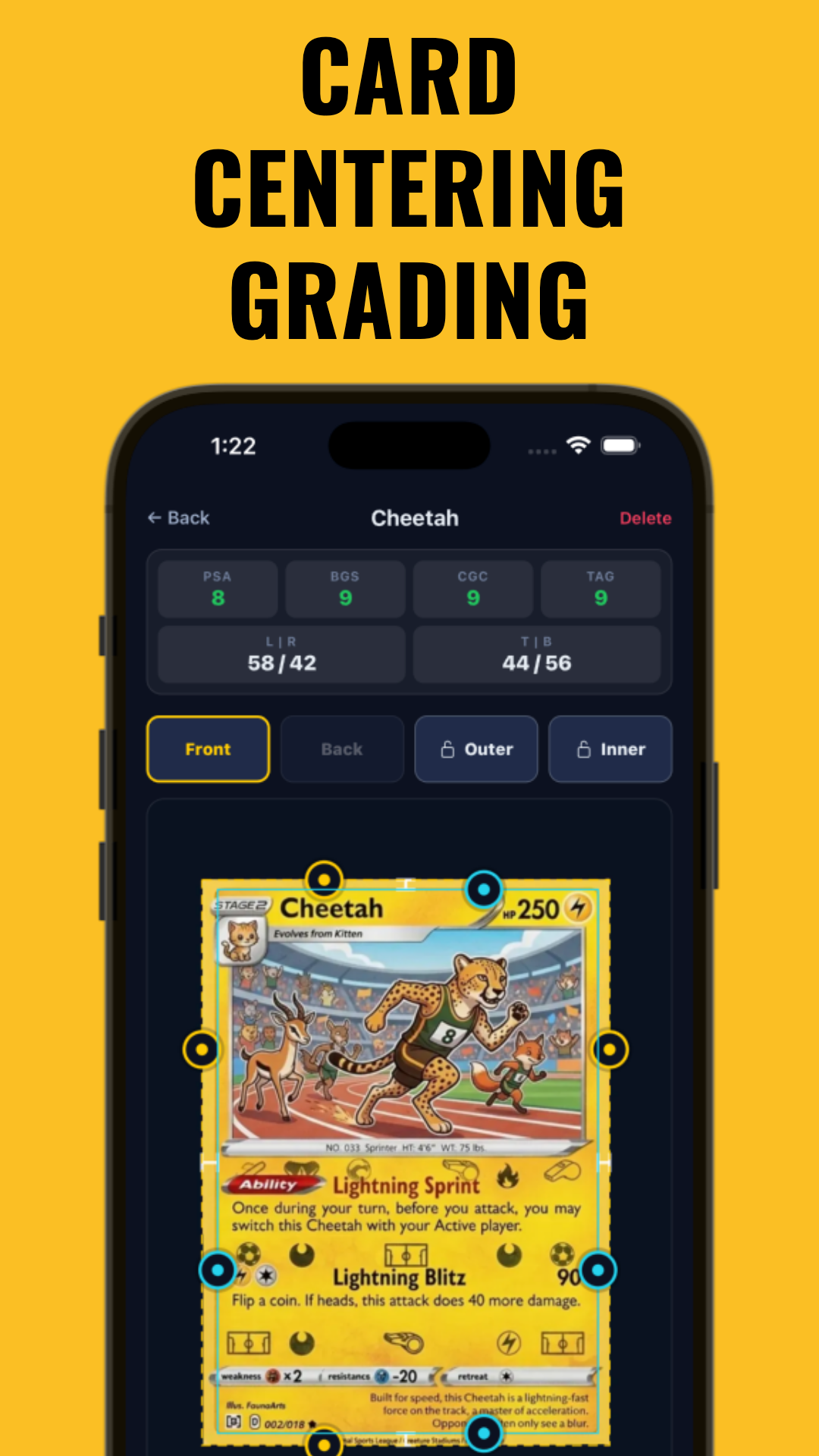
Before investing $30 or more to submit a card for professional grading, collectors can use tools like Midpoint to get AI-powered estimates of card grades based on centering, corners, edges, and surface analysis. This digital grading helps collectors understand potential PSA 10 or BGS 9.5 value and avoid costly grading surprises, which can occur if a card is off-center or has unseen surface defects.
Midpoint’s AI analyzes high-resolution scans or photos across multiple quality parameters, providing a confidence score and estimated grade. For example, a 1989 Upper Deck rookie card that Midpoint rates with high confidence as a PSA 10 equivalent may justify the $30-$50 grading fee, whereas a card with lower confidence might warrant cleaning or restoration before submission.
Section 2: Comparing Raw vs PSA 10 Graded Card Prices
Value Differences Between Raw and Graded Cards
Raw Ken Griffey Jr. cards can vary widely in value, especially if they have off-centering, surface wear, or minor corner dings. For instance, a raw 1989 Upper Deck rookie card with slight edge wear or off-center printing might sell for as low as $100-$200, while pristine raw copies with excellent eye appeal can reach $300-$600. PSA 10 (Gem Mint) graded cards are considered the gold standard and can significantly increase the card’s value. For example, a PSA 10 1989 Upper Deck rookie card can exceed $3,500, often selling for multiple times the value of an equivalent raw card.
Similarly, raw Donruss or Fleer rookie cards might sell for $50-$150, but PSA 10 graded copies can fetch $500 to $1,000, reflecting the grading premium. This premium is primarily due to buyer confidence, authentication, and assurance of condition.
Why PSA 10 Grades Are So Valuable
- Buyer confidence: PSA 10 confirms near-perfect condition, making it easier to resell at a premium because buyers trust the card’s authenticity and condition.
- Grading population scarcity: The number of PSA 10 Griffey rookie cards is limited, increasing rarity and demand. For example, as of mid-2026, PSA’s population report lists around 2,800 PSA 10 Upper Deck Griffey rookies, compared to many more raw cards in circulation.
- Market benchmarks: PSA 10 prices set the ceiling for card values and guide investment decisions. Collectors and investors look to PSA 10 sales to assess market health and potential appreciation.
Other Grading Companies and Their Impact
BGS (Beckett Grading Services) and SGC grades also influence value but tend to trade at slightly different price points. BGS 9.5 cards are highly prized, especially if the centering and edges subgrades are strong (often 9.5 or 10). For example, a BGS 9.5 1989 Upper Deck Griffey can sell for a price close to PSA 10 prices, depending on auction conditions.
SGC grades are respected among vintage collectors and often command a niche premium for their matte slabs and distinct grading scales. CGC and TAG grades are less common but gaining traction among collectors looking for alternatives or faster grading turnaround.
Midpoint’s AI grading provides estimates compatible with these grading standards, helping collectors decide which cards to grade professionally and with which company. For instance, a card with strong centering but minor surface flaws might score higher on Beckett’s subgrade system than PSA’s, guiding grading company choice.
Learn more about grading scale differences in our detailed grading scale guide.
Section 3: High-Value Ken Griffey Jr. Inserts and Parallels
Low-Population and Serial-Numbered Cards
Beyond base rookie cards, Griffey’s inserts, refractors, and numbered parallels from premium sets often command premiums. Cards like the 1989 Upper Deck Tiffany Refractor and limited-edition serial-numbered parallels can sell for multiples of their base counterparts, sometimes several times higher. For example, a 1989 Upper Deck Tiffany Refractor in PSA 10 has been reported to fetch prices in the $5,000-$6,000 range, reflecting both scarcity and desirability.
- Refractors: These cards have a distinctive shiny finish and are often serial numbered, increasing scarcity. Griffey’s 1989 Upper Deck refractor cards with serial numbers below 100 are especially valuable to collectors.
- Parallels: Colored borders or foil variations, often with serial numbers, also attract collectors. For instance, the 1989 Upper Deck Blue Foil parallel is prized for its limited print and vibrant colors.
- Low population cards: Midpoint’s tracking tools help identify which Griffey cards have fewer PSA 10 submissions, signaling rarity. Cards with fewer than 100 PSA 10 submissions in a given set often command a premium.
Examples of Valuable Inserts
While the 1989 Upper Deck base rookie card is the most famous, inserts like the 1989 Upper Deck Desert Shield and Tiffany versions often sell for higher prices in PSA 10 condition. These premium variants can exceed $5,000 at auction due to their limited distribution and print quality. The Desert Shield insert, released during the Gulf War era, was distributed in limited quantities and is among the rarer Griffey cards from the period.
Similarly, 1990s Bowman Chrome refractors and Topps Finest refractors featuring Griffey are sought after by collectors who appreciate the shiny finish and the era’s aesthetics. High-grade refractors from these sets can command prices in the $300-$800 range depending on print run and condition.
Using Midpoint to Track and Value Inserts
Midpoint’s extensive card lookup database of over 250,000 cards allows collectors to compare raw versus graded values, view population reports, and track portfolio values over time. This helps identify under-the-radar Griffey inserts worth grading and collecting. For example, Midpoint’s population tracking shows that some rare refractors have fewer than 50 PSA 10 submissions, indicating scarcity.
Check out our complete guide to grading low population cards for more insights on maximizing returns on these valuable inserts.
Section 4: Autographed and Premium Memorabilia Cards
Autographed Ken Griffey Jr. Cards
Autographed Griffey cards, especially those dual-signed or certified by reputable companies, can fetch some of the highest prices in the market. Cards featuring Griffey’s authentic signature with limited print runs or embedded memorabilia pieces (jersey swatches, bats) have been known to reach five-figure values at auction. For example, dual-signed Griffey/Manto or Griffey/Robinson cards graded PSA 10 with PSA/DNA autograph certification have reportedly sold in the $12,000-$15,000 range.
- Dual-signed cards: Often signed by Griffey and another Hall of Famer, these cards are rare and highly prized, especially if both autographs are PSA/DNA or Beckett authenticated.
- Premium memorabilia cards: Include pieces of game-used equipment and often come with serial numbering, such as 1/25 or 1/50, boosting scarcity and collector interest. Griffey jersey swatch cards from Topps Triple Threads or Upper Deck Ultimate Collection are examples that command strong prices.
Grading Autographs and Cards
Professional grading companies often grade both the card condition and autograph quality separately. PSA/DNA and Beckett Authentication add further assurance for buyers, increasing resale value. For instance, a PSA 10 card with a PSA/DNA 10 autograph grade is considered premium.
Midpoint’s AI tools focus primarily on card condition but can help estimate overall value when combined with autograph certification. Collectors can use Midpoint to assess the card’s condition before paying for combined card and autograph grading.
Investment Considerations
While autographed cards carry premium prices, collectors should exercise due diligence to avoid fakes and overpaying. Seeking cards with strong provenance and certification is advisable. Midpoint’s portfolio tracking can help monitor investment value over time. Autographed Griffey cards may be sensitive to market trends; prices can fluctuate based on player popularity and memorabilia market dynamics.
Section 5: Identifying Valuable 1990s Variants and Special Editions
Desert Shield and Tiffany Editions
The Desert Shield insert cards, released during the early 1990s Gulf War era, are rare and sought after, especially in PSA 10 condition. These cards were distributed in limited quantities to support troops, making them scarce and desirable. A 1989 Upper Deck Desert Shield Griffey PSA 10 has been reported to command prices around $5,000 or more.
Tiffany editions, printed on higher quality glossy stock, are known for superior print clarity, richer colors, and better condition survivability, which boosts collector demand. Tiffany cards generally have a smaller print run than base cards, with some estimates suggesting only 10-15% of the base print run. Their scarcity and premium paper stock make Tiffany editions collectible, often trading at a premium over base cards.
Other Premium Era Variants
Variants from the 1990s like special Topps Traded cards, Bowman Chrome refractors, and limited parallels can be valuable. These cards often have lower print runs than base sets, making them candidates for grading and investment. For example, 1990 Topps Traded Griffey cards with refractor parallels have sold in the $200-$600 range in PSA 9 or 10 condition, depending on population and eye appeal.
Bowman Chrome, released in the early 1990s, was among the first high-end Chrome sets and includes Griffey rookie and prospect cards that are collected. PSA 10 Bowman Chrome Griffey cards have been reported to fetch $800-$1,200, reflecting their premium status.
Which Cards Are Worth It to Grade?
Not all Griffey cards justify the cost of professional grading. Use Midpoint’s pre-grading guide and centering measurement tools to evaluate whether a card’s condition and rarity justify grading fees. Typically, high-end inserts, low population parallels, and autographed cards are the best candidates. For example:
- Base cards with moderate centering or visible surface wear generally don’t justify grading fees.
- Inserts with limited print runs or refractors with strong eye appeal often increase in value enough to offset grading costs.
- Autographed cards with established provenance and clean signatures usually benefit from grading.
Section 6: Market Trends and Affordable Collecting Strategies
Recent Sales and Market Direction
As of late 2026, Ken Griffey Jr. card values remain generally strong, especially for PSA 10 graded rookies and premium inserts. Market data from Midpoint shows steady demand with occasional spikes driven by Hall of Fame anniversaries, player milestones, and renewed interest in 1990s baseball nostalgia. For example, the 30th anniversary of Upper Deck’s 1989 set in 2019 saw a temporary price increase across PSA 10 Griffey rookies.
However, common junk-wax era cards without premium traits generally hold modest value, often below $10-$20 for raw examples. This highlights the importance of focusing on condition, rarity, and grading when collecting Griffey cards.
Affordable Griffey Cards for Budget Collectors
- Raw Donruss and Fleer rookie cards in high-grade condition provide good entry points, often available for under $100, allowing collectors to build a meaningful Griffey collection without large upfront investment.
- Ungraded 1989 Topps Traded cards can be found inexpensively (typically $10-$30) and may appreciate after grading if well-centered and free of surface flaws.
- Focus on well-centered cards with minimal surface wear to maximize future value; even modest centering improvements can add to resale prices.
- Look for lower population parallels or inserts from the 1990s, such as Bowman Chrome refractors, which can be affordable and have appreciation potential.
Using Midpoint to Track and Grow Your Collection
Midpoint’s portfolio tracking feature allows collectors to monitor their collection’s value, get grading estimates, and manage multiple card games and sports sets. This approach helps collectors make informed buying, selling, and grading decisions by providing real-time market data, population reports, and AI grade estimates.
For more on how centering impacts value, explore our detailed centering impact guide and the Card Centering Tool overview to improve grading accuracy and investment returns. Using these tools can increase your success rate in achieving PSA 10 grades and secure higher returns on Griffey card investments.
Conclusion
Ken Griffey Jr. cards with value span a broad spectrum, from his iconic 1989 Upper Deck rookie card to rare inserts, autographed memorabilia, and premium 1990s variants. Understanding the nuances of raw vs PSA 10 graded values, population rarity, and card condition is important for collectors and investors. Leveraging AI-powered grading tools like Midpoint can help pre-grade cards, maximize collection value, and avoid costly grading mistakes. Whether you’re a seasoned investor or a budget-conscious collector, knowing which Griffey cards to target and how to grade them can help ensure your collection remains enjoyable and valuable over time.
FAQ
Q: What is the most valuable Ken Griffey Jr. card?
A: The 1989 Upper Deck #1 rookie card in PSA 10 condition is generally considered the most valuable, typically selling for around $3,700 as of 2026-09-04, with some exceptional sales reported above $4,000.
Q: Are Ken Griffey Jr. rookie cards worth money?
A: Yes, especially those from 1989 Upper Deck, Donruss, Fleer, Bowman, and Topps Traded sets. Condition and grading significantly affect their value, with PSA 10 and BGS 9.5 grades commanding the highest prices.
Q: How much is a 1989 Upper Deck Ken Griffey Jr. rookie card worth?
A: Raw cards in excellent condition typically sell for several hundred dollars ($300-$600), while PSA 10 graded versions can exceed $3,500 and sometimes reach $4,000 or more.
Q: What Ken Griffey Jr. cards are valuable in PSA 10?
A: The 1989 Upper Deck rookie card, Desert Shield, Tiffany editions, and low-population inserts or refractors are among the cards especially valuable when graded PSA 10.
Q: Which Ken Griffey Jr. inserts or autographed cards sell for the most?
A: Autographed dual-signed cards and premium memorabilia cards with serial numbering often command the highest prices, sometimes reaching five-figure auction results.
Q: Are most Ken Griffey Jr. cards common junk-wax cards or actually valuable?
A: While many 1990s cards are common junk-wax era issues with lower value, key rookie cards, inserts, and autographed variants remain valuable and collectible.
Free to start
Try the Midpoint app
Grade any card from a photo, see its raw and PSA 10 value, and track what your collection is worth — free.
Get it on iPhoneGet it on Android