Legends MTG Cards Value: Top Cards, Grades & Grading Odds
Legends MTG cards value guide: most valuable cards, raw vs PSA 10 gem premium, condition pricing, and which Legends cards are worth grading.

Estimated reading time: 11 min
Key Takeaways
- Legends MTG cards value is concentrated in a small group of cards: The Tabernacle at Pendrell Vale, Chains of Mephistopheles, Moat, Karakas, The Abyss, Mana Drain, Sylvan Library and Field of Dreams. Most of the roughly 310-card set trades far lower.
- Condition drives price harder in Legends than in newer sets. Black borders show whitening easily, and the gap between Near Mint and Moderately Played can be large on key cards.
- The Legends PSA 10 value premium over raw comes from scarcity of true gems, so grading only pays when the card is both valuable and visibly clean.
- Check centering, corners and edges before you pay grading fees, which vary by company and service tier. Most older Legends copies will not reach gem.
- Compare several sources (TCGplayer market price, buylist offers, auction sales, graded sales) instead of trusting a single number.
Card values — live data from Midpoint's card database, as of 2026-11-18. Prices move; Midpoint refreshes these daily.
| Card | Raw | PSA 10 | Gem premium | |
|---|---|---|---|---|
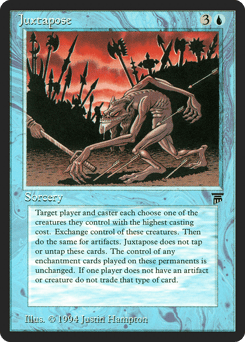 |
Juxtapose #63 Legends (1994) |
$11.84 | — | — |
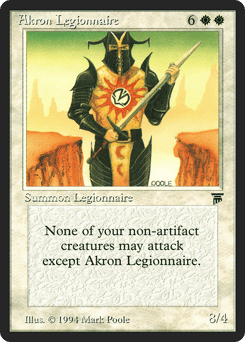 |
Akron Legionnaire #1 Legends (1994) |
$10.43 | — | — |
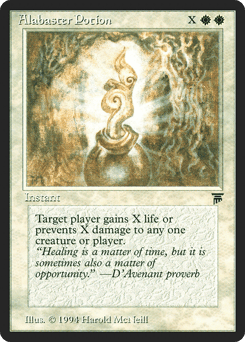 |
Alabaster Potion #2 Legends (1994) |
$0.36 | — | — |
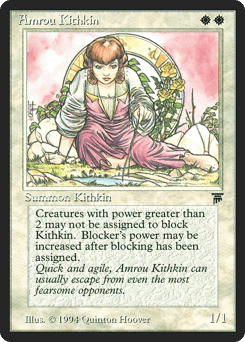 |
Amrou Kithkin #3 Legends (1994) |
$0.43 | — | — |
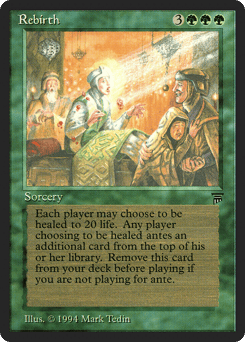 |
Rebirth #200 Legends (1994) |
$7.63 | — | — |
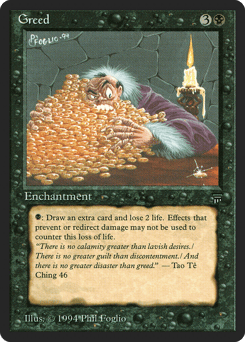 |
Greed #101 Legends (1994) |
$64.50 | — | — |
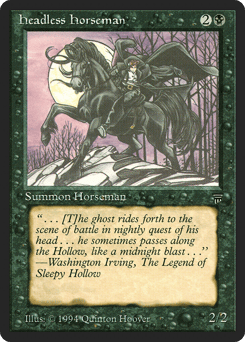 |
Headless Horseman #102 Legends (1994) |
$1.68 | — | — |
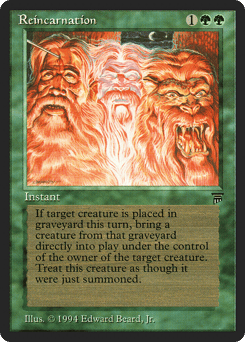 |
Reincarnation #201 Legends (1994) |
$7.70 | — | — |
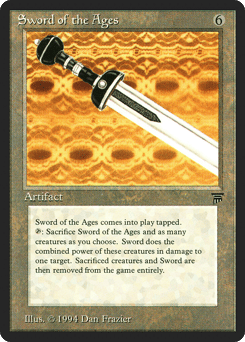 |
Sword of the Ages #296 Legends (1994) |
$101.38 | — | — |
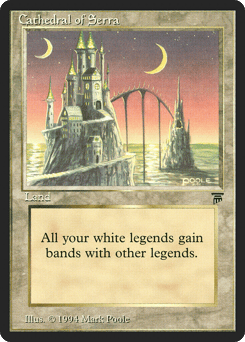 |
Cathedral of Serra #301 Legends (1994) |
$25.40 | — | — |
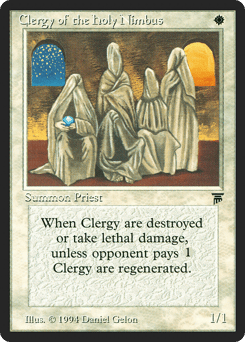 |
Clergy of the Holy Nimbus #6 Legends (1994) |
$0.57 | — | — |
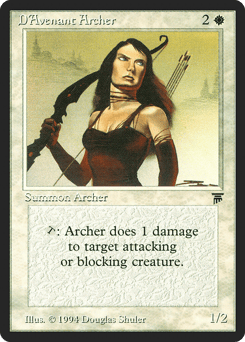 |
D'Avenant Archer #7 Legends (1994) |
$0.36 | — | — |
Look up any card's current raw and graded value in Midpoint — and get an estimated grade before you pay to submit.
Table of Contents
- Section 1: What Drives Legends MTG Cards Value
- Section 2: The Most Valuable Legends Cards
- Section 3: Legends Price Guide by Rarity and Checklist
- Section 4: Condition and Printing Details That Move Price
- Section 5: Legends PSA 10 Value and the Gem Premium
- Section 6: Which Legends Cards Are Worth Grading
- Section 7: Where to Check Prices, Track Trends and Sell
- Conclusion
- FAQ
Section 1: What Drives Legends MTG Cards Value
Legends MTG cards value depends on a handful of factors: scarcity, playability, the Reserved List, and condition. Legends arrived in 1994 as Magic's first set built around legendary creatures, and it was printed in black-bordered English (an Italian edition also exists). It has roughly 310 cards, though counts may vary slightly by source.
Unlike a modern set, you cannot judge Legends by average price. A few cards carry most of the set's total worth, while the bulk of commons and uncommons are inexpensive curiosities.
Why the set total is hard to pin down
Anyone quoting "what a complete Legends set is worth" is making a choice about three things:
- Condition assumed: a Near Mint set and a mixed-condition set are very different totals.
- Price source: TCGplayer market, retail asking prices, and buylist offers all produce different sums.
- Card count: the set is generally listed as 310 cards, but some sources may count slightly differently.
The result is that two honest sources can publish very different set values. Treat any single total as a rough range, not a fact.
The Reserved List effect
Some of the best-known Legends cards are on the Reserved List, Wizards' promise not to reprint certain cards. That supply ceiling is why cards like The Tabernacle at Pendrell Vale and Chains of Mephistopheles keep demand from collectors even when they see little tournament play. Not every top Legends card is on the list, though. Cards that have been reprinted behave differently: a reprint can pull the raw price of the original down while collectors of the original printing hold firm.
Playable vs collectible
Cards such as Mana Drain, Sylvan Library and Karakas have real Commander and Legacy-style demand. Others, like Chains of Mephistopheles, are priced mostly on rarity and nostalgia. Knowing which category a card falls into helps you predict how stable its price will be.
For exact current figures, use Midpoint's card lookup, which shows raw versus graded values so you can see the gap for each card rather than guessing. You can try it free at Midpoint.
Section 2: The Most Valuable Legends Cards
The most valuable Legends cards are consistently the same names, though their exact order shifts as the market moves. Rather than quote stale prices, here is how the top tier breaks down and why each card holds value.
The headline names
- The Tabernacle at Pendrell Vale: a Reserved List land with a punishing effect on creature decks. It is a perennial contender for the set's most valuable card, driven by scarcity and collector demand.
- Chains of Mephistopheles: a quirky rare that never saw much competitive play. Its price is largely collector-driven, which makes it sensitive to condition.
- Moat: a white enchantment that stops ground attackers. It has a long history in casual and Commander play and remains a staple of Legends price lists.
The playable powerhouses
- Mana Drain: a blue counterspell icon with constant Legacy and Vintage-style demand.
- Sylvan Library: a green enchantment loved in Commander for card selection.
- Karakas: a land that bounces legendary creatures, with strong format relevance.
- The Abyss: a black enchantment with a cult following among control and prison players.
- Field of Dreams: a Reserved List rarity that is mostly sought by collectors.
How to rank them yourself
Instead of trusting a static top-10 list, rank by a consistent source. Pull the TCGplayer market price for Near Mint copies, then compare against recent sold listings. Rankings can flip when a card is reprinted, banned, or hyped in a streamer deck.
Note that raw ranking and graded ranking can differ. A card with a modest raw price but tiny graded supply can carry an outsized premium at high grades. That is the gap Section 5 explains.
Section 3: Legends Price Guide by Rarity and Checklist
A practical Legends price guide starts with rarity. The set has commons, uncommons and rares, and the price curve is steep: much of the value lives in the rare slot, with selected uncommons and a few commons trailing far behind.
Rares
Rares hold most of the set's high-value cards. Even among rares, though, the range is wide. A few Reserved List or high-demand cards sit in a tier of their own, while many mid-tier rares are modestly priced legends that mainly interest completionists and Commander players building around that specific creature.
Uncommons
Legends uncommons are the sleeper category. Many are affordable, but several competitive or Commander staples are uncommons, so do not skip them when sorting a bulk lot. A single valuable uncommon can outweigh dozens of common cards.
Commons
Commons are generally the cheapest cards in the set. Because Legends is old, even commons in clean condition command more than modern bulk, but they rarely justify grading.
How to work through a checklist
- Sort your Legends cards by rarity first.
- Pull out every rare and check its Near Mint price.
- Check uncommons against the known staples listed above and in your lookup tool.
- Set aside commons as a bulk pile unless a specific card shows a high price.
- Record condition notes next to each card as you go.
Complete checklists are generally listed at about 310 cards, though counts can differ slightly by source, so match your list to one reference and stick to it. Many collectors build a spreadsheet; others track the whole thing in a portfolio app so the value updates over time.
Section 4: Condition and Printing Details That Move Price
Condition is the single biggest variable in Legends pricing after card identity. The same card can sell for dramatically different amounts at Near Mint versus Heavily Played, so grade your copy honestly before you quote a value.
Condition tiers explained
- Near Mint (NM): minimal wear, clean edges, no creases. This is the benchmark price most sources list.
- Lightly Played (LP): small edge whitening or minor scuffs. Expect a meaningful discount from NM.
- Moderately Played (MP): visible whitening, light creasing or surface wear. Prices drop further.
- Heavily Played (HP): obvious wear, bends or heavy whitening, but still intact.
- Damaged: tears, water damage, inking, or major creases. These sell at a steep discount and are often bought for play only.
Black borders are unforgiving. White edge chips pop against the dark frame, so cards that look fine in a binder can drop a full condition tier under bright light.
Printing, language and authenticity
- Language: English and Italian Legends are priced separately. Always search for the right language version.
- Set symbol and details: confirm the card is from Legends, not a later reprint with a different expansion symbol, border or frame.
- Authenticity: Reserved List and high-value cards are counterfeit targets. Check the card's feel, the printing pattern, and the borders. If you are about to spend serious money, buy graded or from a trusted seller.
Centering matters here too
Print alignment in older sets is often uneven, which affects both collector appeal and grading outcomes. For a closer look at how alignment translates into price, see this guide on how centering impacts card value.
Section 5: Legends PSA 10 Value and the Gem Premium
Legends PSA 10 value is where raw and graded markets diverge the most. A PSA 10 means the card is a gem: sharp corners, clean surface, tidy edges, and acceptable centering. For a 1994 black-bordered card, that standard is very hard to meet.
Why the gem premium exists
The gem premium is the gap between a raw Near Mint price and the price of the same card in a top grade. It exists because:
- Few Legends copies have survived decades without edge whitening.
- Production-era centering was inconsistent, so even pack-fresh cards can miss the mark.
- Collectors pay extra for the certainty of a slab, especially for expensive cards.
Because supply at the top grade is small, a single sale can move the price noticeably. That volatility is a reason to use several sold listings, not one data point.
Grades below 10 still matter
A PSA 9 or 8 is not a failure. For many Legends cards, a mid-high grade can sell above a raw NM copy because buyers trust the slab. The right question is not "can it be a 10?" but "does the graded price at the grade I expect exceed raw price plus grading cost?"
Company scales are not identical
PSA, BGS, CGC and TAG weigh centering and surface differently, and their top grades carry different meanings. If you are choosing where to submit, read this breakdown of grading scale differences by company before you commit.
Midpoint's card lookup lists raw and graded values side by side, so you can see the actual gem premium for any specific Legends card as of today rather than relying on rule-of-thumb multiples.
Section 6: Which Legends Cards Are Worth Grading
Legends cards worth grading share two traits: the graded price clearly exceeds the raw price, and the physical copy looks like it can score high. Missing either one usually makes submission a loss.
A simple decision framework
- Look up raw and graded values. If the difference does not cover grading fees (which vary by company and service tier), plus shipping and insurance, skip it.
- Inspect under bright light. Check all four corners, every edge, and the surface for scratches or print lines.
- Measure centering. A card that is clearly lopsided will not earn a top grade at most companies.
- Estimate the likely grade, not the best case. Price the outcome at that grade.
Strong candidates
- High-value cards such as The Tabernacle at Pendrell Vale, Moat, Mana Drain and Karakas, when a copy is crisp and well centered.
- Authentication-sensitive cards where a slab gives buyers confidence.
- Cards you plan to sell or insure, since a grade can support value. See how card grade impacts insurance value.
Poor candidates
- Commons and low-priced uncommons.
- Anything with visible whitening, bends, or surface damage.
- Cards where the graded premium at realistic grades is smaller than the grading fee.
Pre-grade before you pay
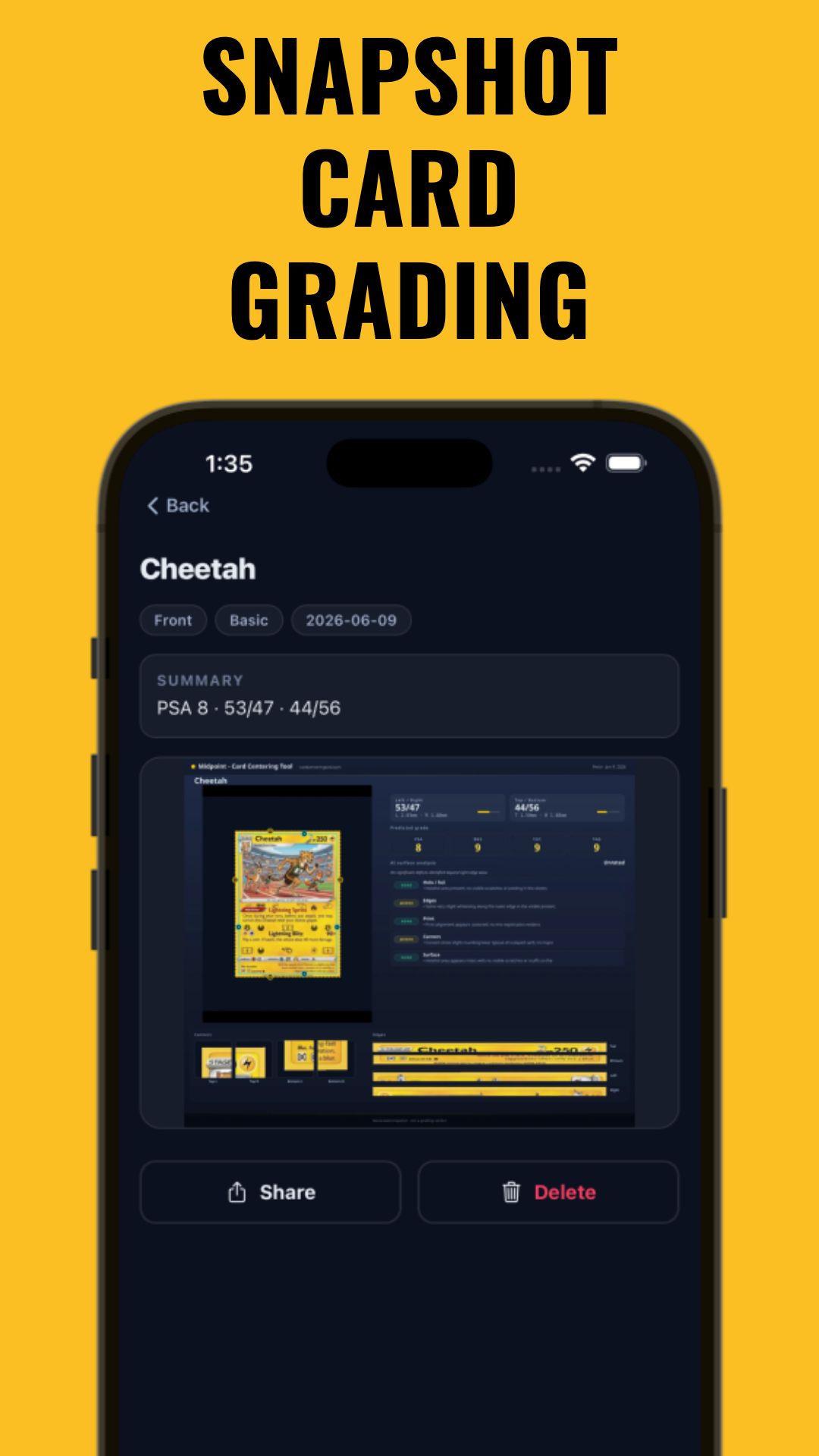
Midpoint estimates a PSA, BGS, CGC or TAG grade from centering, corners, edges and surface, so you can screen a stack before submitting anything. For the manual version of this process, follow this guide on how to pre-grade your card.
Section 7: Where to Check Prices, Track Trends and Sell
No single site gives the full picture of Legends MTG cards value. Use several, and understand what each one measures.
Price sources compared
- TCGplayer market price: reflects recent completed sales and is the most common reference for raw cards. It can lag during fast moves.
- Buylist offers: what dealers will pay now. These typically sit well below market because dealers need margin, but they are real, immediate cash.
- Auction sales: useful for high-value and graded cards. Look at sold listings, not asking prices.
- Graded-card sales: the best guide to the gem premium, as long as you match the grader and grade.
Reading price history
Look at multi-month trends rather than a single day. Reserved List staples tend to move slowly with occasional jumps from format interest or social media attention. Be wary of price spikes driven by one or two sales.
Complete set versus selling singles
Selling a full set to one buyer is convenient but usually means a discount, because the buyer needs margin on the cheap cards. Selling the top cards individually, and the bulk as a lot, typically captures more. The trade-off is time, shipping and fees.
Protect and track what you own
Old Legends cards can lose value quickly when stored badly. Follow this guide on how to store valuable cards, and track your holdings over time in Midpoint's portfolio view so you can see how your collection's value shifts.
Conclusion
Legends is a set where a small number of cards carry the value, and condition decides what you actually get paid. The Tabernacle at Pendrell Vale, Chains of Mephistopheles, Moat, Karakas, The Abyss, Mana Drain, Sylvan Library and Field of Dreams are the names to check first. Everything else is a bulk question.
Before you submit anything, compare raw and graded values, inspect centering and edges, and estimate the grade you would realistically receive. Download Midpoint to look up raw versus graded values, get AI grade estimates, and track your Legends collection from your phone.
FAQ
Q: What is the most valuable card in MTG Legends?
A: The Tabernacle at Pendrell Vale is among the top contenders, along with Chains of Mephistopheles, Moat, Karakas, The Abyss and Mana Drain. The exact order shifts with the market and with condition, so check a current price source for the copy you own.
Q: How much is a complete Legends MTG set worth?
A: It depends on the price source, assumed condition, and how the card count is treated (the set is generally listed at about 310 cards). Retail, TCGplayer market and buylist figures all differ. A full set is typically worth more sold as individual cards than as one lot.
Q: What are the top 10 most valuable Legends cards?
A: Commonly cited names include The Tabernacle at Pendrell Vale, Chains of Mephistopheles, Moat, Karakas, The Abyss, Mana Drain, Sylvan Library and Field of Dreams. Rank them with current Near Mint prices from a consistent source, since the order changes over time.
Q: How do I check the value of old Legends MTG cards?
A: Identify the exact card, language and condition, then compare TCGplayer market price, recent sold auction listings, buylist offers and graded sales. A lookup tool such as Midpoint shows raw versus graded values in one place.
Q: Are MTG Legends cards worth anything?
A: Yes, but unevenly. A handful of rares and select uncommons are worth significant money, while most commons and many mid-tier rares are modestly priced. Condition has a large effect on every card.
Q: What is the difference between Legends card prices in near-mint and played condition?
A: Near Mint copies command the benchmark price, and each step down through Lightly Played, Moderately Played, Heavily Played and Damaged lowers it. Because Legends has black borders that show whitening, the drop can be steep on valuable cards.
Free to start
Try the Midpoint app
Grade any card from a photo, see its raw and PSA 10 value, and track what your collection is worth — free.
Get it on iPhoneGet it on Android