Card Centering Checker: Measure, Analyze, and Estimate Grades Like a Pro
Discover how to use a card centering checker for accurate grading. Learn manual and digital methods, PSA/BGS/CGC standards, and easy tools for collectors.


Estimated reading time: 13 min
Key Takeaways
- A card centering checker helps collectors measure and evaluate card centering, a key grading factor.
- Manual rulers and digital tools both provide centering ratios, but automated apps can offer speed and consistency.
- Grading companies like PSA, BGS, CGC, and TAG have published centering thresholds for top grades.
- Front and back centering both impact the final grade, but the worse side usually sets the maximum.
- Modern apps like Midpoint streamline centering checks and can provide instant grade estimates.
Table of Contents
- Section 1: Why Card Centering Matters for Collectors
- Section 2: Manual Card Centering Checker Methods
- Section 3: Using Digital Card Centering Checker Apps
- Section 4: Understanding Centering Ratios and Grading Standards
- Section 5: Comparing Grading Companies’ Centering Requirements
- Section 6: Front vs. Back Centering – What Counts Most?
- Section 7: Physical Tools: Centering Jigs, 3D Prints, and DIY Solutions
- Section 8: Estimating Final Grades with Centering Data
- Conclusion
- FAQ
Section 1: Why Card Centering Matters for Collectors
The Role of Centering in Card Grading
Card centering is one of the four main criteria used by grading companies to determine a trading card’s grade, along with corners, edges, and surface. Centering refers to how evenly the printed image is positioned within the card’s borders. Poor centering can lower a card’s grade—even if every other aspect is flawless.
- Example: A card with sharp corners and a perfect surface but off-center printing (e.g., 70/30) may be capped at PSA 8 or lower.
- Collectors often pay a premium for well-centered cards, especially vintage sports cards and Pokémon cards, where printing inconsistencies were common.
Impact on Card Value
Centering can make a significant difference in a card's value. For highly sought-after cards, a PSA 10 (Gem Mint) often requires near-perfect centering. Even modern cards, thanks to improved printing, are not immune to slight misalignments.
- A detailed guide on centering and value discusses how even a 60/40 ratio can drop a card one or two grade levels.
- Grading companies publish centering requirements for each grade.
Why Use a Card Centering Checker?
Before submitting a card for grading (often costing $30+ per card), a centering checker helps collectors:
- Avoid costly surprises and rejections.
- Estimate the likely centering grade.
- Decide which cards are worth professional grading.
All these reasons make mastering card centering checks a useful skill for serious collectors.
Section 2: Manual Card Centering Checker Methods
Measuring with a Ruler or Caliper
The simplest card centering checker is a clear plastic ruler or a digital caliper. Here’s how to do it at home:
- Step 1: Place your card on a flat surface with good lighting.
- Step 2: Measure the left and right borders (distance from edge of the card to the start of the printed image). Note both in millimeters.
- Step 3: Repeat for the top and bottom borders.
Calculate the centering ratio for each pair:
- For left/right: (smaller border ÷ (smaller border + larger border)) × 100 = percent centering (lower value)
- Example: 2mm left, 3mm right: (2 ÷ (2+3)) × 100 = 40% (so, 40/60 left-right centering)
Limitations of Manual Methods
- Manual measurements are prone to small errors—especially with textured or colored borders.
- It’s easy to misread the ruler or get uneven lighting, leading to inaccurate results.
- Calculating the exact ratio for all four sides can be tedious for large collections.
Tips for Accuracy
- Use a magnifying glass for older cards with thin or faded borders.
- Double-check your math, or use a calculator.
- Consider making a template or "jig" to line up borders quickly (see Section 7).
For a step-by-step walkthrough, see this precision guide to measuring card centering.
Section 3: Using Digital Card Centering Checker Apps
Photo Upload and Automated Border Detection
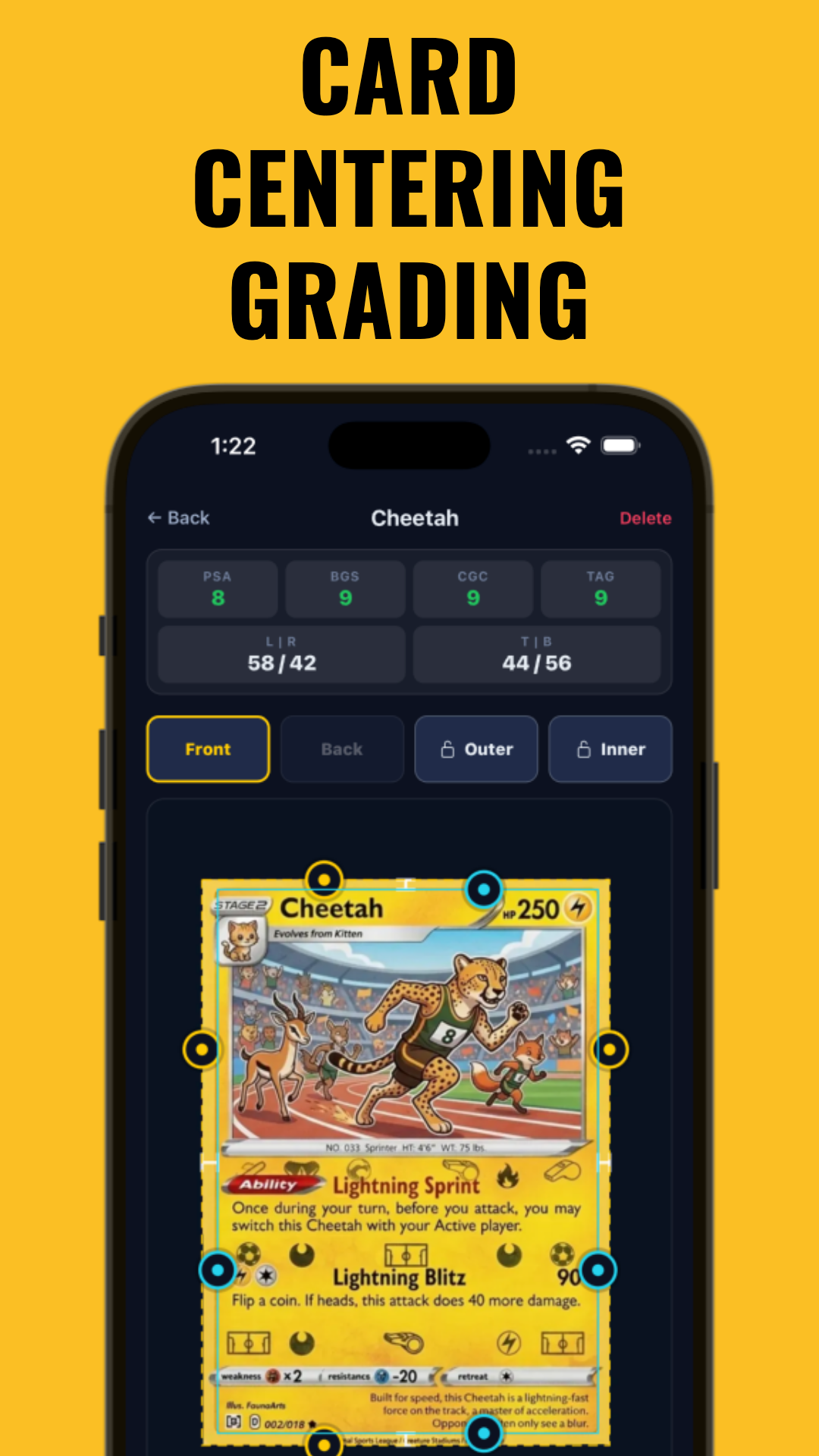
Digital card centering checkers have become increasingly popular in the hobby. Apps like Midpoint allow users to upload a photo of a card, then automatically detect and measure the borders using computer vision. This can reduce some of the human error found in manual methods.
- Just snap a photo with your phone or scan the card.
- The app detects where the printed image starts and ends on each edge.
- Instantly get left-right and top-bottom centering ratios to the tenth of a percent.
Mobile Apps for On-the-Go Grading
- Available for Android and iOS, many card centering checker apps provide instant feedback at shows or while sorting at home.
- Some apps, like Midpoint, let you process multiple cards in bulk, saving time for dealers and serious collectors.
Manual Adjustments and Cropping
Most digital tools let you fine-tune the detected borders, crop the card, or manually adjust corners for odd-shaped or vintage cards.
- This can help ensure accuracy even when automated detection isn’t perfect (e.g., cards with colored or foil borders).
- Some apps offer edge detection or surface analysis as well.
For a deeper look at AI-powered centering, see this comparison of AI card centering analysis tools.
Section 4: Understanding Centering Ratios and Grading Standards
What Is a Centering Ratio?
The centering ratio describes the proportional width of the borders on each side of the card. The "best" centering is 50/50 (equal borders). As the ratio drifts to 60/40, 70/30, or worse, the grade potential drops.
- 50/50: Perfectly centered image.
- 60/40: Slightly off-center, but often acceptable for high grades.
- 70/30 or worse: Noticeably off-center, limits grade to lower levels.
How to Calculate Centering Ratios
- Measure both sides (e.g., left and right borders).
- Add the two border widths together for the total border measurement.
- Divide the smaller border by the total to get the percentage (as in Section 2).
- Repeat for top and bottom.
Common Centering Ratio Examples
- 2mm left, 2mm right = 50/50
- 1.5mm left, 2.5mm right = 38/62 (rounded to 40/60)
- 1mm top, 3mm bottom = 25/75 (significantly off-center)
Understanding these ratios is key to predicting what grade a professional grader is likely to assign.
Section 5: Comparing Grading Companies’ Centering Requirements
PSA Centering Standards (2025)
PSA (Professional Sports Authenticator) is one of the most widely used grading companies. Their published centering thresholds are:
- PSA 10: Front 55/45 or better, Back 75/25 or better
- PSA 9: Front 60/40 or better, Back 90/10 or better
- PSA 8: Front 65/35 or better, Back 90/10 or better
So, for a PSA 10, your card’s front must be no worse than 55/45, and the back no worse than 75/25.
BGS (Beckett) Centering Requirements
- BGS 10 Pristine: 50/50 front and back
- BGS 9.5 Gem Mint: 55/45 or better front, 60/40 or better back
- BGS 9 Mint: 60/40 or better front, 65/35 or better back
BGS is stricter for their top grades, especially on the back. BGS 10* (black label) requires absolute perfection.
CGC and TAG Grading Thresholds
- CGC 10: 50/50 front and back
- CGC 9.5: 55/45 or better
- TAG: Uses proprietary centering algorithms but generally follows the 55/45 or better rule for top grades.
Each company publishes detailed centering guides (check their websites for the latest updates). For a breakdown of how centering impacts grade, see this guide to accurate card grading estimates.
Section 6: Front vs. Back Centering – What Counts Most?
Why Both Sides Matter
Most grading companies specify different centering tolerances for the front and back of the card. The front is usually given more weight, but a poorly centered back can cap the grade.
- Example: A card with 50/50 front but 80/20 back won’t get a PSA 10 (back must be 75/25 or better).
- Back centering is easier to overlook, especially on cards with busy artwork or colored backs.
Which Side Limits the Grade?
- The worse side (front or back) sets the maximum possible centering subgrade.
- For overall grade, the lowest subgrade (corners, edges, surface, centering) often limits the final result.
- For BGS, the "half grade bump" rule sometimes applies, but centering is always a major factor.
How to Check Both Sides Efficiently
- Always measure both front and back centering, not just the side that looks better.
- Digital tools like Midpoint let you upload both sides and receive a combined centering report.
- Be especially careful with vintage cards, where backs are often more off-center than fronts.
For a full pre-grading workflow, see this step-by-step guide to pre-grading cards.
Section 7: Physical Tools: Centering Jigs, 3D Prints, and DIY Solutions
Centering Jigs and Overlays
Collectors have long used physical card centering checkers—clear plastic overlays with printed grid lines—to quickly estimate border widths. These tools are available online or can be homemade with transparency sheets and a printed grid.
- Benefits: Fast, reusable, and no batteries required.
- Great for bulk sorting or quick checks at card shows.
3D-Printed Centering Tools
- Modern hobbyists have created 3D-printed templates that fit over standard card sizes, with slots or markings for measuring borders.
- These can be ordered online or printed at home with a 3D printer.
- Check out what is an edge centering tool? for more details.
DIY Solutions
- A simple ruler and graph paper can serve as a makeshift centering checker.
- Some collectors use phone camera grid overlays or print their own templates.
- While not as precise as digital tools, these methods can help filter out badly off-center cards.
Physical tools are best for those who prefer tactile methods or don’t want to rely on technology for quick checks.
Section 8: Estimating Final Grades with Centering Data
Combining Centering with Other Grading Factors
Centering alone doesn’t determine a card’s final grade, but it’s often the limiting factor for otherwise pristine cards. To estimate your card’s grade:
- Check centering ratios for both front and back.
- Compare your numbers to grading company standards (see Section 5).
- Assess corners, edges, and surface for flaws.
Using a Card Centering Checker for Pre-Grading
- Enter your centering data into a pre-grading calculator or app like Midpoint.
- Receive instant estimates for PSA, BGS, CGC, and TAG centering grades.
- Decide whether a card is likely to achieve your desired grade before spending money on submission fees.
Internal References and Further Reading
- For a comprehensive guide, see Estimate Your Card: A Practical Guide Before Grading.
- For Pokémon cards, see how to use a centering tool for Pokémon cards.
Using all this data, you can make informed decisions, avoid grading disappointments, and maximize the value of your collection.
Conclusion
A card centering checker is a valuable tool for any card collector aiming for top grades and maximum value. Whether you prefer manual measurement, physical jigs, or the convenience of AI-powered apps like Midpoint, understanding centering ratios and grading standards is important. By learning both manual and digital methods, you can save money, avoid grading surprises, and build a collection of high-quality cards. Start measuring today to take your collecting and grading game to the next level.
FAQ
Q: How do you measure card centering at home without special equipment?
A: You can use a clear ruler or digital caliper to measure the left/right and top/bottom borders of the card in millimeters. Calculate the centering ratio by dividing the smaller border by the total border width for each pair. This gives you the centering percentage, such as 60/40. For more detail, see this step-by-step precision guide.
Q: What centering ratio is needed for a PSA 10 in 2025?
A: For a PSA 10 (Gem Mint), the card must have front centering of 55/45 or better and back centering of 75/25 or better. Both front and back must meet these standards to qualify.
Q: Is 60/40 centering good enough for a PSA 9.5?
A: For PSA, 60/40 centering is sufficient for a PSA 9 (Mint), but not a PSA 10. For BGS 9.5 (Gem Mint), 60/40 is typically acceptable on the back, but the front usually needs to be 55/45 or better. Always check the latest grading standards.
Q: Which side (front or back) determines the final centering grade?
A: The side with the worse centering usually determines the maximum possible centering grade. Both front and back must meet their respective grading company’s requirements for a given grade.
Q: What is the difference between PSA and BGS centering standards?
A: PSA generally allows slightly more lenient back centering (up to 75/25 for PSA 10), while BGS requires tighter tolerances, especially for their highest grades. BGS 10 requires 50/50 centering front and back, while PSA 10 allows 55/45 front.
Q: Can I use a photo to check my card's centering accurately?
A: Yes, digital apps like Midpoint allow you to upload a photo and automatically measure border widths using AI, providing centering ratios and instant grade estimates. This can be faster and, in some cases, more consistent than manual methods.
Free to start
Try the Midpoint app
Grade any card from a photo, see its raw and PSA 10 value, and track what your collection is worth — free.
Get it on iPhoneGet it on Android