Centering Testing: The Ultimate Guide to Accurate Card Grading
Learn centering testing for trading cards—why it matters, how to measure, grading standards (PSA, BGS, CGC), and use tools like Midpoint for best results.

Estimated reading time: 13 min
Key Takeaways
- Centering testing is crucial for determining a trading card's grade and market value.
- Precise border measurements and understanding grading standards (PSA, BGS, CGC) can help collectors make informed decisions and avoid disappointment.
- Modern centering tools and apps like Midpoint provide instant, millimeter-accurate analysis and grading estimates.
- Front and back centering tolerances differ across card types, eras, and grading companies.
- Learning to accurately test centering helps collectors make informed grading decisions.
Table of Contents
- Section 1: Understanding Card Centering and Why It Matters
- Section 2: How to Measure Card Centering Using Border Ratios
- Section 3: Left-to-Right vs. Top-to-Bottom Centering Explained
- Section 4: Grading Standards for Centering (PSA, BGS, CGC)
- Section 5: Impact of Off-Center Cards on Grade and Value
- Section 6: Tools and Methods for Accurate Centering Testing
- Section 7: Well-Centered vs. Poorly Centered Cards—Real Examples
- Section 8: Centering Tolerances Across Card Types and Eras
- Conclusion
- FAQ
Section 1: Understanding Card Centering and Why It Matters
What Is Card Centering?
Centering is the measurement of how evenly a trading card's design is positioned within its borders. In centering testing, collectors analyze the width of the borders on all sides—top, bottom, left, and right—to determine how close the printed image is to the exact center of the card.
- Perfect centering means equal borders on all sides.
- Off-centering results in visibly uneven borders and can negatively impact a card's grade.
Why Centering Is Vital for Grading
Major grading companies like PSA, BGS, and CGC consider centering as a significant factor when assigning grades. Even a card with perfect corners and gloss can be knocked down a grade—or more—if the centering falls outside their published standards.
- Cards with better centering typically command higher resale values.
- Highly off-center cards may be labeled "OC" (off-center) and can drop several grade levels.
Market Value and Collectibility
The marketplace often rewards well-centered cards. For example, a PSA 10 Pokémon card with 55/45 centering may sell for significantly more than the same card with 70/30 centering (even if both are otherwise flawless).
Understanding and testing centering before submitting a card for grading can help collectors avoid unexpected results. To learn more about how centering impacts card value, see this detailed guide.
Section 2: How to Measure Card Centering Using Border Ratios
What Are Border Ratios?
Border ratios express the comparative width of a card's borders as a percentage. For example, a card with a 60/40 left-to-right ratio has a left border that is 60% the width of the combined left and right borders.
- Left-to-right and top-to-bottom ratios are calculated separately.
- Precise measurements are essential—small differences can mean the loss of a "Gem Mint" grade.
Step-by-Step Measuring Process
- Place the card on a flat surface with good lighting.
- Use a millimeter ruler or digital caliper to measure the width of the left, right, top, and bottom borders.
- Add the two opposing borders (e.g., left + right) to get the total border width.
- Divide each side's border width by the total to get the percentage (e.g., left border ÷ (left + right) × 100).
The closer these values are to 50/50, the better the centering.
Importance of Precision
Manual measurement can be tricky, with even 0.5mm of error making a difference. Digital tools like Midpoint can help provide instant, accurate centering testing that aligns with grading company standards.
For a step-by-step guide on measuring card centering, see this post.
Section 3: Left-to-Right vs. Top-to-Bottom Centering Explained
Defining the Directions
Centering is always described using two axes:
- Left-to-right: Measures the horizontal balance between the left and right borders.
- Top-to-bottom: Measures the vertical balance between the top and bottom borders.
A card could be perfectly centered left-to-right but off-center top-to-bottom, or vice versa.
Why Both Axes Matter
Grading companies usually require both axes to fall within certain tolerances for the highest grades. For example, PSA requires 55/45 centering or better on the front for a Gem Mint 10. If a card is 50/50 left-to-right but 70/30 top-to-bottom, it will not qualify for a top grade.
Visualizing Centering Issues
Off-centering is often more noticeable in one direction. Some sets—especially vintage sports cards—are known for being off-center in only one axis due to print sheet misalignment.
- Left/right issues may make a card look 'shifted' horizontally.
- Top/bottom problems can push logos or player names too close to the edge.
Understanding these distinctions is key to accurate centering testing and predicting grading outcomes. For further detail, see this overview of accurate card grading estimates.
Section 4: Grading Standards for Centering (PSA, BGS, CGC)
PSA Centering Standards
- PSA 10 (Gem Mint): Must have 55/45 or better centering on the front, 75/25 or better on the back.
- PSA 9 (Mint): 60/40 or better front, 90/10 or better back.
PSA is generally considered strict on centering, especially for modern cards.
BGS (Beckett) Centering Standards
- BGS 10: 50/50 centering is required.
- BGS 9.5: 52/48 or better front, 60/40 back.
- BGS 9: 60/40 front, 65/35 back.
BGS provides subgrades, so a card with nearly perfect centering can still achieve a high overall grade if other subgrades compensate.
CGC Centering Standards
- CGC 10: 50/50 centering front, 60/40 back.
- CGC 9.5: 55/45 front, 70/30 back.
- CGC 9: 60/40 front, 75/25 back.
Each company publishes its own guidelines. For more, see the practical guide to estimating your card before grading.
Front vs. Back Centering
Grading standards are always stricter for the front. The back may allow more leniency because it's less visible in display and less important to most collectors.
Section 5: Impact of Off-Center Cards on Grade and Value
How Off-Center Affects Grading
Even minor centering flaws can downgrade a card from Gem Mint to Mint, or Mint to Near Mint. Severe issues—like 80/20 centering—may result in "OC" qualifiers, which can significantly reduce the grade and market appeal.
- Cards with "OC" or "MC" (miscut) qualifiers often sell for less than a centered example with the same surface and corners.
- Many collectors avoid cards with centering qualifiers.
Market Value Examples
A 1st Edition Pokémon Base Set Charizard in PSA 10 (55/45 or better) has sold for over $300,000, while a PSA 8 (often with a centering flaw) may sell for much less. In the world of sports cards, similar disparities exist. Centering is often the "make or break" factor in high-dollar sales.
Why Pre-Grading and Centering Testing Matter
Testing card centering before submission helps avoid expensive grading fees for cards that can't achieve target grades. Modern apps like Midpoint allow collectors to simulate grading outcomes and make more informed decisions.
See a step-by-step pre-grading guide for practical tips on evaluating centering and other key factors.
Section 6: Tools and Methods for Accurate Centering Testing
Traditional Manual Methods
- Rulers & Calipers: Use metric rulers or calipers to measure border widths to the nearest 0.1mm.
- Centering Gauges: Plastic overlays with percentage markings help estimate centering visually.
While inexpensive, these methods are prone to human error and can be challenging with holographic or dark-bordered cards.
Digital Tools and Apps
Modern solutions like Midpoint offer:
- Upload a card scan or photo directly.
- Automatic edge detection and millimeter-accurate centering analysis.
- Estimates for PSA, BGS, CGC, and TAG grades—helping you assess cards before submission.
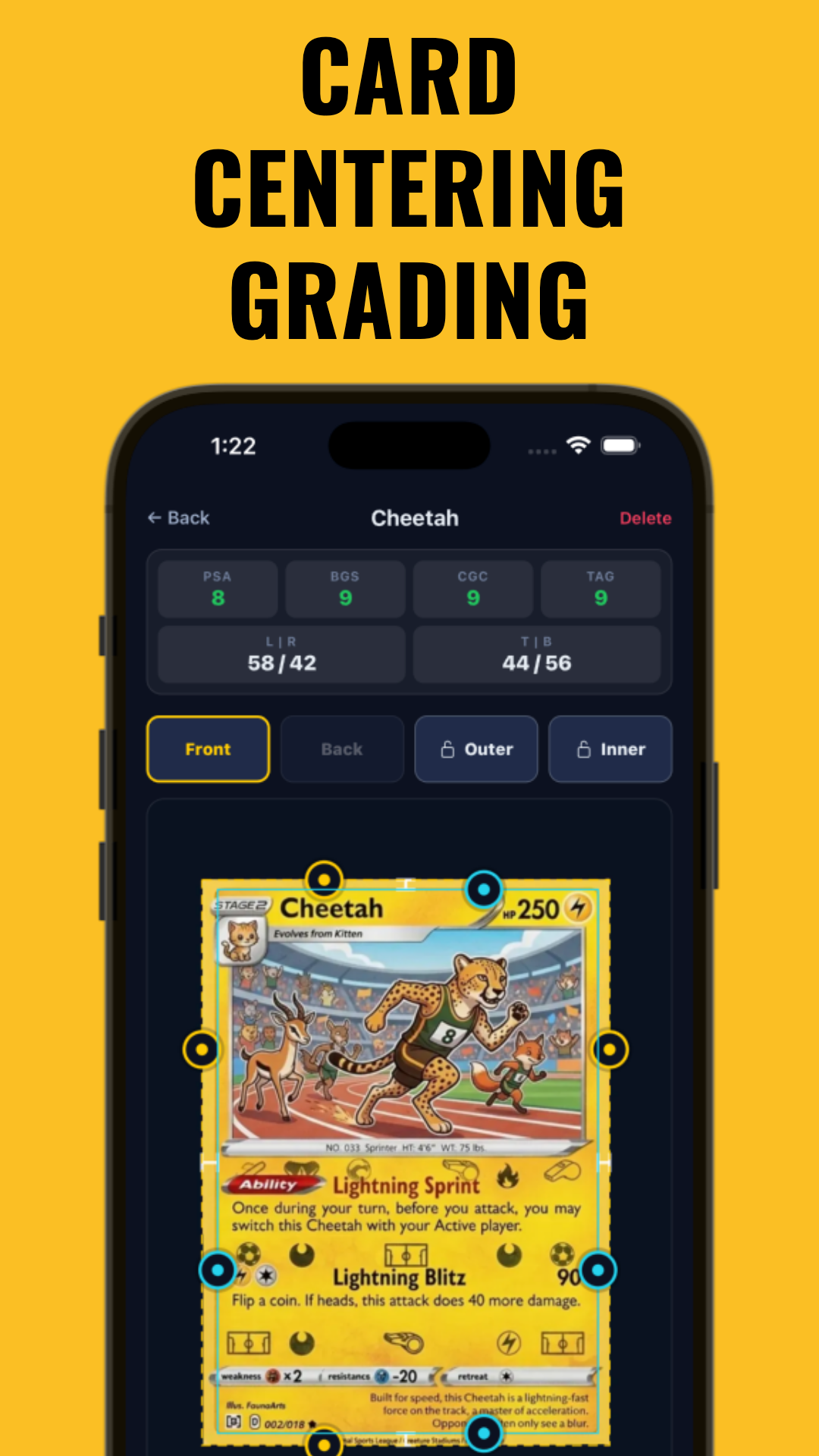
Digital tools also allow bulk uploads and instant batch processing, which can be useful for serious collectors or dealers.
For a deep dive into how AI enhances centering testing, see this AI-focused comparison.
When to Use Which Method
- Manual methods: Best for quick, rough checks or when digital tools are unavailable.
- Apps/tools: Useful for high-value cards and when accuracy is crucial for grading and resale.
Section 7: Well-Centered vs. Poorly Centered Cards—Real Examples
Visual Examples
- Well-centered card: Borders are visually equal, both left/right and top/bottom. The printed image sits squarely in the middle. These cards are candidates for Gem Mint grades.
- Poorly centered card: One or more borders are noticeably thinner or thicker. The image may appear "shifted" or close to an edge. These cards often max out at PSA 8 or lower, even if flawless otherwise.
Case Study: Vintage vs. Modern Cards
Vintage cards (e.g., 1950s Topps baseball) are known for poor centering due to older printing methods. Modern cards, while generally better, can still suffer from sheet misalignments or cutting errors.
- 1952 Topps Mickey Mantle: Most examples are off-center and a well-centered copy can command a significant premium.
- Modern Pokémon cards: Centering issues are usually less severe, but even a 60/40 card may not reach PSA 10.
How to Spot Issues Quickly
- Compare opposite borders visually.
- Use a ruler, gauge, or app for confirmation.
- Check centering on both the front and back—many cards are only off-center on one side.
For specific measuring instructions, the Pokémon centering tool guide provides practical tips.
Section 8: Centering Tolerances Across Card Types and Eras
How Tolerance Standards Evolved
Older cards were produced using less precise printing and cutting equipment. As a result, grading companies often have more lenient centering standards for vintage cards.
- Vintage (pre-1980): PSA may allow 60/40 or 65/35 centering for Gem Mint, depending on the era and set.
- Modern (post-1980): 55/45 or 60/40 is usually the strictest requirement for the highest grade.
Different Card Types
- Sports cards: Often have colored or white borders, making centering issues more obvious.
- Pokémon, Magic, Yu-Gi-Oh: Borders vary by set; some are thick and forgiving, others are razor-thin and highlight even minor shifts.
Understanding the specific tolerances for each card type, set, and grading company is important for successful centering testing.
Back Centering—Why It’s More Lenient
Most grading companies allow much greater deviation on the back (often up to 90/10) since cards are usually displayed front-facing. Still, extreme back centering issues can affect the final grade.
For a complete overview of grading apps and tools for collectors, see this guide.
Conclusion
Centering testing is one of the most critical—and most overlooked—steps in trading card collecting and grading. Even a card with flawless corners and surfaces will struggle to earn top grades if its centering falls outside grading company standards. By learning how to measure centering accurately using border ratios, understanding the nuances of left-to-right and top-to-bottom axes, and applying the correct grading standards for PSA, BGS, and CGC, collectors can maximize both grades and card values.
Modern tools like Midpoint make centering testing easier and more precise, helping collectors save time and make informed decisions. Whether you’re pre-grading your own collection or evaluating cards for purchase, mastering centering testing is a valuable skill for anyone serious about the hobby.
FAQ
Q: What is centering on a trading card?
A: Centering refers to how evenly the printed image is positioned within the borders of a trading card. Perfect centering means the borders are equal on all sides, while off-centering means the image is shifted, producing uneven borders.
Q: How do you measure card centering?
A: Measure the width of each border (left, right, top, bottom) with a millimeter ruler or digital tool. Calculate the ratio of each side compared to its opposite (e.g., left vs. right) and express as a percentage (e.g., 55/45). Digital tools like Midpoint can provide instant, accurate measurements.
Q: What is a good centering ratio for PSA grading?
A: For PSA 10 (Gem Mint), centering must be 55/45 or better on the front and 75/25 or better on the back. Lower grades have more lenient standards, but top grades require near-perfect centering.
Q: Does centering affect card grade a lot?
A: Yes. Centering is a major factor in grading. Even small deviations can prevent a card from achieving the highest grade and may affect its market value.
Q: How do you tell if a card is off-center?
A: Look for uneven borders. If one side is noticeably thinner or thicker than its opposite, the card is off-center. Measuring with a ruler or centering tool provides a precise answer.
Q: What centering standards do PSA, BGS, and CGC use?
A: Each company has published guidelines. For Gem Mint grades: PSA allows 55/45 (front), BGS requires 50/50 to 52/48 (front), and CGC requires 50/50 (front). Back centering standards are more lenient for all three.
Free to start
Try the Midpoint app
Grade any card from a photo, see its raw and PSA 10 value, and track what your collection is worth — free.
Get it on iPhoneGet it on Android