Peyton Manning Cards Worth Money: Top Rookies to Grade
Which Peyton Manning cards are worth money? Compare 1998 rookies, raw vs PSA 10 values, and which cards are worth grading before you submit.

Estimated reading time: 12 min
Key Takeaways
- Peyton Manning cards worth money are concentrated in his 1998 rookie class, especially Topps Chrome #165, Bowman Chrome #1, and Playoff Contenders Rookie Ticket #87, plus serial-numbered parallels, autographs, and one-of-ones.
- The gap between a raw card and a Peyton Manning PSA 10 is where most of the money is made or lost. Chrome-era rookies are especially sensitive to centering and surface flaws.
- Always price from completed sales, not asking prices, and match the exact set, card number, variation, and grade.
- Pre-grade first. Check centering, corners, edges, and surface before paying a grading fee that commonly runs into the tens of dollars per card, before shipping.
Card values — live data from Midpoint's card database, as of 2026-10-31. Prices move; Midpoint refreshes these daily.
| Card | Raw | PSA 10 | Gem premium | |
|---|---|---|---|---|
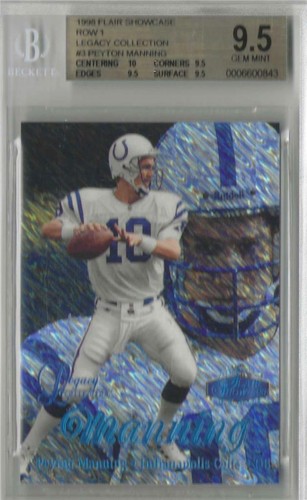 |
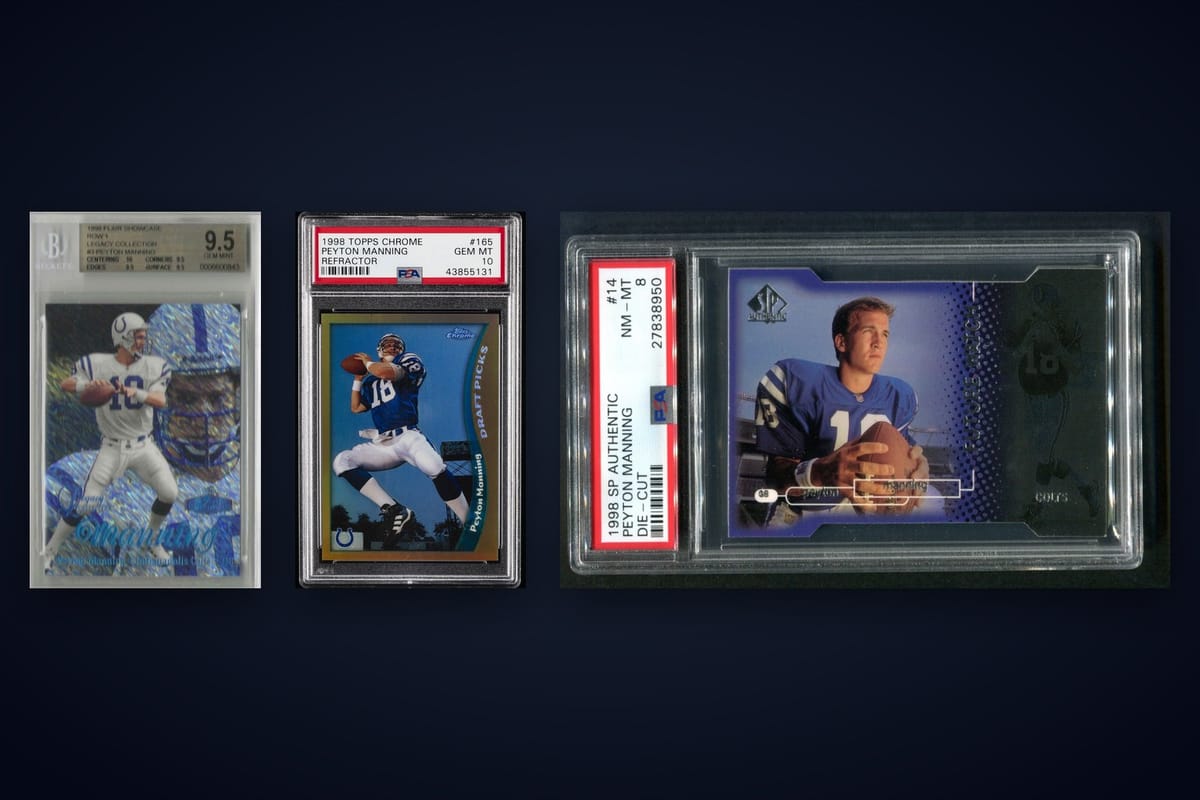
Peyton Manning [Row 1] #3 1998 Flair Showcase Legacy Collection |
— | $19,642 | — |
 |
Peyton Manning [Refractor] #165 1998 Topps Chrome |
$1,487 | $13,129 | 8.8× |
 |
Peyton Manning [Die Cut] #14 1998 SP Authentic |
$1,316 | $10,000 | 7.6× |
 |
Peyton Manning #14 1998 SP Authentic |
$825.00 | $9,446 | 11.5× |
 |
Peyton Manning / Bo Nix [Black] #SCDS-NM 2025 Topps Signature Class Dual Signatures |
$1,500 | $6,990 | 4.7× |
 |
Peyton Manning [Autographed Red] #87 1998 Playoff Contenders Ticket |
$280.91 | $6,606 | 23.5× |
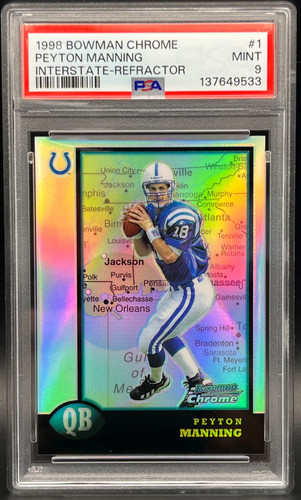 |
Peyton Manning [Interstate Refractors] #1 1998 Bowman Chrome |
$196.25 | $4,968 | 25.3× |
 |
Peyton Manning [Refractor] #1 1998 Bowman Chrome |
$248.50 | $4,716 | 19× |
 |
Peyton Manning [Refractor] #7a 1998 Bowman's Best Autographs |
— | $4,550 | — |
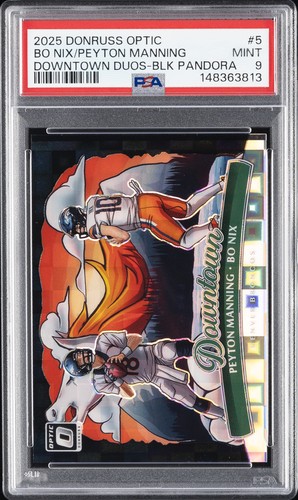 |
Bo Nix / Peyton Manning #5 2025 Panini Donruss Optic Downtown Duo |
$875.00 | $3,795 | 4.3× |
 |
Peyton Manning #M-PMA 2024 Panini Prizm Manga |
$1,650 | $3,394 | 2.1× |
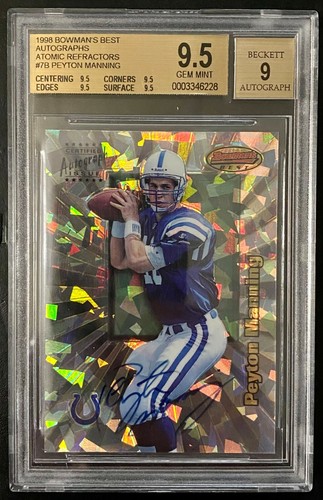 |
Peyton Manning [Refractor] #7b 1998 Bowman's Best Autographs |
— | $3,389 | — |
Look up any card's current raw and graded value in Midpoint — and get an estimated grade before you pay to submit.
Table of Contents
- Section 1: Which Peyton Manning Cards Are Worth Money
- Section 2: Peyton Manning Rookie Card Value (1998 Class)
- Section 3: Most Valuable Peyton Manning Cards
- Section 4: Raw vs PSA 10, BGS, SGC, and CGC
- Section 5: How Condition Changes Value
- Section 6: Identifying Parallels, Refractors, Autographs, and Relics
- Section 7: Checking Sold Listings and Deciding to Grade, Sell, or Hold
Section 1: Which Peyton Manning Cards Are Worth Money
If you are asking which Peyton Manning cards are worth money, the short answer is: his 1998 rookies in high grade, anything serial-numbered, and anything with an autograph or game-used material. Manning is a Hall of Famer, a two-time Super Bowl winner, and the face of the 1998 class. That keeps demand steady across eras.
Prices move constantly, so this guide gives you the ranking logic and the method rather than freezing numbers that go stale. Use it as a starting point, then verify against recent completed sales.
The value tiers, from top to bottom
- Tier 1: One-of-one parallels, low-numbered autographs, and rare inserts from the late 1990s.
- Tier 2: High-grade 1998 rookies, especially Topps Chrome, Bowman Chrome, and Contenders Rookie Ticket.
- Tier 3: Refractors, numbered parallels, and relic cards from later years.
- Tier 4: Raw base cards and common inserts, which are collectible but rarely worth a grading fee.
Why Manning holds value
Three things support the market. First, rookie cards from 1998 have a clear identity as collectibles from the "Manning vs. Leaf" draft class. Second, supply of true gem-condition copies is limited, because many 1990s cards were printed with centering and surface issues. Third, Manning's career keeps him in the conversation among the best quarterbacks ever.
The takeaway: not every Manning card is valuable. The same player can have a card worth a few dollars and another worth a serious chunk of money. Set, scarcity, and grade decide which is which.
Section 2: Peyton Manning Rookie Card Value (1998 Class)
Peyton Manning rookie card value depends first on which 1998 card you hold. Not all rookies are equal. Here are the ones collectors chase, roughly in order of market attention.
The key 1998 rookies
- 1998 Topps Chrome #165: The most recognized chrome rookie. It is the benchmark for the 1998 Topps Chrome Peyton Manning search, and condition drives its price dramatically.
- 1998 Bowman Chrome #1: Card number one in a chrome set, with a strong following and a clean design that shows flaws easily.
- 1998 Playoff Contenders Rookie Ticket #87: A popular rookie because of the ticket design and the autograph version of the Contenders line. The autographed Rookie Ticket is a premium item, and high-grade examples have set records.
- 1998 Finest: A premium-feel card from a respected chrome-style product, with its own protective coating that complicates grading.
- 1998 Upper Deck Star Rookie: A mainstream rookie with wide availability, so only top grades carry a real premium.
- 1998 Topps #360: The base Topps rookie. It is the most affordable entry point and widely available.
How to read the ranking
Chrome and Finest cards are generally more valuable in top grades, in part because their glossy surfaces are hard to keep flawless. Base paper rookies like Topps #360 are usually the cheapest of the group, and a Peyton Manning PSA 10 of a common paper card is a different market than a PSA 10 of a chrome card.
Pay attention to the card number and set name when you search. "Manning rookie" can mean six different cards with very different values. Always include the year, brand, and number, for example "1998 Bowman Chrome #1 Peyton Manning."
Section 3: Most Valuable Peyton Manning Cards
The most valuable Peyton Manning cards are rarely the base rookies. They are scarce by design: serial-numbered, signed, or one of a kind.
One-of-one and low-numbered cards
Rare, low-numbered 1998 SkyBox Metal Universe parallels, such as the Precious Metal Gems cards, are famous examples from the late-1990s insert boom. When a true 1/1 sells, it can set a record because there is literally one copy. Treat any such sale as a ceiling reference, not a typical price.
Other targets include low-numbered parallels and rare inserts from 1990s sets. Their values depend on how often they trade, so there may be few comparable sales.
Autographs
Certified autographs rank high, especially the signed Playoff Contenders Rookie Ticket. A high-grade example of this card has been among the notable record sales. Autographs bring extra grading questions: the card grade and the signature grade can be separate, and a flawed signature can drag value down even when the card is clean.
Refractors, parallels, and memorabilia cards
- Refractors: Chrome-line parallels with a rainbow finish. Rarer than base chrome and priced accordingly.
- Serial-numbered parallels: The lower the print run, the higher the typical premium.
- Relics and patches: Jersey and patch cards from the Colts and Broncos eras. A multi-color patch or a game-used piece with a clean design often outsells a plain swatch.
Rule of thumb: scarcity first, then grade, then eye appeal. A modest card in a beautiful gem slab can still lose to a rarer card in a lower grade.
Section 4: Raw vs PSA 10, BGS, SGC, and CGC
The biggest swing in any Manning card's price is its grade. A raw card is unverified, so buyers discount it for the risk of hidden flaws. A graded card in a high grade removes that doubt.
Why PSA 10 carries a premium
A Peyton Manning PSA 10 is the gem mint standard collectors pay up for. For chrome-era rookies, the gap between PSA 9 and PSA 10 can be large, because gem copies are hard to find. That gap is the reason people search for the best Peyton Manning cards to grade.
- Raw: Lowest price, most variance. Buyers often assume a lower grade unless you show otherwise.
- PSA: The largest market and usually the strongest resale liquidity for football cards.
- BGS: Subgrades add detail, and a BGS 9.5 or Black Label can command its own premium. The scale differs from PSA, so compare carefully.
- SGC and CGC: Often cheaper to submit and increasingly accepted, but buyers may price them below an equivalent PSA slab.
Because each company defines top grades differently, read the grading scale differences by company before assuming a BGS 9.5 and a PSA 10 are equal.
Which cards are best to grade?
Generally, grade cards where the value jump from raw to a high grade clearly exceeds the fee, shipping, and risk. That usually means the chrome rookies, Contenders, serial-numbered parallels, and autographs. Paper base cards and common inserts rarely justify it unless they look perfect.
Section 5: How Condition Changes Value
Grading is a checklist. Each flaw category can pull a card from a 10 down to a 9 or lower, and with Manning chrome rookies that single point can matter a lot.
The five condition factors
- Centering: How evenly the borders sit left to right and top to bottom. Off-center is the most common reason a 1990s card misses gem mint. Our guide on how centering impacts card value explains the tolerances.
- Corners: Look for whitening, softness, or dings, especially on dark borders.
- Edges: Chipping along the edge shows as white flecks. Chrome and Finest are prone to this.
- Surface: Scratches, print lines, fingerprints, and dimples. Tilt the card under a light.
- Print defects: Chrome cards often have factory issues like roller lines, ink spots, or miscuts.
Chrome-specific issues
On 1998 Topps Chrome and Bowman Chrome, inspect the surface for hairline scratches and the edges for chipping. Many chrome cards were also cut slightly off-center at the factory. A card can look perfect to the naked eye and still miss a 10 because of the borders.
Measuring is better than guessing. Midpoint's centering tool lets you check borders before you submit, and the free centering calculator gives you a quick ratio.

A measured 50/50 on both axes with clean corners is a very different submission than a card that looks "pretty good."
Section 6: Identifying Parallels, Refractors, Autographs, and Relics
A common question is: how can I tell if my Peyton Manning card is a rare parallel or refractor? The answer is to identify the card precisely before you price it.
Step-by-step identification
- Read the back. The copyright year, brand, and card number identify the set. Match them to the 1998 list above.
- Check for a serial number. A stamp like "12/50" means a numbered parallel. The lower the denominator, the scarcer the card.
- Look at the finish. A refractor reflects a rainbow when you tilt it. Base chrome has a smooth mirror shine without the spectrum effect. Compare against a known base copy.
- Look for a coating. Finest-style cards can have a peelable protective film that affects appearance.
- Verify autographs. Look for a manufacturer sticker or a card stating it is certified. Be careful with unverified signatures.
- Check relics. A real memorabilia card has a window with fabric or a patch and a statement of authenticity on the card.
Base vs. variation pricing
A base card and its parallel can share the same name and number but trade at completely different prices. Never compare a parallel to a base sale. Use a lookup with raw and graded values by variation. Midpoint's card lookup can help you confirm you have the right version before you search for comps.
If you cannot tell what you have, hold off on listing or grading. Misidentifying a refractor as a base card could mean selling underpriced, while assuming a base card is a parallel leads to overpaying a grading fee.
Section 7: Checking Sold Listings and Deciding to Grade, Sell, or Hold
Asking prices are wishes. Completed sales are facts. Build your own price guide from sold data.
How to check sold listings
- On eBay, search the exact card, then filter by Sold items to see completed sales.
- Check auction house archives for higher-end cards, autographs, and one-of-ones.
- Compare at least five recent sales in the same grade. Drop outliers caused by bidding wars or listing errors.
- Match grader and grade exactly. A PSA 9 and a BGS 9 are not the same comp.
Build a simple price guide
Track each card in a sheet with these columns: card, year, set, card number, variation, grade, recent sale range, date. Update it as new sales appear. Midpoint's portfolio tracking does this over time so you can see your collection's value change.
Grade, sell, or hold?
- Grade if the card is a chrome rookie, Contenders, or numbered card with strong centering, clean surface, and sharp corners. Estimate the grade first with our step-by-step pre-grading guide, and compare the likely graded value to the fee, shipping, and wait time.
- Sell raw if the card shows visible flaws or sits in a low-value tier where grading costs eat the profit.
- Hold if you own a scarce card and do not need cash. Store it properly, since our guide to storing valuable cards covers sleeves and holders that prevent damage.
Buyer demand matters too. Cards that sell often are easy to exit. Rare one-of-ones may wait months for the right bidder. With Midpoint, you can estimate PSA, BGS, CGC, and TAG grades from a photo before spending anything, which helps you avoid grading cards that will not pay off.
Conclusion
The Peyton Manning cards worth money are the ones that combine scarcity and condition: 1998 chrome rookies like Topps Chrome #165 and Bowman Chrome #1, the Playoff Contenders Rookie Ticket #87, serial-numbered parallels, autographs, and rare one-of-ones like the low-numbered 1998 SkyBox Metal Universe parallels. The difference between a raw copy and a PSA 10 can be the entire profit margin.
Identify the exact card, price it from completed sales, and measure condition before you submit. Centering is the step most collectors skip and the one that most often decides the grade. Try Midpoint to check centering and get a grade estimate first, so every grading fee you pay is a smart one.
FAQ
Q: How much is a Peyton Manning rookie card worth?
A: It depends on which 1998 rookie you own and its grade. Chrome rookies like Topps Chrome #165 and Bowman Chrome #1 and the Contenders Rookie Ticket #87 usually lead, while Topps #360 is the more affordable base option. Check completed sales for your exact card and grade rather than relying on asking prices.
Q: What is the most valuable Peyton Manning card?
A: One-of-one and ultra-low-numbered cards generally top the list, such as rare low-numbered 1998 SkyBox Metal Universe parallels. High-grade autographed Playoff Contenders Rookie Tickets have also produced record sales.
Q: Which Peyton Manning cards are worth money?
A: Focus on 1998 chrome rookies, the Contenders Rookie Ticket, serial-numbered parallels, refractors, autographs, and quality relics. Common base cards and paper inserts in average condition are usually worth much less.
Q: What is a 1998 Topps Chrome Peyton Manning card worth?
A: The 1998 Topps Chrome #165 is one of his best-known rookies, and its value swings widely with grade. Raw copies sell for much less than high-grade slabs, so look at sold listings for the exact grader and grade you hold.
Q: How much is a Peyton Manning rookie card worth if it is graded PSA 10?
A: A PSA 10 carries a significant premium over lower grades and raw copies, especially for chrome rookies, because gem copies are hard to find. The exact amount changes with the market, so check recent PSA 10 sales for the specific set and card number.
Q: How can I tell if my Peyton Manning card is a rare parallel or refractor?
A: Check the card back for set and number, look for a serial number stamp, and tilt the card to see if it shows a rainbow refractor effect compared with a base copy. Confirm the variation with a card lookup before pricing.
Free to start
Try the Midpoint app
Grade any card from a photo, see its raw and PSA 10 value, and track what your collection is worth — free.
Get it on iPhoneGet it on Android