PSA Centering Standards: A Complete Guide for Card Graders
Learn PSA centering standards for PSA 10, 9, 8, 7, plus BGS, CGC, SGC, and TAG. See centering tolerances, how to measure, and avoid costly grading mistakes.

Estimated reading time: 13 min
Key Takeaways
- PSA centering standards for PSA 10, 9, 8, 7 are strict, with different front/back tolerances.
- Major graders like BGS, CGC, SGC, and TAG each have unique centering requirements.
- Centering is measured left-right and top-bottom, and the worst axis determines the grade.
- Tools like Midpoint let you check centering before submitting for grading.
- Understanding centering tolerances helps avoid costly grading surprises.
Table of Contents
- Section 1: Why Centering Matters in Card Grading
- Section 2: PSA Centering Standards Explained
- Section 3: How to Measure Card Centering
- Section 4: Centering Tolerances by Grading Company
- Section 5: Common Myths and Misunderstandings
- Section 6: Practical Tools & Pre-Grading Strategies
- Conclusion
- FAQ
Section 1: Why Centering Matters in Card Grading
The Role of Centering in Card Value
In trading card grading, centering refers to how well the printed image is positioned on the card. Poor centering can decrease a card’s grade and, consequently, its value—sometimes by significant amounts. For many collectors, a card with perfect corners and edges but poor centering is still a disappointment, especially in high-value sets like vintage sports or Pokémon cards.
- Centering is one of the four main grading subcategories (along with corners, edges, surface).
- Even minor centering flaws can drop a card from Gem Mint (PSA 10) to Mint (PSA 9) or lower.
- High-value cards with poor centering are often worth less than perfectly centered examples.
Why Graders Set Strict Centering Standards
Grading companies like PSA, BGS, CGC, SGC, and TAG use strict centering tolerances to maintain market trust and ensure consistency. These standards are published (though sometimes with evolving language), so collectors and submitters can know what to expect. This transparency is crucial for fairness—especially when grading fees can exceed $30 per card.
Real-World Impact: Examples
Consider a 1st Edition Base Set Charizard Pokémon card. A PSA 10 Gem Mint copy with strong centering has sold for over $250,000. The same card with 60/40 centering (just outside PSA 10 tolerance) might only achieve a PSA 9 grade—potentially dropping its value significantly.
- PSA 10 1st Edition Charizard: $250,000+ (in some sales)
- PSA 9 1st Edition Charizard: $80,000-$100,000 (approximate range)
- Small centering differences can mean large value changes
That’s why understanding centering standards is essential for collectors and dealers.
Section 2: PSA Centering Standards Explained
PSA 10 Gem Mint Centering Tolerance
According to PSA’s official documentation, a PSA 10 card must have centering of 55/45 or better on the front and 75/25 or better on the reverse. This means the image can be off-center by no more than 5% in either left-right or top-bottom direction (the “worst axis”) on the front, and up to 25% on the back.
- Front (PSA 10): 55/45 or better, left-right and top-bottom
- Back (PSA 10): 75/25 or better, either axis
PSA measures centering to the nearest percent, typically rounding to the more off-centered axis. For example, a card with 56/44 left-right and 54/46 top-bottom would be considered 54/46 (the worst axis), and would not qualify for PSA 10.
Changing Language: 60/40 vs 55/45
Historically, PSA described their Gem Mint (10) standard as requiring 60/40 or better centering. In recent years, official documentation has shifted to 55/45 language. This subtle change has caused confusion in the hobby. For clarity, always reference PSA’s current guidelines, which are published on their website and grading inserts.
Centering Thresholds for Lower PSA Grades
- PSA 9 (Mint): 60/40 or better front, 90/10 or better back
- PSA 8 (NM-MT): 65/35 or better front, 90/10 or better back
- PSA 7 (NM): 70/30 or better front, 90/10 or better back
Cards with centering outside these tolerances will receive lower grades, regardless of how clean the corners, edges, or surface are. If both axes are off, the worst axis dictates the centering grade.
Front vs Back Centering
PSA is much stricter on the front, as it’s the card’s primary display side. The back allows for more leniency, acknowledging that printing technology often results in greater back variation.
For a detailed breakdown of how centering impacts grade and value, see How Centering Impacts Card Value: A Detailed Guide.
Section 3: How to Measure Card Centering
Measuring Left-Right and Top-Bottom Centering
Card centering is measured by comparing the border widths on all four sides of the card. The formula uses the ratio of the narrower border to the wider border on each axis, converting this to a percentage (e.g., 55/45).
- Measure the left and right borders; calculate the percentage difference.
- Repeat for the top and bottom borders.
- The worst axis (the most off-center) is used for grading.
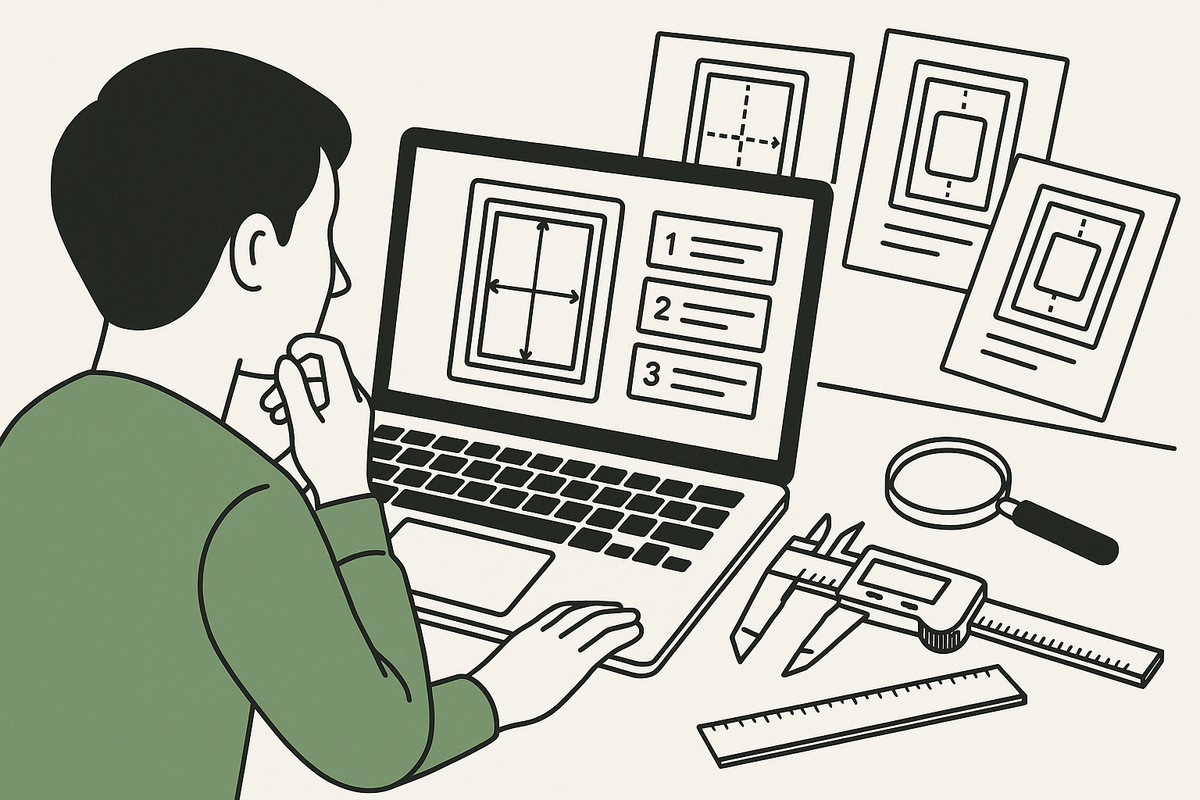
Manual Measurement Tools
- Rulers or calipers (down to the millimeter)
- Printable centering gauges
- Card grading overlays
For a full guide to measuring card centering, see How to Measure Card Centering: Step-by-Step Precision Guide.
Digital Tools and Calculators
Modern collectors use card centering apps like Midpoint to analyze centering within seconds. These tools process a card photo and output precise percentage centering on both axes, showing PSA, BGS, CGC, and TAG estimates. This eliminates guesswork and helps decide if a card is worth submitting for grading.
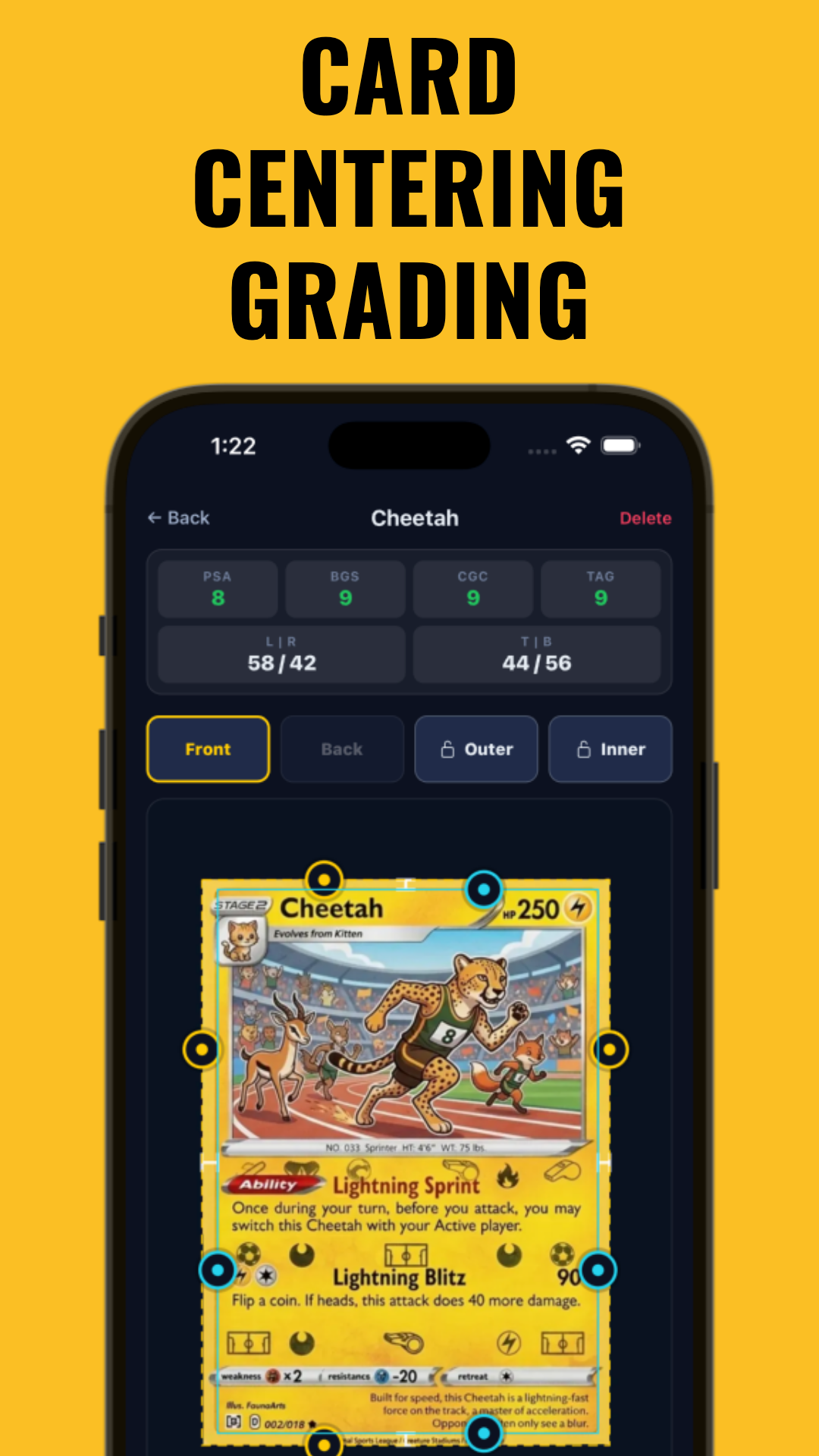
- Upload a card photo
- AI measures all borders instantly
- Outputs centering ratios and grade estimates
For a step-by-step tutorial, see Card Centering Tool: Accurate Card Grading Estimates.
Section 4: Centering Tolerances by Grading Company
PSA Centering Standards Recap
- PSA 10: 55/45 front, 75/25 back
- PSA 9: 60/40 front, 90/10 back
- PSA 8: 65/35 front, 90/10 back
- PSA 7: 70/30 front, 90/10 back
BGS Centering Requirements
- BGS 10 (Pristine): 50/50 to 55/45 front, 60/40 back
- BGS 9.5 (Gem Mint): 50/50 to 60/40 front, 65/35 back
- BGS 9: 60/40 front, 65/35 back
BGS is strict on centering for the Pristine 10 grade, requiring near-perfect alignment. Their full subgrade system means a single centering flaw can drop an otherwise flawless card to 9.5 or below.
CGC Centering Standards
- CGC 10: 55/45 or better front, 75/25 back
- CGC 9: 60/40 front, 90/10 back
CGC’s standards closely mirror PSA's but may apply stricter consistency in measurement due to their digital verification process. For more, compare AI-Focused Comparison: How AI Transforms Card Centering Analysis.
SGC Centering Guidelines
- SGC 10: 55/45 or better front, 80/20 back
- SGC 9: 60/40 front, 90/10 back
SGC is slightly more lenient on back centering than PSA or CGC but aligns closely on the front.
TAG Grading Centering
TAG (Transparency, Authenticity, Grading) uses an AI-driven approach to centering, often displaying an exact centering percentage on the label. Their standards are published as 55/45 or better for the top grade, in line with PSA and CGC.
Which Grader Is Most Lenient?
- For Gem Mint grades, SGC may allow slightly more back variation (80/20).
- BGS is strictest for 10 Pristine, requiring 50/50 to 55/45 centering.
- Overall, PSA, CGC, and TAG are very similar for front centering tolerances.
Always check the latest published guidelines for each company before submitting. For a deeper dive on each, see company-by-company guides on their respective websites and grading documentation.
Section 5: Common Myths and Misunderstandings
Myth 1: 60/40 Is PSA 10 Standard
Many collectors believe a card with 60/40 centering can earn a PSA 10. While older PSA language cited 60/40, current standards require 55/45 or better for PSA 10. Cards outside this, even by 1%, should not receive a 10—though rare exceptions exist due to human error.
Myth 2: Only Left-Right Centering Matters
PSA (and most graders) measure both left-right and top-bottom centering. The “worst-axis” approach means a card can have perfect left-right, but if the top is much thicker than the bottom (or vice-versa), the off-axis dictates the grade. Both directions are equally important.
Myth 3: Back Centering Is Ignored
While the back is less strict, it’s still considered. A card with perfect front centering but a back outside 75/25 (for PSA 10) cannot receive Gem Mint. Back centering is just more forgiving to account for common print shifts.
Myth 4: PSA Graders Use Rulers for Every Card
PSA graders use a mix of visual assessment and templates, but for borderline cases, they may use calibrated tools or digital overlays. Human error can occur; this is why pre-grading with tools like Midpoint can be helpful.
- Don’t rely on “eyeballing”—use precise measurements.
- Document your centering before sending a card to grading.
For best practices, see How to Pre-Grade Your Card: A Step-by-Step Guide.
Section 6: Practical Tools & Pre-Grading Strategies
Using Digital Centering Tools
In the past, collectors relied on plastic rulers and guesswork. Today, digital tools like Midpoint bring centering analysis to your desktop or phone. Upload a photo, and the app instantly measures all four borders, outputs both axes’ percentages, and estimates grades across PSA, BGS, CGC, SGC, and TAG. This lets you avoid costly grading fees for off-center cards.
- Instant centering analysis (down to 0.1mm)
- Grade predictions for all major graders
- Bulk upload and organize your collection
Manual Pre-Grading Checklist
- Measure borders in millimeters (left, right, top, bottom)
- Calculate ratio: (small border ÷ large border) × 100 = centering %
- Compare to published standards (e.g., 55/45 for PSA 10)
- Check both axes—whichever is worse sets the allowed grade
- Document with photos for your records
When to Submit (or Not)
If your card’s worst-axis centering is outside the top grade’s tolerance, consider the cost-benefit of submitting. Skipping cards that won’t achieve your desired grade can save money in grading fees over time. For more on this process, see Estimate Your Card: A Practical Guide Before Grading.
Midpoint and similar apps are especially valuable for bulk submissions and high-value cards, letting collectors prioritize only those cards most likely to earn premium grades.
Conclusion
Understanding PSA centering standards—and how they compare to BGS, CGC, SGC, and TAG—is essential for serious card collectors and submitters. Front and back centering tolerances are stricter than many realize, and the "worst-axis" rule can mean the difference between a Gem Mint 10 and a far less valuable grade. By leveraging measurement tools, carefully checking both axes, and comparing across grading companies, you can maximize your card's value and avoid expensive grading mistakes. Digital apps like Midpoint take the guesswork out of centering analysis and provide instant grade estimates—before you ever spend a dime on grading fees.
FAQ
Q: What are PSA centering standards for a PSA 10?
A: PSA requires 55/45 or better centering on the front (left-right AND top-bottom) and 75/25 or better on the back for a PSA 10 Gem Mint grade.
Q: Is PSA 10 centering 55/45 or 60/40?
A: Current PSA documentation says 55/45 or better on the front for PSA 10. Older language used 60/40, but this is outdated—double-check PSA’s latest standards before submitting.
Q: How does PSA measure card centering on the front and back?
A: PSA measures both left-right and top-bottom borders. The axis that is most off-center (the “worst-axis”) is used to determine the centering grade. The back is allowed more variation than the front.
Q: What centering is allowed for PSA 9, PSA 8, and PSA 7?
A: PSA 9 allows 60/40 front and 90/10 back; PSA 8 allows 65/35 front, 90/10 back; PSA 7 allows 70/30 front, 90/10 back.
Q: Does PSA care more about left-right or top-bottom centering?
A: PSA weighs both equally. The worst of the two axes determines the centering grade, so both must meet the required tolerance for your target grade.
Q: How can I check my card’s centering before submitting to PSA?
A: You can use precise rulers or apps like Midpoint to measure left-right and top-bottom borders. Digital tools instantly calculate centering ratios and show if your card meets PSA, BGS, CGC, SGC, or TAG grading standards.
Free to start
Try the Midpoint app
Grade any card from a photo, see its raw and PSA 10 value, and track what your collection is worth — free.
Get it on iPhoneGet it on Android