SGC Centering: Complete Guide to Card Grading Standards and Tolerances
Master SGC centering standards for trading cards. Learn measurement methods, grade thresholds, comparisons to PSA/BGS/CGC, and practical tips for collectors.

Estimated reading time: 13 min
Key Takeaways
- SGC centering is a critical factor in card grading, directly impacting grade and value.
- SGC publishes clear centering tolerances for each grade, but standards differ from PSA, BGS, and CGC.
- Accurate measurement—front and back—is essential before submitting your card for grading.
- Tools like Midpoint help collectors measure centering precisely down to the millimeter.
- Understanding centering standards helps avoid grading mistakes and disappointment.
Table of Contents
- Section 1: What is SGC Centering?
- Section 2: SGC Centering Standards and Grade Thresholds
- Section 3: Measuring Card Centering for SGC Submission
- Section 4: Front vs. Back Centering and Tolerances by Grade
- Section 5: Comparing SGC Centering to PSA, BGS, and CGC
- Section 6: Common Centering Mistakes and How to Avoid Them
- Section 7: Tools and Methods for Checking Centering
- Section 8: Real-World Centering Examples: Good vs. Bad
- Conclusion
- FAQ
Section 1: What is SGC Centering?
Defining Centering in Card Grading
SGC centering refers to the alignment of a card's printed image within its borders. In the context of card grading, "centering" measures how evenly the card's artwork sits relative to the card’s physical edges. Perfect centering means the margins on all sides are equal, both front and back. Off-center cards have uneven borders—wider on one side than the other—which can impact the card’s grade and value.
Why Centering Matters
- Visual Appeal: Well-centered cards are generally more attractive to collectors and dealers.
- Grade Impact: SGC, like PSA, BGS, and CGC, treats centering as a core component of the grade—sometimes even the deciding factor between a 10 and a 9.5.
- Value: A card with a Gem Mint surface and corners but poor centering can lose significant resale value compared to a well-centered example.
SGC’s Place in the Grading Landscape
SGC (Sportscard Guaranty Corporation) is a well-known grading company, especially for vintage cards. Their centering standards are published, making them a choice for collectors who value transparency. SGC’s approach to centering, including its tolerances and measurement methods, can influence market value and collector confidence.
Section 2: SGC Centering Standards and Grade Thresholds
SGC’s Published Centering Tolerances
SGC publicly lists its centering requirements for each grade level. These are typically expressed as ratios (e.g., 55/45), where the numbers represent the percentage of border (shorter/longer margin) on each side. The tighter the ratio, the better the centering—and the higher the potential grade.
- SGC 10 (Gem Mint): Front 55/45 or better; Back 75/25 or better
- SGC 9.5 (Mint+): Front 60/40 or better; Back 85/15 or better
- SGC 9 (Mint): Front 65/35 or better; Back 90/10 or better
- SGC 8.5/8 (NM-MT+ / NM-MT): Front 70/30; Back 90/10
For lower grades, SGC allows greater centering variance. Always check SGC’s current standards before submitting, as tolerances may occasionally change.
How Centering Affects Final Grade
- If centering fails to meet the minimum for a grade, the card cannot achieve that grade, regardless of surface, corners, or edges.
- SGC rounds down to the lowest subgrade—so a card with perfect surface and corners but 60/40 centering can’t be a 10.
- Back centering standards are more lenient than front, but a severely off-center back can still limit the grade.
Comparing Tolerances Across Companies
SGC’s centering standards are similar to PSA’s, but generally less strict than BGS for Gem Mint grades. For example, SGC allows 55/45 on the front for a 10, while BGS requires 50/50 to 55/45. For a full breakdown, see the section on comparisons further below.
Section 3: Measuring Card Centering for SGC Submission
Manual vs. Digital Measurement
To meet SGC centering standards, precise measurement is essential. Manual methods (ruler, caliper, or grading loupe) can work, but tiny differences matter. Digital tools like Midpoint let you upload a photo and automatically calculate centering ratios within a fraction of a millimeter, streamlining the pre-grading process.
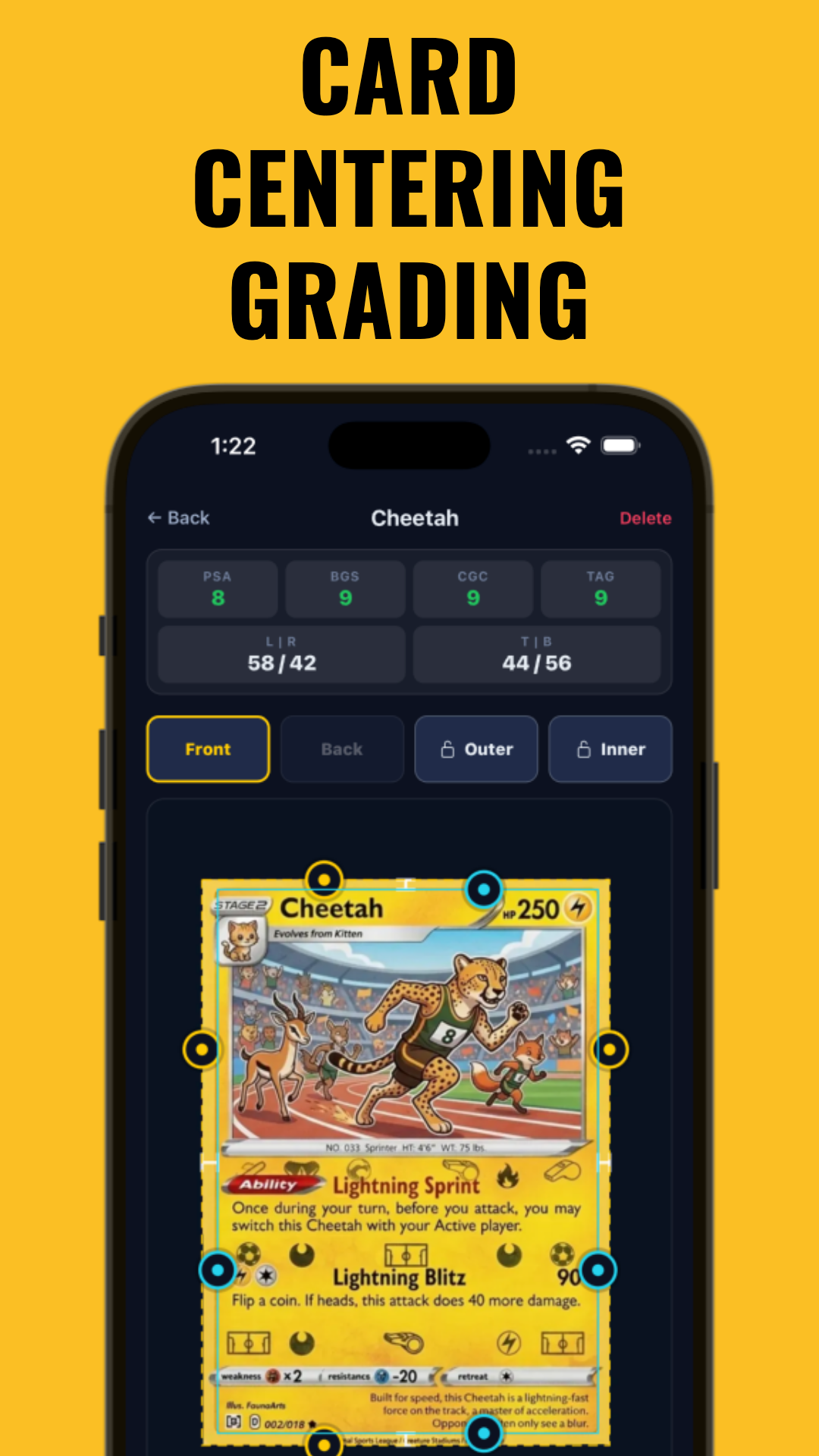
Step-by-Step Centering Measurement
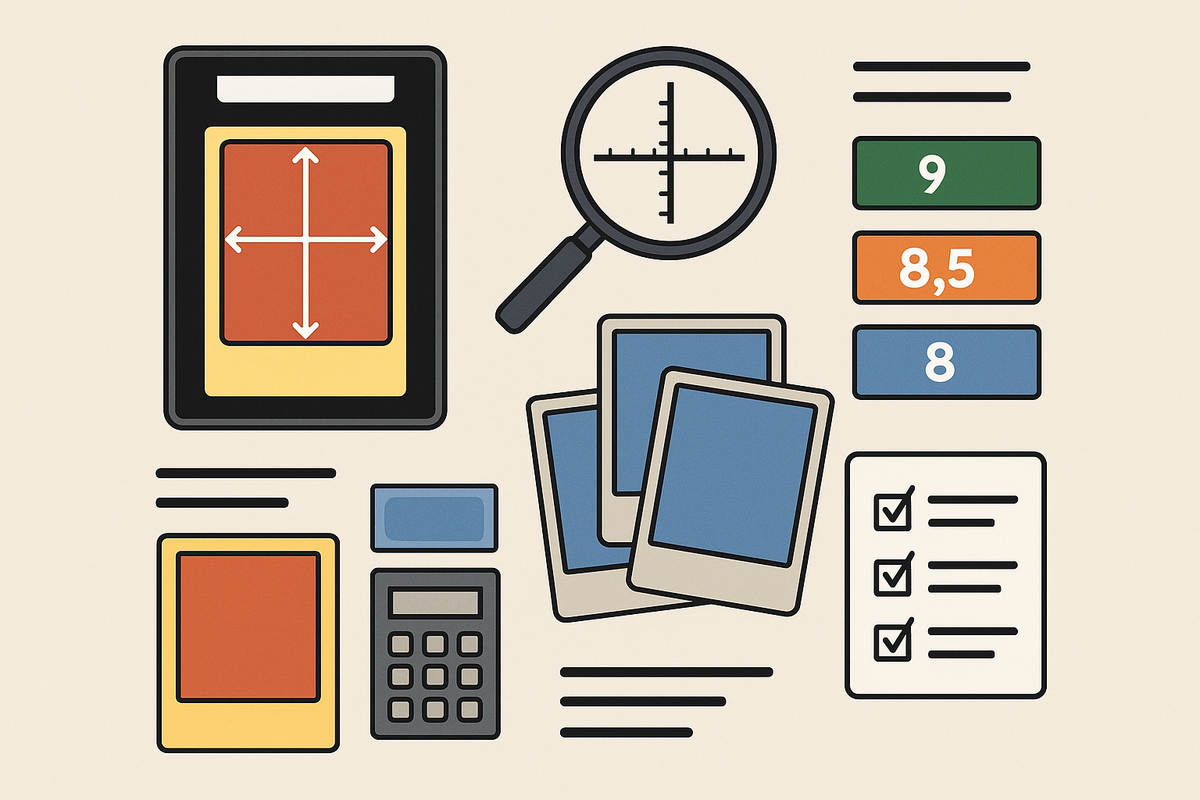
- Step 1: Place the card on a flat, well-lit surface. Photograph or scan at high resolution.
- Step 2: Measure the distance from the image edge to the card edge on each side (left, right, top, bottom) for the front, then the back.
- Step 3: Calculate the ratio:
- Width: Left border / (Left + Right borders)
- Height: Top border / (Top + Bottom borders)
- Step 4: Convert to percentage (e.g., 55/45 means one border is 55% of the total, the other 45%).
For a deep, practical tutorial, see How to Measure Card Centering: Step-by-Step Precision Guide.
Tips for Accuracy
- Always measure both front and back—SGC grades both.
- Avoid parallax error by shooting straight-on, not at an angle.
- Digital centering tools can help reduce human error and guesswork.
Section 4: Front vs. Back Centering and Tolerances by Grade
Front Centering: The Primary Standard
SGC, like PSA and BGS, weighs front centering most heavily. The front’s visual impact is what most collectors notice first. For SGC Gem Mint (10), the card must have front centering of 55/45 or better—so the wider margin can’t exceed 55% of the total width or height.
- For SGC 9.5, up to 60/40 is allowed on the front.
- For SGC 9, up to 65/35 is permitted.
These standards are strict, but SGC does allow some centering tolerance by grade—collectors should know where their card falls before submission.
Back Centering: More Lenient, But Still Important
- Back centering tolerances are wider: 75/25 for SGC 10, 85/15 for 9.5, and 90/10 for 9.
- If the back is grossly off-center, it can still cap the card’s final grade.
How to Apply These Standards
- Measure both axes (side-to-side and top-to-bottom); the worst ratio is what counts.
- Use the stricter of front or back to determine the highest possible grade.
For more on how centering impacts card value, see How Centering Impacts Card Value: A Detailed Guide.
Section 5: Comparing SGC Centering to PSA, BGS, and CGC
PSA Centering Standards
PSA’s Gem Mint 10 requires 55/45 or better on the front and 75/25 or better on the back—identical to SGC’s top grade. However, some collectors perceive PSA as slightly more forgiving in actual practice, especially for modern cards. See their official standards for current details.
BGS Centering Requirements
- BGS 10 (Pristine): 50/50 to 55/45 front, 60/40 back
- BGS 9.5: 50/50 to 60/40 front, 65/35 back
- BGS is stricter for Gem Mint front centering than SGC or PSA, which can make high BGS grades harder to achieve for cards with known print shift issues.
CGC Centering Standards
- CGC 10: 55/45 front, 85/15 back
- CGC 9.5: 60/40 front, 90/10 back
- CGC’s tolerances closely mirror SGC and PSA, but always check the latest grading estimates and standards.
TAG Grading Centering
TAG is an emerging digital grader that uses AI for centering analysis. Their tolerances are similar to the established companies but use automated measurement for consistency. For a deep dive, see AI-Focused Comparison: How AI Transforms Card Centering Analysis.
Which Grader Is Most Lenient on Centering?
- PSA and SGC have similar leniency at the Gem Mint level based on published standards.
- BGS is strictest for top grades but offers subgrades, so a card can get a high overall grade with a lower centering subgrade.
- CGC’s standards are similar to PSA and SGC, but always confirm current ratios before submitting.
For a comprehensive breakdown of how each major grading company approaches centering, see our comparison of card grading centering standards for PSA, BGS, CGC, SGC, and TAG.
Section 6: Common Centering Mistakes and How to Avoid Them
Misreading Border Thickness
Collectors often eyeball centering instead of measuring. Due to printing quirks and border designs, what looks centered can be far off. Always measure—preferably with a digital tool or precise ruler.
Ignoring Back Centering
- Many focus only on the front, but SGC (and all major graders) have back centering requirements.
- Cards with near-perfect fronts but 80/20 or worse backs typically grade lower than expected.
Forgetting Top-to-Bottom Alignment
- Some cards are well-centered side-to-side but off top-to-bottom. Both axes matter—SGC uses the worst case.
Submitting Without Measurement
- Don’t assume your card is a Gem Mint candidate based on appearance alone. Measuring and confirming your card’s centering tolerance by grade can help avoid disappointment.
Not Accounting for Card Shifts and Cuts
- Factory miscuts and print shifts can subtly impact centering—even on pack-fresh cards.
- Use a high-quality scan or photo and measure all four borders for accuracy.
Learn more about best practices in How to Pre-Grade Your Card: A Step-by-Step Guide.
Section 7: Tools and Methods for Checking Centering
Manual Tools
- Ruler or Caliper: Inexpensive but requires care to avoid parallax error.
- Grading Loupe: Magnifies borders, helpful for vintage cards with faint lines.
Digital Tools and Apps
- Midpoint: Upload your card image, and get instant percentage ratios for all four borders. Midpoint estimates SGC, PSA, BGS, CGC, and TAG grading tolerances automatically.
- Other apps exist, but few offer millimeter-level accuracy or multi-grader estimates.
Edge Centering Tools
Specialty edge centering tools are designed for pinpoint border measurement, especially for cards with colored or patterned borders. See What is an edge centering tool? for details.
Bulk and AI-Powered Solutions
- For large collections, bulk upload and AI grading tools can save time compared to manual work.
- AI-based analysis is increasingly accurate and unbiased—potentially useful for pre-screening cards before SGC or other submissions.
Section 8: Real-World Centering Examples: Good vs. Bad
Example 1: SGC 10 vs. SGC 8
- SGC 10: A card with borders measuring 2.5mm (left), 2.7mm (right), 1.9mm (top), and 2.1mm (bottom) on a standard 35mm-wide card results in a 54/46 left-right ratio—within Gem Mint tolerance.
- SGC 8: A card with one border at 3.0mm and the other at 1.5mm (top-bottom) would be 67/33—no better than an SGC 8.5/8, even if the front looks clean.
Example 2: Back Centering Limiting Grade
- A card with perfect 50/50 front centering but 82/18 back centering would be capped at SGC 9.5 under current tolerances.
Visual Differences
- Cards with 65/35 centering may look fine to the eye but will not qualify for Gem Mint status with SGC.
- Vintage cards often have weaker centering due to print technology of their era—SGC applies the same standards regardless of age.
Why Consistent Measurement Matters
By measuring every submission, you can avoid surprises—especially on high-value cards. Digital tools help ensure you don’t miss subtle off-center issues that can drop a potential SGC 10 to an 8.5.
Conclusion
SGC centering is a fundamental pillar of card grading, influencing both the numerical grade and the market value of your collection. By understanding SGC’s precise centering tolerances by grade—and how they compare to PSA, BGS, CGC, and TAG—you empower yourself to make more informed grading decisions. The difference between a Gem Mint and a Mint+ grade can come down to a single millimeter or percentage point.
To give your cards the best shot at top grades, always measure front and back centering before submitting. Tools like Midpoint can automate this process, offering instant, multi-grader estimates and peace of mind. For even more detail, explore our guides on accurate card grading estimates and practical card estimation before grading. For a definitive overview of centering concepts and their impact on grading, see our definitive guide for grading and collectors.
FAQ
Q: What is SGC centering in card grading?
A: SGC centering measures how evenly a card’s printed image is positioned within its borders, both front and back. SGC has published centering standards for each grade—cards must meet these ratios to qualify for top grades.
Q: What are SGC’s centering standards for a 10, 9.5, or 9?
A: For an SGC 10 (Gem Mint), the card must have 55/45 or better centering on the front and 75/25 or better on the back. SGC 9.5 requires 60/40 front, 85/15 back; SGC 9 needs 65/35 front, 90/10 back.
Q: How do you measure card centering for SGC submissions?
A: Measure the distance from the printed image to each card edge (left/right, top/bottom), calculate the ratios for both axes, and compare to SGC’s published tolerances. Digital tools like Midpoint can automate this for accuracy.
Q: What centering ratio is acceptable for SGC Gem Mint grades?
A: SGC Gem Mint (10) requires centering of 55/45 or better on the front and 75/25 or better on the back.
Q: How does SGC centering compare to PSA centering?
A: SGC and PSA use nearly identical centering tolerances (55/45 front, 75/25 back for Gem Mint). In practice, both companies are similarly strict, but SGC is known for transparency in publishing their standards.
Q: Can a card with imperfect centering still get a high SGC grade?
A: Yes, a card with minor centering issues can still achieve high grades (e.g., SGC 9 or 9.5), as long as it meets the minimum tolerance for that grade. However, off-center cards cannot be graded higher than their centering allows, regardless of other factors.
La elección de una camiseta deportiva suele depender del ajuste, el tejido y las preferencias personales de cada aficionado. Para revisar opciones antes de comprar, comprar camisetas del Arsenal permite concentrarse en tallas, ajuste y descripción disponible. Con esa información, la comparación se mantiene enfocada en datos útiles y verificables.
Free to start
Try the Midpoint app
Grade any card from a photo, see its raw and PSA 10 value, and track what your collection is worth — free.
Get it on iPhoneGet it on Android