Soccer Card Prices Rising November 2026: 9 Cards to Watch
Soccer card prices rising in November 2026: the players, sets and signals behind the World Cup run-up, plus how to verify sold prices before you buy or grade.

Estimated reading time: 9 min
Key Takeaways
- Attention around the 2026 World Cup (played June 11 to July 19, 2026) is likely a major driver behind soccer card price moves in November 2026, and it concentrates demand in a handful of names: Mbappé, Messi, Ronaldo and Yamal.
- Rookies, autographs and low-numbered parallels usually react harder than base cards, and PSA 10 copies typically carry a premium over raw.
- Asking prices are not market value. Always confirm with completed sales before you buy, sell or grade.
- Rapid run-ups carry real risk: hype, reprints and a possible post-tournament correction.
If you're tracking soccer card prices rising in November 2026, you're probably asking one question: is this the moment to buy, hold, sell or grade? The soccer card market in November 2026 is still being influenced by the aftermath of the FIFA World Cup, and collectors are watching which trending soccer cards are genuinely moving.
This guide walks through ten areas where soccer cards going up in value tend to show up, and how to read each signal. We deliberately don't quote dollar figures in the prose, because prices change daily. Any Midpoint values referenced here are dated as of 2026-11-05. Check current numbers yourself in the card lookup before acting.
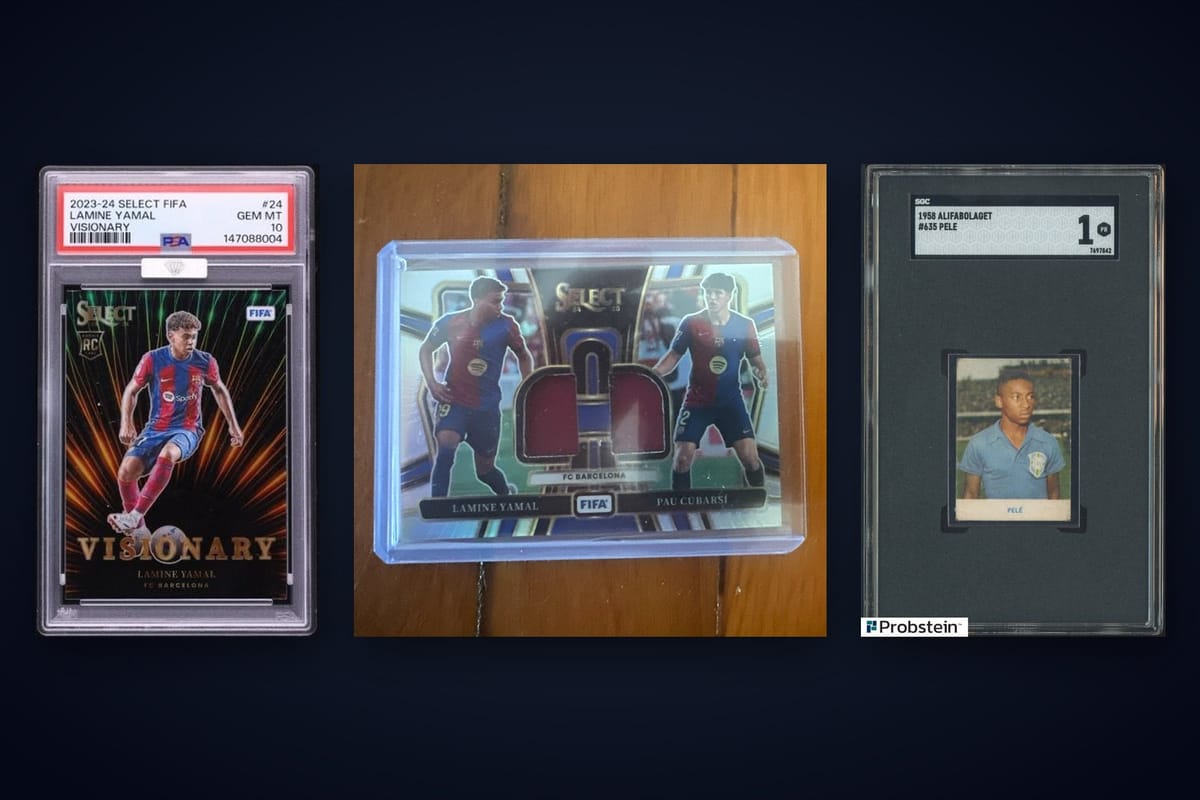
30-day price movers — live data from Midpoint's card database, as of 2026-11-05. Prices move; Midpoint refreshes these daily.
| Card | Raw | PSA 10 | 30-day | |
|---|---|---|---|---|
 |
Lamine Yamal #24 2023 Panini Select FIFA Visionary |
$265.15 | $1,200 | 0% |
 |
Lamine Yamal / Pau Cubarsi #DS-FCB 2024 Panini Select FIFA Dual Swatch |
$55.00 | $235.91 | 0% |
 |
Pele #635 1958 Alifabolaget |
$9,656 | — | 0% |
 |
Konstantinos Karetsas [Gold] #150 2025 Topps UEFA |
$80.00 | $368.58 | 0% |
 |
Maradona #312 1979 Panini Calciatori |
$1,396 | $225,700 | 0% |
 |
Lionel Messi #10 2026 Panini Prizm FIFA Manga |
$3,900 | $7,382 | -33.5% |
Look up any card's current raw and graded value in Midpoint — and get an estimated grade before you pay to submit.
1. Kylian Mbappé Cards
Mbappé is the most obvious name when people ask which soccer cards are going up in value around a World Cup. He is a global headliner, he is active at peak level, and his cards trade across every major set: Panini Prizm, Topps Chrome and Donruss.
Demand tends to build around his rookie-era cards, his autographs and his numbered parallels. Those are the formats where supply is thin and where tournament headlines hit hardest.
- Watch: rookie-year cards and low-numbered parallels first, base cards second.
- Verify: compare raw and PSA 10 sold prices side by side in Midpoint's lookup before deciding whether grading is worth it.
- Tip: a card with off-center printing can lose part of its grading premium, so measure first.
2. Lionel Messi Cards
Messi's market is driven by legacy as much as performance. Around the World Cup, collectors often treat his cards as a long-term hold, and a surge in attention tends to lift both early-career and modern issues.
Because his card universe is enormous, scarcity matters even more. A common base card behaves very differently from a numbered parallel or autograph, even when the headline is the same.
- Focus on cards with built-in scarcity: serial numbers, autographs and early-career issues.
- Be cautious with high-print-run base cards, which can lag even when the player is trending.
- Look at volume: a card that sells often gives you a more reliable price than one with a single sale.
3. Cristiano Ronaldo Cards
Ronaldo remains one of the most traded names in the hobby. A possible final World Cup storyline can add a collector narrative that tends to boost demand for his rookie-era cards, autographs and premium parallels.
That story is also a risk. Narrative-driven demand can fade quickly once the tournament is over or if a player underperforms, so decide up front whether you're buying for the long haul or trying to flip into the event.
- Buy signal: steady completed sales at rising levels across several weeks, not one spike.
- Caution signal: a wide gap between asking prices and what cards actually sold for.
4. Lamine Yamal Cards
Yamal represents the new generation. For collectors who missed early Mbappé, he is the player most associated with a still-developing price curve, and Spanish national-team attention keeps him in the conversation.
Young players are more volatile than established stars. Prices can jump on a single great match and cool just as quickly. Treat his cards as higher upside and higher risk.
- Early-career base and parallel cards can move on performance headlines.
- Autographs and numbered cards are scarcer, so they tend to hold interest longer than base cards.
- Check that listings are real sales and not just optimistic asks.
5. Emerging Spanish and Brazilian Rookies
Every World Cup cycle spotlights players casual buyers hadn't noticed. Spain and Brazil both have deep youth pipelines, so collectors often hunt for the next breakout rookie around the tournament.
This is where the biggest percentage moves can happen, because the starting price is low. It's also where the biggest losses happen if a player doesn't make the squad, doesn't play, or fades.
- Limit position size: treat each rookie as a speculative bet.
- Prefer first-year cards in major sets over obscure parallels with thin sales history.
- Check squad news and playing time before paying up on a headline.
6. Panini Prizm World Cup, Topps Chrome UEFA and Donruss Road to World Cup
Set choice shapes how a player's cards trade. Panini Prizm FIFA World Cup has historically been the flagship for tournament-era demand, Topps Chrome UEFA is closely tied to club competition, and Donruss Road to World Cup offers a different entry point with its own rookie and parallel structure.
Which is the better investment depends on liquidity and scarcity, not brand alone. A set with more buyers and more completed sales is easier to enter and exit.
- Prizm: deep buyer pool, strong recognition, easy to price.
- Topps Chrome UEFA: strong with club-focused and European collectors.
- Donruss Road to World Cup: can offer value, but check how often cards actually sell.
Compare specific cards, not whole sets. A rare parallel of a lesser-known set can outperform a common card from a flagship.
7. Raw vs PSA 10 Pricing and the Grading Premium
When soccer card prices rise, PSA 10 copies often move differently than raw. A PSA 10 carries a premium because it's verified near-flawless, but you only capture that if your card actually grades a 10.
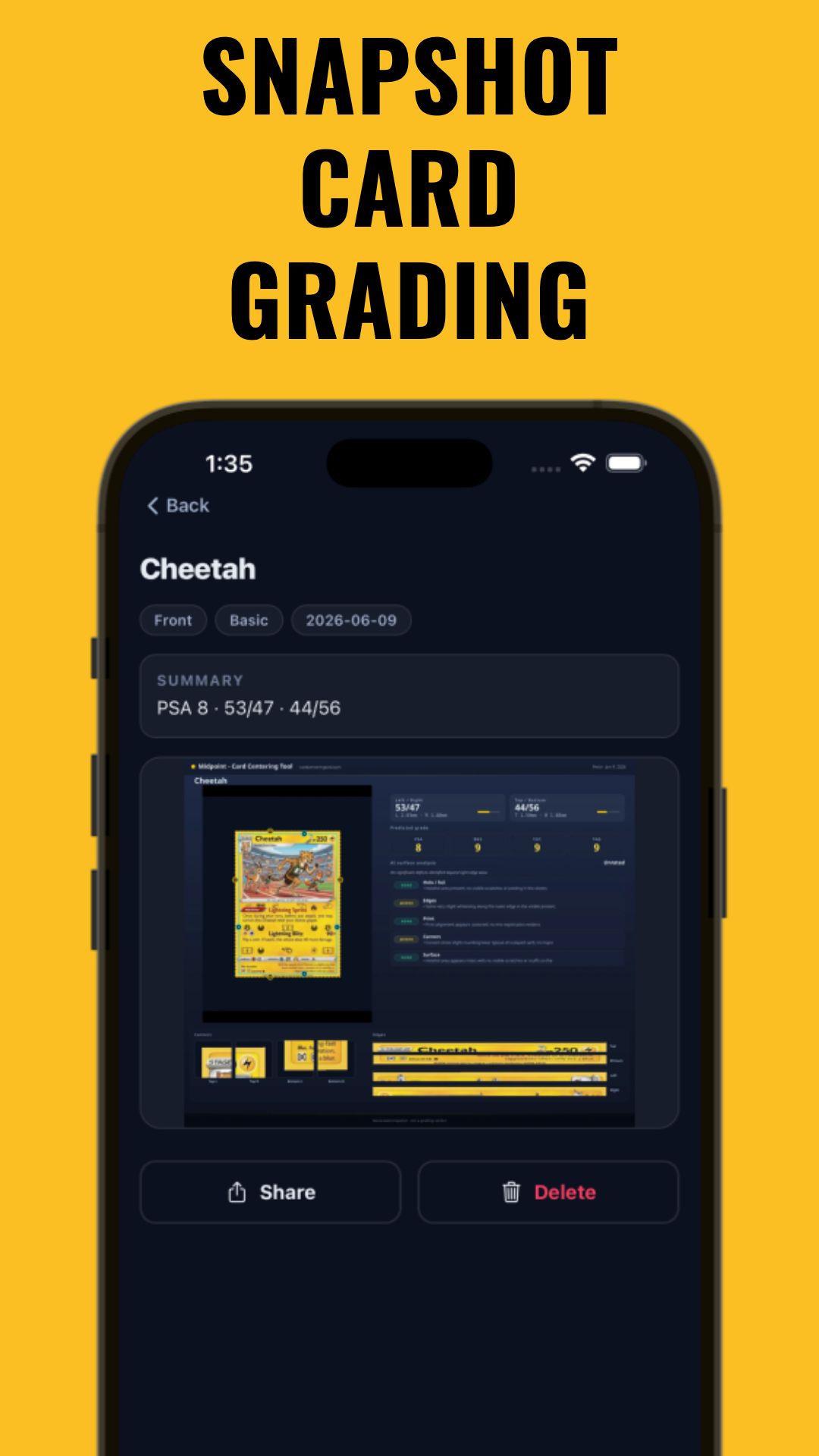
Condition is the swing factor. Centering, corners, edges and surface all count, and centering is the one you can measure before spending money. Our guide on how centering impacts card value explains why a few percentage points can change a grade.
- Raw makes sense when you want cheaper entry, or the card has visible flaws.
- PSA 10 makes sense when you want liquidity and a known grade, and the premium is justified by sold prices.
- Grade it yourself only if an estimate points to a strong result. Midpoint gives you PSA, BGS, CGC and TAG estimates before you pay to submit.
For a walkthrough, see how to pre-grade your card.
8. Rookies, Autographs and Serial-Numbered Parallels
Scarcity is often the most reliable price support in a hot market. A rookie card marks a player's first major release, an autograph limits supply to signed cards, and a serial-numbered parallel caps the print run in plain view.
These formats usually react more sharply to World Cup news, in both directions. They can gain more when demand rises, and they can be harder to sell when it cools, since fewer buyers are looking for a specific numbered card.
- Check the print run: a /10 and a /99 are very different cards.
- For low-population cards, review how grading affects scarcity in our guide to grading low population cards.
- Confirm authenticity on autographs, especially in a fast-moving market.
9. Completed Sales vs eBay Asking Prices
The biggest mistake in a rising market is trusting asking prices. Sellers list optimistically when momentum builds, and listings can sit well above where cards actually trade.
Completed sales show what buyers really paid. Use them as your anchor, and then read the surrounding signals: how many listings are active, how many sold recently, and how auction bids are behaving.
- Rising sales volume alongside rising prices suggests real demand.
- Rising asks with few sales suggests hype without buyers.
- Strong auction bidding on a specific player can signal player-level interest.
- Cross-check with Midpoint's raw vs graded values across 250,000+ cards, and track your own holdings over time with portfolio tracking.
10. The Risks: Hype, Reprints and Post-World-Cup Corrections
Buying into a quick price increase carries clear risks. Hype can pull prices ahead of fundamentals, and new releases or reprints can add supply and soften values for common cards.
The biggest pattern to respect is event-driven cooling. Prices that climb into a tournament can ease after it ends, especially for players who underperform or for cards with large print runs.
- Set exit rules before you buy: a target price, or a date after the tournament.
- Don't chase vertical moves. Wait for pullbacks when you can.
- Protect what you hold. Condition affects value, so review how to store valuable cards.
Conclusion
The soccer card market in November 2026 is likely being shaped by World Cup attention, concentrated in stars like Mbappé, Messi, Ronaldo and Yamal, with emerging Spanish and Brazilian rookies adding speculative upside. Scarce formats and PSA 10 copies tend to carry the strongest premiums, but they also carry the most risk if the market cools.
Verify with completed sales, measure centering before you grade, and set exit rules before you buy. To check raw and graded values and estimate a grade before you submit, try Midpoint, free on iOS and Android.
FAQ
Q: Which soccer cards are increasing in value around the 2026 World Cup?
A: Cards of globally popular stars such as Mbappé, Messi, Ronaldo and Yamal draw the most attention, especially rookies, autographs and serial-numbered parallels. Emerging Spanish and Brazilian rookies are more speculative. Check current figures in Midpoint's lookup, dated as of 2026-11-05 where shown.
Q: Why are soccer card prices rising in November 2026?
A: Attention around the 2026 World Cup is a commonly cited driver, since it can increase demand for player cards, alongside collector interest in scarce formats. Price moves are not guaranteed, and hype can push prices ahead of real demand, so confirm with completed sales.
Q: Which soccer players have the hottest cards right now?
A: Mbappé, Messi, Ronaldo and Lamine Yamal are the names most associated with World Cup-era demand, with rising Spanish and Brazilian rookies drawing speculative interest.
Q: Are Panini Prizm or Topps Chrome soccer cards better investments?
A: Neither is automatically better. Prizm World Cup has a deep buyer pool for tournament demand, while Topps Chrome UEFA suits club-focused collectors. Compare specific cards by scarcity, sales volume and sold prices.
Q: Should I buy raw soccer cards or PSA 10 graded cards?
A: Raw is cheaper to enter but carries condition risk. PSA 10 offers a verified grade and usually a premium. If you plan to grade raw cards, measure centering and estimate the grade first.
Q: How can I check the real sold price of a soccer card?
A: Use completed or sold listings rather than asking prices, and compare several recent sales. Midpoint's card lookup also shows raw and graded values to cross-check against.
Free to start
Try the Midpoint app
Grade any card from a photo, see its raw and PSA 10 value, and track what your collection is worth — free.
Get it on iPhoneGet it on Android