TAG Centering Standards: Complete Guide to TAG Grading Centering Tolerances
Understand TAG grading centering, how it compares to PSA, BGS, CGC, and learn tolerances by grade. Detailed insights to maximize your card's grade.


Estimated reading time: 16 min
Key Takeaways
- TAG grading centering uses digital measurements, with distinct thresholds for Gem Mint 10 and Pristine 10.
- Grading companies like PSA, BGS, CGC, and SGC all have different centering standards—knowing these is important for maximizing value.
- Front and back centering thresholds can differ by grader and card type (sports vs. TCG cards).
- Understanding centering tolerances by grade lets you pre-grade and avoid costly surprises.
- Tools like Midpoint can help you measure centering before submitting cards for grading.
Table of Contents
- Section 1: Why Centering Matters in Card Grading
- Section 2: TAG Grading Centering Standards Explained
- Section 3: TAG Centering by Grade—Gem Mint 10 vs. Pristine 10
- Section 4: Front vs. Back Centering—How TAG Measures Each
- Section 5: Comparing TAG vs. PSA, BGS, CGC, and SGC Centering
- Section 6: How to Measure Card Centering Before Submitting
- Section 7: TAG’s 1000-Point System and How Centering Impacts Grades
- Section 8: Examples and Practical Tips for Collectors
- Conclusion
- FAQ
Section 1: Why Centering Matters in Card Grading
What is Centering?
Centering refers to how evenly the printed area of a trading card is positioned within its borders. It’s a fundamental component of card grading, affecting both the eye appeal and value.
- Front centering measures the balance of the card’s main image and borders.
- Back centering checks the alignment of the design on the card’s reverse side.
Why Graders Prioritize Centering
Major grading companies—TAG, PSA, BGS, CGC, and SGC—consider centering an important part of card assessment. Poorly centered cards can lose an entire grade band, even if corners and surface are pristine.
- Collectors often prefer well-centered cards for display and resale value.
- Off-center cards stand out next to others, decreasing eye appeal and liquidity.
- Grading standards for centering are typically objective: ratios like 55/45 or 60/40 are defined in company guidelines.
Market Value Impact
Centering imperfections are visible at a glance and can affect a card’s final grade—and its market price. For example, PSA 10s with strong centering can sometimes sell for more than PSA 9s with poor centering. TAG’s digital-first approach is designed to measure this precisely, minimizing grader subjectivity.
For a deeper dive into how centering impacts value, see How Centering Impacts Card Value: A Detailed Guide.
Section 2: TAG Grading Centering Standards Explained
TAG’s Digital Measurement Approach
TAG (Technical Authentication & Grading) uses advanced imaging and software to measure card centering with high precision. Unlike more subjective manual grading, TAG’s digital system calculates exact centering ratios based on border widths on all four sides of the card.
- TAG measures the distance from each card edge to the printed area precisely.
- Centering ratios (e.g., 55/45) represent the percentage distribution of the visible borders front and back.
- Each grade level has specific centering tolerance bands enforced by the software.
TAG’s Published Centering Tolerances
TAG publishes strict centering thresholds for every grade. For example:
- TAG Pristine 10: Front centering must be 51/49 or better; back centering must be 60/40 or better for sports cards, or 70/30 for TCG cards.
- TAG Gem Mint 10: Front centering must be 55/45 or better; back centering 65/35 (sports) or 75/25 (TCG).
- Lower grades allow progressively wider centering tolerances.
Why TAG is Considered Strict
TAG’s software-enforced centering standards leave no room for grader subjectivity. Cards outside the published tolerances are automatically downgraded. This precision ensures consistent, transparent grading but requires submitters to know their card’s centering beforehand. Using tools like Midpoint to pre-measure can help avoid costly grading surprises.
Section 3: TAG Centering by Grade—Gem Mint 10 vs. Pristine 10
Understanding TAG’s Top Grade Bands
TAG’s top grades, Gem Mint 10 and Pristine 10, differ mainly in centering requirements:
- Pristine 10: The highest standard, requiring front centering at 51/49 or better and slightly more lenient back centering depending on card type.
- Gem Mint 10: Allows a bit more variance with front centering at 55/45 and back centering thresholds of 65/35 (sports) or 75/25 (TCG).
Front Centering Thresholds
For Gem Mint 10, the front borders must be within a 55/45 ratio—meaning one side can be up to 55% of the border width while the opposite side is at least 45%. For Pristine 10, this tightens to 51/49, demanding near-perfect centering.
Back Centering Thresholds by Card Type
- Sports cards: Pristine 10 requires back centering of 60/40 or better; Gem Mint 10 allows 65/35.
- TCG cards (Pokémon, Magic, etc.): Pristine 10 back centering can be 70/30; Gem Mint 10 allows 75/25.
This distinction reflects the printing variability common in TCG cards versus sports cards. For more on centering differences by card type, see our Card Centering by Type: The Complete Guide for Pokemon, Sports, and More.
Off-Center Enough to Drop a Grade?
If a card’s centering falls outside these tolerances, TAG’s software automatically downgrades it to the next lower grade band. For example, a front centering of 56/44 disqualifies a card from Gem Mint 10, pushing it to Mint 9, regardless of other condition factors.
Section 4: Front vs. Back Centering—How TAG Measures Each
Front Centering: The Heaviest Weight
TAG’s grading algorithm prioritizes front centering because the front is the primary visual element collectors and buyers focus on when assessing a card’s appeal and value.
- The front image is analyzed using edge detection to calculate precise border ratios.
- Any deviation beyond the allowed tolerance leads to an automatic downgrade.
Back Centering: Important but More Forgiving
Back centering is measured with similar precision but allows more leniency, especially for TCG cards, acknowledging known printing inconsistencies.
- Back centering thresholds are typically 10-20% more lenient than front centering.
- For Gem Mint 10, sports cards require 65/35 or better; Pristine 10 requires 60/40.
- TCG cards require 75/25 for Gem Mint 10 and 70/30 for Pristine 10.
Why the Distinction?
This approach aligns with industry practices, as PSA, BGS, and CGC also allow more variance on backs. For a detailed guide on measuring card centering, see Card Grading Centering Standards: PSA, BGS, CGC, SGC & TAG Compared.
Section 5: Comparing TAG vs. PSA, BGS, CGC, and SGC Centering
PSA Centering Standards
- PSA 10 Gem Mint: Front 55/45 or better; back 75/25.
- PSA 9 Mint: Front 60/40; back 90/10.
PSA’s front centering is slightly more lenient than TAG’s for a 10, especially on back centering, allowing cards that miss TAG’s Gem Mint 10 to still earn a PSA 10.
BGS Centering Requirements
- BGS 10 Black Label: Front 50/50 to 55/45; back 60/40.
- BGS 9.5 Gem Mint: Front 50/50 to 60/40; back 65/35.
BGS is comparable to TAG in strictness at the top end but uses subgrades, so a card with average centering can still score high overall if other subgrades are perfect.
CGC Centering Standards
- CGC 10 Pristine: Front 50/50 to 55/45; back 60/40.
- CGC 9.5 Gem Mint: Front 50/50 to 60/40; back 65/35.
CGC’s standards are similar to BGS and TAG’s Pristine 10, with Gem Mint 10 slightly more forgiving than TAG’s.
SGC Centering
- SGC 10: Front 55/45; back 75/25.
- SGC 9: Front 60/40; back 90/10.
SGC’s centering standards align closely with PSA’s, generally more lenient on back centering than TAG.
Which Grader is Most Lenient on Centering?
PSA and SGC are generally the most forgiving on front centering at the Gem Mint 10 level, while TAG is among the strictest, followed by BGS and CGC. On back centering, PSA and SGC allow more variance than TAG, especially for sports cards.
For a detailed comparison of AI's role in centering analysis, see AI-Focused Comparison: How AI Transforms Card Centering Analysis.
For a full breakdown of grading companies’ centering standards, visit our Card Grade Comparisons: PSA vs BGS vs CGC vs SGC Explained.
Section 6: How to Measure Card Centering Before Submitting
Why Pre-Measuring Matters
Given TAG’s strict centering standards, knowing your card’s exact centering ratios before submission is crucial. Guesswork can lead to unexpected downgrades and wasted grading fees.
Manual Measurement Method
- Use a ruler or caliper to measure border widths on each side of the card.
- Calculate centering ratio as: smaller border / (smaller border + larger border) multiplied by 100 to get a percentage.
- Compare your results to TAG’s published tolerance bands: 51/49 for Pristine 10, 55/45 for Gem Mint 10, etc.
Using a Digital Centering Tool
Manual measurement can be slow and prone to error. Digital tools like Midpoint automate this process by analyzing card scans or photos to calculate precise centering ratios front and back.
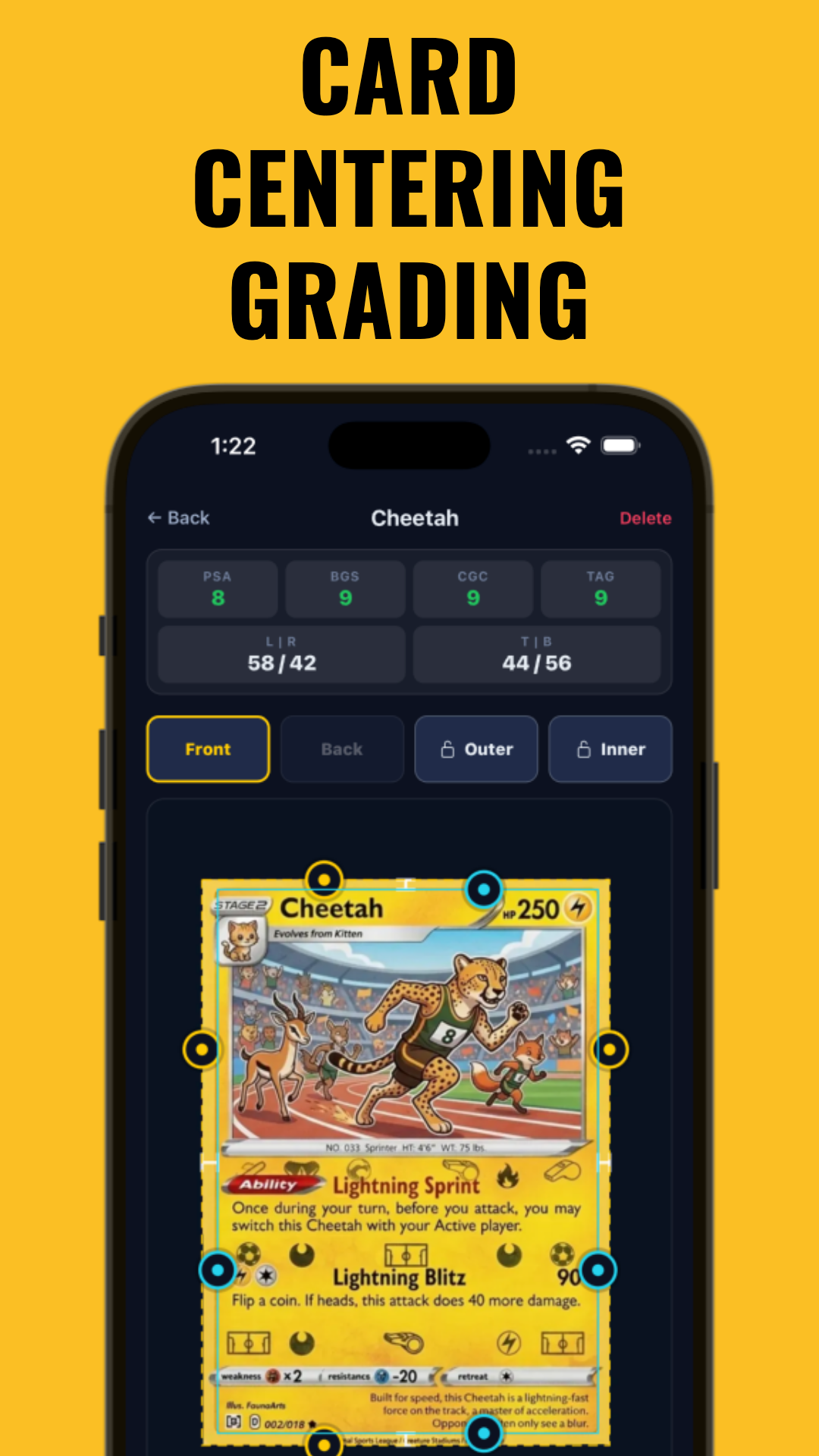
- Upload a clear scan or photo of your card.
- Midpoint’s AI detects edges and calculates centering percentages accurately.
- Receive instant estimated grades for PSA, BGS, CGC, and TAG to help decide the best grading company for your card.
For a full walkthrough, see Card Condition: The Complete Guide to Grading, Inspection, and Value.
Section 7: TAG’s 1000-Point System and How Centering Impacts Grades
TAG uses a 1000-point grading system that incorporates centering as a key factor. Precise centering measurements directly influence the score and final grade, reinforcing the importance of meeting TAG’s strict centering standards.
Cards with borderline centering ratios often see their grades impacted more heavily than other subgrades like corners or surface condition.
Section 8: Examples and Practical Tips for Collectors
When preparing cards for TAG grading, focus on:
- Using Midpoint to pre-check centering ratios.
- Understanding that even slight off-centering can drop a card from Pristine 10 to Gem Mint 10 or lower.
- Comparing your card’s centering to competitor standards to choose the best grading company.
Remember, investing time in accurate centering measurement before submission can save money and maximize your card’s value. For more on grading and inspection, see our TCG Card Collecting: The Ultimate Guide for 2026 Collectors.
Conclusion
TAG centering standards are among the strictest in the industry, relying on digital measurements and tight tolerances for top grades like Gem Mint 10 and Pristine 10. Understanding these tag centering standards and using tools like Midpoint to measure your cards before submission can help you avoid surprises and achieve the best possible grade.
For collectors serious about maximizing card value, mastering TAG’s centering tolerances is essential.
FAQ
What are TAG centering standards?
TAG centering standards define the acceptable border ratio tolerances for each grade, with Gem Mint 10 requiring front centering of 55/45 or better and Pristine 10 requiring 51/49 or better.
How strict are TAG centering tolerances compared to other graders?
TAG is among the strictest grading companies for centering, using software to enforce precise ratios. PSA and SGC are generally more lenient, especially on back centering.
Can I measure TAG centering standards myself?
Yes, you can manually measure border widths with a ruler and calculate ratios, but using digital tools like Midpoint provides faster, more accurate results.
Why is front centering more important than back centering for TAG?
Front centering affects the card’s visual appeal and market value more directly, so TAG weights it more heavily in grading decisions.
What happens if a card fails TAG centering standards?
The card is automatically downgraded to the next lower grade band, even if other condition factors are perfect.