
Whitening on Card Edges: Identification, Causes, and Grading Impact
Learn what whitening on card edges is, how it affects grading, and how to prevent it. Full guide to edge defects, inspection, and value for collectors.

Estimated reading time: 14 min
Key Takeaways
- Whitening on card edges is a common condition issue that can lower a card’s grade and value.
- Proper inspection techniques, lighting, and tools are important to detect edge whitening and other defects before grading.
- Prevention through careful handling, sleeves, and storage helps preserve card condition long-term.
- Edge whitening can result from factory cuts, play wear, storage friction, or environmental factors—each may impact grading differently.
- Digital tools like Midpoint can help assess whitening and other flaws before costly submissions.
Table of Contents
- Section 1: What is Whitening on Card Edges?
- Section 2: Causes of Whitening—From Factory to Everyday Handling
- Section 3: Edge Whitening vs. Dirt, Silvering, and Other Defects
- Section 4: Inspecting for Whitening—Lighting, Magnification, and Tools
- Section 5: Grading Impact—How PSA, BGS, CGC Judge Whitening
- Section 6: Prevention and Care—Best Practices to Avoid Whitening
- Section 7: Can Whitening Be Fixed? Cleaning, Repair, and Myths
- Section 8: Edges, Corners, and Value—Condition Beyond Centering
- Conclusion
- FAQ
Section 1: What is Whitening on Card Edges?
Definition and Visual Characteristics
Whitening on card edges refers to the appearance of white, chalky, or frayed spots along the borders of trading cards. This condition exposes the underlying paper or cardstock beneath the printed layer, making it especially prominent on dark-bordered cards like Pokémon, Yu-Gi-Oh, and Magic: The Gathering. On white-bordered cards, whitening can be harder to spot but still affects surface reflectivity and texture.
- Location: Most commonly seen along the top and bottom edges, but can occur on any side.
- Appearance: White flecks, lines, or fuzzy areas interrupting a clean, colored border.
- Common on: Heavily played, poorly stored, or freshly cut cards with rough factory edges.
Why It Matters to Collectors
Edge whitening is one of the four major grading categories along with centering, corners, and surface. Even minor whitening can lower a card's chance at a PSA 10, BGS 9.5, or CGC 10. Since top grades command significant price premiums, collectors and sellers should carefully inspect for edge whitening before submission.
Edge Whitening in the Grading Process
Professional graders use both the naked eye and magnification to detect whitening. Cards are typically judged under strong, diffuse lighting and at various angles to spot any breaks in edge color. Significant whitening—even from factory cutting—can prevent a perfect score, as detailed in our grading scale differences guide.
Section 2: Causes of Whitening—From Factory to Everyday Handling
Factory Cutting and Manufacturing
Some whitening appears straight from the pack. During production, cards are cut from large sheets using industrial blades. If the blades are dull or misaligned, or if the cutting pressure is too high, the cut can create a fuzzy, white border—sometimes called "factory whitening." This is reported to be more common in certain Pokémon and early Magic: The Gathering sets.
- Factory Cuts: Can show as consistent white lines along one or more edges.
- Miscut Cards: Often display excess whitening where the card wasn’t properly aligned during cutting. Learn more about miscut cards and their value.
Handling and Play Wear
Most whitening accumulates over time due to handling, shuffling, and play. Friction against fingers, other cards, or hard surfaces wears away the colored ink or gloss, exposing the white core beneath.
- Shuffling: Regular play, especially with unsleeved cards, leads to edge wear.
- Picking Up Cards: Fingernails and skin oils can cause micro-abrasions.
- Sleeves and Binders: Inserting or removing cards from tight sleeves or binder pockets can scrape edges.
Storage and Environmental Factors
Humidity, temperature changes, and improper storage can contribute to whitening. As cards expand and contract, or rub against hard plastic, the edges can fray or chip. Keeping cards in unsleeved stacks or loose in boxes increases the risk.
- Binder Pressure: Overloaded binders compress cards, creating edge friction.
- Cardboard Boxes: Unprotected cards can jostle and abrade each other.
- Environmental Damage: Exposure to moisture or rapid climate changes can weaken edge integrity.
Section 3: Edge Whitening vs. Dirt, Silvering, and Other Defects
How to Tell Whitening Apart
Not all marks on card edges are whitening. It's important to distinguish between whitening, dirt, silvering, and surface damage, as each affects grading differently.
- Whitening: Exposed white paper or cardstock, usually from abrasion or bad cuts.
- Dirt: Removable smudges or grime that may wipe off gently.
- Silvering: Fine, metallic-looking streaks along the edge, usually from friction against sleeves or manufacturing issues.
- Surface Damage: Includes scratches, print lines, or indentations on the card’s face or back, not just the edges.
Why Dark Borders Show Whitening More Clearly
Cards with dark or black borders (e.g., Base Set Pokémon, many Magic sets) highlight whitening because of the stark contrast between the colored border and the white core. On white-bordered cards, whitening is less visible but still detectable under certain lighting angles.
Corner Wear and Grading
Corner wear often accompanies edge whitening. When inspecting for corner wear grading, note that even slight whitening at corners can cause a downgrade. Corners are often judged more harshly than flat edges by PSA, BGS, and CGC.
Section 4: Inspecting for Whitening—Lighting, Magnification, and Tools
Best Lighting for Trading Cards
Proper lighting is crucial for detecting whitening and other edge or surface defects. Use strong, diffuse daylight or a high-CRI LED lamp. Hold the card at slight angles to catch any white flecks or texture changes. Avoid direct, harsh light that can obscure fine details with glare.
- Natural daylight or 5000K-6500K LED desk lamps are optimal.
- Diffuse the light with a white lampshade or lightbox for even coverage.
- Rotate the card slowly in the light to check each edge and corner.
Magnification and Inspection Tools
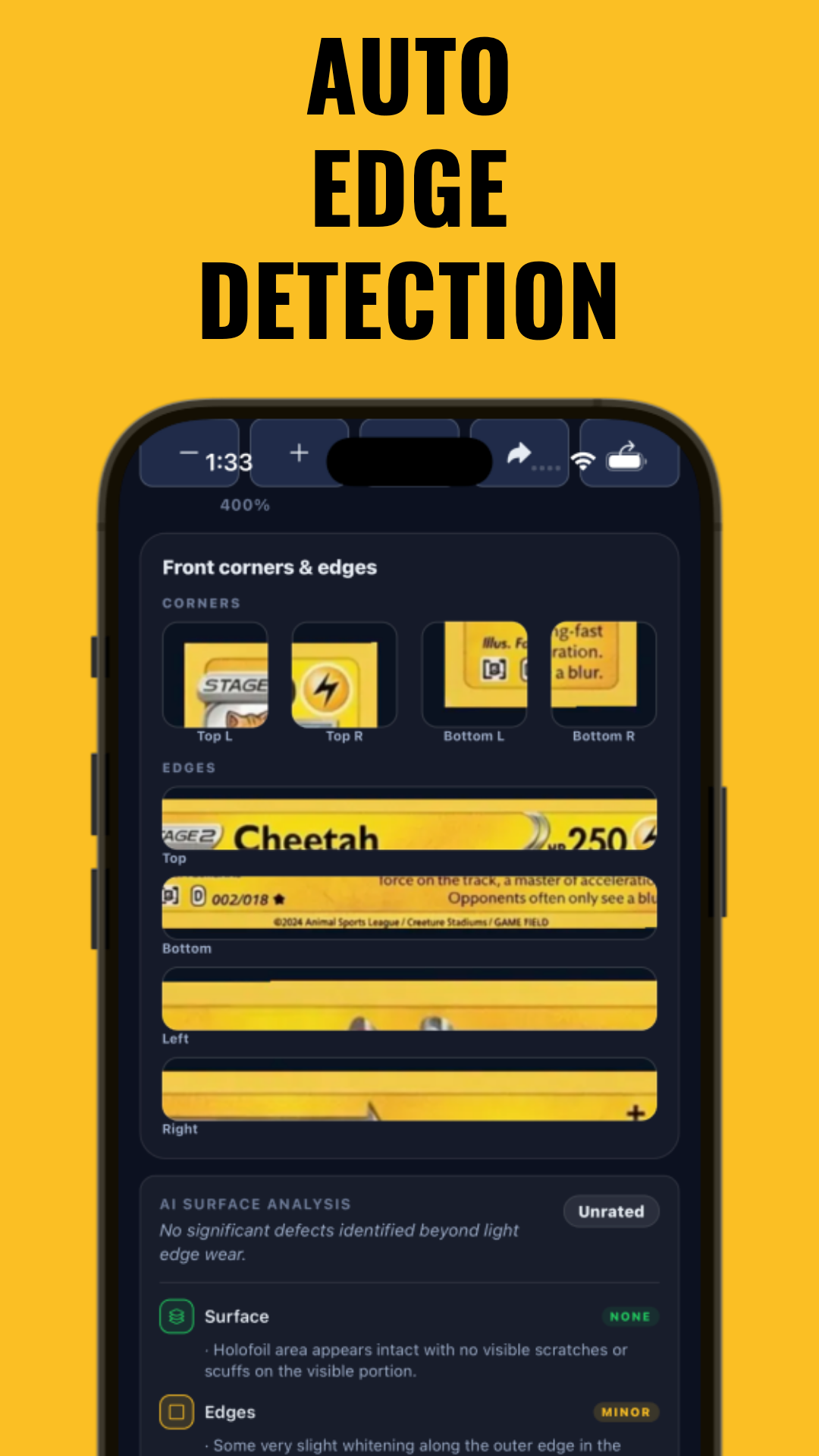
Use a 5x-20x loupe or a macro lens to inspect edges closely. Many collectors use their smartphone camera with 2x-3x digital zoom for basic checks. For a more advanced analysis, tools like Midpoint offer digital grading features, highlighting whitening, centering, and surface damage in real time.
- Hand loupes (5x-10x) reveal subtle whitening invisible to the naked eye.
- Macro photos can document condition for pre-grading and insurance.
- Midpoint's edge detection and surface analysis screens can help visualize whitening automatically.
How to Inspect Cards Before Grading
Develop a pre-grading checklist:
- Examine all four edges under good lighting and magnification.
- Check for whitening, chipping, and color breaks.
- Inspect corners for rounding or fraying.
- Review the card’s surface for scratches, print lines, or dents.
For a detailed walkthrough, see How to Pre-Grade Your Card: A Step-by-Step Guide.
Section 5: Grading Impact—How PSA, BGS, CGC Judge Whitening
Grading Criteria: Edges and Whitening
All major grading companies—PSA, BGS, CGC, TAG—evaluate edge condition as a separate subgrade. Whitening, even when minimal, can lower the edges subgrade and impact the final overall score. For example:
- PSA 10: Allows virtually no whitening. Even a single significant white nick can result in a PSA 9.
- BGS 9.5/10: Permits only the tiniest, nearly invisible specks. Anything obvious under 5x magnification is likely to drop the edges subgrade.
- CGC 9.5/10: Similar strictness; small factory whitening may be forgiven, but play wear is not.
For a breakdown, see grading scale differences by company.
Examples of How Whitening Affects Grade
- One or two tiny white flecks on the edge: Usually a PSA 9 or BGS 9.5 at best.
- Consistent whitening along one full edge: Often BGS 8.5 or lower, depending on severity.
- Heavy whitening on multiple edges: Can result in a PSA 7 or lower.
- Factory whitening is typically treated the same as play wear unless very faint.
How Whitening Impacts Value
Cards graded 10 fetch the highest premiums. Even a small drop to a 9 can significantly reduce value for high-end Pokémon, Magic, or sports rookies. Grade impact on insurance value is also substantial, so documenting whitening is important for insurance and resale.
Section 6: Prevention and Care—Best Practices to Avoid Whitening
Protective Sleeves and Storage
The best way to prevent whitening on card edges is through immediate and ongoing protection. High-quality sleeves, inner sleeves (double-sleeving), and rigid top loaders or magnetic holders are recommended for valuable cards.
- Use soft penny sleeves for initial protection.
- Double-sleeve with a perfect-fit inner sleeve and standard sleeve for tournament cards.
- Store high-value cards in top loaders, one-touch magnetic cases, or graded slabs.
- For collection storage, use binders with side-loading pockets and soft, archival-safe pages.
Handling Guidelines
Always handle cards by the edges, using clean, dry hands or cotton gloves. Avoid bending, flexing, or excessive touching. When moving cards in and out of sleeves or binders, be gentle to prevent scraping. Never force a card into a tight sleeve or pocket.
Environmental Controls
Keep your collection in a cool, dry, and stable environment. Avoid exposure to moisture, direct sunlight, and extreme temperature swings. For more comprehensive storage tips, read How to Store Valuable Cards: The Ultimate Collector's Guide.
Section 7: Can Whitening Be Fixed? Cleaning, Repair, and Myths
Can Whitening Be Removed?
Unlike surface dirt, whitening on card edges is generally impossible to "clean" or repair without causing further damage. Whitening is the result of lost ink or gloss, exposing the paper core. Attempting to recolor or press the edge is considered restoration and will often be flagged by grading companies or result in an "Altered" label.
- Do Not: Use markers, paint, or pens to cover whitening. This is easily detected and not allowed.
- Do Not: Attempt to sand, file, or trim edges—this will almost certainly void authenticity.
- Do: Gently use a soft brush or air blower to remove loose dust only.
Factory Whitening vs. Play Whitening
Some collectors believe factory whitening is "forgivable." In practice, grading companies may allow extremely minor factory nicks, but will not overlook obvious white lines or chipping, regardless of origin.
Repair Myths and Realities
There are no safe, grading-approved methods to reverse whitening. Any attempt to alter edge color or texture may result in a lower grade or even a rejected submission. Transparency and honest condition reporting are key in the trading card community.
Section 8: Edges, Corners, and Value—Condition Beyond Centering
Comprehensive Condition Assessment
While centering is the most frequently discussed grading factor, edges, corners, and surface are also important. Assessing all four is essential before considering a submission—and before asking, "Will this card grade a 10?"
- Edges: Look for whitening, chipping, and color breaks.
- Corners: Check for rounding, bends, or fraying.
- Surface: Inspect for scratches, print lines, dents, or gloss loss.
- Centering: Measure borders to millimeter precision. Use the Card Centering Tool for accurate estimates.
Which Areas Are Graded Most Strictly?
Grading companies often scrutinize corners most harshly, followed by edges. The top edge and upper corners (as seen in a display case) may draw extra attention. A minor white spot in these areas can mean the difference between a 9 and a 10.
How Digital Tools Help
Apps like Midpoint let you analyze your cards at home, checking for edge whitening, centering, and surface flaws before you invest in professional grading. Instant centering and edge reports can help you decide whether to submit, trade, or sell.
Conclusion
Whitening on card edges is a critical aspect of trading card condition that can impact both grading outcomes and value. Whether caused by manufacturing, handling, shuffling, or storage, whitening is almost always irreversible and is penalized by grading companies. Careful inspection—using the right lighting, magnification, and digital tools—can help you catch edge whitening early. By protecting your cards with sleeves, proper storage, and gentle handling, you can help prevent whitening and maintain the highest possible grades. If you’re serious about maximizing your collection’s value, consider leveraging modern apps like Midpoint to pre-grade your cards with digital accuracy and confidence.
FAQ
Q: What is edge whitening on a trading card?
A: Edge whitening is the appearance of white, frayed, or chalky spots along a card’s borders where the ink or finish has worn away, exposing the white paper core. It’s common on dark-bordered cards and can result from factory cutting, handling, or storage friction.
Q: Can whitening on card edges be removed or fixed?
A: Whitening is generally permanent damage to the card’s surface. Attempting to color over or repair whitening is considered alteration and is not accepted by grading companies. Only loose dirt can be gently removed.
Q: Does edge whitening lower PSA or other grading scores?
A: Yes. Even minor whitening can drop a card from a PSA 10 to a 9 or lower. All grading companies penalize visible whitening, especially on edges and corners.
Q: What causes whitening on Pokémon card edges?
A: Whitening on Pokémon cards can be caused by rough factory cuts, shuffling without sleeves, handling, friction from sleeves or binders, and environmental factors like humidity.
Q: Is whitening on the edges a sign of damage or just factory cutting?
A: It can be either. Some cards have factory whitening, but grading companies treat most visible whitening as a flaw, regardless of its source, unless it’s extremely minor and consistent for the set.
Q: How can I prevent whitening on my card edges?
A: Use high-quality sleeves, avoid excessive handling, store cards in top loaders or side-loading binders, and keep them in a stable, dry environment to minimize risk of whitening.
Free to start
Try the Midpoint app
Grade any card from a photo, see its raw and PSA 10 value, and track what your collection is worth — free.
Get it on iPhoneGet it on Android


