
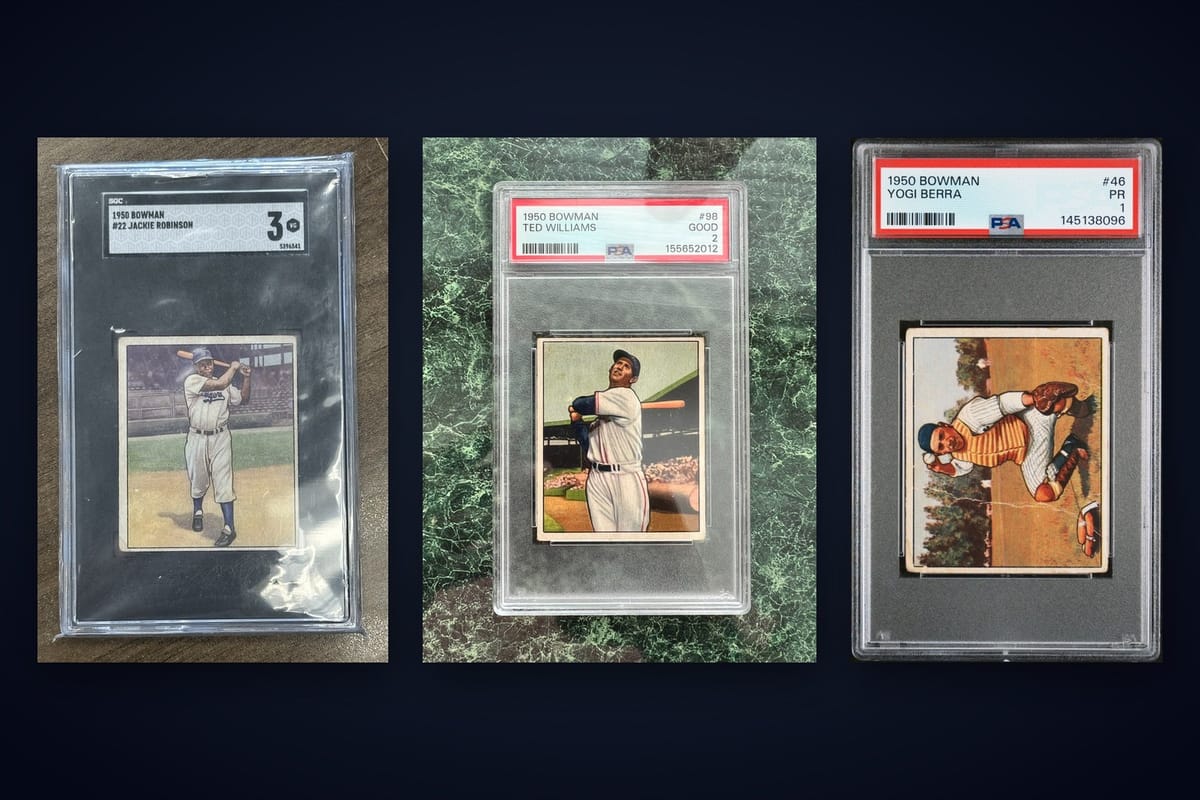
1950 Bowman Baseball Cards Value: Price Guide by Grade
1950 Bowman baseball cards value explained: most valuable cards, raw vs PSA 10 premiums, set values, authentication tips, and what is worth grading.

Estimated reading time: 11 min
Key Takeaways
- 1950 Bowman baseball cards value swings enormously by grade: the gap between a creased raw card and a gem is far larger than the gap between most players.
- The set is led by Jackie Robinson #22 and Ted Williams #98, followed by Hall of Fame stars like Yogi Berra #46, Duke Snider #77, Bob Feller #6 and Ralph Kiner #33.
- Centering, print snow, rough cuts, and trimming are the main reasons high-grade examples are scarce and command premiums.
- Only cards with realistic mid-to-high-grade potential, or key stars, are usually worth grading; commons rarely justify the fees.
- Always check current comparable sales; the table in this guide shows Midpoint database figures as of 2026-11-15.
Card values — live data from Midpoint's card database, as of 2026-11-15. Prices move; Midpoint refreshes these daily.
| Card | Raw | PSA 10 | Gem premium | |
|---|---|---|---|---|
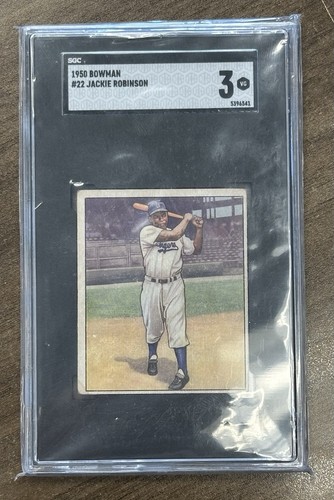 |
Jackie Robinson #22 1950 Bowman |
$1,306 | $340,723 | 261× |
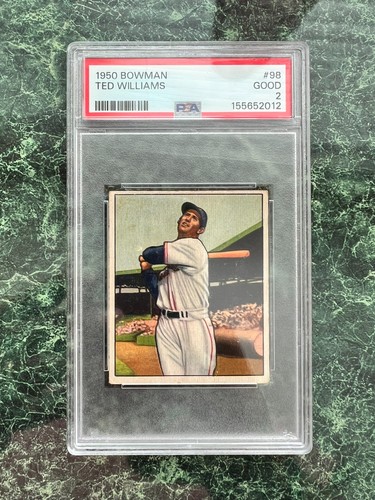 |
Ted Williams #98 1950 Bowman |
$386.13 | $86,336 | 223.6× |
 |
Yogi Berra #46 1950 Bowman |
$239.47 | $53,031 | 221.5× |
 |
Phil Rizzuto #11 1950 Bowman |
$80.17 | $23,195 | 289.3× |
 |
Roy Campanella #75 1950 Bowman |
$91.00 | $20,517 | 225.5× |
 |
Duke Snider #77 1950 Bowman |
$78.12 | $19,563 | 250.4× |
 |
Larry Doby #39 1950 Bowman |
$63.97 | $17,933 | 280.3× |
 |
Bobby Shantz #234 1950 Bowman |
$64.23 | $16,691 | 259.9× |
 |
Warren Spahn #19 1950 Bowman |
$62.75 | $16,108 | 256.7× |
 |
Don Newcombe #23 1950 Bowman |
$58.00 | $14,951 | 257.8× |
 |
Pee Wee Reese #21 1950 Bowman |
$55.40 | $14,345 | 258.9× |
|
Luke Appling #37 1950 Bowman |
$43.76 | $11,288 | 258× |
Look up any card's current raw and graded value in Midpoint — and get an estimated grade before you pay to submit.
Table of Contents
- Section 1: The 1950 Bowman Set at a Glance
- Section 2: How Grade Drives 1950 Bowman Values
- Section 3: The Most Valuable 1950 Bowman Cards
- Section 4: 1950 Bowman Price Guide by Card Type and Set
- Section 5: Condition, Centering, and PSA 10 Value
- Section 6: Spotting Authentic Cards, Reprints, and Alterations
- Section 7: Are 1950 Bowman Cards Worth Grading and Selling?
Section 1: The 1950 Bowman Set at a Glance
If you are researching 1950 Bowman baseball cards value, start with what the set actually is. Bowman issued 252 cards in 1950, numbered 1 through 252, featuring a color-tinted, painted-looking portrait design.
Understanding the checklist, the design, and the physical quirks of the cards explains most of the pricing logic that follows.
Checklist and numbering
The set runs #1 to #252, with big names scattered throughout rather than front-loaded. Notable numbers include Bob Feller #6, Jackie Robinson #22, Ralph Kiner #33, Yogi Berra #46, Ted Kluszewski #62, Duke Snider #77, and Ted Williams #98. Whitey Ford's rookie card is #207.
Scarcity can differ by card number, so always check population data rather than assuming every number is equally common.
Design and physical traits
Each card is roughly 2-1/16 inches by 2-1/2 inches, with a color-tinted portrait that looks hand-painted and a player name panel. The artwork is part of the appeal, but the production methods created condition problems:
- Rough cuts and uneven borders from sheet cutting.
- Print defects such as snow, fuzzy registration, and ink specks.
- Off-center images, very common in this era.
Why the set matters to collectors
This is a classic early postwar issue with real star power. Robinson was in the middle of his Dodgers career, Williams was a Red Sox legend, and Ford's rookie gives the set a Yankees dynasty angle. Note that Mickey Mantle's Bowman rookie belongs to 1951, not 1950, which is a frequent mix-up.
Next, a data table from the Midpoint database lists specific values as of 2026-11-15. The rest of this guide explains how to read those numbers, and why two cards of the same player can sit in completely different price brackets.
Section 2: How Grade Drives 1950 Bowman Values
For a 70+ year old cardboard issue, grade is the single biggest value variable. A 1950 Bowman is not priced by player alone; it is priced by player multiplied by condition.
Raw, low-grade, mid-grade, and high-grade tiers
Think of the market in four tiers, then check the table for the exact figures as of 2026-11-15:
- Raw (ungraded): Priced as a discount to graded cards, because buyers must assume risk about trimming, repairs, and true condition. Raw prices vary widely based on photo quality and seller reputation.
- Low grade (roughly PSA 1 to 3): Creases, rounded corners, stains, and surface wear are tolerated. This is the entry point for collecting the big stars.
- Mid grade (roughly PSA 4 to 6): Clean eye appeal, sharper corners, and lighter wear. Many collectors consider this the sweet spot for value.
- High grade (PSA 7 and up): Scarce. Premiums grow steeply because so few survive with sharp corners, good centering, and clean surfaces.
PSA, SGC, and ungraded: why the holder matters
PSA slabs usually carry the strongest resale demand for vintage baseball, so identical-looking cards often sell for more in a PSA holder. SGC is well regarded in vintage and trades at competitive levels, but the premium for a given number varies by card and buyer. BGS and CGC have less vintage baseball market depth.
Our guide on grading scale differences by company explains how each company defines its top grades.
The gem-premium gap
The gem-premium gap is the jump between a typical grade and a top grade. For 1950 Bowman, that gap is large because top-grade examples are rare. A mid-grade star card might be an attainable collectible, while a top-grade copy of the same card can sit in a different financial universe. Use the table's raw versus graded columns to see this gap card by card.
Section 3: The Most Valuable 1950 Bowman Cards
When people ask for the most valuable 1950 Bowman cards, the answer is a short list of Hall of Fame names, with two clear leaders.
Jackie Robinson #22
Robinson is the headline card. His historical importance, Dodgers legacy, and demand from both baseball and cultural collectors make #22 the key to the set. In almost every grade tier, it sits at or near the top of the price guide. Check the table for the as-of 2026-11-15 values, and compare recent sales before you buy, because sale-to-sale spreads at the same grade can be large when eye appeal differs.
Ted Williams #98
Williams is the other pillar. A Red Sox icon with a .400 season on his résumé, his 1950 Bowman consistently draws strong demand. In many grades it trades in the same conversation as Robinson, with the order sometimes shifting depending on condition and the specific sale.
The next tier of stars
These Hall of Famers and big names form the second rank:
- Yogi Berra #46: A Yankees legend with broad collector demand.
- Duke Snider #77: A Dodgers star whose card benefits from Brooklyn nostalgia.
- Bob Feller #6: A pitching great and a popular Hall of Fame name.
- Ralph Kiner #33: A power-hitting Hall of Famer.
- Ted Kluszewski #62: A fan favorite, popular for his Reds career and sleeveless-jersey look.
Whitey Ford's rookie (#207) is also a major name for rookie-card collectors and deserves a look in the table.
What separates the leaders
Demand follows name recognition, then Hall of Fame status, then rookie or historic significance. But even the most valuable cards lose most of their value if they are trimmed, creased, or stained. Always compare the card in your hand against the grade, not just the player. For more on how scarcity shapes the market, read our guide to grading low population cards.
Section 4: 1950 Bowman Price Guide by Card Type and Set
A useful 1950 Bowman price guide separates the set into tiers rather than treating all 252 cards as equal. Use the database table for specific entries, and this framework to estimate the rest.
Tier-by-tier overview
- Superstars: Robinson and Williams. Highest values at every grade, and the most closely watched sales.
- Hall of Famers and big stars: Berra, Snider, Feller, Kiner, and others. Strong premiums, but far below the top two.
- Rookies and key subsets: Whitey Ford (#207) is the main rookie draw. Rookie status adds demand beyond the player's raw stats.
- Solid regulars and All-Stars: Fan favorites like Ted Kluszewski can carry notable premiums, especially in higher grades.
- Commons: The majority of the set. Low-grade commons are inexpensive, but high-grade commons can still bring surprising money because gem examples are scarce.
Complete, partial, and uncut-sheet values
A complete 1950 Bowman set is a major project because of the tougher cards and the two stars at the top. Complete sets are normally valued by summing the grade-specific price of each card, then adjusting for uniformity of condition and eye appeal. A set assembled in a consistent grade can be worth more than a random mix.
Partial sets are usually priced by their key cards. If the set includes Robinson and Williams, those two cards can account for much of the total. If it is missing them, the value drops quickly, often to a fraction of what a similar-sized set with the stars would bring.
Uncut sheets and panels are rare and are best handled by specialists. Their value depends on the players in the panel, the condition, and whether the piece is authenticated. Never estimate these from single-card prices alone; seek an auction house or a vintage specialist for an opinion.
How to use the table
Look at the raw and graded values for your card, then locate your condition tier. If your card is a common in low grade, expect modest value. If it is a star in mid grade, there is real money in the market. Always cross-check with recent sold listings, since a database price is an estimate, not a guarantee.
Section 5: Condition, Centering, and PSA 10 Value
Searchers often want the 1950 Bowman PSA 10 value. The honest answer is that top-grade copies are extremely scarce for most of this set, so there may be very few sales to anchor a price, and any figure can swing with a single auction. Use the table's top-grade entries as of 2026-11-15 as a reference, and treat them as a snapshot.
What graders look for
- Centering: Vintage Bowman is often visibly off-center. Even a strong-looking card can lose points here. See our guide on how centering impacts card value.
- Corners: Rounding, fraying, and soft tips are the most common issues.
- Surface: Print snow, wax stains, scratches, and gloss loss reduce grades.
- Creases: A crease caps the grade sharply, even on an otherwise attractive card.
- Stains and trimming: Stains lower the grade, while trimming can result in a rejection or an altered designation.
Why population matters
Population reports show how many examples a grader has certified at each grade. For 1950 Bowman, the numbers typically drop as grades rise. Scarcity at the top is the reason premiums are so steep. A buyer paying a gem premium is paying for the rarity of finding a card that survived 70+ years looking sharp.
Measure centering before you spend
Centering is the one factor you can measure at home. A quick check can tell you whether a card is likely to land in a lower tier before you pay for grading. Midpoint's centering tool lets you measure borders to the millimeter, as shown below.

You can also try the free centering calculator for a quick ratio check on front-to-back borders.
Section 6: Spotting Authentic Cards, Reprints, and Alterations
Because values are high, 1950 Bowman cards attract fakes and doctored examples. Authentication is part of any honest valuation.
Reprints and counterfeits
Reprints exist for many vintage sets, including this one. Common warning signs include:
- Glossy or modern stock: Original cards have an older, matte-like feel with age-appropriate toning.
- Print pattern differences: Under magnification, originals show offset printing dot patterns. Digital reprints often show uniform dots or inkjet patterns.
- Wrong size: Compare against a known authentic card. Reprints are sometimes slightly off in dimension.
- Too-clean appearance: A flawless card with no age-related wear on a set known for condition issues deserves skepticism.
Alterations to watch for
Not every problem card is a counterfeit. Many are real cards that were improved.
- Trimming: Edges cut to remove wear and sharpen the look. Compare size against a known standard and look for unnaturally straight, clean edges.
- Recoloring: Touch-ups on borders or corners to hide chipping. Look for color that differs under magnification or UV light.
- Surface repair: Filled creases, pressed warps, or cleaned stains.
Practical authentication steps
- Compare the card side-by-side with a graded example of the same number.
- Inspect with a loupe for print dots, edges, and corners.
- Check the back for consistent toning and print quality.
- Buy graded cards from reputable holders when budget allows, and verify certification numbers on the grader's website.
- For raw high-value cards, buy only from established sellers with a return policy.
If a deal on a Robinson or Williams looks too good, assume there is a reason. Third-party authentication is cheap insurance relative to the card's value.
Section 7: Are 1950 Bowman Cards Worth Grading and Selling?
The question of 1950 Bowman cards worth grading comes down to simple math: the expected graded value, minus grading fees, versus the raw sale price.
When grading makes sense
- Key stars: Robinson, Williams, Berra, Snider, Feller, Kiner, and Kluszewski generally have enough value that authentication and a grade pay for themselves.
- Cards with good eye appeal: Sharp corners, reasonable centering, and clean surfaces suggest a mid-to-high grade.
- Cards you plan to sell: A slab makes buyers more comfortable and often widens the buyer pool.
When to skip
- Low-grade commons where the fee exceeds the likely uplift.
- Visibly creased, trimmed, or stained cards that will not achieve a meaningful number.
Pre-screening helps. Our step-by-step pre-grading guide walks through the process, and Midpoint can give an estimated PSA, BGS, CGC, or TAG grade before you pay to submit.
Valuation and selling channels
- Comparable sales: Search sold listings for the same player, number, grader, and grade.
- Auction houses: Best for top stars and high grades, where specialist bidders compete.
- Online marketplaces: Good for mid-value cards, with reach but more price variance.
- Dealer offers: Fast and convenient, but expect a discount to retail since dealers need margin.
Get several offers, compare, and factor in fees and shipping insurance. Track your collection's value over time in Midpoint's portfolio view, so you know when market shifts make selling attractive.
Conclusion
1950 Bowman baseball cards value is driven by three things: the player, the grade, and authenticity. Robinson #22 and Williams #98 anchor the set, with Berra, Snider, Feller, Kiner, and Kluszewski forming a strong second tier. Whitey Ford's rookie adds another collector draw.
The biggest lesson is the gem-premium gap. Because high-grade copies are scarce, premiums climb sharply with each grade step, while raw cards trade at a discount reflecting uncertainty. Before buying, selling, or submitting, check centering, corners, surfaces, and signs of trimming, then compare against recent sold listings.
Use the data table in this guide as a starting point, and confirm with live comps. When you are ready to evaluate a card, Midpoint can help you measure centering and estimate a grade before you spend on submission.
FAQ
Q: How much are 1950 Bowman baseball cards worth?
A: It depends on the player and grade. Commons in low grade are inexpensive, while stars like Jackie Robinson and Ted Williams are worth far more, and high-grade copies command steep premiums. See the table in this guide for Midpoint database figures as of 2026-11-15, and verify with recent sold listings.
Q: What is the most valuable 1950 Bowman baseball card?
A: Jackie Robinson #22 and Ted Williams #98 are the top cards in the set. Robinson is usually considered the headline card, with Williams close behind depending on grade and sale.
Q: How much is a 1950 Bowman Jackie Robinson card worth?
A: Value depends heavily on condition, from low-grade copies up to rare high-grade examples. Check the table for the as-of 2026-11-15 figure at your grade, then compare with recent PSA or SGC sold comps.
Q: How much is a 1950 Bowman Ted Williams card worth?
A: Ted Williams #98 is one of the set's most valuable cards. Its price rises steeply with grade, so compare your card's condition with the table and recent sales of the same grade.
Q: Are 1950 Bowman baseball cards rare?
A: Cards in the set are not unique, but high-grade examples are scarce because of centering problems, print defects, rough cuts, and 70+ years of wear. Population reports show how few survive at top grades.
Q: What is a complete 1950 Bowman baseball card set worth?
A: A complete 252-card set is typically valued by summing each card's price at its grade, adjusted for overall condition and eye appeal. The Robinson and Williams cards account for a large share, so a set missing them is worth considerably less.
Free to start
Try the Midpoint app
Grade any card from a photo, see its raw and PSA 10 value, and track what your collection is worth — free.
Get it on iPhoneGet it on Android


