1958 Topps Football Cards Value: Jim Brown & Key Cards
1958 Topps football cards value explained: Jim Brown #62, Unitas, Starr, Jurgensen, raw vs graded gaps, set value, and which cards are worth grading.

Estimated reading time: 11 min
Key Takeaways
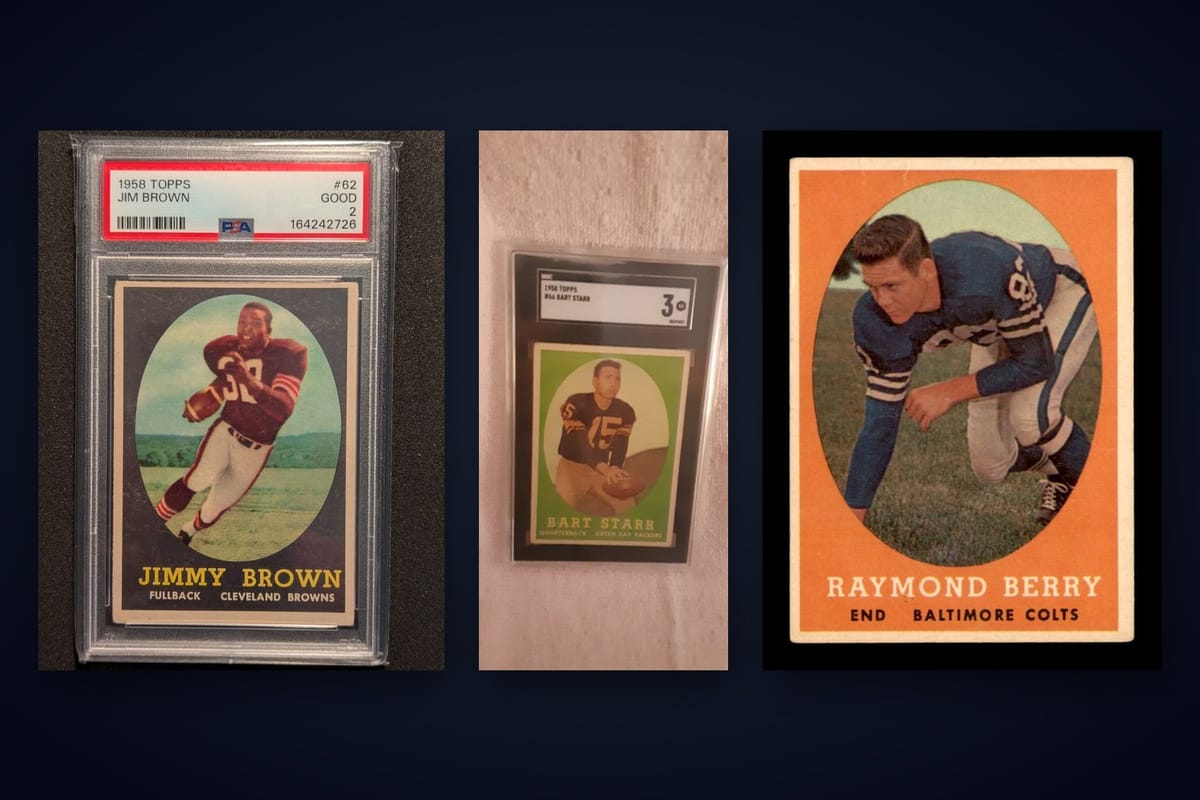
- 1958 Topps football cards value is driven overwhelmingly by one card: the Jim Brown rookie #62. Its condition sets the tone for the whole 132-card set.
- Star cards like Johnny Unitas #22, Bart Starr #66, Sonny Jurgensen #90 and Frank Gifford #73 carry real premiums, but they sit in a different tier from Brown.
- On a vintage set this old, the gap between raw, mid-grade and high-grade is steep. Centering, corners and print quality decide which tier a card lands in.
- Ask prices on marketplaces are not market value. Compare completed sales and price-guide ranges, and check live raw vs graded numbers before you buy, sell or submit.
- Only submit cards where the expected graded value clearly beats the grading fee plus the raw value you give up.
Card values — live data from Midpoint's card database, as of 2026-11-15. Prices move; Midpoint refreshes these daily.
| Card | Raw | PSA 10 | Gem premium | |
|---|---|---|---|---|
 |
Jim Brown #62 1958 Topps |
$472.68 | $95,282 | 201.6× |
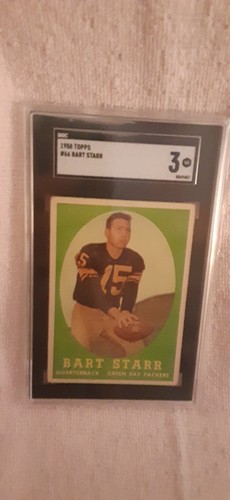 |
Bart Starr #66 1958 Topps |
$42.89 | $25,200 | 587.6× |
 |
Raymond Berry #120 1958 Topps |
$10.05 | $14,400 | 1432.8× |
 |
Sonny Jurgensen #90 1958 Topps |
$42.00 | $8,430 | 200.7× |
 |
Frank Gifford #73 1958 Topps |
$13.25 | $7,200 | 543.4× |
 |
John Unitas #22 1958 Topps |
$29.49 | $6,122 | 207.6× |
 |
Johnny Carson #47 1958 Topps |
$3.95 | $5,616 | 1421.8× |
 |
Yale Lary #18 1958 Topps |
$4.11 | $5,472 | 1331.4× |
 |
Gary Knafelc #56 1958 Topps |
$2.64 | $4,800 | 1818.2× |
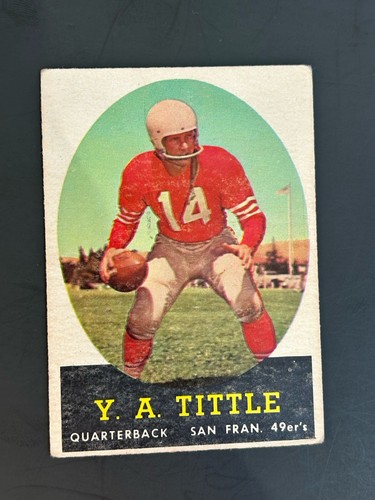 |
Y.A. Tittle #86 1958 Topps |
$6.36 | $4,528 | 712× |
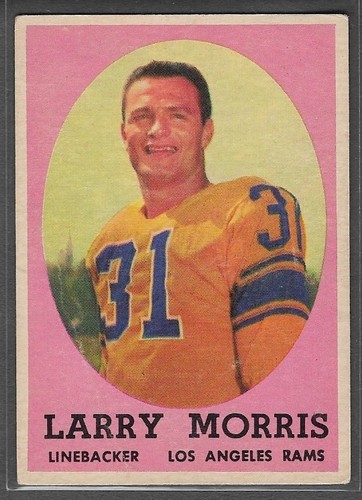 |
Larry Morris #50 1958 Topps |
$2.25 | $4,464 | 1984× |
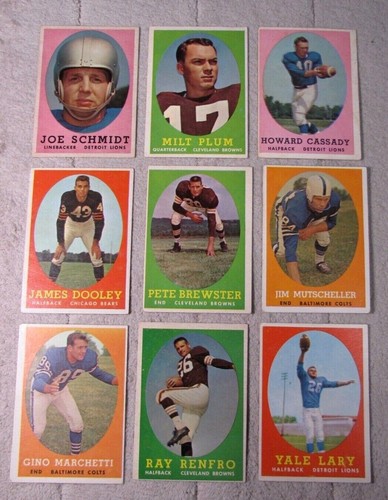 |
Ray Renfro #17 1958 Topps |
$3.43 | $4,176 | 1217.5× |
Look up any card's current raw and graded value in Midpoint — and get an estimated grade before you pay to submit.
Table of Contents
- Section 1: The 1958 Topps Football Set at a Glance
- Section 2: Jim Brown #62 Rookie Card Value by Grade
- Section 3: Other Key Stars and Hall of Famers
- Section 4: Value by Condition and the Gem-Premium Gap
- Section 5: Complete Set Value
- Section 6: Price Guides vs Auction Sales vs Asking Prices
- Section 7: Authenticity, Grading Decisions and Where to Sell
Section 1: The 1958 Topps Football Set at a Glance
The 1958 Topps football issue is a 132-card set from the golden age of NFL cardboard. It is a pre-modern, pre-glossy product: simple design, color-tinted player photography, card stock and limited quality control. Those traits matter a great deal when you assess 1958 Topps football cards value, because the stock and printing style can make clean, well-centered copies hard to find.
One note on numbers: card prices move constantly, so this guide explains how value works and which cards matter, rather than quoting a fixed dollar figure that will be stale next month. For current raw vs graded values, use a live lookup (more on that below).
Design and Checklist Structure
The cards are standard size, roughly 2-1/2" x 3-1/2", with the player image front and center and the name and team information printed on the card. The numbered checklist runs from #1 to #132. The cards that collectors chase are concentrated in a handful of numbers:
- #62 Jim Brown – the rookie and the headline card.
- #22 Johnny Unitas – a quarterback icon and a perennial buyer favorite.
- #66 Bart Starr – a Packers legend.
- #73 Frank Gifford – a Giants star with crossover appeal.
- #90 Sonny Jurgensen – an early-career Hall of Fame quarterback card.
- #129 George Blanda – a long-career Hall of Famer late in the checklist.
Print Variations and Subsets
Vintage Topps sets often have minor print differences: ink density, border tone, registration and cut. Before paying a premium for a supposed variation, confirm it against a recognized catalog or a graded example. Many "variations" are simply print-run quirks that do not change value, and some of the most important differences are cosmetic issues like poor registration that actually hurt the grade.
Late-number cards in vintage sets can sometimes be tougher to find in high grade, because they may have been handled and stacked differently in packs and boxes. Always check the condition of the specific card in front of you rather than assuming a number tells you scarcity.
Section 2: Jim Brown #62 Rookie Card Value by Grade
If you want to know the most valuable 1958 Topps cards, start and nearly finish with Jim Brown #62. His rookie is one of the cornerstone football cards of the entire hobby, and it commands a premium across every condition level. A low-grade Brown can rival the price of a much higher-grade copy of many other cards in the set.
How Brown's Value Scales With Grade
Value on this card moves in steps, not in a straight line. Think in tiers:
- Raw, ungraded: Prices vary widely because the seller's description may or may not match what a grader would say. A raw Brown with creases, rounded corners or surface wear sits at the bottom. A raw Brown that looks sharp and well-centered is where submission upside lives.
- PSA 1–3 (Poor to Very Good): The affordable entry point for a real Brown rookie. Collectors here buy the card, not the grade.
- PSA 4–6 (VG-EX to EX-MT): The "sweet spot" for many buyers who want an attractive but attainable example.
- PSA 7–8 (NM to NM-MT): A large premium appears. Each point up can mean a multiple of the price below it.
- PSA 9 and above: Exceptionally scarce for a card of this age, and priced accordingly when one surfaces.
Why the Higher Grades Jump So Sharply
A 1958 card that reaches NM-MT or better has survived roughly seven decades with sharp corners, clean edges, a clean surface and acceptable centering. Few did. Thin supply meets deep demand from set builders, Hall of Fame collectors and investors, so each grade step can reprice the card dramatically.
That is why a 1958 Topps PSA 10 value is largely theoretical for most cards in the set. For many vintage numbers, a PSA 10 may not exist or may be so rare that no reliable comp does. If you see one advertised, check the population report and recent completed sales before believing the number.
Always pull current figures for the exact grade you hold. Midpoint's card lookup shows raw vs graded values so you can see the spread for #62 rather than guessing.
Section 3: Other Key Stars and Hall of Famers
After Brown, value spreads across a group of Hall of Fame names. None match the rookie premium, but several are strong, liquid cards that hold buyer interest year after year.
Johnny Unitas #22 and Bart Starr #66
Johnny Unitas #22 is one of the most recognized cards in the set for many buyers. Unitas is a defining figure for the era, and his 1958 card is a staple for quarterback collectors. Note that his true rookie is generally cataloged in the 1957 Topps set, so the 1958 issue is an early-career star card rather than a rookie. That distinction affects pricing versus the rookie.
Bart Starr #66 follows a similar pattern. Starr's rookie is generally attributed to 1957, so #66 is a key early Starr card without the rookie label. Packers collectors and Super Bowl-era buyers keep demand steady.
Sonny Jurgensen #90, George Blanda #129 and Frank Gifford #73
- Sonny Jurgensen #90 is widely treated as his rookie-era Topps card, which makes it one of the more important non-Brown cards in the set.
- George Blanda #129 is a late-checklist Hall of Famer. Blanda's extraordinary career length gives him broad appeal, and condition-sensitive buyers pay up for sharp copies.
- Frank Gifford #73 benefits from his fame beyond the field, which keeps a wider audience interested than many players of his era.
Rookie Status: Verify Before You Pay
Rookie designation drives pricing, so confirm it. A card labeled a "rookie" in a listing may only be a player's early card. Check a reputable checklist and the grading company's own label description. If a seller leans on rookie language for anything other than Brown or Jurgensen-type cards, treat it as a prompt to verify rather than a reason to pay more.
For non-star commons, value is mostly condition and set-building demand. Do not expect meaningful graded premiums unless the card is truly high-grade.
Section 4: Value by Condition and the Gem-Premium Gap
The core idea behind 1958 Topps cards worth grading is the gem-premium gap: the spread between what a card is worth raw and what it is worth in a high grade. On vintage cards this gap can be wide, but it also cuts the other way. A card that grades low can be worth less in a slab than a good-looking raw copy sold on appearance.
Condition Tiers Explained
- Poor / Good: Heavy wear, creasing, rounded corners, possible paper loss or stains. Value comes from the name and the card number.
- Very Good: Visible wear but intact; corners rounded, light creases possible.
- Excellent: Mild corner wear, a clean overall look, decent eye appeal.
- Near Mint: Sharp corners, strong gloss or surface, minimal print flaws.
- Professionally graded: A third-party number that buyers trust, often priced above raw equivalents.
What Actually Moves a 1958 Card Up or Down
Four factors dominate, and any one can cap the grade:
- Centering: Many 1958 cards are off-center. PSA's 10 standard allows up to about 55/45 on the front, so a badly shifted border can end a top-grade dream immediately. Our guide on how centering impacts card value breaks down the effect.
- Corners: Soft or rounded corners are the most common reason vintage cards miss NM.
- Edges and print quality: Chipping on dark borders and rough cuts are common on this issue.
- Surface: Print dots, scratches, wax stains, and creases all pull grades down.
Different companies also weigh these differently. See grading scale differences by company before deciding where to submit.
The practical takeaway: the biggest returns on grading come from cards that already look NM or better and have decent centering. Everything else is usually worth more as a raw card, or at least not worth the fee.
Section 5: Complete Set Value
A complete 1958 Topps football set is a major vintage project, and its value depends on a single variable above all others: which Jim Brown you own. Because #62 is so expensive relative to the other 131 cards, it can account for a large share of a set's total price.
Why Brown Dominates the Set Price
Two complete sets with the same overall average condition can differ by thousands of dollars if one holds a low-grade Brown and the other holds a mid-grade one. When people ask "how much is a complete 1958 Topps football set worth," the honest answer begins with "what grade is the Brown, and what grade is everything else?"
- Low-grade complete sets: Often assembled with a Poor-to-Good Brown. They are the most accessible way to own the full checklist.
- Mid-grade sets: Cards in VG-EX to EX across the board. This is where most serious set builders live.
- High-grade or registry-style sets: Graded NM or better across the checklist. These are extremely difficult and expensive to complete because of Brown, Unitas and the other key cards.
Building vs Buying a Set
You can buy a set already assembled, or build it card by card. Buying assembled can be convenient, but check every card: sets sometimes include trimmed cards, repaired cards or mismatched grades. Building gives you control over quality but takes patience.
A smart approach is to buy the best Brown you can afford first, then fill the rest to match in a consistent grade band. Mixing a high-grade Brown into a set of low-grade commons makes the set look unbalanced; mixing a low-grade Brown into an otherwise sharp set drags down the whole piece's appeal.
If you track your own collection, Midpoint's portfolio view lets you log each card and watch your set's estimated value change over time, so you see how an upgrade of #62 changes the total.
Section 6: Price Guides vs Auction Sales vs Asking Prices
Anyone checking a 1958 Topps price guide should understand that guide numbers, completed auction sales and online asking prices are three different things. Mixing them up is a common way collectors overpay or underprice.
What Each Number Really Tells You
- Price guide ranges: A smoothed estimate. Useful for orientation, but they can lag behind fast-moving cards like Brown.
- Completed auction sales: The best evidence of what a specific card in a specific grade actually brought. Look at the date, the grading company and the eye appeal.
- Asking prices: Aspirational. Sellers can list anything. Treat them as a ceiling, not a value.
How to Compare Properly
Follow a simple routine before you buy or sell:
- Match the exact card number and grade, including the grading company.
- Look at several recent sales, not one outlier.
- Check image quality: two cards with the same grade can sell for noticeably different prices based on centering and color.
- Account for fees and shipping in net proceeds.
Population reports add another layer. A low population at a given grade can support higher prices, but if only a few cards exist, there may be few comps and wider price swings. Our guide on card grading for low-population cards covers how scarcity interacts with grade.
Midpoint's card lookup aggregates raw vs graded values across more than 1.5 million cards, so you can compare a card's raw price with its graded outcomes in one place. Always check the date on any value you rely on; this guide does not quote dollar amounts because they change.
Section 7: Authenticity, Grading Decisions and Where to Sell
Vintage value is only as good as the card's authenticity and honesty. High prices attract trimming, recoloring and other alterations, so verify before you pay.
How to Spot a Problem Card
- Trimming: The card measures smaller than standard or has unnaturally sharp, uniform edges. Compare against a known genuine card.
- Recoloring or touch-up: Borders that look unusually dark or glossy in spots, or corners that look inked.
- Reprints and fakes: Check print pattern under magnification, card stock feel, and the back text and layout against a verified example.
- Wrong number or label: Confirm the card number and player match the checklist.
Graded cards from PSA, SGC and Beckett add a layer of authentication, though you should still look at the slab and verify the cert number on the grader's site.
Is It Worth Grading?
Grading fees vary by company and service level, and often start around $30 or more per card, plus shipping and wait time. Before you submit, estimate a realistic grade, compare the likely graded value with the raw value, and subtract fees. Pre-grading helps: our walkthrough on how to pre-grade your card shows the process.
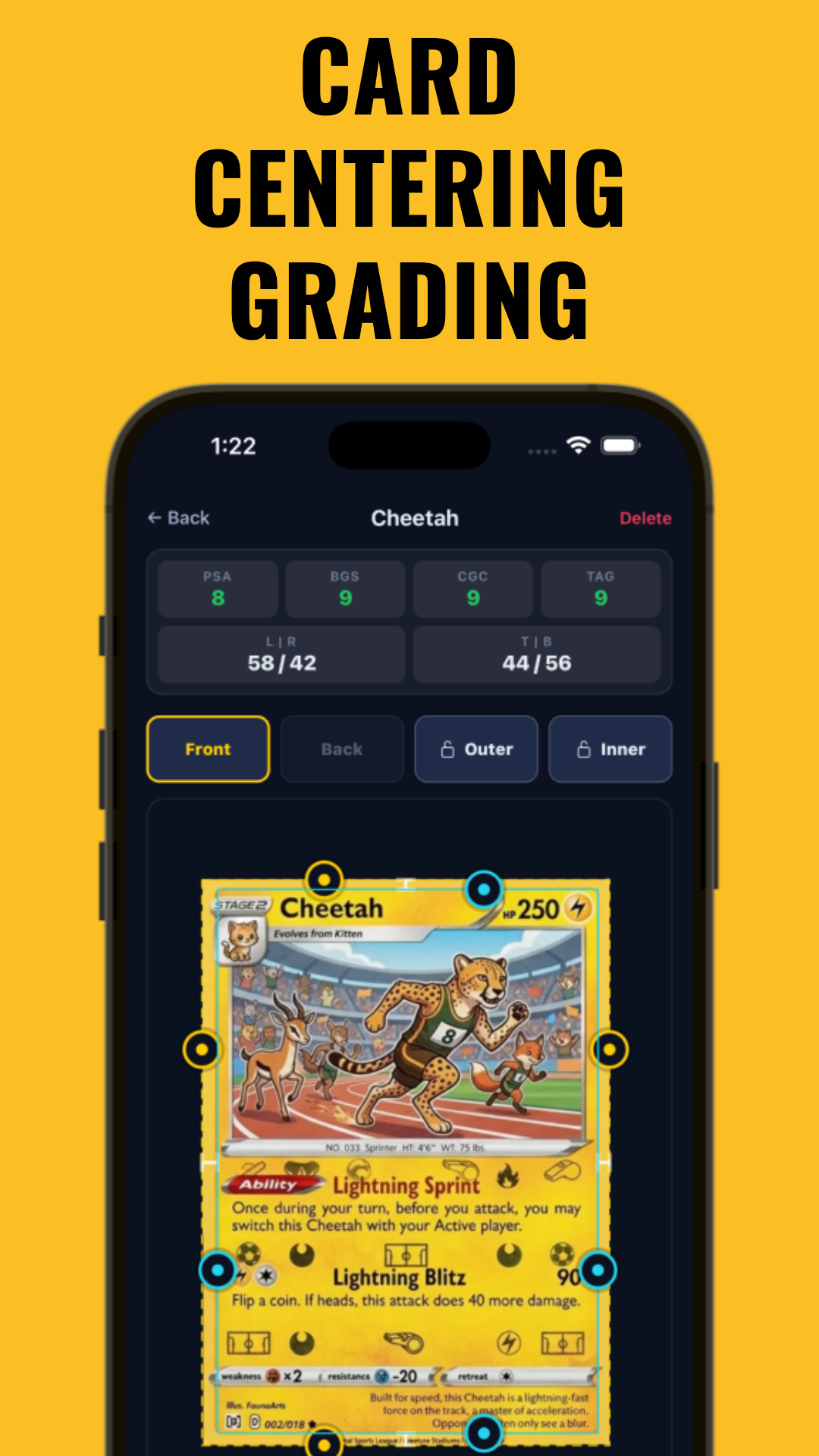
With Midpoint, you can measure centering down to the millimeter and get an AI-estimated PSA, BGS, CGC or TAG grade from centering, corners, edges and surface before you pay to submit.
Where to Sell or Buy
- Major auction houses: Best for Brown and other high-value cards with strong provenance.
- Online marketplaces: Broad reach; good for mid-tier cards if you photograph well.
- Card shows and dealers: Useful for in-person inspection and quick deals.
Whatever you choose, protect your cards properly while they wait: our guide to storing valuable cards covers holders and humidity.
Conclusion
The 1958 Topps football cards value story is simple at the top and nuanced everywhere else. Jim Brown #62 is the anchor, with Unitas, Starr, Jurgensen, Blanda and Gifford forming a strong second tier. Condition drives everything: centering, corners, edges and surface decide whether a card sits in a modest raw tier or a high-grade premium tier.
Use completed sales rather than asking prices, check population and authenticity, and only grade when the numbers clearly justify it. If you want to measure centering, estimate a grade and track your collection, try Midpoint, free on iOS and Android.
FAQ
Q: How much is a 1958 Topps Jim Brown rookie card worth?
A: It depends almost entirely on grade. Low-grade copies are the affordable entry point, mid-grade copies carry a clear premium, and NM-MT or better copies are scarce and priced at a steep multiple. Check recent completed sales for the exact grade, and use Midpoint's card lookup for current raw vs graded values.
Q: What is the most valuable 1958 Topps football card?
A: The Jim Brown rookie card, #62, is the most valuable card in the set by a wide margin. Stars like Johnny Unitas #22, Bart Starr #66, Sonny Jurgensen #90, Frank Gifford #73 and George Blanda #129 follow in a lower tier.
Q: How much is a complete 1958 Topps football set worth?
A: The total depends heavily on the condition of Jim Brown #62 and the overall grade of the other cards in the 132-card checklist. A low-grade Brown with average-condition commons costs far less than a set with a mid- or high-grade Brown. Verify that every card is genuine and untrimmed.
Q: What are the key rookie cards in the 1958 Topps football set?
A: Jim Brown #62 is the headline rookie, and Sonny Jurgensen #90 is also widely treated as a rookie-era card. Unitas and Starr are generally cataloged with earlier rookie cards, so their 1958 cards are key star cards rather than rookies. Confirm against a reputable checklist.
Q: How much are 1958 Topps football cards worth in ungraded condition?
A: Raw values vary widely with visible wear. Commons in worn condition are modest, while raw copies of stars and especially Brown vary based on corners, creases, centering and surface. Compare against sales of similarly described cards, not asking prices.
Q: What condition factors make a 1958 Topps football card valuable?
A: Centering, corner sharpness, clean edges, print quality and an unblemished surface matter most, along with authenticity and no trimming or repair. A card that checks every box can move into a much higher grade tier and price.
Free to start
Try the Midpoint app
Grade any card from a photo, see its raw and PSA 10 value, and track what your collection is worth — free.
Get it on iPhoneGet it on Android