1959 Topps Baseball Cards Value: What's Worth Grading
1959 Topps baseball cards value explained: most valuable cards, gem-premium gap, high numbers, rookies, and which cards are worth grading before you submit.

Estimated reading time: 12 min
Key Takeaways
- 1959 Topps baseball cards value depends on three things: the player, the card number (high numbers #507-572 are scarcer), and the grade.
- The most valuable 1959 Topps cards include Mickey Mantle #10, Bob Gibson's rookie #514, Sandy Koufax #163, Hank Aaron #380, Willie Mays and Yogi Berra #180.
- Vintage grade premiums are steep: the gap between a PSA 5 and a PSA 8 is often far larger than the gap between a PSA 3 and a PSA 5, and a PSA 10 is a different universe.
- Centering and print defects often hold back 1959 Topps cards as much as corners do, so measure before you submit.
- Always value a card from recent comparable sales that match the card number, grade, and back variety, not from a single price guide number.
Card values — live data from Midpoint's card database, as of 2026-11-18. Prices move; Midpoint refreshes these daily.
| Card | Raw | PSA 10 | Gem premium | |
|---|---|---|---|---|
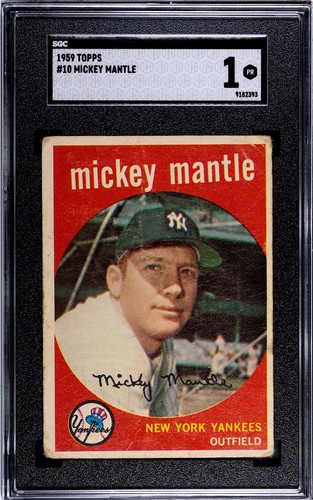 |
Mickey Mantle #10 1959 Topps |
$341.50 | $184,824 | 541.2× |
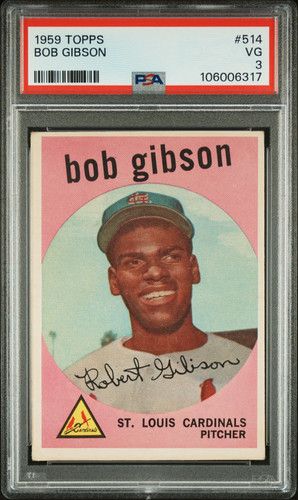 |
Bob Gibson #514 1959 Topps |
$699.94 | $156,827 | 224.1× |
 |
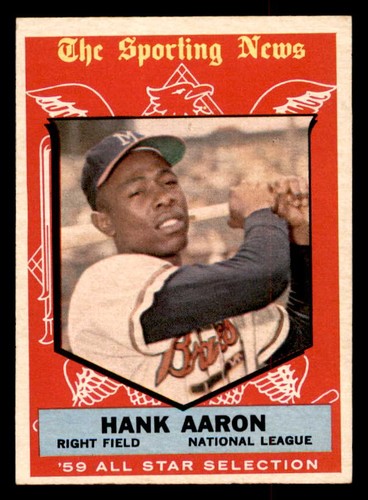
Hank Aaron #380 1959 Topps |
$107.61 | $30,000 | 278.8× |
 |
Willie Mays #50 1959 Topps |
$79.00 | $24,647 | 312× |
 |
Bob Clemente #478 1959 Topps |
$97.50 | $19,610 | 201.1× |
 |
Sandy Koufax #163 1959 Topps |
$90.96 | $16,097 | 177× |
 |
Stan Musial #150 1959 Topps |
$37.50 | $12,548 | 334.6× |
 |
Mickey Mantle #461 1959 Topps |
$55.47 | $12,337 | 222.4× |
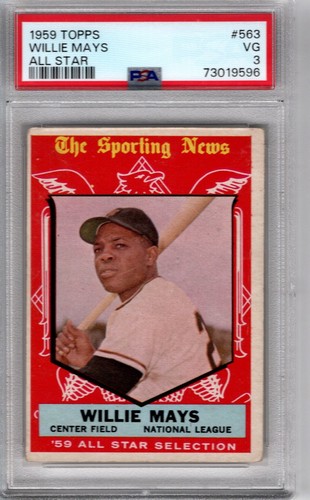 |
Willie Mays #563 1959 Topps |
$60.50 | $11,329 | 187.3× |
 |
Hank Aaron #561 1959 Topps |
$57.29 | $10,704 | 186.8× |
 |
Richie Ashburn #300 1959 Topps |
$10.68 | $10,465 | 979.9× |
 |
Duke Snider #20 1959 Topps |
$29.50 | $9,624 | 326.2× |
Look up any card's current raw and graded value in Midpoint — and get an estimated grade before you pay to submit.
Table of Contents
- Section 1: 1959 Topps Set Overview
- Section 2: How a 1959 Topps Price Guide Really Works
- Section 3: Most Valuable 1959 Topps Cards
- Section 4: Rookies and High-Number Cards
- Section 5: All-Star Cards, Variations and Errors
- Section 6: Condition, the Gem Premium and 1959 Topps PSA 10 Value
- Section 7: Authenticity and How to Value Your Card
- Conclusion
- FAQ
Section 1: 1959 Topps Set Overview
If you want to understand 1959 Topps baseball cards value, start with how the set was built. The base set runs 572 cards, issued in series through the 1959 season. The structure of those series explains most of the price differences you will see.
Series Structure and Checklist
Early-series cards (the low numbers) were generally printed in larger quantities and are usually the easiest to find. The final series, #507-572, was released late in the season, when kids and retailers were winding down. Fewer were sold and saved, so these high numbers are scarcer in nice condition.
The checklist mixes several kinds of cards:
- Base player cards for regulars and role players
- Rookie and prospect cards, including multi-player rookie issues
- Manager and team cards
- Topical subsets such as Baseball Thrills
- All-Star cards, deep in the high series
Design and Card Stock
The 1959 design is bright and colorful, with a large photo and the player's name and team printed prominently. That strong color is part of the set's appeal, but it can also show wear on edges and corners.
Gray Back vs. White Back
Collectors talk about gray-back and white-back cards, a reference to the back card stock. The difference matters when you compare sales: some numbers are known to be tougher in one stock than the other, and buyers may pay differently for each. Check your card's back in natural light against a known example, and make sure any comparable sale you use matches your back variety.
Section 2: How a 1959 Topps Price Guide Really Works
A 1959 Topps price guide is a starting point, not a verdict. The table above gives Midpoint's database figures as of 2026-11-18, and this post deliberately does not restate every number. Instead, here is how to read those figures correctly.
Raw vs. Graded Values
A raw (ungraded) price assumes a typical, unverified condition. A graded price reflects a specific grade from a grading company, which removes the guesswork for the buyer. For vintage cards the spread between the two is often wide, because many raw cards that look decent have hidden creases, trimming, or soft corners.
- Raw: cheaper, riskier, depends on your honest assessment
- Graded: verified authenticity and condition, higher price, easier to sell
Why Low Grades Still Matter
Are 1959 Topps baseball cards worth anything ungraded? Yes, particularly stars and key rookies. Even a well-loved, lower-grade Mantle, Koufax, or Aaron carries real value, because demand for vintage stars is steady. Commons and role players, by contrast, tend to be inexpensive unless the condition is exceptional or the card is a high number.
The Limits of Any Price Guide
Guide numbers lag the market. A single auction can move the price of a thin-population card, and a guide may average different grades together. Treat every guide figure as a range, then verify it with recent sales. Section 7 covers that process step by step.
For a clean mental model, remember that value is built from who (the player), which (the number and series), and how good (the grade, centering, and eye appeal).
Section 3: Most Valuable 1959 Topps Cards
The most valuable 1959 Topps cards follow a familiar pattern: Hall of Famers, rookies, and scarce high numbers. Here are the names every collector should know.
The Marquee Stars
- Mickey Mantle #10: the flagship card of the set and the one most buyers ask about. Demand from both set builders and Mantle collectors keeps it at or near the top of any 1959 Topps price guide.
- Willie Mays: his base card (#50) and his All-Star card are both strongly collected.
- Hank Aaron #380: a core card for Aaron collectors and a staple of mid-series wants.
- Sandy Koufax #163: a Dodgers icon whose cards have stayed in high demand.
- Yogi Berra #180: a Yankees legend with a card that is generally easier to afford than Mantle but still firmly in the stars tier.
Other Names Worth Watching
Beyond that group, stars such as Ernie Banks and Roberto Clemente have enthusiastic followings, and the top rookies in the set can rival the established stars. Check Midpoint for current raw and graded values on any of these cards, since lookup covers over 1.5 million cards.
What Separates the Top From the Rest
Three factors explain why these cards lead:
- Player legacy: Hall of Fame status and broad collector appeal
- Card significance: a rookie, a signature design, or a cultural icon
- Scarcity in condition: few survive with sharp corners, clean surfaces, and solid centering
That last point is critical. Many of these cards were handled, flipped, or stuffed in shoeboxes, so high-grade examples are scarce even when the raw card itself is plentiful. A well-centered Mantle in strong condition is worth a lot more than a typical one, and you can see this in how graded prices climb in the table above.
Section 4: Rookies and High-Number Cards
Two categories deserve special attention when you consider 1959 Topps cards worth grading: rookie cards and the final series.
Key Rookie Cards
The headline rookie is Bob Gibson #514. It is a high number, a Hall of Fame pitcher's rookie, and a card that combines both scarcity and demand. That combination is why it sits among the most valuable 1959 Topps cards. A 1959 Topps Bob Gibson rookie card is worth meaningfully more than most base stars, and graded copies carry a steep premium over raw. Look up the current figure in Midpoint's table as of 2026-11-18 rather than trusting a stale number.
Norm Cash (#509) is another notable rookie in the set. He was a standout player for the Tigers, and his rookie is a solid mid-tier target for collectors who cannot reach the biggest names.
Why High Numbers #507-572 Cost More
High-number cards were printed and distributed late. Lower print runs and lower survival rates generally mean the same grade costs more than it would for an early-series card.
- Fewer cards were pulled from packs late in the season
- Many were stored carelessly or discarded
- Set builders need them to finish, so demand is constant
Spotting Opportunities
Even commons in the high series can command a premium in high grades. If you have a stack of 1959s, sort out the #507-572 range first. A seemingly ordinary player in that range may be worth a graded look when an early-series equivalent would not be.
For cards with limited graded examples, see our guide to card grading for low population cards, which explains how thin populations change the math.
Section 5: All-Star Cards, Variations and Errors
The all-star subset is some of the most collectible material in the set, and it sits in the scarce late series.
Premium All-Star Cards
- Mickey Mantle #564: a second major Mantle card in the set, and a favorite for collectors who want more than the base issue.
- Billy Pierce #572: the final card in the checklist. Last-number cards tend to attract extra attention because set builders hunt them.
- Other all-star cards: several Hall of Famers appear in this subset, including Willie Mays and Hank Aaron versions.
Variations and Printing Quirks
1959 Topps is known for variety. You may encounter differences in back stock, print quality, and registration. Some are minor, while others can change the price. The gray-back versus white-back distinction is the one most sellers mention. Use it, but do not overpay for a variation until you have confirmed that sold comps exist for your exact version.
Centering and Print Differences
Vintage Topps was not cut with modern precision. Off-center borders, rough cuts, and print spots are common, even on cards that look clean at first glance. This is why two raw cards of the same player can price very differently.
When you evaluate a variation, ask:
- Is the difference documented in sold listings?
- Does it appear on graded examples, or only in raw listings?
- Is the card truly a variation, or simply a print flaw that lowers its grade?
Print defects are usually a discount, not a premium. Be skeptical of any listing that treats an ordinary flaw as a rare error.
Section 6: Condition, the Gem Premium and 1959 Topps PSA 10 Value
Grade is one of the biggest levers on 1959 Topps baseball cards value. Here is how it plays out.
What Graders Look At
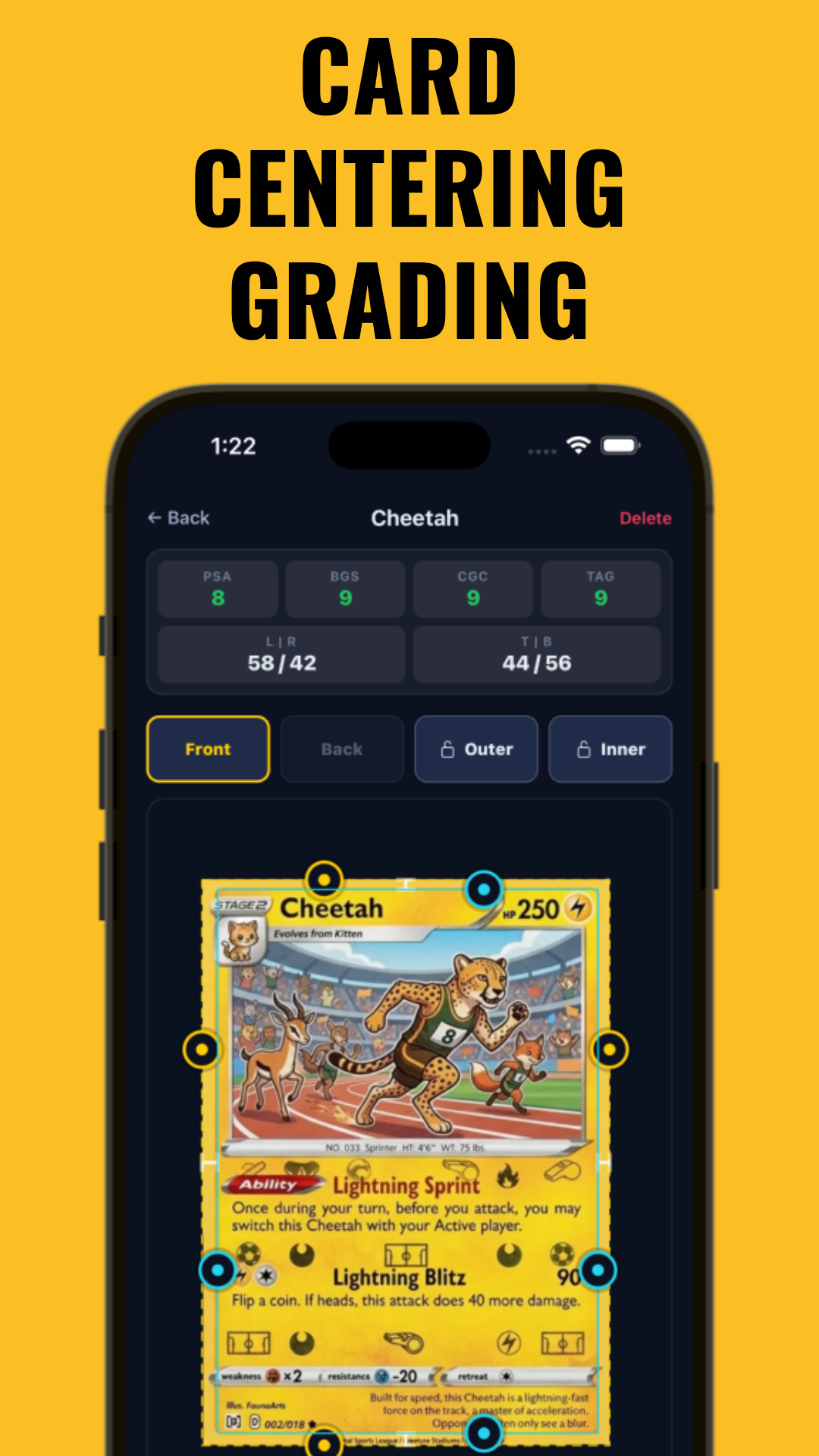
- Centering: how evenly the borders sit left to right and top to bottom
- Corners: sharpness versus rounding or fraying
- Edges: chipping, especially on dark borders
- Surface: gloss, scratches, print dots, stains, wax residue
- Structural damage: creases, trimming, and alterations
For a deeper look at the first factor, read how centering impacts card value.
The Gem-Premium Gap
Vintage prices do not rise in a straight line. Moving from PSA 5 to PSA 7 typically costs a meaningful step, PSA 8 more, and PSA 9 a large leap. A 1959 Topps PSA 10 value is a different category entirely: gem-mint examples of a card this old are exceptionally rare, so any sale can reset the market and the price is driven by a handful of buyers. Do not assume a PSA 10 value from a PSA 9 multiple.
Which 1959 Topps Cards Are Worth Grading?
Use a simple test:
- Is the raw card a star, key rookie, or high number?
- Does it look like a PSA 5 or better, with no creases or trimming?
- Is the graded premium over raw larger than grading fees plus shipping and risk?
If you answer yes to all three, grading is usually worth it. Commons in low grades rarely justify the fee. Before you submit, measure centering with the free centering calculator and compare scales in our guide to grading scale differences by company.
Section 7: Authenticity and How to Value Your Card
Vintage cards attract fakes and alterations, so authenticity is part of value.
Identifying Authentic 1959 Topps Cards
- Card number and back: confirm the number matches the player and that the back layout, font, and color look right against a known-good example.
- Print pattern: real cards show a consistent printing dot pattern under magnification. Reprints often look too sharp or too smooth.
- Card stock: the thickness, color, and aging should be consistent with a card from the late 1950s.
- Alterations: watch for trimmed edges, recolored borders, and surface repairs. Altered cards can look great and still be worth little.
For expensive cards such as Mantle, Koufax, or Gibson, professional authentication and grading is the safest route.
Valuing a Card With Comparable Sales
Follow these steps:
- Identify the exact card number, back variety, and grade or condition.
- Find several recent sales of the same card at the same grade.
- Discard outliers, such as damaged cards or auction anomalies.
- Check graded population data, since a thin population can inflate prices.
- Adjust for centering and eye appeal, which can move price within a grade.
Protecting and Tracking What You Own
Once you know what you have, store it correctly using our guide on how to store valuable cards. Midpoint also offers an AI pre-grade estimate, raw versus graded lookup, and portfolio tracking so you can watch your collection's value over time before you spend $30+ on a submission.
Conclusion
The value of 1959 Topps baseball cards comes down to the player, the number, and the grade. Mantle #10, Gibson #514, Koufax #163, Aaron #380, Mays and Berra #180 are among the leaders of the set, and the scarce high-number series adds depth for rookies and all-stars like Mantle #564 and Billy Pierce #572.
Do not rely on one price guide. Use the table of Midpoint's data as of 2026-11-18, confirm with recent comparable sales, and only submit cards where the graded premium clearly beats the cost. Measure centering first and check authenticity on anything valuable.
Ready to check your cards? Try Midpoint to measure centering, estimate PSA, BGS, CGC, and TAG grades, and look up raw and graded values before you submit.
FAQ
Q: What are the most valuable 1959 Topps baseball cards?
A: Mickey Mantle #10 is the set's flagship card, alongside Bob Gibson's rookie #514, Sandy Koufax #163, Hank Aaron #380, Willie Mays and Yogi Berra #180. High-number all-star cards such as Mantle #564 are also prized. Rankings shift by grade, so check current figures in Midpoint.
Q: How much is a 1959 Topps Mickey Mantle card worth?
A: It depends heavily on grade, centering, and which Mantle card you hold (#10 or the all-star #564). Value climbs steeply with grade, so compare recent sales of the same card and grade, and look up current raw and graded values in Midpoint.
Q: What is a 1959 Topps Bob Gibson rookie card worth?
A: Gibson #514 is a high-number Hall of Fame rookie, so it carries a strong premium, especially graded. Verify the latest value using sold comps and Midpoint's database figures as of 2026-11-18.
Q: Are 1959 Topps baseball cards worth anything ungraded?
A: Yes. Stars, key rookies, and high-number cards hold real value raw, even in lower condition. Commons and role players are typically modest unless they are in exceptional shape.
Q: Which 1959 Topps cards are rare or valuable?
A: Rarity concentrates in the final series, #507-572, which includes Gibson's rookie and the all-star cards. Gem-grade examples of any card from the set are scarce.
Q: How can I tell if my 1959 Topps card is a gray back or white back?
A: Examine the back in natural light and compare its color to a known example, ideally a graded one. Make sure any sold comp you use matches your back variety, since pricing can differ.
Free to start
Try the Midpoint app
Grade any card from a photo, see its raw and PSA 10 value, and track what your collection is worth — free.
Get it on iPhoneGet it on Android