1960 Topps Hockey Cards Value: Raw vs Graded Price Guide
1960 Topps hockey cards value explained: Mikita #14, Hull #58, raw vs PSA 10 gaps, condition factors, and which cards are worth grading.

Estimated reading time: 11 min
Key Takeaways
- 1960 Topps hockey cards value is driven by three things: the player (Hall of Famers and rookies lead), the grade, and centering and print quality.
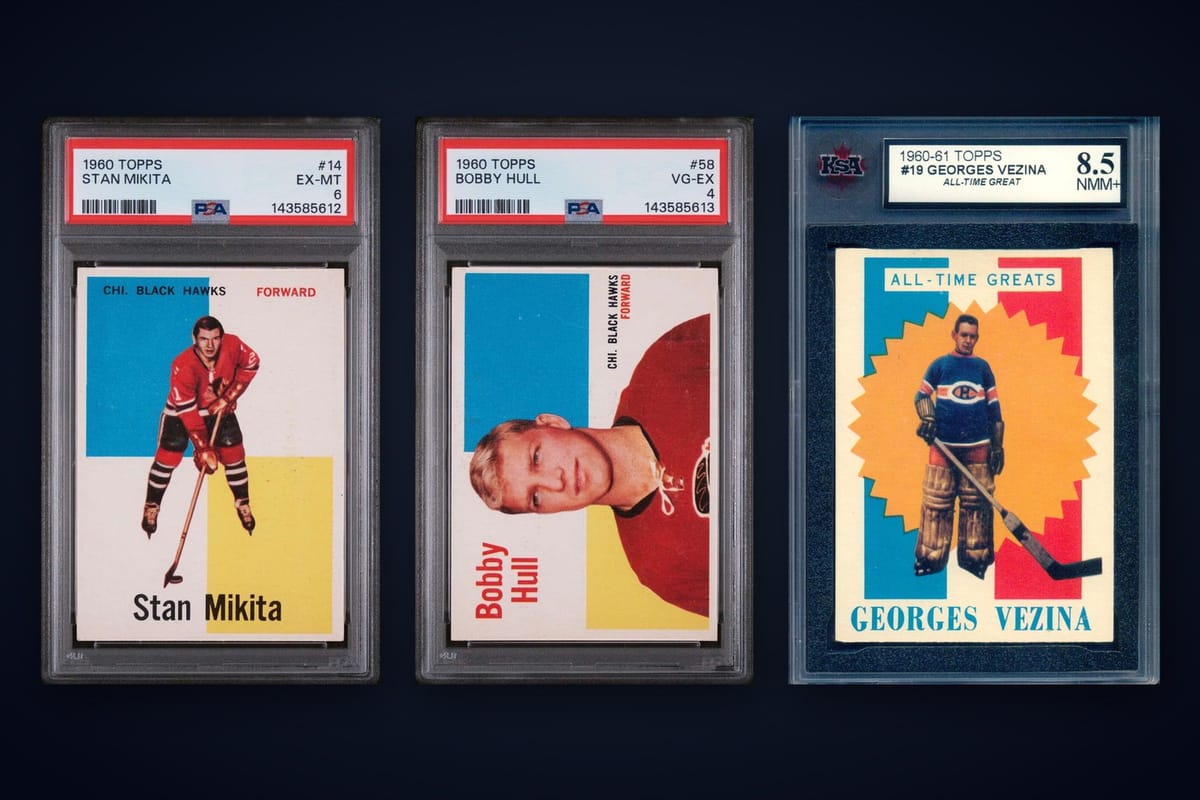
- The Stan Mikita rookie #14 and Bobby Hull #58 anchor the set. Bill Hay #6 and the other stars sit behind them.
- The gem premium is the real story: the jump from a mid-grade card to a PSA 10 is typically far larger than the jump between mid grades.
- Grade only when the expected graded value beats raw value by well more than the submission cost, which is often $30 or more per card. Pre-screen centering first.
- Check live raw and graded comps in Midpoint before you buy, sell, or submit. Prices move, and this post gives you a framework instead of stale numbers.
Card values — live data from Midpoint's card database, as of 2026-11-15. Prices move; Midpoint refreshes these daily.
| Card | Raw | PSA 10 | Gem premium | |
|---|---|---|---|---|
 |
Stan Mikita #14 1960 Topps |
$207.00 | $40,503 | 195.7× |
 |
Bobby Hull #58 1960 Topps |
$113.93 | $23,641 | 207.5× |
 |
Georges Vezina #19 1960 Topps |
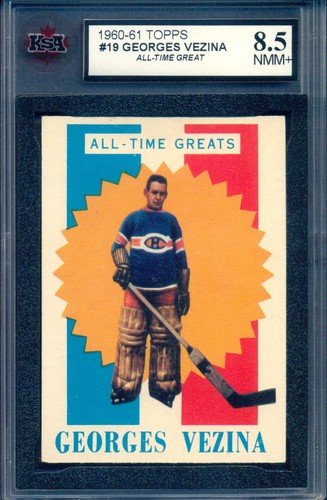
$66.00 | $12,488 | 189.2× |
 |
Eddie Shore #20 1960 Topps |
$34.99 | $6,594 | 188.5× |
 |
Gump Worsley #36 1960 Topps |
$33.48 | $6,441 | 192.4× |
 |
Lester Patrick #1 1960 Topps |
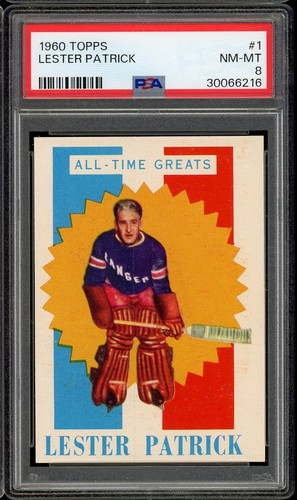
$31.00 | $5,846 | 188.6× |
 |
Johnny Bucyk #11 1960 Topps |
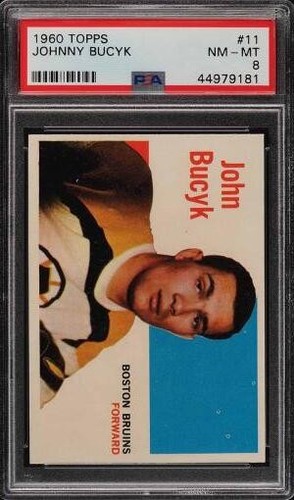
$30.75 | $5,800 | 188.6× |
 |
Cyclone Taylor #46 1960 Topps |
$23.10 | $4,441 | 192.2× |
 |
Howie Morenz #59 1960 Topps |
$22.50 | $4,252 | 189× |
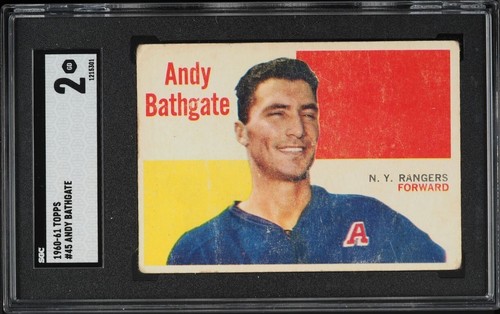 |
Andy Bathgate #45 1960 Topps |
$21.33 | $4,030 | 189× |
 |
King Clancy #47 1960 Topps |
$19.25 | $3,642 | 189.2× |
 |
Art Ross #27 1960 Topps |
$19.99 | $3,575 | 178.8× |
Look up any card's current raw and graded value in Midpoint — and get an estimated grade before you pay to submit.
Table of Contents
- Section 1: The 1960-61 Topps Hockey Set at a Glance
- Section 2: Most Valuable 1960 Topps Cards: Mikita, Hull, Hay and More
- Section 3: Raw vs Graded: The Gem Premium and PSA 10 Value
- Section 4: How Condition Changes a 1960 Topps Price Guide
- Section 5: Which 1960 Topps Cards Are Worth Grading
- Section 6: Authenticity, Reprints and Misidentified Years
- Section 7: Complete Sets, Selling and Valuing a Collection
- Conclusion
- FAQ
Section 1: The 1960-61 Topps Hockey Set at a Glance
Understanding 1960 Topps hockey cards value starts with knowing what the set is. Topps issued its 1960-61 hockey set as a compact 66-card run, sold in wax packs with a slab of gum. Small checklist, big names, and a lot of surviving copies with rough edges. That combination is why condition matters so much.
Naming: 1960 vs 1960-61
Hockey seasons span two calendar years, so collectors write the set as 1960-61 Topps. Searchers often type "1960 Topps hockey" or lump hockey in with the baseball and football issues of the same year. If you are comparing prices, make sure every comp is the hockey card with the right card number, not a different sport or a neighboring season such as 1959-60 or 1961-62.
Why the set carries value
- Original Six era: six-team NHL, so the checklist is dense with Hall of Fame talent.
- Key rookie: Stan Mikita's rookie card is #14, a cornerstone of vintage hockey collecting.
- Short checklist: a 66-card set is achievable, which keeps demand for complete and near-complete sets steady.
- Tough condition: vintage stock, gum staining, and loose cutting leave few truly sharp copies.
How to use this price guide
Midpoint's database tracks raw versus graded values for these cards. Rather than list figures that go stale, this guide explains how to read them: which cards lead, where the gap between raw and graded opens up, and where a grading fee makes sense.
One caution up front. Vintage card prices are thin-market prices. A single high-grade sale can move a card's number noticeably, so treat any figure as a snapshot and check recent sold comps before acting.
Section 2: Most Valuable 1960 Topps Cards: Mikita, Hull, Hay and More
When collectors ask for the most valuable 1960 Topps cards in the hockey issue, the answer comes from player significance first, then scarcity in high grades. Here is how the main names line up.
Stan Mikita rookie card #14
Mikita's #14 is the set's marquee rookie. A Chicago Blackhawks legend and Hall of Famer, he is one of the most beloved centers of his era, and the card is the first Topps appearance collectors want. Expect it to command a strong premium over common cards at every grade, and likely one of the widest raw-to-graded spreads in the set.
Bobby Hull #58
Hull's #58 is not his rookie card, since his first Topps issue came earlier, but the "Golden Jet" is among the most popular players in hockey history. The card is typically the other pillar of the set alongside Mikita. Demand comes from both set builders and player collectors.
Bill Hay #6 and the supporting cast
Bill Hay #6 is a Blackhawks teammate of Mikita and Hull, and the card appears early in the numbering. Collectors often say early-number cards are more vulnerable to wear because they may have sat at the top of stacks and bundles, which can make well-centered, sharp copies tougher to find. Beyond Hay, the set's other Hall of Famers and star goaltenders form the next tier. Look each one up by card number in Midpoint to see where it sits against the commons.
The value ladder in plain terms
- Tier 1: Mikita #14 and Hull #58.
- Tier 2: other Hall of Famers and iconic goalies.
- Tier 3: solid regulars and Blackhawks names like Hay.
- Tier 4: commons, where only top grades carry meaningful premiums.
Even Tier 4 commons can surprise you. In a small vintage set, a clean, centered copy of a nobody can outsell a beat-up star.
Section 3: Raw vs Graded: The Gem Premium and PSA 10 Value
Every serious 1960 Topps price guide eventually comes down to one chart: what a card is worth ungraded, and what it is worth in a slab. The gap between those two numbers is where collectors make or lose money.
The gem-premium gap
Vintage prices do not climb in a straight line. A card from PSA 5 to PSA 7 typically gains steadily. From PSA 8 to PSA 9 the jump generally gets steeper. From PSA 9 to PSA 10 it can be dramatic, because so few examples survive with sharp corners, clean surfaces and centered printing. That is the gem premium.
- Low and mid grades: graded and raw prices often sit close together. A slab adds authentication and liquidity more than raw dollars.
- High grades (8-9): the slab premium becomes meaningful, especially for stars.
- Gem (PSA 10): the premium can be many multiples of the grade below, but supply is tiny.
What a 1960 Topps PSA 10 value really means
For a 1960-61 Topps hockey card, PSA 10 value is often more theoretical than practical. Cards from this era rarely hit gem mint, so a PSA 10 may have few or no public sales to anchor it. When comps are sparse, one buyer's appetite sets the market. Check recorded sales in Midpoint's card lookup and read PSA's population report before assuming any PSA 10 number is repeatable.
Company differences
PSA, SGC, BGS and CGC use different scales and attract different buyers. PSA generally has the strongest resale presence for vintage hockey, SGC is respected for older cards, and BGS offers subgrades that expose centering and corner scores. For the nuances, see our breakdown of grading scale differences by company. Never compare a PSA price to a BGS or SGC price as if they were equivalent.
Section 4: How Condition Changes a 1960 Topps Price Guide
Two copies of the same card can sell for wildly different amounts. Graders look at the same factors you can check at your kitchen table.
Centering
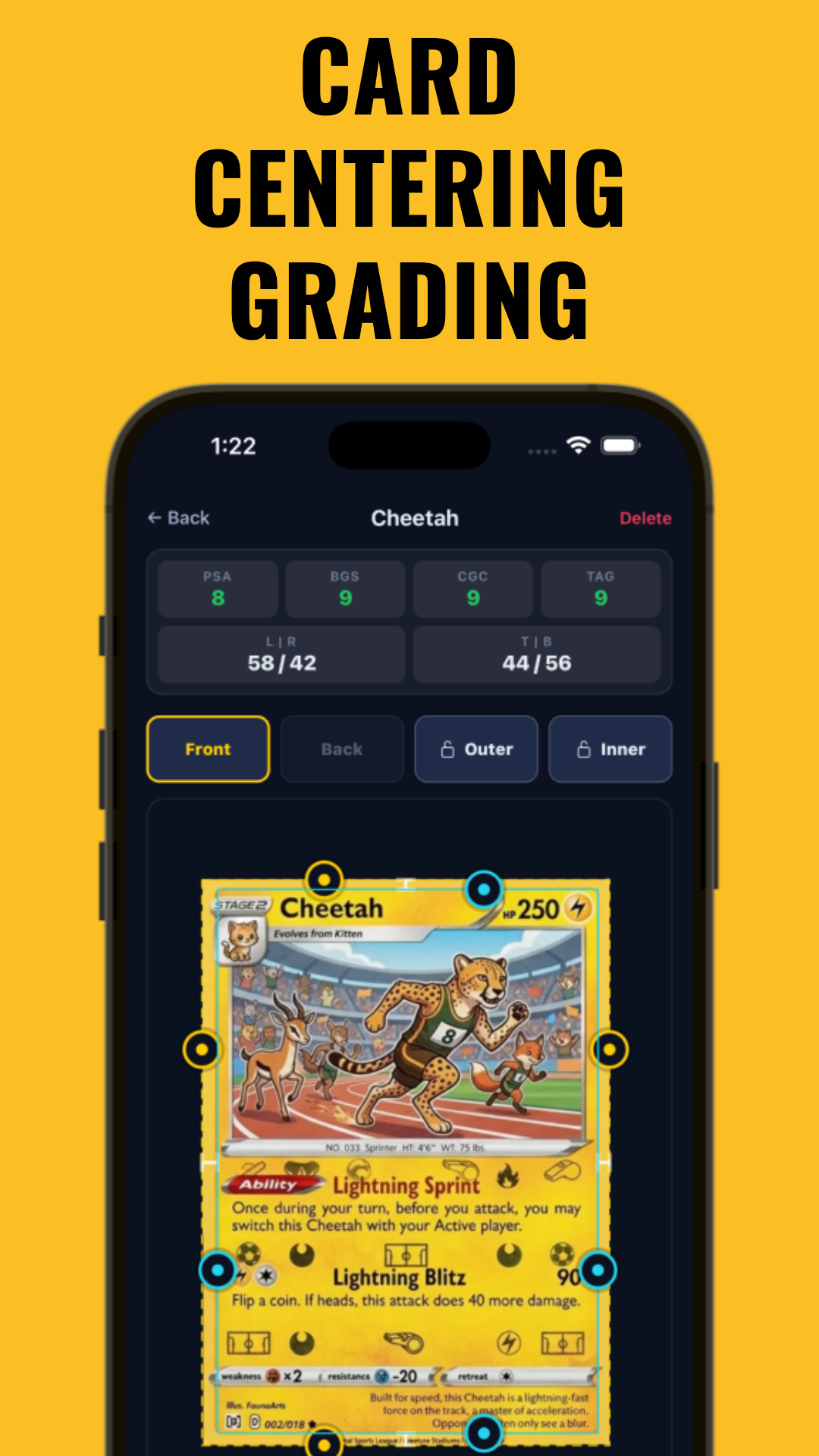
Centering is a common dealbreaker on 1960-era Topps hockey. Cutting was imperfect, so off-center cards are the norm and well-centered ones are the prize. PSA's published standard for a gem mint 10 is roughly 55/45 or better on the front (a more lenient tolerance on the back), while 60/40 on the front is generally associated with a PSA 9. Measure left-to-right and top-to-bottom, front and back. Our guide on how centering impacts card value shows how a few percentage points can change a grade.
Corners and edges
- Corners: look for fuzzing, rounding and soft tips. Sharp, square corners separate an 8 from a 6.
- Edges: chipping shows up as white flecks, especially on dark borders.
Surface, creases, stains and print defects
- Creases: any visible crease typically caps a card at a low grade, and a hard crease can send it into the lowest tiers.
- Stains: wax or gum residue from the original packs is common on vintage Topps. Heavy staining hurts.
- Print defects: print dots, roller marks and uneven ink are often original to the card, but they can still limit a grade.
- Surface wear: scratches, scuffs and loss of gloss are visible under angled light.
Inspect every card with a bright, angled light and a loupe. The surface problems you miss at arm's length are the ones a grader will find.
Section 5: Which 1960 Topps Cards Are Worth Grading
The question behind 1960 Topps cards worth grading is simple: will the graded value exceed raw value by enough to cover the fee and the risk? Submission fees often start around $30 or more per card, plus shipping and insurance, and turnaround can be slow.
A simple decision rule
- Look up the card's raw value in Midpoint.
- Look up the graded value at the grade you realistically expect, not the best-case grade.
- Subtract raw value, the grading fee, shipping and insurance from the graded value.
- If the remainder is comfortably positive even at one grade lower, submit. If it only works at the top grade, skip it.
Strong candidates
- Mikita #14 and Hull #58 with sharp corners, clean surfaces and centering near 60/40 or better.
- Other Hall of Famers that look clearly high-grade.
- Cards with an authentication need, where a slab raises buyer confidence and helps the sale.
Cards to leave raw
- Commons with visible wear. The fee will exceed any premium.
- Anything with creases, heavy staining or paper loss.
- Very off-center cards, where centering alone caps the grade.
Pre-grade before you pay
Midpoint estimates a PSA, BGS, CGC or TAG grade from centering, corners, edges and surface before you commit, and its free centering calculator gives a fast read on ratios. Our step-by-step pre-grading guide walks through the process. Even a rough estimate prevents a common mistake: paying to grade a card that was never going to clear a 7.
Section 6: Authenticity, Reprints and Misidentified Years
Value only counts if the card is genuine and correctly identified. Vintage hockey has its share of reprints, alterations and mislabeled listings.
Spotting reprints and fakes
- Print pattern: original cards show a fine rosette dot pattern under magnification. Reprints often show smooth or blurry printing.
- Card stock: vintage stock has a specific feel and tone. Bright white, glossy stock is a red flag.
- Size and cut: compare against a known genuine card of the same set.
- Back text: check fonts, ink color and layout against a verified example.
Alterations
Trimmed edges, re-colored borders, and filled-in corners are classic tricks to inflate a grade. Look for edges that are unusually crisp for the card's age, cards that measure slightly short, and borders with a mismatched shade. Major third-party grading companies generally will not grade altered cards as genuine, which is another reason to submit valuable ones.
Misidentified years and sets
- Season confusion: the 1960-61 hockey set is different from the 1959-60 and 1961-62 issues. Verify the card number and design.
- Sport confusion: "1960 Topps" also brings up baseball and football. Confirm hockey before comparing prices.
- Brand confusion: other manufacturers issued hockey cards around the same time. Make sure you are looking at Topps.
When in doubt, match the card number and photo against the checklist, then confirm in Midpoint's lookup.
Section 7: Complete Sets, Selling and Valuing a Collection
If you hold more than a card or two, you need a way to value the whole group and a plan for selling it.
Complete and near-complete sets
A complete 66-card set is typically worth considerably more than the sum of its commons because the stars, especially Mikita #14 and Hull #58, drive the total. Set value depends heavily on the condition of those key cards. A "complete" set made of low-grade copies sells at a very different level than one built from sharp, well-centered examples. Near-complete sets with the key cards present usually move more easily than sets missing both stars.
Estimating a collection's total value
- Sort cards by number and identify the stars first.
- Grade each card honestly, using the condition criteria above.
- Look up comparable raw or graded values for each.
- Add the totals, then discount slightly for selling costs and unsold risk.
Midpoint's portfolio tracking lets you enter cards once and watch your collection's value over time, so you are not rebuilding a spreadsheet every time prices shift.
How to sell
- Stars: sell graded or high-grade copies through major auctions or well-reviewed online marketplaces, where buyers search by player and grade.
- Commons: bundle them into lots or sell as a set.
- Photos: show front, back, corners and any flaws. Honest, clear scans reduce disputes.
- Comps: price off recent sold listings at the same grade, not asking prices.
Store everything properly while you decide. Our guide on how to store valuable cards covers sleeves, holders and humidity so you do not lose value to avoidable damage.
Conclusion
1960 Topps hockey cards value comes down to a handful of stars, a steep gem premium and a lot of condition-driven variation. Mikita's #14 rookie and Hull's #58 lead the set, Bill Hay #6 and the other Hall of Famers fill the next tier, and the commons only get interesting in top condition.
Before you buy, sell or grade, do three things: check the card's raw and graded values, inspect centering and surface honestly, and run the cost math at a realistic grade, not a hopeful one. You can look up values and pre-grade a card in Midpoint for free on iOS and Android, so you know what you have before you spend $30 or more on a submission.
FAQ
Q: How much is a 1960-61 Topps hockey card worth?
A: It depends on the player, card number and grade. Commons in worn condition are worth little, while Hall of Famers and the Mikita rookie command real premiums, especially graded. Check the card in Midpoint for raw versus graded values as of the latest update, and compare against recent sold listings.
Q: What is the value of a 1960 Topps Stan Mikita rookie card #14?
A: It is the most important rookie in the set and typically carries one of the largest premiums at every grade. The raw-to-graded gap tends to widen sharply at high grades, so condition, centering and corners matter enormously. Look up the specific grade in Midpoint and check recent sales before pricing a copy.
Q: How much is a 1960-61 Topps Bobby Hull #58 worth?
A: Hull's #58 is one of the set's two headline cards. It is not his rookie, but his popularity keeps demand strong. Value rises quickly with grade, so confirm your copy's condition and compare it with sold comps at the same grade.
Q: What are the most valuable cards in the 1960-61 Topps hockey set?
A: Stan Mikita #14 and Bobby Hull #58 lead, followed by other Hall of Famers and star goaltenders. Bill Hay #6 and similar regulars sit in the middle, and commons trail unless they are in top grades.
Q: How much is a complete 1960-61 Topps hockey set worth?
A: The set has 66 cards, and total value depends mostly on the condition of Mikita and Hull plus the other stars. A complete set of low-grade cards sells far below one built from sharp copies. Value each card individually, add them up, and discount for selling costs.
Q: Should I get my 1960-61 Topps hockey cards graded?
A: Grade stars with sharp corners, clean surfaces and good centering, where the graded premium clearly exceeds the fee, which is often $30 or more. Skip creased, stained or badly off-center cards and most commons. Pre-grade first with a tool like Midpoint to avoid paying for a low grade.
Free to start
Try the Midpoint app
Grade any card from a photo, see its raw and PSA 10 value, and track what your collection is worth — free.
Get it on iPhoneGet it on Android