
Allen Iverson Cards Worth Money: Top Rookies to Grade
Which Allen Iverson cards are worth money? See the most valuable rookies, parallels and inserts, PSA 10 premiums, and which cards are worth grading.

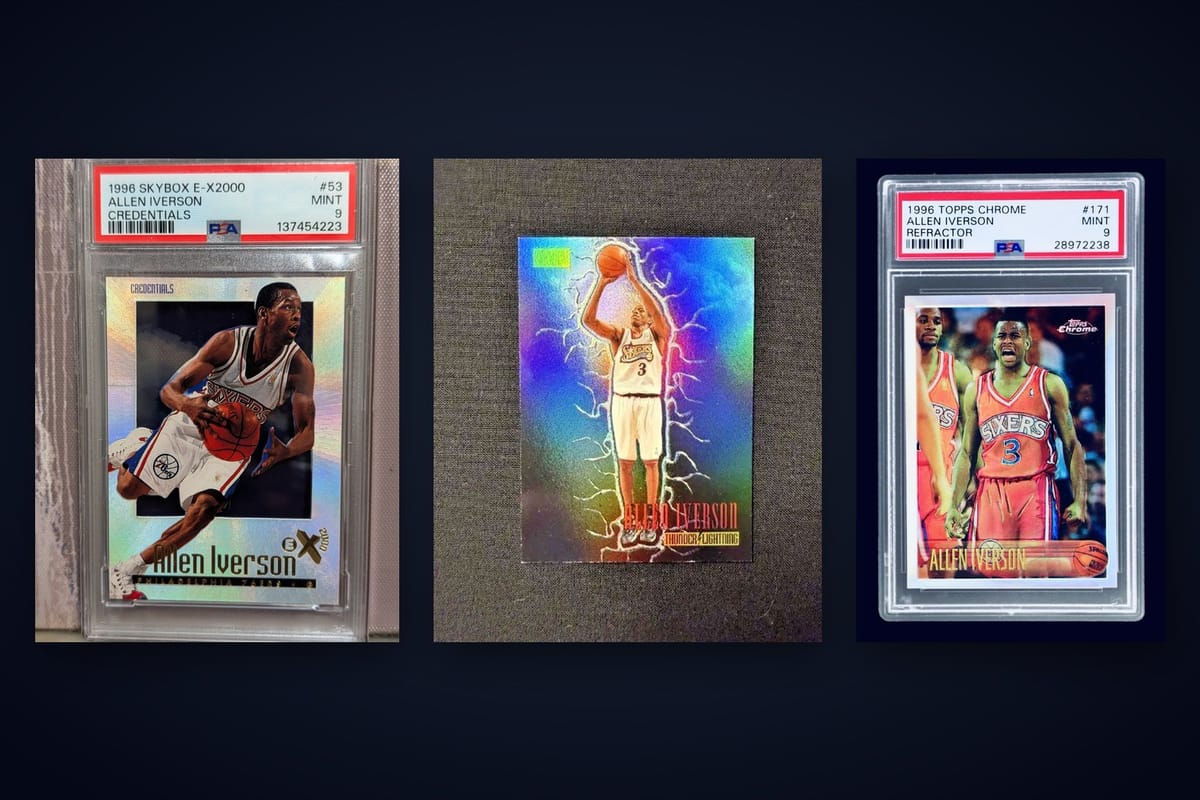
Estimated reading time: 11 min
Key Takeaways
- Allen Iverson cards worth money are concentrated in his 1996-97 rookie class, led by Topps Chrome #171 and its Refractor, plus scarce parallels and inserts.
- Allen Iverson rookie card value depends far more on grade and parallel type than on the set name alone.
- A PSA 10 can carry a major premium over a raw copy, but only if centering, corners, edges, and surface all hold up.
- Always compare recent sold prices, not asking prices, and match the exact grade and variation.
- Pre-grade first: the best Allen Iverson cards to grade are clean, well-centered copies of his key rookies and scarce parallels.
Card values — live data from Midpoint's card database, as of 2026-09-04. Prices move; Midpoint refreshes these daily.
| Card | Raw | PSA 10 | Gem premium | |
|---|---|---|---|---|
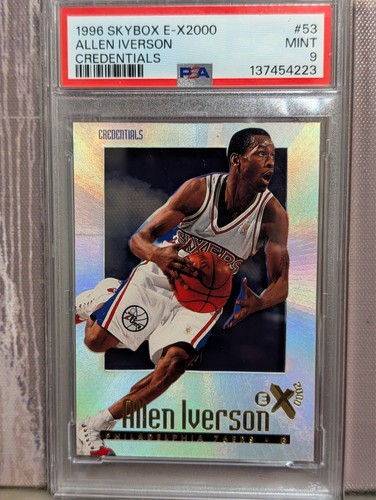 |
Allen Iverson [Credentials] #53 1996 Skybox E-X2000 |
$2,176 | $18,288 | 8.4× |
 |
Allen Iverson #15 1997 Skybox Premium Thunder & Lightning |
$500.00 | $13,005 | 26× |
 |
Allen Iverson [Refractor] #171 1996 Topps Chrome |
$1,710 | $12,210 | 7.1× |
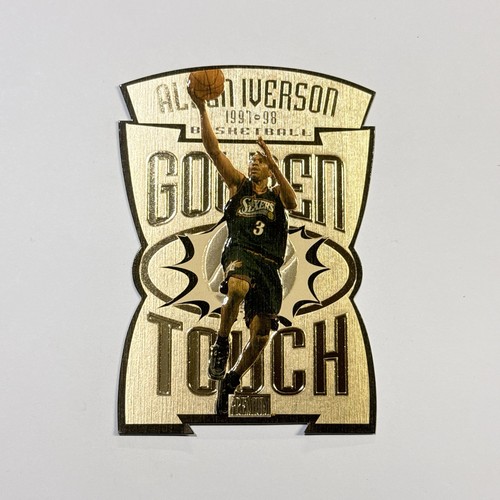 |
Allen Iverson #2GT 1997 Skybox Premium Golden Touch |
$288.72 | $7,352 | 25.5× |
 |
Allen Iverson #5DG 1998 Skybox E-X Century Dunk 'N Go-Nuts |
$731.04 | $6,735 | 9.2× |
 |
Allen Iverson #10 1998 Skybox Premium That's Jam |
$627.68 | $6,500 | 10.4× |
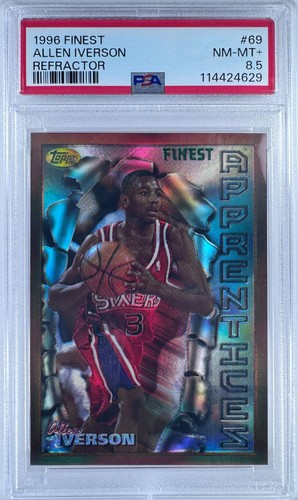 |
Allen Iverson [Refractor] #69 1996 Finest |
$262.75 | $6,200 | 23.6× |
 |
Allen Iverson [Atomic Refractor] #R1 1996 Bowman's Best Rookie |
$535.10 | $6,000 | 11.2× |
 |
Allen Iverson [Refractor] #280 1996 Finest |
$1,255 | $4,668 | 3.7× |
 |
Allen Iverson #2 1997 Ultra Court Masters |
$179.99 | $4,658 | 25.9× |
 |
Allen Iverson [Plus] #20 1996 Ultra Scoring Kings |
$176.25 | $4,188 | 23.8× |
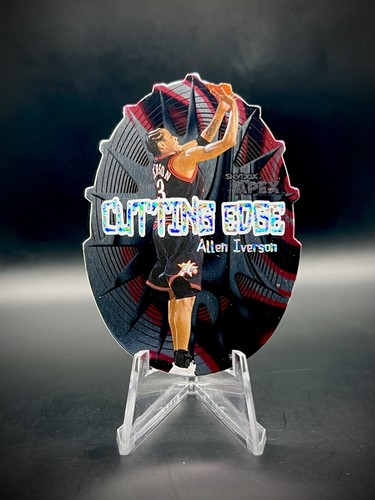 |
Allen Iverson [Plus] #1 1999 Skybox Apex Cutting Edge |
$180.00 | $3,853 | 21.4× |
Look up any card's current raw and graded value in Midpoint — and get an estimated grade before you pay to submit.
Table of Contents
- Section 1: Are Allen Iverson Cards Worth Money?
- Section 2: 1996-97 Rookie Cards and Allen Iverson Rookie Card Value
- Section 3: Most Valuable Allen Iverson Cards: Parallels, Inserts, and Autographs
- Section 4: Asking Prices vs. Sold Prices
- Section 5: Allen Iverson PSA 10 and How Grades Move Value
- Section 6: Best Allen Iverson Cards to Grade
- Section 7: Identify, Authenticate, and Protect Your Cards
Section 1: Are Allen Iverson Cards Worth Money?
Short answer: yes, some of them. Allen Iverson cards worth money exist in every era of his career, but the value is lopsided. A handful of rookie cards, rare parallels, and serial-numbered or autographed pieces command the real dollars. Most common base cards from the junk-wax years do not.
Why Iverson Holds Collector Demand
Iverson was the No. 1 pick in the 1996 NBA Draft, won Rookie of the Year in 1997, took the 2001 MVP award, and was inducted into the Hall of Fame in 2016. His crossover, his cultural footprint, and his 76ers legacy keep collectors buying. That demand is steady rather than speculative, which is why his key cards tend to hold attention year after year.
The 1990s Problem: Supply
The 1996-97 season sits in an era of heavy production. Many base rookies were printed in large quantities, so a raw, ungraded base copy is rarely a windfall. Scarcity comes from three places:
- Parallels and refractors with limited distribution.
- Inserts with low pull rates.
- Condition: a gem-quality copy of a common card is scarce even when the card itself is not.
What the Data Table Shows
The table in this post comes from Midpoint's own database and lists raw versus graded values for key Iverson cards as of 2026-09-04. Use it as a starting range, then confirm with live sold comps. Values move, and one auction can reset a card's market for weeks.
The rest of this guide walks through which cards matter, how grade changes the picture, and how to decide what to submit. If you have a shoebox of 90s basketball cards, treat this as your sorting guide.
Section 2: 1996-97 Rookie Cards and Allen Iverson Rookie Card Value
Allen Iverson rookie card value starts with the 1996-97 class. Nearly every major brand issued an Iverson rookie, and they are not equal. Knowing which tier you hold saves you from overestimating or underestimating a card.
The Tier-One Rookies
These are the cards most collectors mean when they say "Iverson rookie":
- 1996-97 Topps Chrome #171: the chrome-finish flagship rookie and the most widely recognized.
- 1996-97 Topps Chrome Refractor: the rarer, shinier version of #171. It usually commands a substantial premium over the base chrome in comparable grades.
- 1996-97 Finest: a premium, metallic-style rookie with a loyal following.
- 1996-97 Bowman's Best: a chrome-style rookie that collectors place near the top of the class.
The Mid-Tier and Entry Rookies
These are cheaper and more plentiful, but still worth checking:
- SP and Ultra: popular, well-designed rookies with solid recognition.
- Upper Deck, Fleer, and Collector's Choice: widely printed, so raw copies are modest and grade matters most.
- Stadium Club Rookies: a sharp-looking issue that is easy to find and affordable.
How to Read the Rookie Hierarchy
Brand prestige, finish, and print run set the order. Chrome and refractor cards generally sit above standard cardboard because they are harder to find in top condition. A base Fleer in PSA 10 can narrow the gap with a raw chrome that has soft corners, so condition can reshuffle the order.
Check the table above for how Midpoint's database lists raw versus graded values for these entries. The gap between raw and graded on tier-one rookies is where grading decisions get interesting.
Section 3: Most Valuable Allen Iverson Cards: Parallels, Inserts, and Autographs
When collectors ask for the most valuable Allen Iverson cards, they usually mean the scarce, low-population pieces rather than base rookies. Here is where the top end tends to live.
Rare 1996-97 Parallels and Inserts
Several inserts and parallels from his rookie season carry premium reputations:
- Precious Metal Gems: a scarce metal-era parallel family. Collectors chase these in high grades, and they are a frequent search topic for a reason.
- Essential Credentials: a low-print insert type that shows up in high-dollar conversations.
- Star Rubies: a rare parallel prized for its red-hued look and limited distribution.
- Playmakers Theater: a scarce insert that appeals to collectors who want something beyond the base checklist.
- Gold Medallion: a sought-after parallel treatment that sits well above standard base copies.
- Topps Chrome Refractors: the most recognizable chase card for many Iverson collectors.
Before you assume any of these is in your collection, confirm the exact set, card number, and parallel. Names repeat across brands, and the wrong match leads to the wrong price.
Autographs, Patches, and Logoman
Beyond the rookie year, the top of the market usually includes:
- Autographed cards from authenticated signing programs.
- Game-used patch cards, especially with multi-color or jersey-number swatches.
- Logoman pieces, where the NBA logo patch is the centerpiece.
- Serial-numbered cards, where a low print run caps supply.
The rarer the print run and the cleaner the autograph or patch, the more a card behaves like a one-off. Those sales are harder to predict and depend on the specific example.
Why Scarcity Beats Brand Alone
Three levers drive the price: print run or serial number, parallel type, and authentication quality. A Logoman patch with a bold, clean autograph is a different asset than a lightly signed card with a plain swatch. Always value the exact card, not the category.
Section 4: Asking Prices vs. Sold Prices
The single biggest mistake in pricing Iverson cards is trusting listing prices. An asking price is a hope. A sold price is a fact. Treat them differently.
How to Check Sold Prices
Follow this simple workflow:
- Identify the card exactly: year, brand, set, card number, and parallel.
- Search eBay and filter to Sold Items or Completed Items.
- Match the grade: PSA 10, PSA 9, BGS 9.5, SGC 10, CGC 10, or raw.
- Look at the last several sales, not just the highest one.
- Check major auction house archives for scarce or autographed cards.
Red Flags in the Data
- Best Offer accepted listings may show the listing price, not the final price.
- Shill bidding or one-off outliers can distort the high end.
- Mismatched parallels inflate comps if you compare a refractor to a base card.
- Different grading companies trade at different premiums even at the same numeric grade.
Using Price Guides Properly
Price guides and databases are good for ballpark ranges and trend direction. Midpoint's card lookup covers raw versus graded values across more than 1.5 million cards, which helps you see the gap between ungraded and graded outcomes before you submit. Still, treat any single number as a midpoint, not a promise.
How to Record Verified Sales
If you track a card over time, log the date, marketplace, grade, and variation for each sale. That four-part record is how serious collectors cut through noise. It is also how you spot whether a market is rising, flat, or cooling before you buy or sell.
Section 5: Allen Iverson PSA 10 and How Grades Move Value
An Allen Iverson PSA 10 is often the benchmark graded outcome for his key rookies. The premium over a raw card can be large, but 1990s production makes PSA 10s harder to earn than many collectors expect.
What Graders Actually Evaluate
PSA, BGS, SGC, and CGC all look at the same four areas, with different weighting and scales:
- Centering: how evenly the image sits within the borders. PSA allows a bit more tolerance on the back than on the front for a 10. Use our guide to how centering impacts card value for the detail.
- Corners: sharp points, no whitening or fraying.
- Edges: clean, with no chipping, especially on dark borders.
- Surface: no scratches, print lines, dimples, or stains.
Chrome Coating and Surface Risk
Topps Chrome, Finest, and Bowman's Best have shiny finishes that show tiny flaws. Print lines, light scratches, and coating defects are common. A card can look perfect to the naked eye and still miss a 10 under magnification. Refractors are especially unforgiving.
Company Differences
The same card can price differently depending on the slab. A PSA 10 and a BGS 9.5 are not identical in market value, and a BGS 10 is its own tier. Our breakdown of grading scale differences by company explains how top grades compare.
Why the Gap Between 9 and 10 Matters
On sought-after rookies, the jump from a 9 to a 10 can be dramatic. That gap is why condition screening matters more than anything else you do before submitting. A card that grades a 9 may not cover its grading fee and shipping through resale value alone, depending on the card.
Section 6: Best Allen Iverson Cards to Grade
The best Allen Iverson cards to grade are not necessarily the most expensive. They are the ones where a good grade meaningfully increases value relative to cost. With fees starting around $30 or more per card, plus shipping and insurance, selection matters.
Cards Worth Submitting
- Topps Chrome #171 in sharp, well-centered condition.
- Topps Chrome Refractors with clean surfaces and strong centering.
- Finest and Bowman's Best rookies that pass a close surface check.
- Scarce parallels and inserts such as Precious Metal Gems or Gold Medallion, where graded copies command premiums.
- Authentic autographs and patch cards that benefit from third-party authentication.
Cards to Skip or Think Twice About
- Common base cards with visible wear, since a 6 or 7 rarely pays.
- Off-center cards with obvious borders imbalance.
- Chrome cards with visible print lines or scratches.
- Low-value Fleer or Collector's Choice copies unless they look flawless.
Pre-Grade Before You Pay
A smart workflow is to measure centering, inspect corners and edges under bright light, and estimate the likely grade first. Our step-by-step pre-grading guide walks through it. With Midpoint, you can measure centering down to the millimeter and get estimated PSA, BGS, CGC, and TAG grades before you spend on submission.

The Simple Decision Rule
Compare the likely graded value at the grade you expect against the raw value plus total grading cost. If the margin is thin at your realistic grade, keep the card raw. If it only works at a perfect 10, be honest about the odds.
Section 7: Identify, Authenticate, and Protect Your Cards
Valuation only works if you know exactly what you hold. Many Iverson cards look similar across brands, and parallels are easy to confuse.
Identify the Card Step by Step
- Year and brand: check the copyright line on the back.
- Set name: look for the logo and design cues.
- Card number: Topps Chrome #171, for example, is a specific match.
- Parallel type: look for refractor rainbow effects, gold or ruby tints, or serial numbering.
- Authenticity: compare against known copies and check for correct print quality, font, and finish.
Autograph and Patch Authentication
For signed or game-used cards, the key question is provenance. Look for a manufacturer-issued sticker or on-card signing from an official program, or a third-party authenticated slab. Be cautious of loose signed cards with no documentation. For patches, check that the swatch is embedded properly and matches the set's design.
Raw Cards: Handle With Care
Condition begins with handling. Use penny sleeves and top loaders, and avoid touching the surface. Our guide on how to store valuable cards covers sleeves, humidity, and storage for long-term protection.
Track Value Over Time
Once you know what you own, track it. Midpoint's portfolio tracking shows your collection's value over time, so you can see which cards are rising and which are stalled before deciding whether to hold, grade, or sell.
Conclusion
Allen Iverson cards worth money are real, but they are specific. The 1996-97 rookie class, led by Topps Chrome #171 and the Topps Chrome Refractor, anchors the market, while scarce parallels and inserts like Precious Metal Gems, Star Rubies, Playmakers Theater, and Gold Medallion sit at the high end. Autographed, patch, Logoman, and serial-numbered cards add another tier where the exact card decides the price.
Grade is the multiplier. An Allen Iverson PSA 10 can change a card's value significantly, but only if centering, corners, edges, and surface hold up, and chrome surfaces make that harder. Use sold comps, match grade and variation exactly, and pre-grade before paying fees.
Ready to sort your collection? Check the table above for values from Midpoint's database as of 2026-09-04, then measure your cards with Midpoint to decide which ones deserve a slab.
FAQ
Q: What Allen Iverson rookie cards are worth money?
A: The 1996-97 Topps Chrome #171 and its Refractor lead the class, followed by Finest and Bowman's Best. SP, Ultra, Upper Deck, Fleer, Collector's Choice, and Stadium Club Rookies are more affordable, and their value depends heavily on grade.
Q: How much is an Allen Iverson Topps Chrome rookie card worth?
A: It depends on condition and whether it is the base card or the Refractor. Raw copies are worth far less than graded gems. Check the table in this post for Midpoint's raw versus graded values as of 2026-09-04, then confirm with recent eBay sold listings for your exact grade.
Q: What is the most valuable Allen Iverson basketball card?
A: There is no single answer, because the top end includes rare parallels, serial-numbered cards, autographed pieces, and game-used patch cards. High-grade Topps Chrome Refractors and scarce inserts are the usual leaders, and the exact copy and its grade determine the price.
Q: Are Allen Iverson cards from the 1990s worth anything?
A: Yes, but selectively. Common base cards are widely available and often modest in value. Rookies, refractors, scarce parallels, and cards in top condition carry the value, so check your exact card and grade.
Q: How much is an Allen Iverson Precious Metal Gems card worth?
A: Precious Metal Gems cards are scarce and priced by exact version and grade. Recent sold listings for the same variation and grade are the most reliable guide, since a single high sale can differ widely from typical results.
Q: Should I get my Allen Iverson card graded?
A: Grade only cards where a likely high grade clearly beats the raw value plus fees, which start around $30 or more per card. Key rookies, refractors, and scarce parallels in clean condition are the best candidates. Pre-grade first by measuring centering and checking corners, edges, and surface.
Free to start
Try the Midpoint app
Grade any card from a photo, see its raw and PSA 10 value, and track what your collection is worth — free.
Get it on iPhoneGet it on Android


