Card Centering Calculator: Measure Card Centering Ratios & Percentages
Learn how to use a card centering calculator, understand centering ratios like 55/45, PSA/BGS standards, and get grading estimates. Step-by-step guide included.

Estimated reading time: 14 min
Key Takeaways
- A card centering calculator provides centering ratios and percentages (e.g., 55/45) to help estimate grading outcomes.
- PSA, BGS, CGC, and other grading companies have distinct centering standards for Gem Mint grades.
- Manual and digital methods—ruler, photo upload, mobile app—can all be used to measure centering.
- Front centering is generally considered more critical than back centering for most grading companies.
- AI-driven tools and apps like Midpoint can deliver instant centering calculations.
Table of Contents
- Section 1: What Is a Card Centering Calculator?
- Section 2: Understanding Card Centering Ratios and Percentages
- Section 3: PSA, BGS, CGC & SGC Centering Standards Explained
- Section 4: Manual Card Centering Checker: Ruler & Measurement Methods
- Section 5: Digital & AI Card Centering Calculators: Photo Upload & Apps
- Section 6: Comparing Grading Companies' Centering Requirements
- Section 7: Common Centering Ratios and Their Impact on Card Grades
- Section 8: How to Read and Use Centering Points for Pre-Grading
- Conclusion
- FAQ
Section 1: What Is a Card Centering Calculator?
Definition and Purpose
A card centering calculator is a digital or physical tool that determines how well-centered a trading card is by comparing the distances between the card’s artwork and its edges. These calculators quantify centering as a ratio or percentage (e.g., 55/45, 60/40) and are useful for collectors seeking top grades from PSA, BGS, CGC, SGC, or other grading companies.
Why Centering Matters in Card Grading
Centering is one of the four major grading criteria alongside corners, edges, and surface. Poor centering can lower a card’s grade—even if the other aspects are flawless. Since Gem Mint (PSA 10, BGS 10, CGC Pristine, etc.) grades often sell for multiples of lower grades, measuring centering precisely is important before submitting to grading services.
Key Features of Modern Card Centering Checkers
- Calculates left/right and top/bottom border ratios as percentages.
- Offers feedback on whether a card meets PSA, BGS, CGC, or SGC standards.
- Works with both physical rulers and digital uploads (photo-based analysis).
- Some use AI to detect borders and calculate centering points automatically.
Whether you use a manual ruler or a mobile app, a card centering calculator can help you make more informed decisions about submitting cards for grading.
Section 2: Understanding Card Centering Ratios and Percentages
How Card Centering Is Expressed
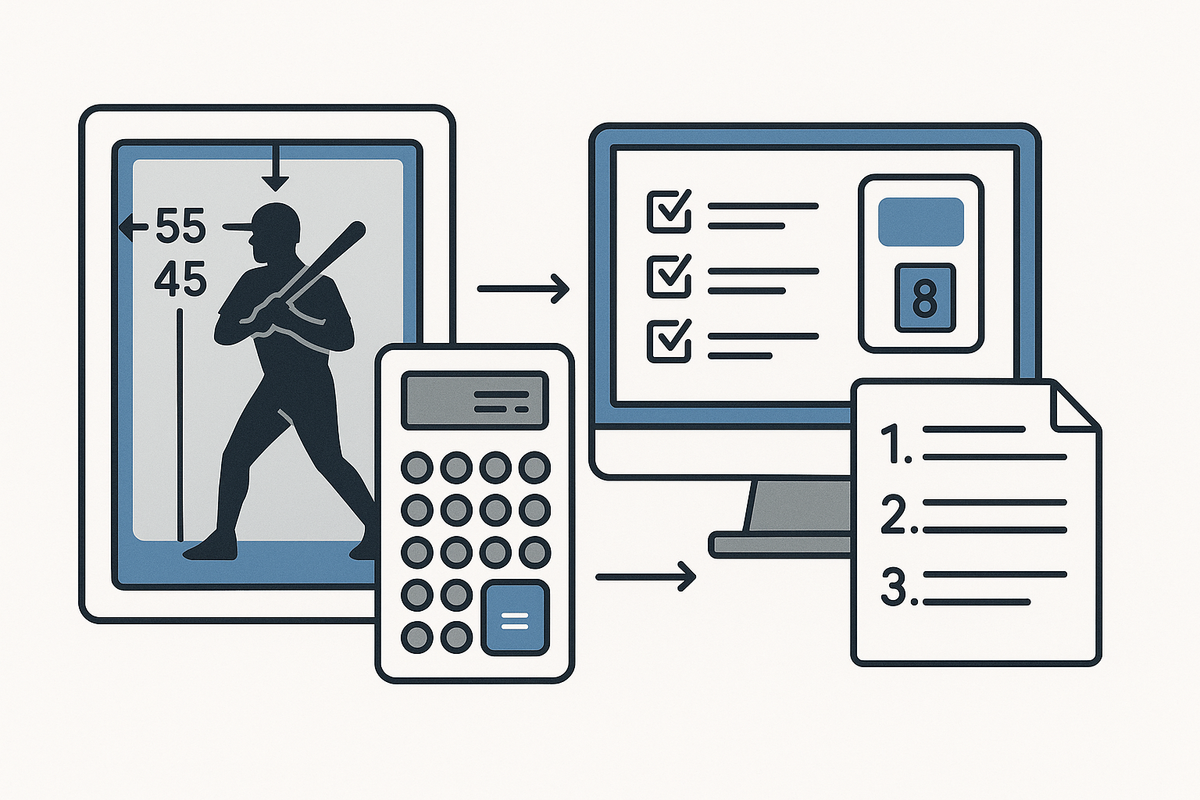
Card centering is typically shown as a ratio—like 55/45 or 60/40—indicating the relative thickness of opposing borders. The first number is the thicker border, the second is the thinner. For example, '55/45 left-to-right' means the left border is 55% of the total, while the right is 45%.
Formula for Calculating Centering Percentages
- Measure the distance from the edge of the card to the artwork on both sides (e.g., left and right).
- Add the two border measurements together.
- Divide each border by the total and multiply by 100 to get the percentage.
Example: If the left border is 3mm and the right is 2.5mm, the total is 5.5mm. The left border is (3/5.5) x 100 = 54.5%, and the right is (2.5/5.5) x 100 = 45.5%, or approximately 55/45.
Reading Card Centering and Centering Points
- Ratios like 55/45 or 60/40 are considered 'strong' centering.
- Ratios exceeding 70/30 or 75/25 often result in lower grades.
- Some grading companies assign 'centering points' based on these ratios, which can impact the final grade.
Understanding how to read card centering ratios and percentages is helpful for estimating grades. For more on this, see How to Measure Card Centering: Step-by-Step Precision Guide.
Section 3: PSA, BGS, CGC & SGC Centering Standards Explained
PSA Centering Requirements
PSA (Professional Sports Authenticator) publishes centering standards for each grade. For a PSA 10 (Gem Mint):
- Front: 55/45 or better (left-to-right and top-to-bottom)
- Back: 75/25 or better
For a PSA 9, the front can be 60/40, and back 90/10.
BGS (Beckett Grading Services) Standards
- BGS 10 (Pristine): 50/50 centering on the front, 60/40 on the back
- BGS 9.5 (Gem Mint): 55/45 front, 65/35 back
- BGS Black Label: 50/50 centering on both front and back—this is among the most demanding centering standards in the industry.
CGC, SGC, TAG, and Edge Centering
Other companies such as CGC, SGC, and TAG have similar but slightly different thresholds. For example, CGC Pristine 10 usually requires 55/45 or better, while SGC allows up to 60/40 for its highest grade. Edge centering is sometimes evaluated with specialized tools—see What is an edge centering tool?.
Front vs. Back Centering
Most companies are more lenient on back centering. The front has stricter requirements because it’s the main display side and affects visual appeal the most.
For a more detailed breakdown, visit Card Centering Tool: Accurate Card Grading Estimates.
Section 4: Manual Card Centering Checker: Ruler & Measurement Methods
Using a Millimeter Ruler
The classic way to check card centering involves a precise millimeter (mm) ruler:
- Step 1: Place the ruler at the card’s edge and measure the distance from the edge to the artwork on the left and right sides. Record both values.
- Step 2: Repeat the process for the top and bottom borders.
- Step 3: Add each pair together (left + right, top + bottom) to get the total border width for each axis.
- Step 4: Divide each measured border by the total and multiply by 100 to get centering percentages.
This method is widely used and allows you to compare your results with grading standards before submitting your card. For a visual, check out this step-by-step precision guide.
Pros and Cons of Manual Checking
- Pros: No tech needed, can be accurate with a good ruler, works for any card.
- Cons: Time-consuming, prone to human error, requires a steady hand and strong lighting.
Tips for Precision
- Use a magnifying glass for more precise border measurements.
- Measure multiple times to reduce errors.
- Write down ratios in both axes (L/R and T/B) for a complete centering picture.
Section 5: Digital & AI Card Centering Calculators: Photo Upload & Apps
How Photo-Based Centering Calculators Work
Modern card centering calculators like Midpoint allow you to upload a photo of your card. You then drag digital guide lines to the card’s borders, and the app calculates centering ratios and percentages.
- Some AI-based tools can auto-detect artwork and borders for you.
- Some apps provide PSA, BGS, CGC, and SGC grade estimates based on your measurement.
- Mobile apps are available for both iOS and Android, letting you check centering anywhere.
This approach can reduce manual calculation errors and offers pixel-level precision.
Screenshot: Card Centering Grading Tool Interface
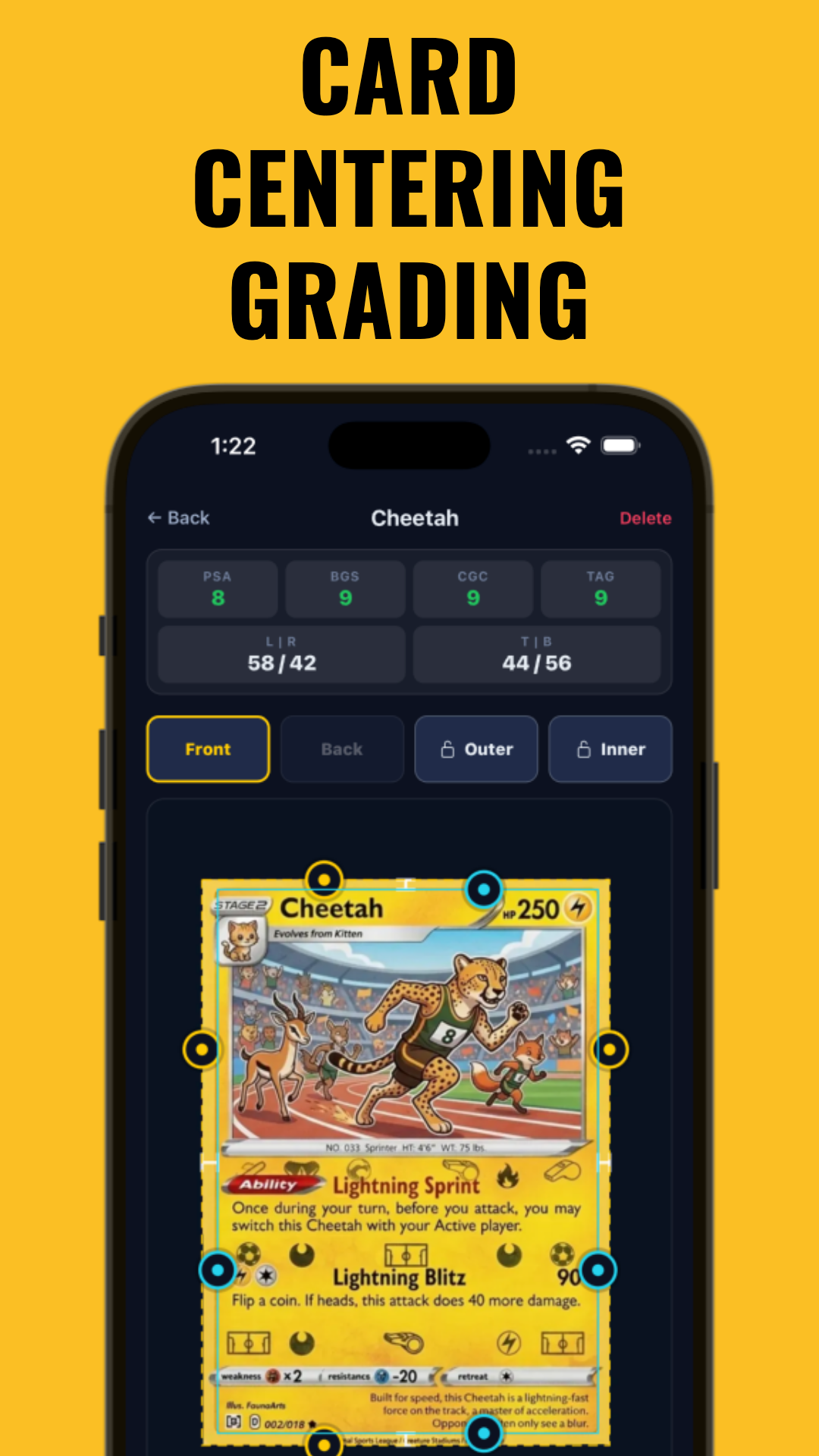
App Features: Instant Calculation & Pre-Grading
- Upload card images individually or in bulk.
- Draggable lines for manual or automatic border detection.
- Displays both centering ratios (e.g., 55/45) and centering points.
- Calculates front and back centering separately.
- Shows if your card meets Gem Mint thresholds for PSA, BGS, CGC, SGC, TAG, and others.
For a deeper dive into how AI transforms centering analysis, see this AI-focused comparison.
Why Use a Card Centering App?
- Faster than manual methods.
- Removes guesswork from centering calculations.
- Useful for bulk checking before a grading submission.
Section 6: Comparing Grading Companies' Centering Requirements
PSA vs. BGS vs. CGC vs. SGC
While all grading companies evaluate centering, their requirements differ, especially for the top grades. Below is a summary of the most commonly cited standards for a Gem Mint (or equivalent) grade:
| Company | Front Centering | Back Centering |
|---|---|---|
| PSA 10 | 55/45 | 75/25 |
| BGS 10 | 50/50 | 60/40 |
| BGS Black Label | 50/50 | 50/50 |
| CGC Pristine 10 | 55/45 | 75/25 |
| SGC 10 | 60/40 | 90/10 |
| TAG | Varies; often 55/45 or better | Varies |
The Strictest Standard: BGS Black Label
BGS Black Label is known for its strict 50/50 requirement on both front and back—a level of centering perfection that is rare in most print runs. Meeting this threshold is associated with premium valuation.
Why the Differences Exist
- Grading companies prioritize visual presentation (front) over the less-visible back.
- Back centering is often less consistent due to printing technologies; thus, standards are more forgiving.
- Some companies, like TAG, use proprietary digital systems to score centering with additional nuance.
For more on grading impacts, see How Centering Impacts Card Value: A Detailed Guide.
Section 7: Common Centering Ratios and Their Impact on Card Grades
The Meaning of 55/45, 60/40, 70/30, 75/25
- 55/45: Generally, the cutoff for Gem Mint (PSA 10, CGC Pristine). Strong, visually pleasing centering.
- 60/40: Acceptable for PSA 9, SGC 10, and some Gem Mint grades at other companies.
- 70/30: Usually the lowest centering tolerated for a Near Mint-Mint 8.
- 75/25 or worse: Typically results in lower grades (e.g., PSA 7 or below).
Grade Implications of Each Ratio
Cards with 55/45 or better centering are candidates for top grades. If your card is 60/40, it may receive a Mint 9 or equivalent, depending on the company. Anything below 70/30 generally precludes a Gem Mint grade.
How to Use Centering Ratios for Pre-Grading
- Check your card’s centering with a ruler or centering calculator.
- Compare your results to the standards from PSA, BGS, or your preferred company.
- Consider submitting only cards that meet the grade threshold you’re targeting to maximize ROI.
To learn how to pre-grade your card, visit this practical guide before grading.
Section 8: How to Read and Use Centering Points for Pre-Grading
What Are Centering Points?
Some grading companies, especially BGS, use a point system to score centering. For instance, BGS assigns a centering subgrade out of 10; perfect 50/50 centering earns a 10, while 60/40 might be graded as 9 or 9.5.
How to Read Centering Points on a Card Centering Checker
- After measuring or uploading your card, the calculator displays centering as a ratio and a score (e.g., 9.5/10).
- The score typically reflects how closely the card matches Gem Mint requirements.
- Apps like Midpoint can show if your card’s centering meets PSA, BGS, CGC, or SGC thresholds and what subgrade it might receive.
Using Centering Percentages in Your Grading Strategy
- Use centering percentages and points to select cards for grading—only send those with the best ratios.
- For cards just outside Gem Mint thresholds, consider waiting for a better copy or targeting a lower grade.
- Bulk upload tools let you scan entire collections for centering outliers before you spend on grading fees.
For more on how to estimate your card’s grade, see Estimate Your Card: A Practical Guide Before Grading.
Conclusion
Understanding and accurately measuring card centering is important for collectors looking to maximize card value and grading outcomes. With a card centering calculator—whether manual or digital—you can determine if your card meets Gem Mint standards (like 55/45 for PSA or 50/50 for BGS Black Label) before committing to grading fees.
Modern solutions, including AI-driven apps like Midpoint, offer instant centering analysis and grading estimates for PSA, BGS, CGC, SGC, and more. These tools can help you avoid expensive mistakes and optimize your submission strategy.
For more insights into how centering impacts card value and how to use centering tools for specific card games, explore our guides on how centering impacts value and using centering tools for Pokémon cards.
FAQ
Q: What centering ratio do I need for a PSA 10?
A: For a PSA 10 (Gem Mint), your card must have centering of 55/45 or better on the front and 75/25 or better on the back.
Q: How do you measure card centering with a ruler?
A: Measure the distance from the artwork to the card edge on both sides, sum them, then divide each border by the total and multiply by 100 to get centering percentages (e.g., 55/45).
Q: Is 60/40 centering good for a Gem Mint grade?
A: 60/40 is slightly outside the Gem Mint (PSA 10) threshold for the front, but can qualify for Mint (PSA 9) or SGC 10, and for the back it exceeds most standards.
Q: Does front centering matter more than back centering for grading?
A: Yes, grading companies generally weigh front centering more heavily, often allowing more leniency on the back since the front is the card’s display side.
Q: What is the strictest centering requirement among grading companies?
A: BGS Black Label requires 50/50 centering on both front and back—this is among the toughest standards in the industry.
Q: Can I upload a photo to automatically calculate my card's centering?
A: Yes, digital tools like Midpoint let you upload a card photo, auto-detect borders, and calculate centering ratios, percentages, and grade estimates.
Free to start
Try the Midpoint app
Grade any card from a photo, see its raw and PSA 10 value, and track what your collection is worth — free.
Get it on iPhoneGet it on Android