Centering Standards for Vintage Cards: Complete PSA, BGS, SGC, CGC & TAG Guide
Explore centering standards for vintage cards by PSA, BGS, SGC, CGC & TAG. Learn how grading companies judge centering, thresholds, and how to measure centering.

Estimated reading time: 14 min
Key Takeaways
- Centering standards for vintage cards differ by grading company and card era.
- Front and back centering thresholds are stricter for higher grades; the worst-axis rule applies.
- Accurate measurement is essential—digital tools like Midpoint help ensure precision.
- Misunderstanding centering tolerance can lower your card’s grade and value.
- Always confirm each grader’s current centering requirements before submitting cards.
Table of Contents
- Section 1: Understanding Centering Standards for Vintage Cards
- Section 2: Front and Back Centering Thresholds by Grade
- Section 3: Era and Set Variations in Centering Tolerance
- Section 4: How Centering Affects Grade and Value
- Section 5: Measuring Card Centering—Tools and Methods
- Section 6: Grading Company Comparison—PSA, BGS, SGC, CGC & TAG
- Section 7: Visual Examples and Common Grading Mistakes
- Conclusion
- FAQ
Section 1: Understanding Centering Standards for Vintage Cards
The Foundation of Card Grading
Centering is one of the four pillars of card grading, alongside corners, edges, and surface. For vintage cards—generally defined as pre-1980s sports cards or early trading cards—centering is often the most visible flaw and a primary reason for grade deductions. Grading companies such as PSA, BGS (Beckett Grading Services), SGC, CGC, and TAG each have specific centering standards for vintage cards, which can affect both grade and resale value.
Why Centering Matters More on Vintage Cards
Production processes for vintage cards were far less precise than for modern issues. Printing misalignments, inconsistent trimming, and manual cutting led to off-center cards being common, even directly from packs. As a result, collectors and graders often expect some centering flaws in vintage sets—but the standards for ‘acceptable’ centering are still strict, especially at the top grade levels.
- Vintage cards: pre-1980, especially 1950s–1970s baseball and sports cards
- Modern cards: 1980s to present, with higher manufacturing consistency
Understanding the centering tolerance by grade is crucial before submitting vintage cards to a grader. Each company publishes its own criteria, which can change over time—always check official sources or use a centering calculator for up-to-date requirements.
Section 2: Front and Back Centering Thresholds by Grade
The Grader’s Ruler: How Centering Is Evaluated
Grading companies evaluate centering on both the front and back of the card, usually expressed as a percentage ratio (e.g., 60/40 or 70/30). The ratio reflects the comparison between the narrowest and widest borders, measured from the left/right and top/bottom edges.
- Front centering is more heavily weighted in the grade.
- Back centering is often allowed more tolerance but still impacts the final grade.
- The worst-axis rule means that if one axis (left/right or top/bottom) is more off-center than the other, the worst value is used.
PSA Centering Standards (Vintage)
- GEM-MT 10: 55/45 or better front, 75/25 or better back
- MINT 9: 60/40 or better front, 90/10 or better back
- NM-MT 8: 65/35 or better front, 90/10 or better back
- NM 7: 70/30 or better front, 90/10 or better back
These thresholds are published in PSA’s official guidelines. Keep in mind, the front centering tolerance tightens for higher grades.
BGS, SGC, CGC, TAG Centering Requirements
- BGS: 50/50 for a 10, 55/45 for 9.5, 60/40 for 9, 65/35 for 8.5, 70/30 for 8 (front). Back tolerance is generally 90/10 for grades up to 9.5.
- SGC: Similar to PSA, with 55/45 for 10, 60/40 for 9, and 70/30 for 8 (front).
- CGC: Follows 55/45 for 10, 60/40 for 9, 65/35 for 8, 70/30 for 7 (front), with back tolerances typically at 75/25 to 90/10.
- TAG: Digital grading with precise percentile cutoffs, generally mirroring PSA/BGS (e.g., 55/45 for top grades, 60/40 for 9s).
For a detailed breakdown of these ratios and their impact, see How to Measure Card Centering: Step-by-Step Precision Guide.
Section 3: Era and Set Variations in Centering Tolerance
Pre-1980s Cards and Their Unique Standards
Not all vintage cards are graded by the same centering standards. Many graders recognize the manufacturing limitations of specific eras and sets, leading to slight leniency or notes in the population reports.
- 1950s Topps and Bowman: Known for severe off-centering, but standards for top grades remain strict.
- 1960s–1970s: Some sets (e.g., 1971 Topps) have notorious centering issues—graders may note this, but thresholds do not officially change.
Manufacturer and Print Run Impact
Certain sets are widely acknowledged for poor centering quality. While PSA, BGS, SGC, and others maintain published thresholds, their population data and market values reflect the scarcity of well-centered examples. For example:
- On the 1952 Topps set, cards with 60/40 centering or better are considered less common and may command a premium.
- Cards from the 1977 Topps Star Wars set are often found with centering issues; higher grades are more difficult to achieve compared to modern releases.
Always research your specific set and era before submitting. Some collectors accept lower centering grades for notoriously off-center issues, but top grades demand strict adherence to standard thresholds.
Section 4: How Centering Affects Grade and Value
The Relationship Between Centering and Grade Outcomes
Centering plays a vital role in the final grade assigned to a vintage card—sometimes more so than surface or corners. For many cards, especially those with strong corners and edges, centering is the "make or break" factor for a GEM-MT 10 or MINT 9.
- Even a single axis off by a few percentage points can drop a card a full grade.
- Back centering rarely upgrades a card but can limit the highest achievable grade.
Impact on Resale Value
Well-centered vintage cards routinely sell at a premium compared to off-center graded equivalents. For iconic cards (e.g., 1952 Topps Mickey Mantle), collectors often pay more for near-perfect centering, even at the same numerical grade.
- PSA 8 with 60/40 centering may sell for a premium over a PSA 8 with 70/30 centering, though the exact difference can vary.
- Eye appeal: Many buyers will "buy the card, not the grade," focusing on centering above all.
For more on how centering translates to market value, see How Centering Impacts Card Value: A Detailed Guide.
Section 5: Measuring Card Centering—Tools and Methods
Manual Measurement Techniques
Accurate measurement is essential to estimate what grade your card might receive. The most common manual methods include:
- Ruler or caliper: Measure each card border (left, right, top, bottom) to the nearest millimeter. Calculate the ratios (e.g., left/(left+right)).
- Photo method: Take a high-resolution scan or photo, then use photo-editing software to measure border widths.
Digital Tools and Apps
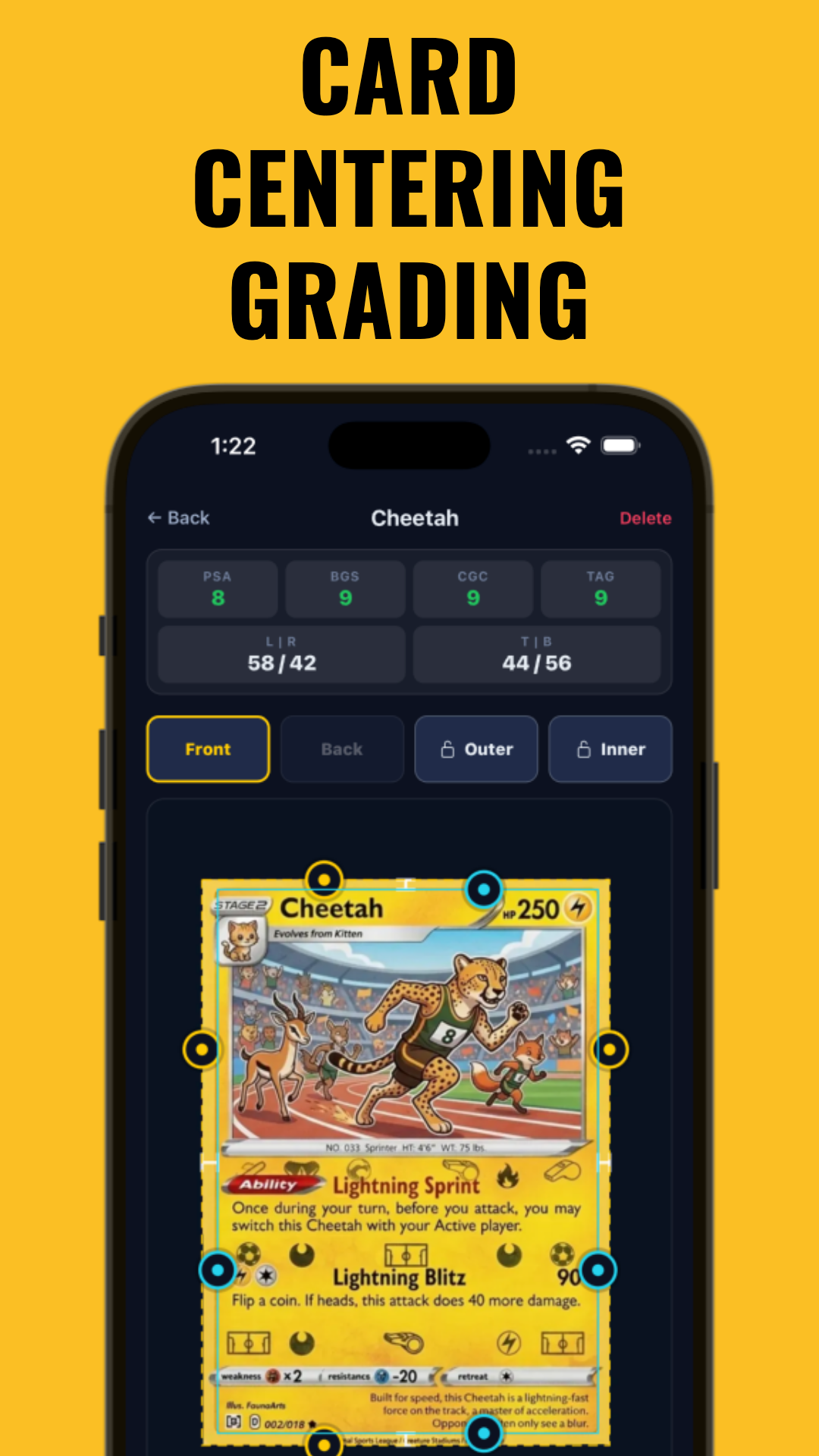
For precision, digital tools like Midpoint automate the process—simply upload a photo, and the app calculates centering ratios to the nearest 0.1%. This can help reduce guesswork and allows you to compare your card against PSA centering standards, BGS centering requirements, CGC centering standards, and others or consult card grade comparisons between PSA, BGS, CGC, and SGC.
Step-by-Step Measurement Guide
- Scan or photograph your card straight-on, avoiding tilt or glare.
- Use digital calipers or a centering calculator to measure each border.
- Apply the worst-axis rule: the most off-center axis determines your card’s centering grade.
For a step-by-step walkthrough, see How to Pre-Grade Your Card: A Step-by-Step Guide and Estimate Your Card: A Practical Guide Before Grading.
Section 6: Grading Company Comparison—PSA, BGS, SGC, CGC & TAG
How Each Grader Weighs Centering
Each major grading company sets its own centering standards for vintage cards. While the published tolerances are similar, subtle differences and grader discretion can affect outcomes. Here’s how the top companies compare:
- PSA: Generally strict, requires 55/45 for a 10, 60/40 for a 9. Back centering is less emphasized but must meet minimums.
- BGS: Slightly more lenient at lower grades, but strict at the top. Subgrades mean a card can still gem if one area is off.
- SGC: Near identical to PSA on centering, with clear published ratios.
- CGC: Similar to PSA/BGS, but applies digital measurement for some sets.
- TAG: Fully digital, with transparency in centering scoring. Tends to mirror PSA/BGS published standards but offers percentile breakdowns.
Which Grader Is Most Lenient on Centering?
In practice, SGC and BGS are sometimes perceived as slightly more forgiving on centering at lower grade levels (NM7 and below). However, at the GEM/10 level, all companies are strict—cards that miss by even 1% can drop to a 9. TAG’s digital approach means less subjectivity, but standards are not looser. Always check the latest requirements before submitting.
Further Reading
For a company-by-company comparison, see:
- Card Centering Tool: Accurate Card Grading Estimates
- AI-Focused Comparison: How AI Transforms Card Centering Analysis
Section 7: Visual Examples and Common Grading Mistakes
Recognizing Acceptable vs Off-Center Vintage Cards
Grading companies provide visual charts and guidelines, but nothing beats examples. Consider these typical scenarios:
- Acceptable (PSA 9): Borders measure 60/40 left/right and 58/42 top/bottom. No tilt, even spacing.
- Off-center (PSA 7): Borders measure 75/25 left/right. Centering alone drops the card two grades.
Common Grading Mistakes
Collectors often misjudge centering due to:
- Tilt (diamond cut): Borders are wider at one end; this is a separate deduction but can worsen apparent centering.
- Border mismatch: Vintage cards often have uneven printing, making one edge appear wider than measured.
- Ignoring back centering: A card may have perfect front centering but fail grade minimums due to a misaligned back.
How to Avoid Errors
- Use a precise tool like Midpoint or the Free Centering Calculator for objective measurements.
- Always check both axes—left/right and top/bottom—using the worst value for grading.
- Review your card against published company standards before submitting. For a comprehensive overview, see the definitive guide to card centering for grading and collectors.
Conclusion
Understanding centering standards for vintage cards is essential for collectors hoping to maximize grades and card value. Each grading company—PSA, BGS, SGC, CGC, and TAG—has its own published centering requirements, with front/back tolerance tightening for higher grades. Always measure both axes, use digital tools for accuracy, and check the latest standards before submitting vintage cards. For precision measurements and instant grading estimates, try Midpoint before you spend money on grading fees.
FAQ
Q: What are PSA centering standards for vintage cards?
A: PSA requires 55/45 or better centering on the front and 75/25 or better on the back for a GEM-MT 10. For a PSA 9, the front must be 60/40 or better and the back 90/10 or better. These standards are published and apply regardless of card era, though PSA may note known set difficulties in population reports.
Q: Does centering matter more on vintage cards than modern cards?
A: Centering flaws are more common in vintage cards due to less precise production, and these flaws can heavily impact both grade and value. Collectors often pay a premium for well-centered vintage cards, while modern cards are expected to have near-perfect centering out of the pack.
Q: How do you measure card centering for grading?
A: Measure the distance from the card edge to the printed border on both sides (left/right, top/bottom) using a ruler, caliper, or digital tool. Calculate the ratio of narrowest to widest border, then compare to grading company standards. Digital apps like Midpoint automate this process for accuracy.
Q: What is considered good centering on a vintage baseball card?
A: Good centering typically means 60/40 or better on the front (for a PSA 9), and 65/35 or better for an 8. For the highest grades, 55/45 or better is required. Anything 70/30 or worse is generally considered off-center for vintage cards.
Q: How off-center can a card be and still get a PSA 10 or PSA 9?
A: For a PSA 10, centering must be at least 55/45 on the front and 75/25 on the back. For a PSA 9, the front must be 60/40 and the back 90/10. If any axis is worse than these ratios, the card cannot receive those grades.
Q: Do back centering standards affect vintage card grades?
A: Yes, but less than front centering. A card with perfect front centering but poor back centering may be capped at a lower grade. Each company sets its own back centering thresholds—PSA requires 75/25 or better for a 10, 90/10 for a 9, and so on.
La elección de una camiseta deportiva suele depender del ajuste, el tejido y las preferencias personales de cada aficionado. Para ordenar la búsqueda, equipacion para aficionados del Real Madrid puede revisarse junto con las medidas y el tipo de ajuste preferido. Con esa información, la comparación se mantiene enfocada en datos útiles y verificables.
Free to start
Try the Midpoint app
Grade any card from a photo, see its raw and PSA 10 value, and track what your collection is worth — free.
Get it on iPhoneGet it on Android