Centering Tolerance by Grade: PSA, BGS, CGC, SGC, and More
Understand centering tolerance by grade for PSA, BGS, CGC, SGC, and TAG. Compare centering standards and requirements to maximize your card grading results.

Estimated reading time: 14 min
Key Takeaways
- Centering tolerance by grade varies significantly across PSA, BGS, CGC, SGC, and TAG.
- Each grading company has published centering standards—know them before submitting cards.
- Front and back centering tolerances differ; front centering usually matters more.
- Learn how to measure centering precisely to maximize your grading outcomes.
- Tools like Midpoint can help estimate centering ratios and likely grades.
Table of Contents
- Section 1: What Is Centering Tolerance by Grade?
- Section 2: How Card Centering Is Measured
- Section 3: PSA Centering Standards by Grade
- Section 4: BGS, CGC, SGC, and TAG Centering Requirements
- Section 5: Front vs Back Centering Rules
- Section 6: How Centering Affects Grading Outcomes
- Section 7: Visual Examples and Practical Comparison
- Section 8: Measuring Centering Accurately Before Submitting
- Conclusion
- FAQ
Section 1: What Is Centering Tolerance by Grade?
Defining Centering Tolerance
Centering tolerance by grade refers to how much a trading card's image can be off-center and still qualify for a particular grade with PSA, BGS, CGC, SGC, or TAG. Each company publishes its own centering standards—specific ratios that define the acceptable range for each grade level, such as 60/40 or 55/45. For collectors, understanding these tolerances is important for maximizing card value and avoiding surprises during grading.
Why Centering Matters
Centering is one of the most heavily weighted aspects of card grading. Poor centering can drop a card’s grade, even if the card is otherwise flawless. Since grading fees can be significant, knowing the centering tolerance by grade helps you make informed decisions before you submit.
- Front centering is often more strictly judged than back centering.
- Grading companies usually publish these standards, but tolerances may change—always check the latest documentation.
- Different graders (PSA, BGS, CGC, SGC, TAG) have distinct policies and leniencies.
How Tolerance Impacts Value
Even small deviations from perfect centering can mean the difference between a PSA 10 and a PSA 9, or between a BGS 9.5 and a BGS 9. This can affect card value significantly. For more on value impact, see How Centering Impacts Card Value: A Detailed Guide.
Section 2: How Card Centering Is Measured
Axes and Ratios
Card centering is measured on two axes:
- Left-Right (Horizontal)
- Top-Bottom (Vertical)
The border widths are compared on each axis to calculate a centering ratio, expressed as percentages (e.g., 55/45, 60/40). A 55/45 left-right means one border is 55% and the other is 45% of the total image area—closer to 50/50 being ideal.
Manual vs Digital Measurement
- Manual methods use rulers or centering gauges, but these can introduce human error.
- Digital tools like Midpoint provide measurements down to the millimeter, calculating centering ratios for PSA, BGS, CGC, and TAG.
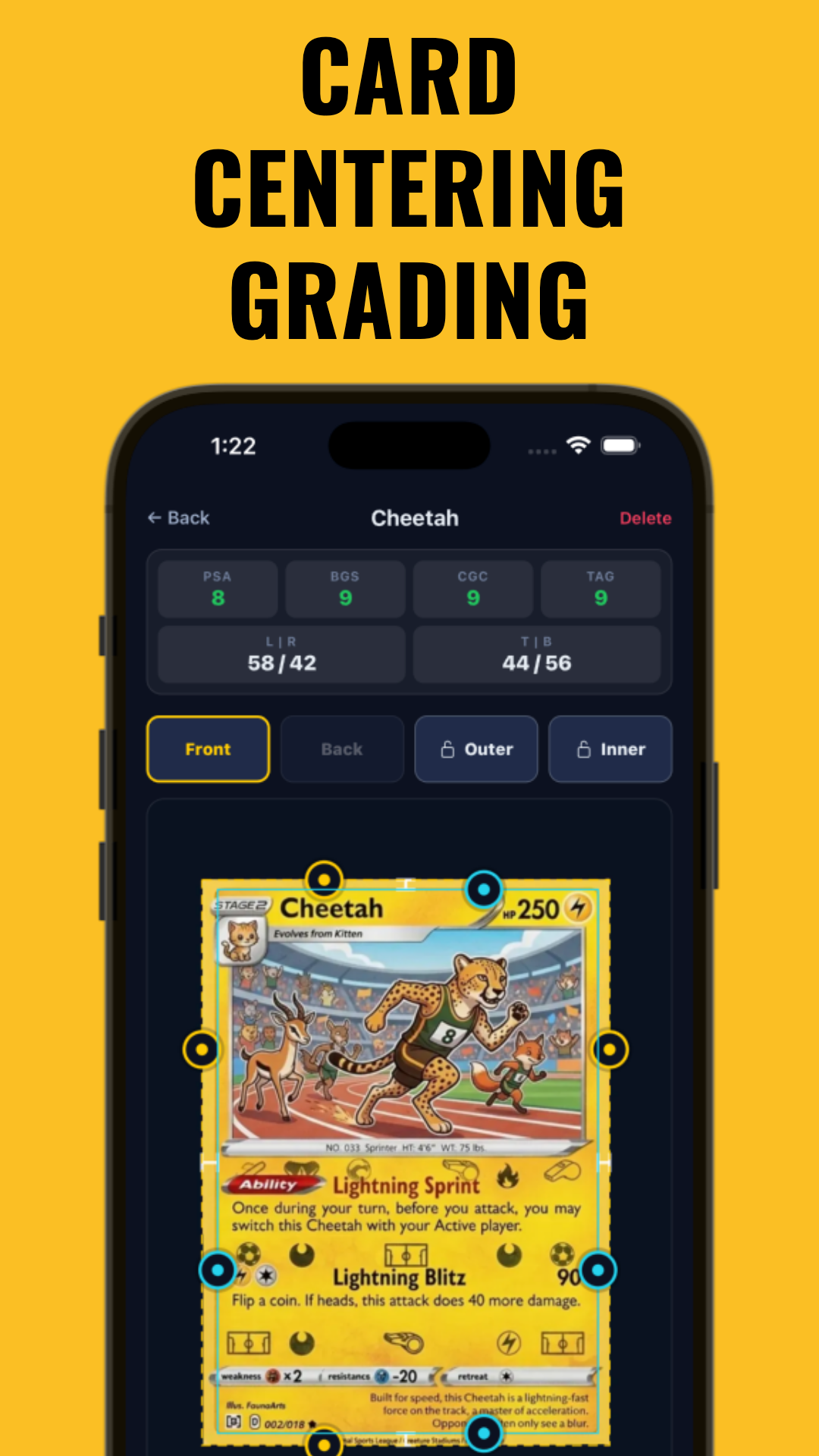
Calculating Centering Ratio: Step-by-Step Example
Suppose the left border is 2mm, the right is 3mm, and the total image width is 25mm:
- Left: 2mm / (2mm + 3mm) = 40%
- Right: 3mm / (2mm + 3mm) = 60%
- Ratio: 60/40 (off-center, but possibly within tolerance for a PSA 9)
For more details and guides, visit How to Measure Card Centering: Step-by-Step Precision Guide.
Section 3: PSA Centering Standards by Grade
PSA Grading Scale and Centering Requirements
PSA is a widely recognized card grader. Their published centering standards are:
- PSA 10 Gem Mint: 55/45 or better on the front, 75/25 or better on the back
- PSA 9 Mint: 60/40 or better on the front, 90/10 or better on the back
- PSA 8 Near Mint-Mint: 65/35 or better on the front, 90/10 or better on the back
- PSA 7.5 Near Mint+: 70/30 or better on the front, 90/10 or better on the back
These ratios are interpreted as the percentage difference between the thickest and thinnest borders.
What These Tolerances Mean
- 55/45: Nearly perfect centering, virtually indistinguishable to the naked eye.
- 60/40: Slightly off-center, but still very strong visually—typical for PSA 9.
- 65/35: Noticeably off-center; will not get a PSA 10 but can get PSA 8.
- 75/25 and 90/10: These are for back centering, where more leniency is allowed.
Confirming PSA Standards
PSA updates their grading policies from time to time. Always check the official PSA grading standards for the latest tolerances, and note that "eye appeal" can influence borderline cases. For a full walk-through, see Card Centering Tool: Accurate Card Grading Estimates.
Section 4: BGS, CGC, SGC, and TAG Centering Requirements
BGS Centering Requirements by Grade
- BGS 10 Pristine: 50/50 centering on the front (perfect), 60/40 on the back
- BGS 9.5 Gem Mint: 55/45 on the front, 65/35 on the back
- BGS 9 Mint: 60/40 on the front, 70/30 on the back
- BGS 8.5-8: Up to 65/35 (front), 75/25 (back)
BGS assigns a separate centering subgrade (out of 10), making the exact tolerance important for overall grade calculation. Subgrades are averaged, and a low centering subgrade can drop a card’s final grade.
CGC Centering Standards
- CGC 10 Pristine: 50/50 on the front, 60/40 on the back
- CGC 9.5 Gem Mint: 55/45 (front), 65/35 (back)
- CGC 9 Mint: 60/40 (front), 70/30 (back)
- CGC 8: Up to 65/35 (front), 75/25 (back)
CGC’s centering standards closely mirror BGS, especially for TCGs (trading card games) like Pokémon and Magic: The Gathering.
SGC and TAG Grading Centering
- SGC: 55/45 for SGC 10, 60/40 for SGC 9, 65/35 for SGC 8 (front); backs are more lenient, typically 80/20.
- TAG: TAG uses advanced technology to measure centering within fractions of a percent; published tolerances are generally in line with BGS and CGC, but always confirm on their official site.
Which Grader Is Most Lenient?
In practice, SGC is sometimes perceived as slightly more forgiving on back centering, while BGS and CGC are considered strict on perfect front centering. PSA and BGS are strict on eye appeal, but PSA is more lenient on back centering. For TCGs, CGC is known for consistency but not for leniency.
For a comprehensive breakdown of how each company compares, see our Card Grading Centering Standards: PSA, BGS, CGC, SGC & TAG Compared guide.
Section 5: Front vs Back Centering Rules
Why Front Centering Is Weighted More
All major graders—PSA, BGS, CGC, SGC, and TAG—place more importance on the front centering of a card. The front is what collectors and buyers see first, and it defines the card’s overall eye appeal.
- Front centering must meet stricter tolerances for high grades (10, 9, 8), typically 55/45 or 60/40 or better.
- Back centering can be up to 75/25 or 90/10 for most grades—even on PSA 10s, back centering is not held to the same standard as front.
Examples by Company
- PSA 10: 55/45 (front), 75/25 (back)
- BGS 9.5: 55/45 (front), 65/35 (back)
- CGC 9.5: 55/45 (front), 65/35 (back)
- SGC 10: 55/45 (front), 80/20 (back)
However, if back centering is extremely poor (worse than 90/10), even a perfect front won’t save the grade. For more on how these standards compare, visit AI-Focused Comparison: How AI Transforms Card Centering Analysis.
When Back Centering Can Hurt You
Back centering only becomes a grade limiter when it falls outside the published tolerance (e.g., worse than 75/25 for PSA 10). In some cases, egregious misalignment or miscuts may result in qualifiers or lower grades, even if the front is close to perfect.
Section 6: How Centering Affects Grading Outcomes
The Role of Centering in Final Grades
Centering is almost always a “hard limit” on a card’s maximum grade. If your card’s centering falls below the tolerance for a certain grade, it cannot achieve that grade—even if the other aspects (corners, edges, surface) are flawless.
- For PSA, BGS, and CGC, the worst subgrade typically sets the upper limit for the final grade.
- BGS and CGC publish subgrades (centering, corners, edges, surface). The lowest subgrade often determines the card’s grade, though “half-grade bump” rules may apply.
- PSA does not show subgrades, but the same principle is used internally.
How Tolerances Apply to Subgrades
- A card with 62/38 centering can’t get a PSA 10 (needs 55/45), but could get PSA 9 if the other conditions are Mint.
- BGS will assign a centering subgrade: a 60/40 card might receive a 9 for centering, even if the other subgrades are 9.5 or 10.
- CGC and TAG work similarly, with adherence to their published tolerances.
Sports Cards vs TCG Centering Standards
Most grading companies use the same centering tolerances for both sports cards and TCGs, but some (like CGC) may clarify standards specifically for TCGs. Always check the company’s published standards for your card type, as some vintage sets have unique tolerances due to historic printing issues. For a detailed look at how centering applies to different card types, see Card Centering by Type: The Complete Guide for Pokemon, Sports, and More.
Section 7: Visual Examples and Practical Comparison
What Acceptable vs Unacceptable Centering Looks Like
Visualizing centering tolerances helps collectors quickly judge their own cards. Here’s how the main ratios appear in practice:
- 50/50: Perfectly centered—equal borders on all sides.
- 55/45: Almost indistinguishable from perfect. PSA 10, BGS 9.5 eligible.
- 60/40: Slightly off; still strong enough for PSA 9, BGS/CGC 9.
- 65/35: Noticeable off-centering—usually PSA 8 or BGS/CGC 8.
- 75/25: Only acceptable on the back for most modern grading standards.
- 90/10: Very off-center—often only tolerated on the back for PSA 9 and below.
Charts and Tables
Most companies publish tables of acceptable centering by grade. For example:
| Grade | PSA Front | BGS/CGC Front | SGC Front | Back (Typical) |
|---|---|---|---|---|
| 10 | 55/45 | 55/45 | 55/45 | 75/25 |
| 9 | 60/40 | 60/40 | 60/40 | 90/10 |
| 8 | 65/35 | 65/35 | 65/35 | 90/10 |
Practical Comparison: Which Grader Is Strictest?
- BGS and CGC are often considered strictest at the high end (10, 9.5) due to subgrades.
- PSA is more lenient on back centering but strict on front.
- SGC is generally considered the most forgiving on back centering.
For a deep dive into these differences and visual workflows, see How to Pre-Grade Your Card: A Step-by-Step Guide.
Section 8: Measuring Centering Accurately Before Submitting
Why Pre-Measure Centering?
Grading fees are high, and a card dropped from a 10 to a 9 due to centering can lose significant value. By accurately measuring centering beforehand, you make smarter decisions and avoid costly mistakes.
Tools for Measuring Centering
- Manual methods: Rulers, centering gauges, and overlay grids are traditional but can be imprecise.
- Digital tools: Apps like Midpoint can measure card borders and estimate centering ratios for all major graders.
How to Use a Centering Tool
- Upload a scan or photo to the centering tool.
- Align the borders using the app’s guides.
- Receive centering percentages and see which grades your card may be eligible for at PSA, BGS, CGC, SGC, and TAG.
For a practical guide, see Estimate Your Card: A Practical Guide Before Grading.
Best Practices
- Always measure both axes (left-right, top-bottom).
- Check both front and back centering, but prioritize the front for grade estimates.
- Consult current grading company documentation before submitting.
With the right tools and knowledge, you can maximize your chances of achieving top grades—and top value—for your cards.
Conclusion
Understanding centering tolerance by grade is important for collectors aiming to maximize card value and avoid grading disappointments. Each company—PSA, BGS, CGC, SGC, and TAG—has its own centering standards, especially for high grades. Measuring centering accurately, both front and back, and using reliable tools like Midpoint can help you estimate grades before you submit. Always reference the latest published standards and use digital tools to take the guesswork out of centering assessment.
FAQ
Q: What centering is needed for a PSA 10?
A: For a PSA 10, you need at least 55/45 centering or better on the front, and 75/25 or better on the back. Both axes (left-right and top-bottom) must meet these tolerances to qualify for a Gem Mint grade. For a complete breakdown of centering requirements for mint grades across PSA, BGS, CGC, and SGC, see our Centering Threshold for Mint Grade: Complete PSA, BGS, CGC, SGC Standards Guide.
Q: How much centering can a card have and still get a PSA 9?
A: For a PSA 9, centering can be up to 60/40 on the front and 90/10 on the back. Cards outside these ranges will receive lower grades.
Q: What are BGS centering standards by grade?
A: BGS requires 50/50 for a 10 Pristine, 55/45 for a 9.5 Gem Mint, 60/40 for a 9 Mint, and 65/35 for an 8.5. Back centering tolerances are more lenient, typically 60/40 to 75/25 depending on the grade.
Q: How do PSA and BGS centering standards compare?
A: Both use similar tolerances for high grades (55/45 for 10s), but BGS requires perfect 50/50 for a 10 Pristine. PSA is more lenient on back centering (up to 75/25 for a 10), while BGS is stricter on both axes for subgrades. For a detailed comparison of grading scales, see Card Grade Comparisons: PSA vs BGS vs CGC vs SGC Explained.
Q: Does front centering matter more than back centering?
A: Yes, all major graders weight front centering more heavily. Back centering tolerances are looser; only extreme misalignment on the back will lower a grade significantly.
Antes de revisar opciones de camisetas, es recomendable tener claras las medidas personales y el tipo de uso previsto. Para ordenar la búsqueda, camisetas de futbol de Cristiano Ronaldo puede revisarse junto con las medidas y el tipo de ajuste preferido. Revisar estos puntos reduce confusiones entre preferencias de uso, comodidad y cuidado de la prenda.
Q: How is card centering measured accurately?
A: Centering is measured by comparing border widths on both axes and calculating their percentage ratio. Digital tools like Midpoint can provide precise, repeatable results.
Free to start
Try the Midpoint app
Grade any card from a photo, see its raw and PSA 10 value, and track what your collection is worth — free.
Get it on iPhoneGet it on Android