Football Card Prices Dropping November 2026: 9 Moves to Make
Football card prices dropping in November 2026? See which segments are cooling, why supply and hype matter, and how to buy the dip or protect your cards.

Estimated reading time: 9 min
Key Takeaways
- Football card prices dropping in November 2026 is being discussed as a market-wide story, but the pain is not evenly spread. Quarterback rookies, raw cards and serial-numbered parallels tend to swing the most.
- Compare the 7-day move to the 30-day move before reacting. One bad week is noise, and a steady 30-day slide is a trend.
- New releases, fading early-season hype and thin sales samples all push numbers around. Completed sales matter more than asking prices.
- A dip rewards patience: affordable graded rookies, vintage and cheap raw copies with strong centering are the usual places to look.
- Check centering before you buy or submit anything. It is the cheapest way to avoid overpaying for a card that will not grade.
Football card prices dropping in November 2026 has collectors asking the same thing: is this a crash, or just the market catching its breath? The honest answer is that it depends on which cards you hold, what condition they are in and how long you plan to keep them.
This guide walks through the football card market in November 2026 one segment at a time. It covers what may be cooling, why, and what to do about it. Use the framework below alongside current completed-sales data for the specific cards you care about. We will not invent numbers where the data does not support them. Treat every pattern here as a way to read the data, not as a prediction.
30-day price movers — live data from Midpoint's card database, as of 2026-11-22. Prices move; Midpoint refreshes these daily.
| Card | Raw | PSA 10 | 30-day | |
|---|---|---|---|---|
 |
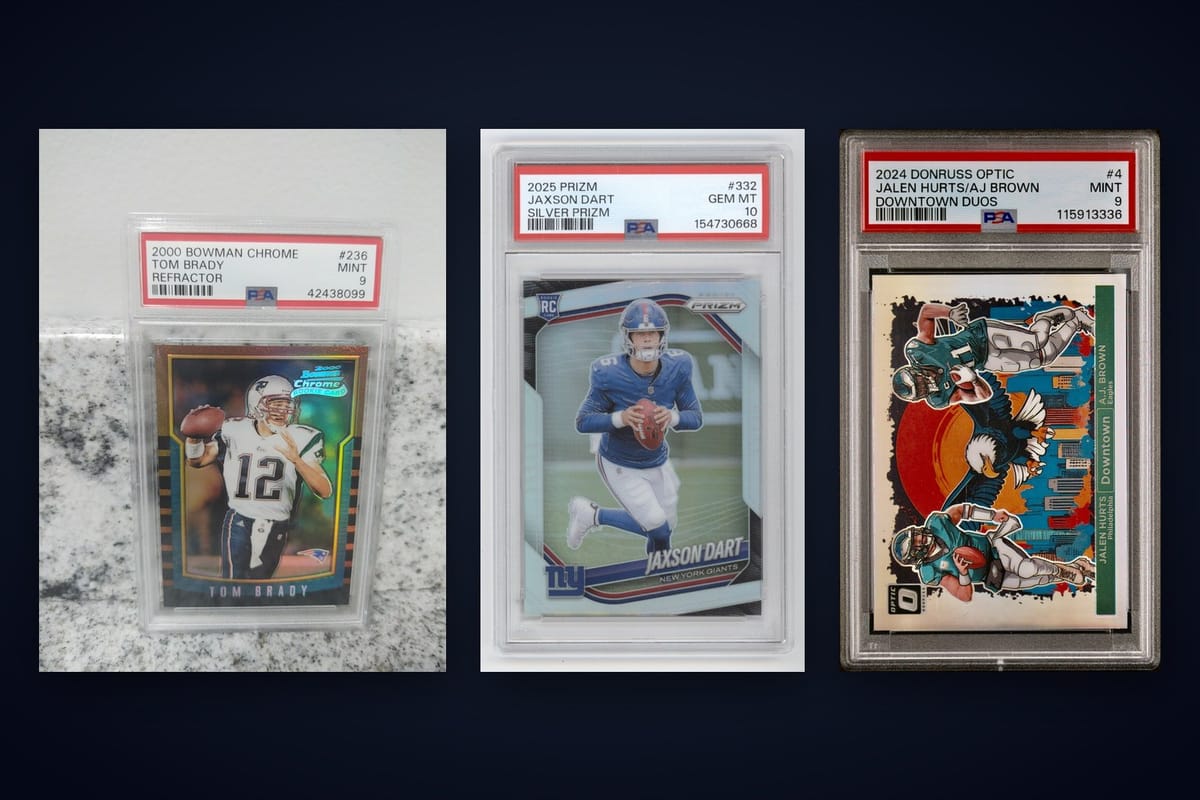
Tom Brady [Refractor] #236 2000 Bowman Chrome |
$10,353 | $203,488 | -89% |
 |
Jaxson Dart [Silver] #332 2025 Panini Prizm |
$57.50 | $574.59 | -6.9% |
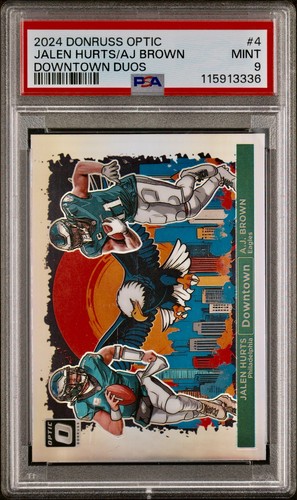 |
A.J. Brown / Jalen Hurts #4 2024 Panini Donruss Optic Downtown Duos |
$396.86 | $588.96 | -3.8% |
 |
Drake Maye #17 2025 Panini Phoenix Resurgent Snow Globe |
$45.25 | $210.10 | -3.6% |
 |
Tom Brady #236 2000 Bowman |
$1,500 | $15,510 | -2.6% |
 |
Walter Payton #J 1987 Topps Box Bottoms Hand Cut |
$51.00 | — | 0% |
 |
Jerry Rice [Refractor] #185 1995 Topps Finest Boosters |
$132.00 | $1,000 | 0% |
 |
Troy Aikman [Refractor] #170 1995 Topps Finest Boosters |
$23.52 | $663.27 | 0% |
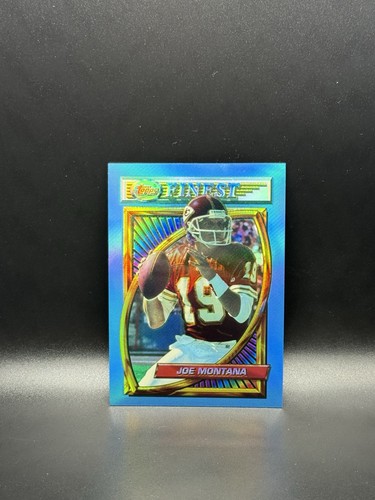 |
Joe Montana [Refractor] #172 1994 Topps Finest |
$172.12 | $3,502 | 0% |
 |
Joe Burrow [Gold] #4 2023 Panini Absolute Kaboom Horizontal |
$5,500 | — | 0% |
 |
Brock Purdy [Gold] #K33 2023 Panini Absolute Kaboom Vertical |
$5,239 | $20,044 | 0% |
 |
Troy Aikman #270 1989 Panini Score |
$13.36 | $675.00 | 0% |
Look up any card's current raw and graded value in Midpoint — and get an estimated grade before you pay to submit.
1. Compare 7-Day vs 30-Day Moves: Correction or Crash?
The first step in any football card market check is time frame. A card that is down in the last 7 days but flat over 30 days is behaving very differently from one that has slid steadily for a month.
A simple way to read the two windows:
- Down 7 days, flat or up 30 days: usually short-term noise or a cooling after a spike.
- Down both windows: a real trend, so look for the cause (supply, performance, hype).
- Up 7 days, down 30 days: a possible bounce inside a longer decline. Do not mistake it for a recovery.
A correction is broad, gradual and concentrated in cards that ran up fastest. A crash would show deep drops across nearly every segment, including blue-chip and vintage cards, along with sales that dry up. Falling football card prices that hit speculative modern cards hardest while established cards hold up point toward a correction.
2. Quarterback Rookies: Often the Most Volatile Segment
Quarterback rookies are priced on projection. Their values sit on expected stardom, so they have the most to lose when expectations are reset. When a rookie's early-season hype fades, football cards tied to that player can lose value quickly.
What to check on any quarterback rookie you track:
- How far the 30-day move is from the 7-day move. A widening gap signals momentum.
- Whether the drop is in raw, PSA 10 or both.
- Whether the player's team results or a recent injury explain it.
Rookie premiums are often among the first things to compress when sentiment turns. That is why football cards losing value often look like a list of last year's hottest names.
3. Raw and Lower-Grade Cards: Where Drops Can Hit Hardest
Raw cards and lower grades are the easiest to replace. When a flood of ungraded copies hits the market, buyers have lots of choices, so prices can slip fast. A raw card has no population report to limit supply. Anyone can list one.
Lower-grade slabs (think PSA 7 or 8 on modern cards) can get squeezed from both sides. Buyers who want a slab often pay up for a 10, and buyers on a budget buy raw. The middle may get little demand during a dip.
The flip side is useful: a raw card with strong centering is not like other raw cards. Centering is one of the biggest factors you can see before submission. Read how centering impacts card value to see why two copies of the same card can sell for very different prices.
4. Serial-Numbered Parallels and Premium Cards
Numbered parallels can look safe because of their scarcity. In a soft market, they are not always. A /99 or /25 card has a small buyer pool, so one cheap sale can reset its price. Premium cards face a similar problem: they need a confident buyer willing to pay a premium, and those buyers may step back first when sentiment weakens.
When you look at falling football card prices in this segment:
- Check how many sales stand behind the number. One or two sales is a weak signal.
- Separate the player from the print run. A scarce card of a fading player is still a fading card.
- Do not assume low serial numbers or on-card autographs protect you from a dip.
5. PSA 10 vs BGS 9.5: Do Grading Premiums Hold Up?
Graded cards often hold up better than raw in a downturn, because the slab gives buyers a third-party opinion of condition. But a PSA 10 premium is only as strong as the buyers behind it. When supply of 10s grows, the gap between PSA 10 and raw can shrink.
Remember that a BGS 9.5 and a PSA 10 are not the same thing, and the market prices them differently on different cards. Our breakdown of grading scale differences by company explains why.
When you compare raw and PSA 10 prices for a card, ask two questions:
- Is the PSA 10 premium widening or narrowing over 30 days?
- After grading costs and the risk of a 9, does the 10 still pay?
6. New Supply: Topps Chrome and Topps Midnight Releases
New releases pull attention and money toward new rookies and parallels. Products such as Topps Chrome and Topps Midnight add fresh supply and can give buyers cheaper alternatives to older cards. The effect may be strongest on the same players' earlier cards and on cards that look similar.
Supply pressure can show up in a few ways:
- More raw copies listed, which can drag raw prices first.
- Collectors rotating cash into boxes and breaks instead of singles.
- Grading queues filling with new cards, which later adds to PSA 10 supply.
This is often a temporary effect. Early in a release window, supply is typically at its peak and pricing is least settled.
7. Fading Hype, Injuries and Team Results
Football is unusual because performance changes quickly. A hot start can lift a player's cards, and a slump, an injury or a poor team record can pull them back down. Early-season hype is the most fragile kind.
Things that can move football card prices in November:
- Injuries: a season-ending injury can reset a card's price quickly.
- Team results: playoff chances shape how collectors feel about a player.
- Collector sentiment: attention shifts to other sports and other releases, and demand follows.
None of these says anything definitive about a player's long-term career. That distinction is where buying opportunities can come from.
8. Know the Limits of the Data
Price data helps, but it can mislead. Before acting on any number, keep these caveats in mind:
- Index composition: an index only covers the cards in it, so it does not represent the whole market.
- Sample size: a card with few sales can swing a lot on one transaction.
- Median changes: a median can move because of which cards sold, not because prices changed.
- Sales volume: a price drop on thin volume means less than the same drop on heavy volume.
- Asking vs completed: asking prices are wishes, and completed sales are facts. Weight completed sales more.
Use any price data as a starting point, then verify any card you care about against recent comparable sales.
9. Football Cards to Buy the Dip
A football card market in November 2026 that is soft for sellers is more interesting for buyers. Focus on quality, not just discounts. Good places to look:
- Affordable graded rookies: slabbed cards of players with solid long-term outlooks, where the drop makes the entry price reasonable.
- Undervalued cards: cards that fell on short-term noise rather than a real change in the player's outlook.
- Vintage cards: older cards tend to be less tied to this week's game results.
- Cheap raw copies with grading potential: a discounted raw card with sharp centering has a better chance of grading well than an average copy.
That last one is where a tool helps. Before paying for a raw card or for grading, measure the borders. Midpoint measures centering and gives estimated PSA, BGS, CGC and TAG grades, so you can see whether a cheap copy is worth submitting. You can also try the free centering calculator for a quick check.
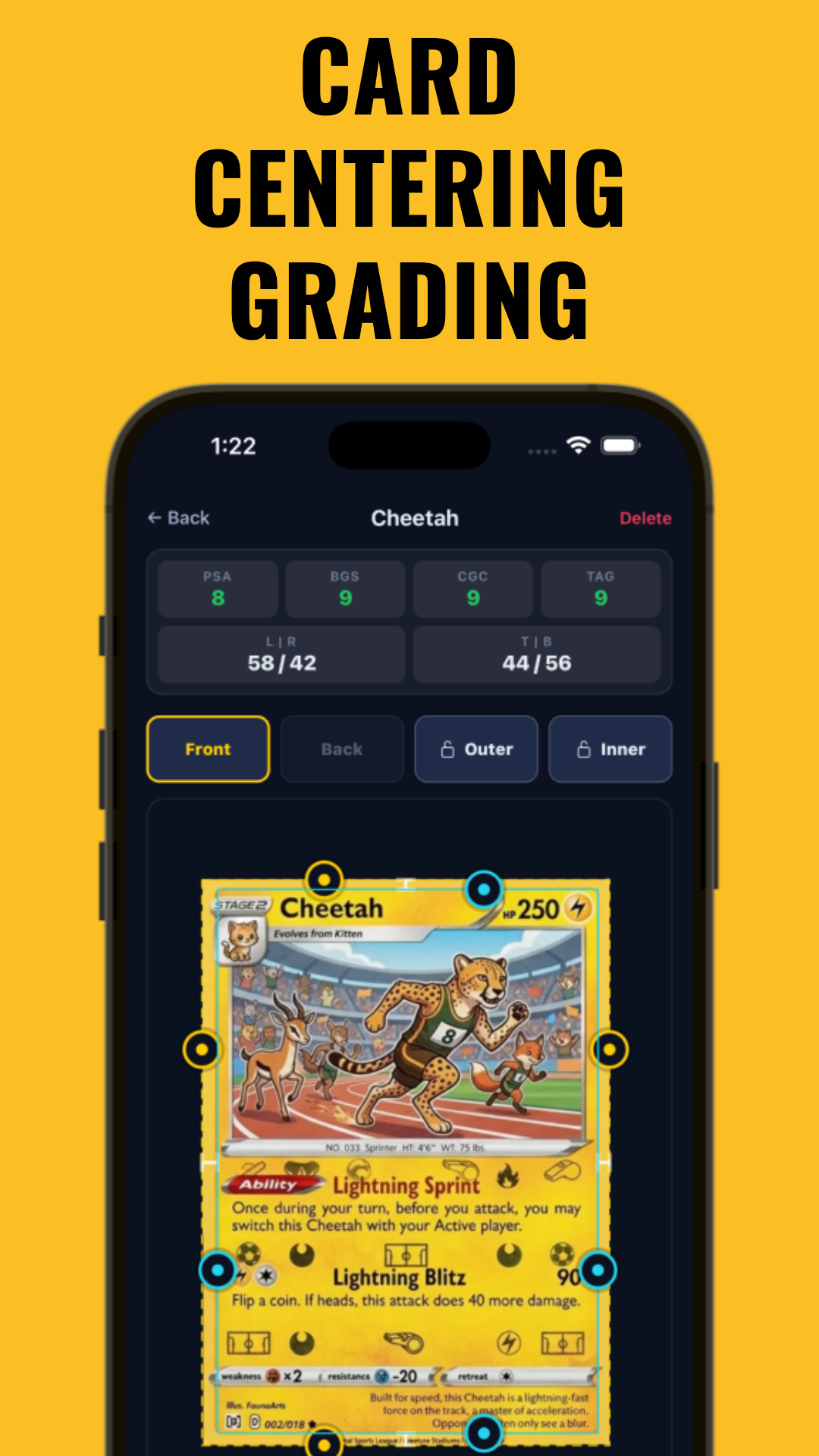
For a fuller walkthrough, see how to pre-grade your card before you spend money on submission.
10. Build a Buy, Hold or Sell Plan
The worst moves in a down market are emotional ones. A plan keeps you steady.
- Avoid panic selling: if a card is down 7 days but flat over 30, wait before you sell.
- Set price targets: decide what you would pay and what you would sell for before you look at listings.
- Sell what you would not rebuy: if you would not buy a card at today's price, ask why you are holding it.
- Buy in stages: spreading purchases over weeks protects you if prices keep sliding.
Hold cards you believe in over years, not weeks. Sell cards you only bought for a hype run that has faded.
11. Protect Your Collection Value
You cannot control the market, but you can control your collection's strength in it.
- Grade selectively: submit cards with strong centering, clean corners and clean surfaces, not every card you own.
- Prioritize condition: a well-centered copy tends to hold its value better than a flawed one when demand weakens.
- Diversify: do not hold only volatile modern rookies. Mix in vintage, veterans and other sports.
- Track comps: follow completed sales for your cards, and watch your portfolio value over time in Midpoint.
- Store properly: condition loss is value loss. See how to store valuable cards.
Conclusion
Football card prices dropping in November 2026 is best read as a sorting event. Hype-driven rookies, raw cards and thinly traded parallels tend to feel it first, while quality cards in strong condition tend to hold up better. Look at both the 7-day and 30-day moves, trust completed sales over asking prices, and use dips to pick up well-centered cards you would be happy to own for years.
If you want to find the cards worth grading before you spend, try Midpoint. It is free on iOS and Android.
FAQ
Q: Why are football card prices dropping in November 2026?
A: Several factors usually combine: new releases such as Topps Chrome and Topps Midnight add supply, early-season hype fades, and player performance, injuries and team results change collector sentiment. Thin sales data can also exaggerate the moves.
Q: Is the football card market crashing or just correcting?
A: A correction is gradual and concentrated in cards that rose fastest, such as speculative rookies. A crash would hit nearly every segment, including vintage and top graded cards, with sales drying up. Compare 7-day and 30-day moves across segments to tell the difference.
Q: Which football cards are losing value the fastest right now?
A: Typically quarterback rookies, raw and lower-grade cards, and serial-numbered parallels or premium cards with few buyers. Check recent completed sales for specific cards.
Q: Should I buy, sell, or hold football cards during the November 2026 dip?
A: Avoid panic selling. Compare short-term and 30-day moves, set price targets, hold cards you believe in long term, and sell hype-only purchases you would not rebuy at today's price.
Q: Are raw football cards dropping faster than PSA 10 cards?
A: Raw cards are often hit harder because supply is easy to add and buyers have many alternatives. Graded cards tend to hold better, but PSA 10 premiums can narrow if more 10s reach the market. Check each card's raw and PSA 10 move.
Q: What football cards are good buys while prices are falling?
A: Look at affordable graded rookies, undervalued cards, vintage cards and discounted raw copies with strong centering and grading potential. Measure centering first so you do not overpay for a card that will not grade well.
Free to start
Try the Midpoint app
Grade any card from a photo, see its raw and PSA 10 value, and track what your collection is worth — free.
Get it on iPhoneGet it on Android