Grading Marvel Cards for Centering: The Ultimate Collector's Guide
Learn how grading Marvel cards for centering works, including PSA, BGS, and CGC standards, how to measure centering, and tips for all trading card types.

Estimated reading time: 15 min
Key Takeaways
- Centering is a core factor in grading Marvel, Pokémon, sports, vintage, and TCG cards, directly impacting grade and value.
- Grading companies like PSA, BGS, CGC, and SGC each use specific front and back centering standards and tolerances.
- Measuring card centering accurately requires precision tools or dedicated apps like Midpoint.
- Understanding centering ratios (60/40, 55/45, 75/25) is vital before submitting your cards for grading.
- Centering quirks vary by card type — Marvel, Pokémon, sports, MTG, Yu-Gi-Oh, One Piece, and vintage cards all have unique challenges and standards.
Table of Contents
- Section 1: Why Centering Matters in Grading Marvel Cards
- Section 2: PSA, BGS, CGC, and SGC Centering Standards Explained
- Section 3: How to Measure Card Centering Accurately
- Section 4: Decoding Centering Ratios (55/45, 60/40, 75/25)
- Section 5: Centering Quirks by Card Type: Pokémon, Sports, MTG, Yu-Gi-Oh, One Piece, Vintage
- Section 6: Pre-Grading Tools and Digital Centering Calculators
- Conclusion
- FAQ
Section 1: Why Centering Matters in Grading Marvel Cards
The Role of Centering in Overall Card Grade
Centering is one of the four primary grading factors for Marvel cards (alongside corners, edges, and surface). For collectors and investors, centering directly affects both the final numeric grade and the card's resale value. Even a card in perfect condition may fail to achieve a PSA 10 or BGS Pristine if it is off-center.
- Gem Mint Grades Require Near-Perfect Centering: For most grading services, a PSA 10 or BGS 10 demands tight centering tolerances — typically no worse than 55/45 on the front and 60/40 or 75/25 on the back, according to their published standards.
- Impact on Value: Centered Marvel cards often sell for more than off-center equivalents. For example, a 1990 Marvel Universe Spider-Man PSA 10 can command a premium compared to a PSA 8 or 9 with centering flaws.
- First Impressions Matter: Collectors often notice off-centering instantly, even before scrutinizing corners or surface. A visually balanced card is generally more appealing.
Marvel Cards vs. Other Trading Cards
While the focus here is grading Marvel cards for centering, the same principles apply to Pokémon card centering, sports card centering, MTG card centering, and more. Marvel cards, especially vintage sets from the 1990s, are known for print alignment issues that can make high-grade centering harder to find.
How Centering Relates to Print and Manufacturing
Centering flaws result from the manufacturing process — cards are cut from large sheets, and slight misalignments during cutting can create left-right or top-bottom shifts. On some Marvel sets, border thickness can vary card to card, making gem-mint centered examples less common and more desirable to collectors.
Section 2: PSA, BGS, CGC, and SGC Centering Standards Explained
PSA Centering Requirements for Marvel Cards
PSA (Professional Sports Authenticator) uses specific centering thresholds. For a PSA 10 Marvel card:
- Front: Must be centered within 55/45 or better (meaning the narrower border is at least 45% of the wider one).
- Back: Centering must be 75/25 or better for a PSA 10. For PSA 9, the back can be as off as 90/10.
This means the front of the card is held to a much higher standard than the back. For more details, see the PSA grading FAQ.
BGS, CGC, and SGC Standards Compared
Other grading companies have similar but slightly different centering tolerances:
- BGS (Beckett Grading Services): Pristine 10 requires 50/50 front, 60/40 back. BGS 9.5 allows up to 55/45 front, 65/35 back.
- CGC (Certified Guaranty Company): For CGC 10, front centering must be 55/45 or better, back 75/25 or better.
- SGC (Sportscard Guaranty): Gem 10 requires 55/45 front, 80/20 back.
Always check the specific grading company's published standards for the latest tolerances. These slight differences can be the deciding factor in which service you choose for your Marvel or other trading cards.
Front vs. Back Centering: Which Matters More?
All major grading services weigh front centering more heavily. A card can have near-perfect front centering and an off-center back and still achieve a top grade, but the reverse is rarely true. This is especially important for Marvel cards, Pokémon cards, and vintage cards with noticeable border differences front-to-back.
Section 3: How to Measure Card Centering Accurately
Manual Measurement: Ruler and Scan Methods
Measuring centering by hand requires precision and patience. Here’s how:
- Ruler Method: Use a millimeter ruler or digital caliper. Measure the left and right (and top/bottom) borders on the card’s face. Calculate centering by dividing the smaller border by the total width of both borders. Multiply by 100 to get a ratio (e.g., left border = 2mm, right border = 3mm; centering = 2/(2+3) ≈ 40%).
- Scanner Method: Scan your card at high resolution. Use image editing software to measure pixel widths of borders, then calculate ratios as above. This method is more precise for subtle differences.
For a complete walkthrough, check out our in-depth guide: How to Measure Card Centering: Step-by-Step Precision Guide.
Automated Measurement: Apps and Digital Tools
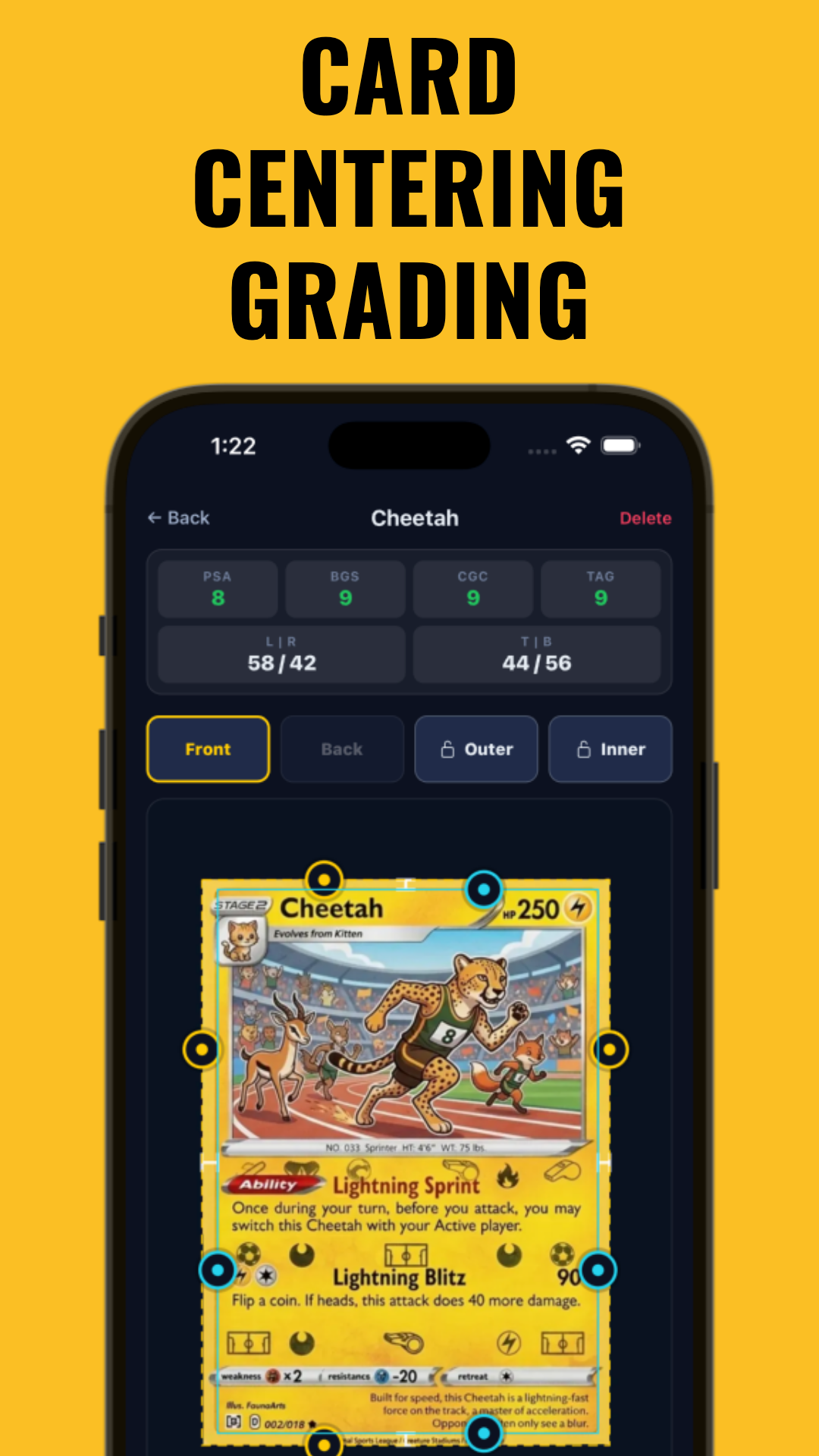
Modern collectors increasingly rely on digital centering tools. Midpoint is a purpose-built app that measures card centering down to the millimeter and estimates PSA, BGS, CGC, and SGC outcomes. Simply upload or photograph your card, and the tool calculates centering ratios for all borders — no manual math required.
Special Cases: Rotated, Tilted, and Borderless Cards
- Rotated/Tilted Cards: Some cards are cut at an angle, making border thickness inconsistent. Digital tools can compensate, but manual measurement can be tricky.
- Borderless Cards: For cards without clear borders (some modern Pokémon, MTG, and Marvel inserts), graders use the artwork frame as a reference. Digital centering calculators like Midpoint allow manual adjustment for these cases.
Section 4: Decoding Centering Ratios (55/45, 60/40, 75/25)
What Do Centering Ratios Mean?
Centering ratios express how much the card's image is shifted left/right or top/bottom compared to a perfectly centered (50/50) card. For example:
- 55/45: One border is 55% the width of the total, the other is 45%. Acceptable for PSA 10 (front).
- 60/40: One border is 60%, the other 40%. Often the minimum for a PSA 9 or BGS 9.5.
- 75/25: One border is 75%, the other 25%. Typical back centering tolerance for a PSA 10.
These ratios are crucial for pre-grading your Marvel cards, Pokémon cards, and vintage sports cards.
Reading and Calculating Centering Ratios
To calculate a centering ratio:
- Measure both borders (e.g., left and right) in millimeters or pixels.
- Add them together for the total border width.
- Divide the smaller border by the total to get the smaller percentage, and the larger border by the total for the larger percentage.
Example: Left border = 3mm, right border = 4mm. Total = 7mm. Ratio = 43/57.
How Centering Ratios Affect Grading Outcomes
If your card falls outside the grading company's published ratio, the grade will drop. For a visual breakdown of how centering influences card value, see How Centering Impacts Card Value: A Detailed Guide.
Section 5: Centering Quirks by Card Type: Pokémon, Sports, MTG, Yu-Gi-Oh, One Piece, Vintage
Pokémon Card Centering
Pokémon cards are known for back centering issues, especially in early English sets (Base, Jungle, Fossil). PSA and BGS apply the same front/back standards as with Marvel cards. For a specialized walkthrough, see How to Use a Centering Tool for Pokémon Cards: Step-by-Step Guide.
- Front: 55/45 or better for Gem Mint.
- Back: Up to 75/25 for PSA, 60/40 for BGS 10.
- Quirk: Back centering is more variable, but front is more heavily weighted.
Sports Card Centering
Vintage sports cards (baseball, basketball, etc.) frequently display centering flaws due to older printing technology. Collectors tolerate some off-centering, but high grades are less common — and often more valuable.
- Standard: Same 55/45 to 60/40 tolerances for top grades.
- Quirk: Tilted or diamond cut cards may be penalized even if border measurements are in spec.
MTG, Yu-Gi-Oh, One Piece Card Centering
Magic: The Gathering (MTG), Yu-Gi-Oh, and One Piece card centering presents unique challenges:
- MTG: Early sets often have thin borders and inconsistent cuts, making centering measurement more difficult.
- Yu-Gi-Oh: Japanese and English print runs vary in centering quality; some sets are known for off-center issues.
- One Piece: As a newer TCG, print quality is generally more consistent, but collectors still seek gem-mint centering for top value.
For all these types, the same grading principles apply, but be aware of set-specific manufacturing quirks.
Vintage Card Centering
Vintage cards (pre-1980s sports, early Marvel, Pokémon) are rarely perfectly centered. Graders may allow more leeway, but PSA, BGS, and SGC standards remain stringent for top grades. Off-centering is often the main reason vintage cards fail to achieve high grades.
Section 6: Pre-Grading Tools and Digital Centering Calculators
Why Use a Centering Calculator Before Grading?
Grading fees can be significant. Submitting an off-center Marvel card for grading can be a costly mistake if it’s unlikely to meet a Gem Mint grade. Pre-grading with a centering calculator lets you:
- Estimate the likely grade outcome before sending your card to PSA, BGS, CGC, or SGC.
- Decide which cards are worth submitting — and which are better sold raw.
- Avoid disappointment and wasted fees.
For a practical walkthrough, see How to Pre-Grade Your Card: A Step-by-Step Guide.
How Digital Tools Like Midpoint Work
Midpoint is a digital card centering tool. Its features include:
- Upload a scan or photo — app detects card edges automatically.
- Manual adjustment for tricky or borderless cards.
- Instant centering ratios for all four borders (left, right, top, bottom).
- Pre-built grading standards for PSA, BGS, CGC, SGC, and custom settings.
- Batch processing for large collections.
If you want to see how AI is being used in this space, check out AI-Focused Comparison: How AI Transforms Card Centering Analysis.
Free and Paid Tools
Some collectors use free spreadsheets or calculators, like the Free Centering Calculator from Midpoint. For more advanced features and instant grading estimates, a paid app may help you avoid grading fees on cards unlikely to achieve high grades.
Conclusion
Grading Marvel cards for centering involves both careful measurement and understanding of PSA, BGS, CGC, and SGC standards. Whether you’re evaluating Marvel, Pokémon, sports, MTG, Yu-Gi-Oh, One Piece, or vintage cards, precise measurement is key. Modern digital tools like Midpoint can help you assess centering before you spend money on grading. For deeper dives into card grading and centering, explore guides like How to Measure Card Centering: Step-by-Step Precision Guide and Estimate Your Card: A Practical Guide Before Grading. Happy grading!
FAQ
Q: What is the centering requirement for a PSA 10 Marvel card?
A: For a PSA 10, the front must be centered 55/45 or better, and the back must be at least 75/25. These standards are published by PSA, so precise measurement is important before submitting your card.
Q: How do you measure card centering before submitting to PSA?
A: Measure the left, right, top, and bottom borders using a ruler or digital tool. Divide the smaller border by the sum of both borders to calculate the centering percentage. Tools like Midpoint automate this process for you.
Q: Is back centering as important as front centering on Marvel cards?
A: Front centering is more heavily weighted in grading. However, if the back centering falls below the grading company’s minimum (e.g., worse than 75/25 for PSA 10), the card cannot receive a Gem Mint grade.
Q: How strict is PSA compared with BGS or CGC for centering?
A: PSA, BGS, and CGC have similar front centering standards for Gem Mint, but BGS is slightly stricter for their Pristine 10 grade. Back centering tolerances also vary slightly among them, but all require very tight centering for top grades.
Q: Does off-centering automatically lower a Marvel card’s grade?
A: If a card's centering falls outside the published tolerances for a grade level, it will receive a lower grade, regardless of how flawless the corners, edges, and surface are.
Q: What is a 60/40 centering ratio on a trading card?
A: 60/40 means one border is 60% of the combined left and right (or top/bottom) border width, and the other is 40%. This is the maximum allowed for some grading company’s Mint or Near Mint-Mint grades, but not for Gem Mint.
Free to start
Try the Midpoint app
Grade any card from a photo, see its raw and PSA 10 value, and track what your collection is worth — free.
Get it on iPhoneGet it on Android