
Matthew Stafford Cards Worth Money: Top Picks to Grade
Which Matthew Stafford cards are worth money? See the most valuable rookies, parallels and inserts, plus when a PSA 10 is worth grading for.

Estimated reading time: 11 min
Key Takeaways
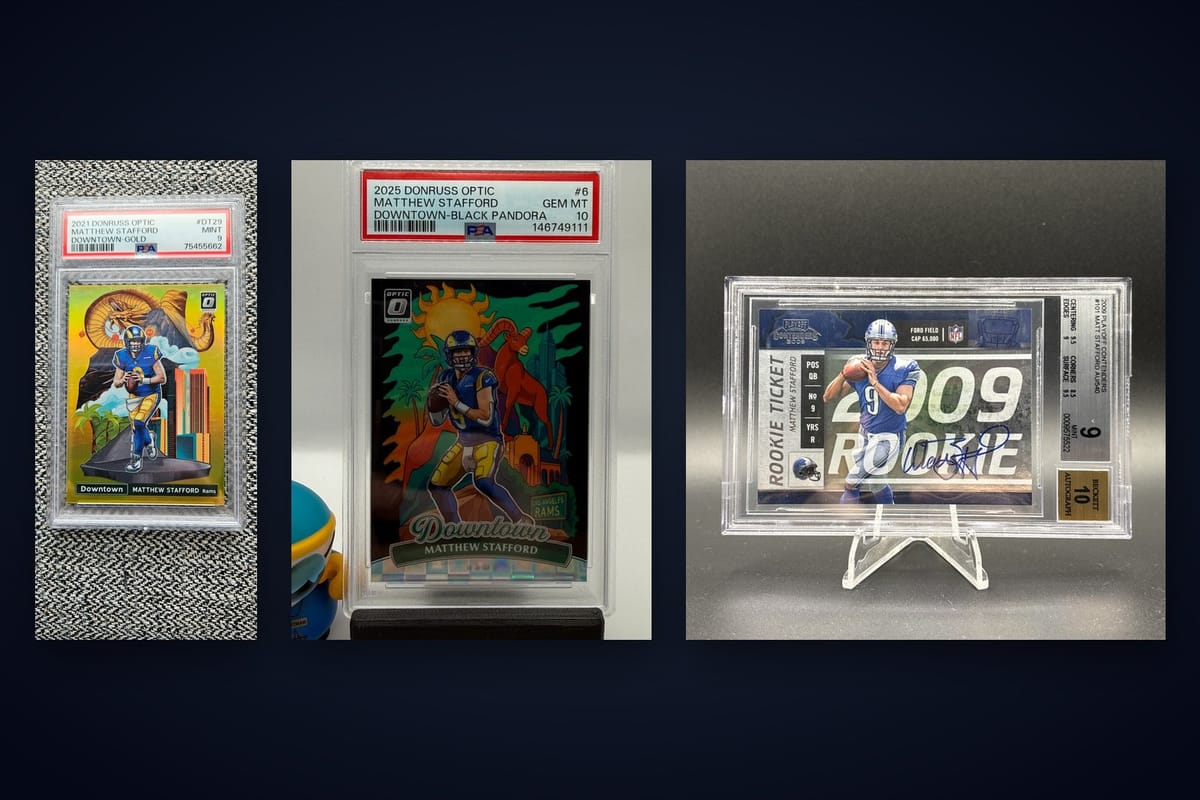
- Matthew Stafford cards worth money fall into three groups: 2009 rookies (especially chrome-style and autographed), low-numbered parallels, and rare inserts like Kaboom! and Downtown.
- Matthew Stafford rookie card value depends far more on the specific set, parallel, and grade than on the player name alone.
- A Matthew Stafford PSA 10 usually carries a meaningful premium over raw, but only sharp centering, corners, edges, and surface qualify.
- Asking prices are not market value. Use completed sales and compare raw against graded values before you list, buy, or submit.
- The best Matthew Stafford cards to grade are the ones where the PSA 10 premium clearly outweighs grading fees and your odds of missing the grade.
Card values — live data from Midpoint's card database, as of 2026-09-04. Prices move; Midpoint refreshes these daily.
| Card | Raw | PSA 10 | Gem premium | |
|---|---|---|---|---|
 |
Matthew Stafford [Gold] #DT-29 2021 Panini Donruss Optic Downtown |
$430.00 | $5,160 | 12× |
 |
Matthew Stafford [Black Pandora] #6 2025 Panini Donruss Optic Downtown |
$2,063 | $4,795 | 2.3× |
 |
Matthew Stafford [Playoff Ticket] #101 2009 Playoff Contenders |
$290.00 | $3,500 | 12.1× |
 |
Matthew Stafford [Refractor] #TC210 2009 Topps Chrome |
$276.05 | $2,125 | 7.7× |
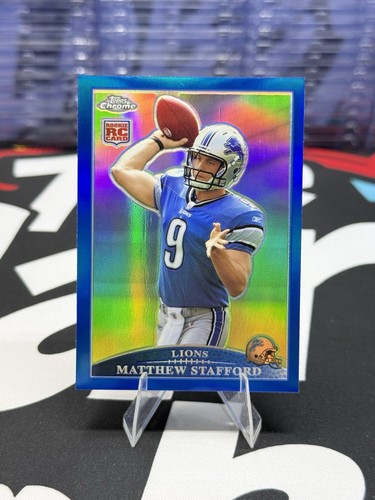 |
Matthew Stafford [Blue Refractor] #TC210 2009 Topps Chrome |
$394.00 | $1,990 | 5.1× |
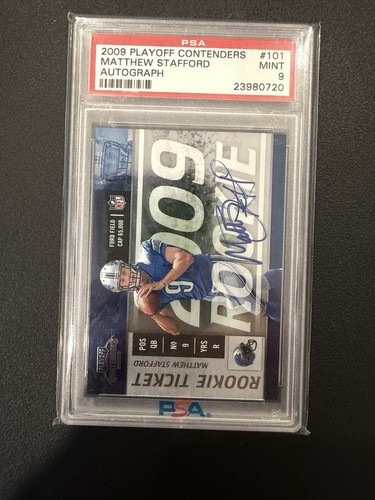 |
Matthew Stafford [Autograph] #101 2009 Playoff Contenders |
$214.75 | $1,800 | 8.4× |
 |
Matthew Stafford #6 2025 Panini Donruss Optic Downtown |
$391.50 | $1,800 | 4.6× |
 |
Matthew Stafford [Throwing Black] #430 2009 Topps |
$429.99 | $1,575 | 3.7× |
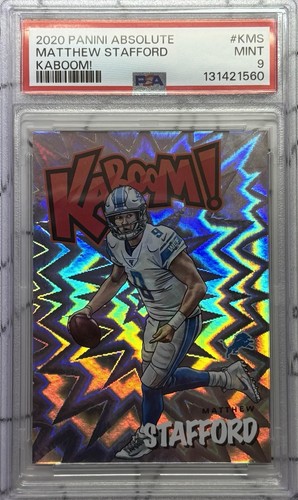 |
Matthew Stafford #K-MS 2020 Panini Absolute Kaboom |
$620.00 | $1,574 | 2.5× |
 |
Matthew Stafford #15 2025 Panini Absolute Kaboom Horizontal |
$562.92 | $1,364 | 2.4× |
 |
Matthew Stafford [Copper Refractor] #TC210 2009 Topps Chrome |
$249.03 | $1,273 | 5.1× |
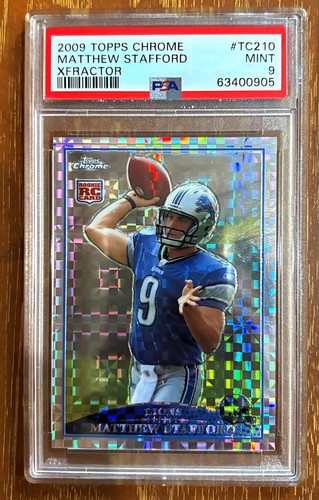 |
Matthew Stafford [Xfractor] #TC210 2009 Topps Chrome |
$144.11 | $1,062 | 7.4× |
Look up any card's current raw and graded value in Midpoint — and get an estimated grade before you pay to submit.
Table of Contents
- Section 1: Why Matthew Stafford Cards Are Worth Money
- Section 2: Most Valuable Matthew Stafford Cards
- Section 3: Matthew Stafford Rookie Card Value and the Prizm Question
- Section 4: Inserts, Parallels, Memorabilia, and Autographs
- Section 5: Raw vs Matthew Stafford PSA 10 Values
- Section 6: Best Matthew Stafford Cards to Grade
- Section 7: Identify, Price, and Sell Your Stafford Cards
- Conclusion
- FAQ
Section 1: Why Matthew Stafford Cards Are Worth Money
If you are wondering whether your Matthew Stafford cards are worth money, start with the player. Stafford was the first overall pick in the 2009 NFL Draft, spent over a decade as the Detroit Lions' franchise quarterback, and then won Super Bowl LVI with the Los Angeles Rams. That mix of a No. 1 pick pedigree and a championship gives his cards a long-term collector base.
But a famous name does not make every card valuable. Most Stafford cards from the 2009 era were likely printed in large quantities, so a common base card is usually modest in value. The money sits in scarcity and condition.
What Actually Drives Value
- Rookie status: Cards from his 2009 debut year are the foundation of the market.
- Scarcity: Serial-numbered parallels, short-printed inserts, and on-card autographs sit above base cards.
- Grade: The gap between a raw card and a high-grade slab can be large.
- Brand and set prestige: Chrome-style rookies and premium autograph products tend to draw more attention than flagship base cards.
Why Prices Move
Player cards respond to performance, playoff runs, Hall of Fame talk, and wider hobby sentiment. A strong season can lift demand, while a quiet stretch cools it. That is why any single price you read in an article goes stale quickly.
For that reason, this guide focuses on how to rank and evaluate Stafford cards rather than quoting numbers from memory. For live raw and graded values, look up the exact card in Midpoint, which compares raw and graded pricing across more than 1.5 million cards.
Section 2: Most Valuable Matthew Stafford Cards
The most valuable Matthew Stafford cards generally share one trait: they are hard to find in strong condition. Here is how the major categories generally rank in the market's eyes, from the top down.
Tier 1: Rookie Autographs and Low-Numbered Rookies
Premium 2009 products such as National Treasures and other autograph or patch-autograph rookies sit at the top. These combine rookie status, a signature, often memorabilia, and a low print run. Authenticity matters here: confirm the autograph is on-card or sticker, and that it is the right card.
Tier 2: Chrome Rookie Refractors
Chrome-style rookies from Topps Chrome and Bowman Chrome are staples of football rookie collecting. The base versions are widely available, but refractor parallels, and especially numbered or rare colored refractors, command the real premiums. Chrome cards also tend to show surface flaws and edge chipping, which makes true gem copies harder to find.
Tier 3: Rare Inserts
Panini inserts like Kaboom! and Downtown are among the most talked-about Stafford cards. These are known for striking designs and a reputation for scarcity, so collectors treat them as grail-style pieces for a player. Gold parallels and other numbered versions follow the same logic: the lower the print run, the stronger the pull.
How to Rank Your Own Cards
- Autograph or patch rookie, serial-numbered: highest potential.
- Rookie refractor or numbered parallel: strong potential.
- Rare insert (Kaboom!, Downtown, Gold): strong, but condition-sensitive.
- Base rookie: modest unless graded gem mint.
- Later-year base cards: usually low value.
Section 3: Matthew Stafford Rookie Card Value and the Prizm Question
Matthew Stafford rookie card value is not one number. It is a spread that depends on the set, the parallel, and the grade. A 2009 base rookie and a 2009 autographed rookie are different markets entirely.
The 2009 Rookie Class of Cards
Stafford's rookie year produced cards across many brands. The ones collectors search for most include:
- Bowman Chrome: A classic rookie-focused chrome release with refractor parallels.
- Topps Chrome: The flagship chrome set, with refractor and numbered parallels.
- National Treasures: A high-end product with autograph and memorabilia rookies.
- Other flagship and premium brands: Base rookies, short prints, and autograph inserts from the era.
Clearing Up the Prizm Rookie Confusion
Many searchers ask about a Matthew Stafford Prizm rookie card. Here is the catch: Panini Prizm football did not exist in 2009. It launched later, so there is no true Stafford Prizm rookie. Any Stafford Prizm you find is a later-year card, from his Lions or Rams years, and should be valued as a veteran card rather than a rookie.
That does not make Prizm irrelevant. Prizm Silver and numbered color parallels of Stafford are popular because Prizm is one of the most recognized modern football brands. Just do not pay rookie-card prices for a non-rookie card. Always check the year printed on the card.
How to Check Rookie Value
- Confirm the year and set on the card.
- Identify the parallel (base, refractor, numbered, colored).
- Look up completed sales for the same card at the same grade.
- Compare raw and graded values to see how big the premium is.
Run that process on each card, and you will quickly see which ones are worth money and which are just nice keepsakes.
Section 4: Inserts, Parallels, Memorabilia, and Autographs
Not all Stafford cards are created equal. Understanding the differences between card types is the fastest way to estimate where a card sits in the value ladder.
Base Cards vs Inserts
Base cards make up the bulk of any set. They are plentiful, so supply is high and prices are lower. Inserts are separate subsets with their own designs, and the scarcer ones, like Kaboom! and Downtown, can leap far above base value because collectors prize them as showpieces.
Parallels and Serial Numbers
A parallel is a variation of a base card with a different finish or color. Many carry a serial number stamped on the front or back, such as 12/25. As a rule:
- A lower print run generally means higher demand.
- A low serial number (like 1/25 or a jersey-number match) can add a further premium.
- Gold and other color-themed parallels vary widely, so check the actual print run.
- Unnumbered refractors are scarcer than base, but less scarce than numbered refractors.
Memorabilia and Autograph Cards
Memorabilia cards include a piece of game-used or event-worn material. Plain jersey swatches are often more common than patches with logos, stripes, or multi-color pieces. Autographs add another layer. Check for these details:
- On-card signatures are typically preferred over sticker autographs.
- A clean, bold signature is better than a faded or smudged one.
- Look for authentication language on the card back or a grading company label.
Tip: a card can combine several value drivers, like a numbered rookie patch autograph. These multi-feature cards are the ones to research most carefully, since there may be only a few sales to compare.
Section 5: Raw vs Matthew Stafford PSA 10 Values
A Matthew Stafford PSA 10 is the benchmark for high-grade copies. PSA 10 means gem mint, which is a very strict standard, and the market pays a premium for it because those copies are comparatively rare, particularly on older chrome cards.
Why the PSA 10 Premium Exists
Graded cards give buyers confidence. A slab confirms authenticity, protects the card, and removes the guesswork about condition. When a card is hard to find in flawless shape, the top grade can sell at a multiple of the raw price. The more rare a card is in gem condition, the larger that gap tends to be.
The exact premium differs by card, so check current raw versus graded values for the specific card you hold. Midpoint's card lookup shows both side by side.
What Separates a 10 from a 9
- Centering: Borders need to be very close to even front-to-back and left-to-right. See how centering impacts card value for the numbers.
- Corners: Sharp, with no whitening or fraying.
- Edges: No chipping, which is common on dark-bordered chrome cards.
- Surface: No scratches, print lines, or dimples, and no haze on refractor finishes.
Print Defects Matter Too
Chrome cards from the late 2000s are known for print lines and surface flaws straight from the pack. A card that looks perfect at arm's length can show a hairline under bright light. These defects can limit a card to a PSA 9 or lower, so inspect carefully before assuming gem mint.
Different companies also grade differently, and a top grade at one may not match another. This breakdown of grading scale differences by company explains what each top grade really means.
Section 6: Best Matthew Stafford Cards to Grade
The best Matthew Stafford cards to grade are those where the potential payoff clearly exceeds the cost of grading and the risk of a disappointing result. Grading fees plus shipping can add up quickly per card, so a low-value base card rarely makes sense.
Strong Grading Candidates
- 2009 chrome rookie refractors with clean surfaces and good centering.
- Numbered parallels where graded copies sell well above raw.
- Rare inserts like Kaboom! or Downtown, if your copy looks near-mint or better.
- Rookie autographs where a grade adds trust and liquidity.
Cards to Skip
- Common base cards from later years.
- Cards with obvious corner damage, creases, or surface scratches.
- Cards where the raw price is already close to the PSA 9 price and the PSA 10 premium is thin.
Pre-Grade Before You Pay
The smartest move is to estimate the grade before submitting. Measure centering first, since poor centering alone can rule out a 10. Midpoint's AI digital grading estimates PSA, BGS, CGC, and TAG grades from centering, corners, edges, and surface, so you can screen your stack without spending a cent on fees.

For a manual routine, follow this step-by-step guide to pre-grading your card. Then submit only the cards that pass.
Section 7: Identify, Price, and Sell Your Stafford Cards
Before you can price a card, you have to identify it precisely. Small details change value enormously.
How to Identify a Stafford Card
- Year: Printed on the card, usually on the back near the copyright line.
- Manufacturer and set: Topps, Bowman, Panini, Upper Deck, and so on, plus the product name.
- Card number: Found on the back and used to confirm the exact card.
- Parallel: Look at the finish and color, then compare against a checklist.
- Serial number: A stamp like 7/50 tells you the print run.
- Autograph details: On-card or sticker, and any authentication marks.
Asking Prices vs Sold Comps
Active listings show what sellers hope to get. Completed sales show what buyers actually paid. The two often differ, sometimes by a lot, so base your decisions on sold comps from the same card at the same grade. Watch for outliers, and look at several recent sales rather than one.
Where to Sell
- eBay: The largest audience and the most transparent sold data.
- Auction houses: A good fit for high-end autographs and low-numbered rookies.
- Card marketplaces and shows: Useful for mid-value cards and fast local deals.
- Grading services: Not a sales channel, but a slab can improve your resale position.
Whatever you keep, protect it. Good storage preserves grade potential, as covered in this guide on how to store valuable cards. To track what your collection is worth over time, Midpoint's portfolio tools show value trends across your Stafford cards and the rest of your collection.
Conclusion
Matthew Stafford cards worth money are defined by scarcity and condition: 2009 rookies in chrome and premium products, numbered parallels, autographs, and standout inserts like Kaboom! and Downtown. Base cards from later years rarely move the needle unless they are graded flawlessly.
Before you buy, sell, or grade, identify the exact card, check completed sales, and compare raw versus graded values. Then estimate the grade realistically, with centering first. If you want to do that quickly, try Midpoint to measure centering, preview a grade, and look up values before you spend on grading.
FAQ
Q: What Matthew Stafford cards are worth money?
A: The cards with the most value are 2009 rookie cards in chrome-style and premium products, rookie autographs and patch autographs, serial-numbered parallels, and rare inserts such as Kaboom! and Downtown. Common base cards are worth much less unless graded at a high level.
Q: How much is a Matthew Stafford rookie card worth?
A: It depends on the set, parallel, and grade. A base rookie and an autographed or numbered rookie are very different markets. Check completed sales for your exact card and grade, and compare raw and graded values in Midpoint's card lookup.
Q: What is the most valuable Matthew Stafford card?
A: The top of the market is generally made up of low-numbered rookie autographs and patch autographs, rare refractor parallels, and scarce inserts like Kaboom! and Downtown. The single most valuable card changes with recent sales, so verify with current sold comps.
Q: How much is a Matthew Stafford Prizm rookie card worth?
A: There is no true Stafford Prizm rookie, because Prizm football launched after his 2009 rookie season. Stafford Prizm cards are later-year cards, so value them as veteran cards. Silver and numbered parallels in high grades are the ones that tend to matter.
Q: Are Matthew Stafford football cards worth collecting?
A: Yes, especially for collectors who like a No. 1 pick with a Super Bowl win. Focus on rookies, scarce parallels, and strong condition, and buy based on completed sales rather than asking prices.
Q: How much more is a PSA 10 Matthew Stafford card worth than an ungraded card?
A: The premium varies by card and is largest on cards that are hard to find in gem condition, such as chrome rookies and refractors. Compare the raw and PSA 10 values for your specific card, and subtract grading costs and the risk of a lower grade before deciding to submit.
Free to start
Try the Midpoint app
Grade any card from a photo, see its raw and PSA 10 value, and track what your collection is worth — free.
Get it on iPhoneGet it on Android


