1957 Parkhurst Hockey Cards Value: Prices, Grades, Key Rookies
See 1957 Parkhurst hockey cards value, top rookies, graded price gaps, checklist notes, and which cards are worth grading.

Estimated reading time: 14 min
Key Takeaways
- 1957 Parkhurst hockey cards value is driven by scarcity, Hall of Fame demand, rookie status, and condition-sensitive grading premiums.
- The biggest names in the set include Henri Richard #4, Frank Mahovlich #17, Maurice Richard #5, Jacques Plante #15, Jean Beliveau #3, Doug Harvey, and Tim Horton.
- Centered, clean, crease-free examples can jump sharply in price when graded, especially for star rookies and high-demand Hall of Famers.
- Reprints, altered cards, and trim jobs are real risks in vintage hockey, so authentication and pre-grading matter before you sell or submit.
- If you want a fast pre-grade read, Midpoint can help you measure centering and estimate a likely grade before you spend on submission fees.
Card values — live data from Midpoint's card database, as of 2026-11-08. Prices move; Midpoint refreshes these daily.
| Card | Raw | PSA 10 | Gem premium | |
|---|---|---|---|---|
 |
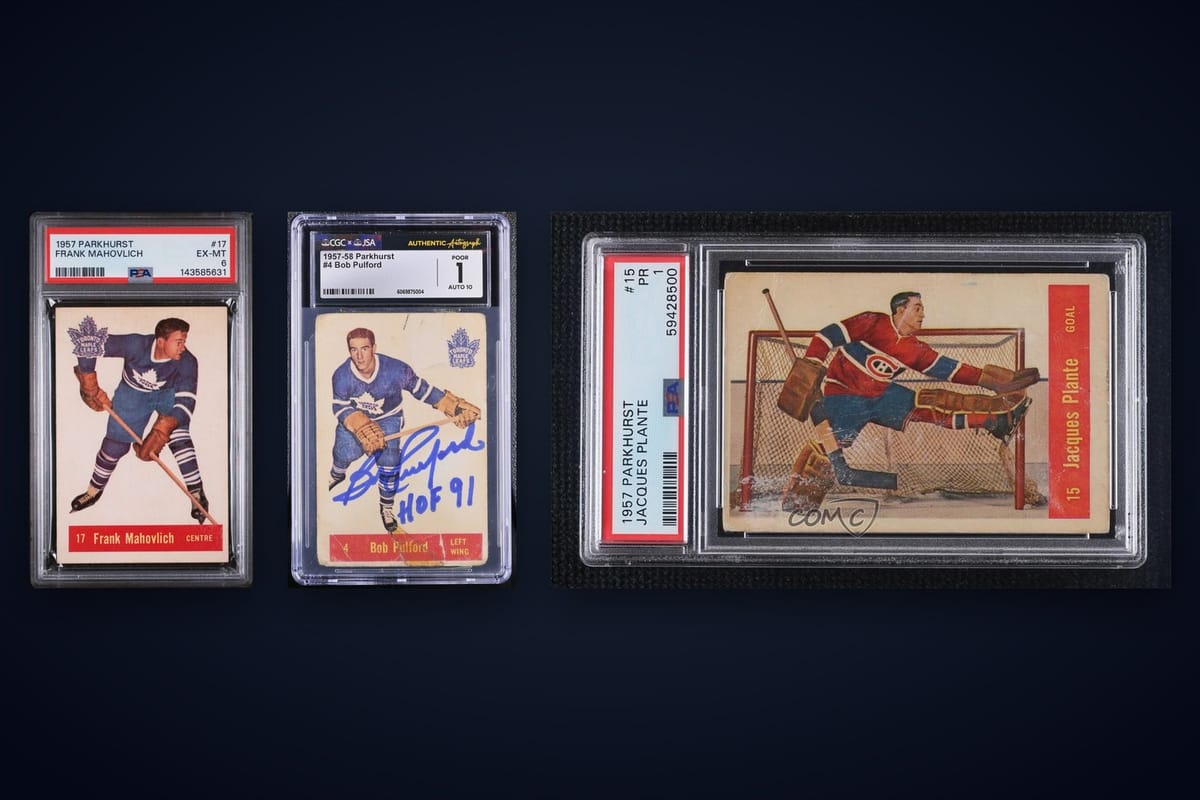
Frank Mahovlich #17 1957 Parkhurst |
$299.99 | $62,561 | 208.5× |
 |
Bob Pulford #4 1957 Parkhurst |
$99.99 | $20,884 | 208.9× |
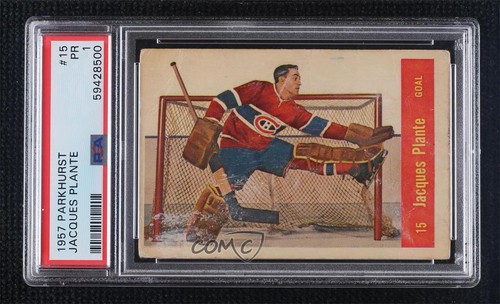 |
Jacques Plante #15 1957 Parkhurst |
$110.00 | $20,876 | 189.8× |
 |
Jean Beliveau #3 1957 Parkhurst |
$73.55 | $15,326 | 208.4× |
 |
Tim Horton #22 1957 Parkhurst |
$39.44 | $8,137 | 206.3× |
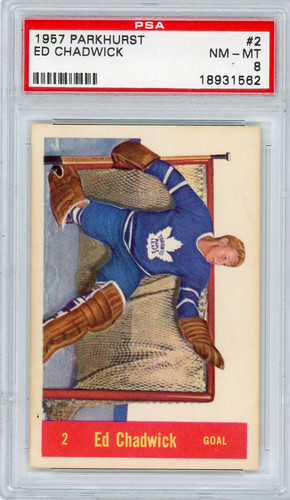 |
Ed Chadwick #2 1957 Parkhurst |
$58.65 | $5,678 | 96.8× |
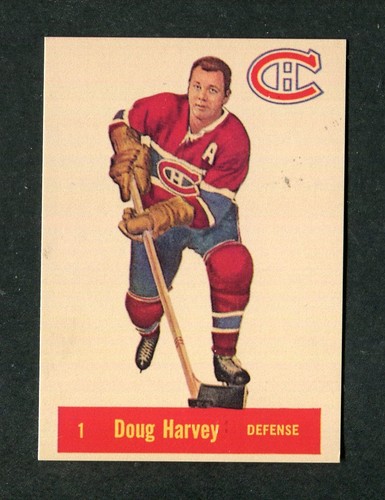 |
Doug Harvey #1 1957 Parkhurst |
$26.71 | $5,570 | 208.5× |
 |
Dickie Moore #14 1957 Parkhurst |
$23.03 | $4,122 | 179× |
 |
Charlie Hodge #17 1957 Parkhurst |
$28.41 | $3,819 | 134.4× |
 |
Andre Pronovost #7 1957 Parkhurst |
$16.06 | $3,359 | 209.1× |
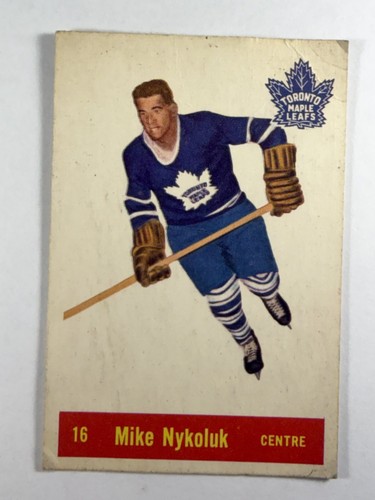 |
Mike Nykoluk #16 1957 Parkhurst |
$15.50 | $3,241 | 209.1× |
 |
Canadiens on Guard #21 1957 Parkhurst |
$14.38 | $3,010 | 209.3× |
Look up any card's current raw and graded value in Midpoint — and get an estimated grade before you pay to submit.
Table of Contents
- Section 1: 1957 Parkhurst set overview and checklist basics
- Section 2: Most valuable 1957 Parkhurst cards and rookie highlights
- Section 3: Raw vs graded values and the PSA premium gap
- Section 4: Condition factors that move price the most
- Section 5: How to grade, authenticate, and spot problem cards
- Section 6: Where to sell or appraise 1957 Parkhurst cards
- Section 7: Practical buying and submission strategy
Section 1: 1957 Parkhurst set overview and checklist basics
Why this set matters
The 1957 Parkhurst hockey cards value conversation starts with one simple fact: this is a landmark postwar hockey issue packed with Hall of Famers, rookie cards, and condition-sensitive vintage cardboard. Collectors chase it for the stars, the classic portrait-style photography, and the old-card scarcity that makes clean copies hard to find.
For buyers, the set is especially attractive because the best cards can show a wide spread between raw and graded prices. That means a card can look affordable ungraded and then become much more expensive once it earns a strong third-party grade.
Checklist structure and numbering quirks
The 1957-58 Parkhurst set is commonly collected as a complete checklist rather than only by star cards. The checklist includes a mix of veterans, rookies, team stars, and role players, and collectors often hunt by card number because some numbers carry more recognition than others.
Collectors should also be aware of possible card numbering or variation quirks and the usual vintage oddities that can confuse newer collectors. When people talk about the 1957 Parkhurst price guide, they are usually comparing the same player across different grades rather than treating every card equally.
Important collector categories in the set include:
- Rookie cards for first-year stars and future Hall of Famers
- Hall of Fame cards for established legends
- Star player cards that usually draw stronger collector interest than commons
- Any scarcer variations and tough condition upgrades that can outprice common copies
How to use the checklist strategically
If you own a stack of Parkhurst cards, start by sorting them into three buckets: key stars, mid-tier Hall of Famers, and lower-end commons. That saves time and tells you which cards deserve a closer look for grading, centering, and authentication.
It also helps to compare raw condition against the likely cost of professional grading. A card that is visually sharp but has a subtle crease, heavy gum stain, or off-center borders may not justify submission, while a strong rookie or Hall of Fame card often does.
For deeper grading prep, collectors often pair set research with a pre-grade pass using a measurement tool. If you want to compare raw surfaces and border balance before submission, the step-by-step pre-grade guide is a useful companion to this checklist approach.

Section 2: Most valuable 1957 Parkhurst cards and rookie highlights
The key names collectors chase
The most valuable 1957 Parkhurst hockey cards are concentrated around a short list of elite players. The strongest demand typically centers on Henri Richard rookie #4, Frank Mahovlich rookie #17, Maurice Richard #5, Jacques Plante #15, Jean Beliveau #3, Doug Harvey, and Tim Horton.
These names matter because they combine Hall of Fame pedigree, era-defining reputations, and broad collector demand. Rookie cards tend to carry the sharpest upside, but veteran legends can still be very strong when the card is clean, centered, and problem-free.
Why rookies and stars separate from the pack
In vintage hockey, rookies often outperform because collectors want the earliest mainstream issue for a player. That is especially true for marquee names like Henri Richard and Frank Mahovlich. A star rookie in excellent condition can command a major premium over a lower-grade copy of the same card.
Hall of Fame veterans such as Maurice Richard, Jacques Plante, Jean Beliveau, Doug Harvey, and Tim Horton are also heavily collected because they represent hockey history at the top tier. These are the cards buyers mention first when asking about the most valuable 1957 Parkhurst cards.
What to look for in the card-specific hierarchy
When sorting a 1957 Parkhurst lot, prioritize the following:
- Rookies first: Henri Richard #4 and Frank Mahovlich #17 should be examined carefully for centering, print quality, and surface wear.
- Iconic Hall of Famers next: Maurice Richard #5, Jacques Plante #15, and Jean Beliveau #3 have strong name recognition and broad demand.
- Strong supporting legends: Doug Harvey and Tim Horton remain highly desirable because vintage buyers know the significance of elite defensemen and two-way stars.
- Condition-sensitive examples: even a big-name card can fall sharply in value if the corners are soft or the surface has a crease or stain.
Because collector demand often shifts toward the best-graded copies, it is smart to separate cards by eye appeal before you look up price data. For players in this set, the difference between “nice raw” and “top-pop style” can be meaningful.
If your goal is a broader grading strategy, the low population grading guide explains why scarce vintage cards can sometimes justify grading even when the surface is not flawless.
Section 3: Raw vs graded values and the PSA premium gap
Why graded cards sell differently
The biggest pricing mistake with vintage hockey is assuming a raw card and a graded card will trade in the same value range. They usually do not. For a set like Parkhurst, the market pays for confidence: authentication, grade transparency, and a slab that reduces buyer uncertainty.
That is why the current ungraded values versus PSA, SGC, CGC, and BGS graded prices matter so much. Even within the same card number, the market can separate a well-centered PSA example from a rough raw copy by a large margin, especially for key rookies.
PSA premium and top-grade expectations
The phrase 1957 Parkhurst psa 10 value gets attention because top grades create the largest premium gap in vintage. In reality, PSA 10 outcomes are extremely rare in old cardboard, and collectors often focus more practically on the jump from raw to mid-grade, or from mid-grade to PSA 8/9 territory.
Still, the lesson is important: as the grade climbs, value can rise disproportionately. That premium is strongest on the cards collectors already target most aggressively.
How to think about the market by grade tier
As of 2026-11-08, use these buying lenses rather than guessing blindly:
- Raw: best for builders, authenticity risk-takers, and bargain hunters willing to inspect condition closely.
- PSA/SGC/BGS/CGC mid-grades: often the sweet spot for collectors who want certified quality without paying top-tier money.
- High grades: best for scarce stars where eye appeal, centering, and grading consistency are all strong.
One practical approach is to estimate the likely grade before you submit. That matters because vintage grading is expensive relative to card value on many commons. If you want a better sense of whether a card is worth the fee, the accurate card grading estimates guide shows how pre-grading can help narrow the decision.
Bottom line: the best 1957 Parkhurst cards often sell in very different lanes depending on whether they are raw, authenticated, or high-grade slabbed examples. The market rewards certainty, especially on star rookies.
Section 4: Condition factors that move price the most
The big four: centering, corners, edges, surface
Vintage hockey value is rarely about the player alone. The condition checklist does the heavy lifting. In 1957 Parkhurst, the most important value drivers are centering, corners, edges, and surface. A card with a strong image but poor border balance can grade lower than buyers expect.
Centering is especially important because old print runs often show noticeable left-right or top-bottom imbalance. Corners can soften quickly from storage, and edges may show whitening or chipping. Surface issues such as scratches, print defects, wax residue, and gloss loss can also hold down value.
Gum stains, creases, and print defects
Buyers should pay special attention to gum stains, creases, and print defects. These are the kinds of flaws that can turn a visually appealing vintage card into a much lower-value example.
- Gum stains: often seen from old packaging contact and commonly reduce eye appeal.
- Creases: usually one of the most damaging flaws and often the first thing experienced buyers check.
- Print defects: can include registration issues, spots, roller marks, or transfer problems that affect grade.
Even when a flaw is small, it may matter more on a key rookie than on a common card because the market is paying for high-end examples. If you are deciding whether a raw card deserves submission, the centering and value guide is especially relevant for vintage sets like this one.
How condition changes real buyer behavior
A buyer shopping for the Henri Richard rookie may happily pay more for a clean, centered copy even if it is not perfect, while another buyer will only want a slabbed example with strong eye appeal. That split is what creates pricing gaps across the same card number.
The practical takeaway is simple: small defects matter more when the card is a star. If the card has a chance at a strong grade, the added resale value can justify the grading cost. If the card has multiple visible flaws, it may still be worth selling raw to avoid wasted submission fees.
For collectors who want to preserve value after purchase, storage matters too. Vintage cards should be protected from bending, humidity, and friction, especially if they may later be submitted or sold. A useful reference is the guide to storing valuable cards.
Section 5: How to grade, authenticate, and spot problem cards
Should you submit the card?
Not every 1957 Parkhurst card is worth grading. The best candidates usually have three things in common: strong player demand, clean surfaces, and enough visual quality to justify the fee. That is what makes a card part of the 1957 Parkhurst cards worth grading discussion.
For lower-value commons, grading costs can exceed the resale lift. For key stars and rookies, the math can flip quickly if the card presents well. Think about the likely grade before you spend money, not after.
How to identify authentic vintage cards
Authenticating 1957 Parkhurst cards means looking beyond the front image. Reprints, altered cards, and counterfeits can fool inexperienced buyers. Watch for these warning signs:
- Paper stock that feels wrong for the era
- Suspiciously bright or washed-out print
- Trimmed edges that look too sharp or inconsistent
- Misaligned borders that seem altered rather than naturally printed
- Surface tampering such as cleaning, pressing, or attempts to hide wear
Vintage cards can also have legitimate factory issues, so the goal is not to punish every print flaw. Instead, separate normal production characteristics from manipulation and damage.
Why centering tools help before submission
Centering is one of the easiest measurable parts of grading prep. If a card is dramatically off-center, it may cap the grade before the corners and surface even matter. That is where a measurement workflow helps: you can assess whether the card is a realistic candidate for PSA, SGC, CGC, or BGS before you spend on grading.
Midpoint is built for that exact kind of pre-submission decision. With AI digital grading, centering measurement, and raw-versus-graded value lookup, it helps collectors evaluate a card before they commit. If you want to compare grade company behavior as well, the grading scale differences guide is useful when choosing a submission target.
Remember: a card can be authentic and still not be worth grading. The winning move is to separate “real” from “profitable.”
Section 6: Where to sell or appraise 1957 Parkhurst cards
Best places to price the card correctly
If you are trying to cash out, appraise, or simply verify a sale price, the best option depends on the card’s quality. Higher-end rookies and Hall of Famers often do best through auction houses or specialized vintage dealers, while lower-tier copies may move faster on marketplaces where volume is higher.
For the biggest cards, use venues that attract serious vintage hockey buyers. Those buyers understand the difference between raw, slabbed, and top-grade examples and are more likely to pay fair market value for strong cards.
How to choose between marketplaces and auction houses
Consider the following:
- Auction houses: best for rare, high-grade, or premium-star cards where competition can lift the final price.
- Marketplaces: useful for simpler raw sales and quicker turnover, but you need strong photos and honest condition disclosure.
- Card dealers: convenient for direct offers, especially if you want speed and less hassle.
The right choice depends on card level. A high-end Maurice Richard or Henri Richard can justify the broader audience of a strong auction listing, while a lower-end common may be better sold directly.
How to appraise before listing
Before selling, document the card’s front and back, note the centering, and mention visible flaws. Transparency helps you avoid disputes and makes your listing stronger. If you can, compare your card to recent auction sales of the same card number and grade tier so you do not undersell a premium example.
For collectors interested in broader price impact beyond resale, there is also a useful crossover between grading and asset protection. The card grade and insurance value guide explains why certified cards often sit in a different risk category than raw inventory.
Practical rule: use auction houses for the best cards, marketplaces for speed, and dealers when convenience matters most.
Section 7: Practical buying and submission strategy
How to build a smart purchase plan
The smartest way to buy 1957 Parkhurst cards is to define your goal first. Are you collecting Hall of Famers, chasing a complete set, speculating on grading upside, or building a display with only the best names? The answer changes what a fair price looks like.
For set builders, a clean lower-grade example may be enough. For investors and grading-focused collectors, centering, corners, and grade potential matter more than simply owning the card.
Which cards deserve extra scrutiny
Not every card should be treated equally. Start with the big names and then move down the list:
- Henri Richard rookie #4
- Frank Mahovlich rookie #17
- Maurice Richard #5
- Jacques Plante #15
- Jean Beliveau #3
- Doug Harvey
- Tim Horton
These are the cards where condition gaps matter most. If one of these presents well, it is the type of card many collectors would consider for third-party grading.
How to decide on grading versus raw sale
Use a simple test:
- Grade it if it is a key card, looks clean, and has solid centering.
- Sell it raw if it has major wear, obvious creases, or weak appeal that will likely cap the grade.
- Get a pre-grade read if you are unsure and want to avoid wasting submission costs.
That final step is where a tool like Midpoint can save money. Its AI estimates, centering measurement, and value lookup help you make a submission decision with less guesswork. If you want to test a card before sending it out, start at the free centering calculator or explore Midpoint for the full workflow.
Final buying mindset: the best 1957 Parkhurst cards are not just famous; they are famous in good enough condition to justify the premium.
Conclusion
The 1957 Parkhurst hockey set remains one of the most important vintage hockey releases because it combines legendary names, rookie demand, and real grading upside. The strongest value usually belongs to the big rookies and Hall of Famers, but condition can change the price story fast.
If you are evaluating 1957 Parkhurst hockey cards value, focus on centering, corners, edges, and surface first. Then compare raw and graded outcomes, especially for Henri Richard #4, Frank Mahovlich #17, Maurice Richard #5, Jacques Plante #15, Jean Beliveau #3, Doug Harvey, and Tim Horton.
Whether you are buying, grading, or selling, the winning move is the same: authenticate carefully, inspect closely, and submit only the cards that have real upside. A smart pre-grade pass can turn uncertainty into a profitable decision.
FAQ
Q: What are the most valuable 1957 Parkhurst hockey cards?
A: The key cards collectors usually target are Henri Richard rookie #4, Frank Mahovlich rookie #17, Maurice Richard #5, Jacques Plante #15, Jean Beliveau #3, Doug Harvey, and Tim Horton. As of 2026-11-08, these names lead the set because they combine star power, rookie demand, and strong collector recognition.
Q: How much is a 1957 Parkhurst Henri Richard rookie card worth?
A: Its value depends heavily on condition, centering, and whether it is raw or graded. The strongest examples bring the most interest, while lower-condition copies trade at a much lower level. As of 2026-11-08, the main value gap comes from grade and eye appeal, not just the player name.
Q: How much is a 1957 Parkhurst Frank Mahovlich rookie card worth?
A: Frank Mahovlich rookie #17 is one of the biggest cards in the set and is especially sensitive to grade. As of 2026-11-08, clean and well-centered copies are the ones that usually command the biggest premium, while worn raw examples are much cheaper.
Q: Are 1957 Parkhurst hockey cards worth anything ungraded?
A: Yes. Many raw 1957 Parkhurst cards still have value, especially the top rookies and Hall of Famers. As of 2026-11-08, raw value is still meaningful, but the market usually pays more for authenticated and higher-grade examples.
Q: What is the value of a PSA 8 or PSA 9 1957 Parkhurst hockey card?
A: PSA 8 and PSA 9 examples can carry very strong premiums because high grades are hard to achieve on vintage cardboard. As of 2026-11-08, the most desirable cards in high grade are the star rookies and Hall of Famers, where the PSA premium can be especially large.
Q: How can I identify and price my 1957 Parkhurst hockey cards?
A: Start by matching the player name and card number, then inspect centering, corners, edges, surface, gum stains, creases, and print defects. Next compare raw condition against the likely graded outcome. For a faster pre-grade workflow, Midpoint can help you measure centering and estimate an AI-based grade before submission.
Free to start
Try the Midpoint app
Grade any card from a photo, see its raw and PSA 10 value, and track what your collection is worth — free.
Get it on iPhoneGet it on Android