1962 Post Cereal Football Cards Value: Graded vs Raw
1962 Post cereal football cards value explained: most valuable cards, PSA 10 premiums, short prints, trimming checks and which are worth grading.

Estimated reading time: 11 min
Key Takeaways
- 1962 Post cereal football cards value depends far more on condition, cut quality and the player than on the year alone. Hall of Famers like Jim Brown, Johnny Unitas and Fran Tarkenton anchor the set.
- These cards were cut by hand from cereal boxes, so crisp edges, square corners and centering are rare. That is where the gem premium comes from.
- Raw and graded prices can sit far apart. Compare both before you decide whether grading is worth the fee.
- Trimming is the biggest risk in this set. Learn the checks before you buy or submit.
- Prices in this guide come from Midpoint's database as of 2026-11-08. Check live values before you buy or sell.
Card values — live data from Midpoint's card database, as of 2026-11-08. Prices move; Midpoint refreshes these daily.
| Card | Raw | PSA 10 | Gem premium | |
|---|---|---|---|---|
 |
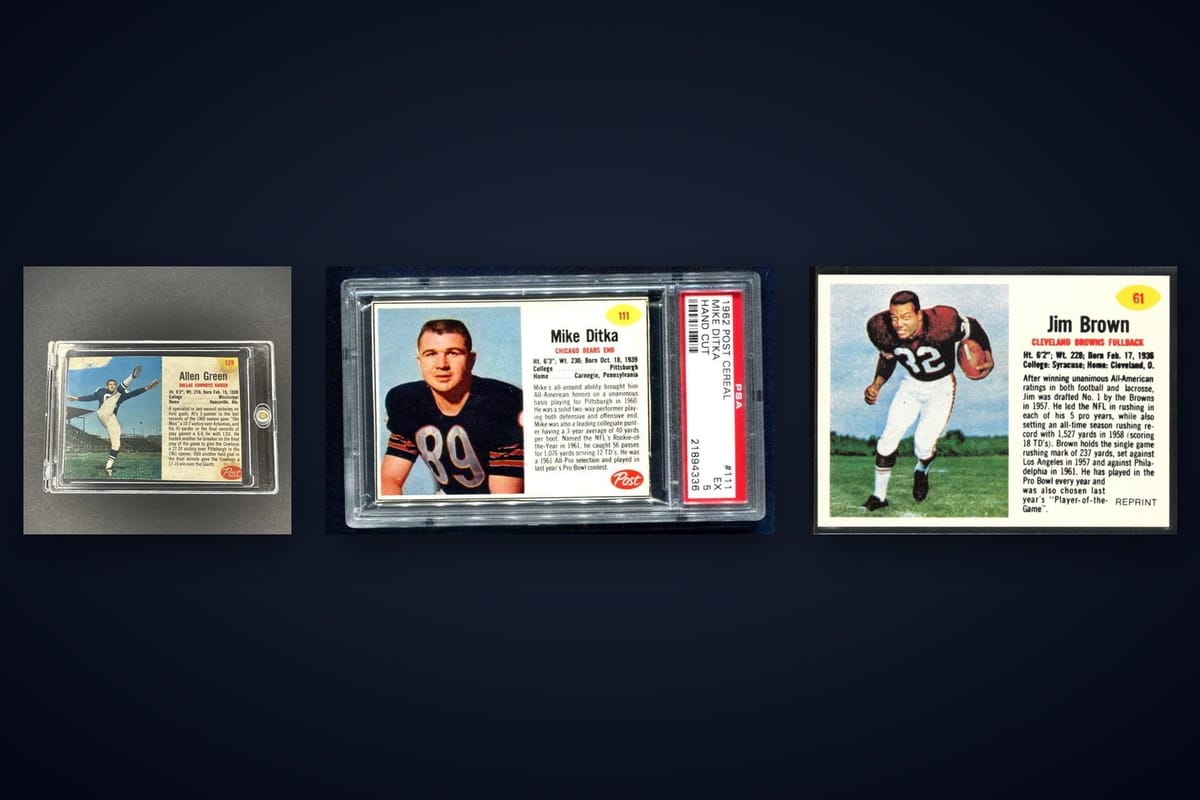
Allen Green #139 1962 Post Cereal |
$92.00 | $16,234 | 176.5× |
 |
Mike Ditka #111 1962 Post Cereal |
$76.63 | $15,600 | 203.6× |
 |
Jim Brown #61 1962 Post Cereal |
$77.05 | $13,516 | 175.4× |
 |
Tom Moore #10 1962 Post Cereal |
$61.83 | $10,781 | 174.4× |
 |
Angelo Coia #110 1962 Post Cereal |
$39.79 | $6,823 | 171.5× |
 |
Bob Lilly #141 1962 Post Cereal |
$40.06 | $6,764 | 168.9× |
 |
Jerry Tubbs #145 1962 Post Cereal |
$39.70 | $6,622 | 166.8× |
 |
Frank Clarke #135 1962 Post Cereal |
$40.00 | $6,328 | 158.2× |
 |
Del Shofner #28 1962 Post Cereal |
$34.00 | $5,935 | 174.6× |
 |
Bob St. Clair #103 1962 Post Cereal |
$36.56 | $5,785 | 158.2× |
 |
Fran Tarkenton #184 1962 Post Cereal |
$28.53 | $5,028 | 176.2× |
 |
Max McGee #9 1962 Post Cereal |
$34.68 | $4,879 | 140.7× |
Look up any card's current raw and graded value in Midpoint — and get an estimated grade before you pay to submit.
Table of Contents
- Section 1: What the 1962 Post Cereal Football Set Is
- Section 2: A 1962 Post Cereal Price Guide Framework
- Section 3: Most Valuable 1962 Post Cereal Cards
- Section 4: 1962 Post Cereal PSA 10 Value and the Gem Premium
- Section 5: Short Prints, Box Distribution and Scarcity
- Section 6: Condition Factors and Spotting Trimmed Cards
- Section 7: Are 1962 Post Cereal Cards Worth Grading?
- Section 8: Complete Sets, Partial Sets and Uncut Panels
- Conclusion
- FAQ
Section 1: What the 1962 Post Cereal Football Set Is
Anyone researching 1962 Post cereal football cards value needs to understand how these cards were made first. They were not sold in wax packs. They were printed on the backs of Post cereal boxes, and kids (or their parents) cut them out with scissors. That one fact explains much of the pricing.
A 200-card set built from cereal boxes
The set contains 200 cards of football players. Because the cards ran on panels of different Post brands, a card's scarcity can be tied to which box it ran on and how widely that box was distributed. We cover that in Section 5.
- Cards were printed as box-back panels, not as standalone cards.
- Cutting was done at home, so there is no factory-cut uniformity.
- Many survivors show wear from loose storage, albums or tape, which hurt surface and corners.
Why it matters for value
A card cut by a child will rarely be perfectly square. Slight angles, uneven borders and rounded corners are normal. Collectors generally accept more of this in Post cards than in a pack-issued card, but the best-cut examples still command a premium.
The result is a set where the same player can have a very wide price range. A tidy, centered, sharp-cornered Unitas and a heavily wrinkled one are not in the same market.
How this guide uses data
The pricing table shown after this section comes from Midpoint's database as of 2026-11-08. I will not repeat every row in prose. Instead, the rest of the article explains how to read those numbers, where the gaps are widest, and how to decide whether a card is worth submitting. If you want live raw and graded values for any card in this set, look it up in Midpoint.
Section 2: A 1962 Post Cereal Price Guide Framework
A good 1962 Post Cereal price guide is less about a single number and more about knowing which number applies to your card. Every card in this set has at least three price layers.
The three price layers
- Raw, ungraded: Sold as is. Pricing depends on photos, centering and the seller's honesty about trimming.
- Mid-grade slabbed: A graded card in the EX to NM range. This is where many surviving cards land.
- High-grade slabbed: Near Mint-Mint and above. Supply is thin and prices typically rise sharply.
How to read the table
Use the table as a map, not a promise. Look at the ratio between raw and graded for each card. A small ratio means grading adds little. A large ratio means the graded premium is doing most of the work, and a high grade may be worth chasing.
Also compare commons with stars. In a set like this, common cards often trade at modest prices even in nice condition, while star cards tend to carry the premium at every grade tier.
Pitfalls when using any price guide
- Stale data: A single sale can move a thin market. Treat one result as a data point, not a rule.
- Grade mismatch: Compare like with like. A PSA 6 and a PSA 8 are very different assets.
- Cut mismatch: Two cards with the same grade can differ in eye appeal if one is cleanly cut and the other is crooked.
- Altered cards: A suspiciously cheap, sharp card may have been trimmed.
To understand how the different grading companies stack up when you compare sold prices, see this guide to grading scale differences by company.
Section 3: Most Valuable 1962 Post Cereal Cards
When collectors search for the most valuable 1962 Post Cereal cards, the answer is usually Hall of Famers and the biggest names of the early 1960s.
The headline names
Three players show up first in most discussions of this set:
- Jim Brown: The most recognized running back of his era and a perennial top seller in vintage football.
- Johnny Unitas: The defining quarterback of the period and a staple of any serious vintage football collection.
- Fran Tarkenton: A Hall of Fame quarterback whose early cards are favorites among set builders.
Other Hall of Fame names in the set also tend to carry premiums over the average card. Check the table after Section 1 for the as-of-2026-11-08 figures on these entries.
Why stars command more at every grade
Demand is the driver. A Jim Brown card is wanted by player collectors, Browns fans, vintage football investors and set builders. A journeyman's card is wanted mostly by set builders. That broader buyer pool tends to lift both raw prices and slabbed prices.
Scarcity within the stars
Not every star card is equally easy to find. Some may have run on less common box types or been cut and discarded more often. A star with limited supply in high grade can outpace a bigger name that is easy to find in nice shape.
- Check the number of graded copies before you chase a top grade.
- Compare the star's price at one grade level against a common at the same level to see the "star premium."
- Watch for iconic poses, since eye appeal matters.
If you track several cards at once, a portfolio view helps you see which names are driving the value of your collection over time.
Section 4: 1962 Post Cereal PSA 10 Value and the Gem Premium
The phrase 1962 Post Cereal PSA 10 value deserves caution. Gem Mint examples of a hand-cut cereal card from the early 1960s are extremely hard to come by, and some cards may have few or no examples at that grade. That scarcity is what creates the gem-premium gap.
What the gem-premium gap is
The gem-premium gap is the difference between the price of a card in a typical grade and the price of the same card at the top of the scale. In vintage cereal sets, that gap is often much larger than in modern sets because:
- Factory-cut modern cards are far more consistent.
- Hand-cut vintage cards rarely have four clean, even edges.
- Handling over decades wore down many surfaces and corners.
Why a top grade is so rare here
To earn a very high grade, a card needs sharp corners, clean edges, a clean surface and strong centering. A Post card has to survive being cut from a box, stored for 60+ years, and still look fresh. Even the centering alone is a challenge, because the printed border sits against a hand-cut edge. For more on this, read how centering impacts card value.
How to use the premium in decisions
- Do not assume a top grade. Price your card at the grade it will realistically receive, not the grade you hope for.
- Use the ratio. Compare mid-grade to top-grade values in the table. A huge ratio signals big upside but also big risk.
- Remember grader differences. A top grade from one company may not equal a top grade from another in the market's eyes.
The table's figures for the highest tiers are as of 2026-11-08. Treat them as a ceiling for what perfection can bring, not an expectation for your card.
Section 5: Short Prints, Box Distribution and Scarcity
Cereal sets do not behave like pack sets. Scarcity here may come from which box carried the card and how widely that box was sold, rather than from a deliberate short-print run.
How box distribution creates scarcity
Post printed cards on the backs of several cereal products. If a particular brand sold less, or a panel was available for a shorter period, the cards on it may be harder to find today. Collectors sometimes call these short prints, although the cause is distribution rather than a planned print run.
- Fewer boxes sold means fewer cards cut and saved.
- Less popular cereals may have been discarded with the cards still attached.
- Some players may appear on less common panels, raising their cost relative to similar-level peers.
How to verify scarcity for a specific card
Do not rely on a single article's claim about a short print. Instead:
- Cross-check a reputable checklist that lists card numbers, players and teams.
- Compare how often the card appears in recent sales versus its neighbors.
- Look at graded population counts. A very low count at a given grade may signal real scarcity, or just a card nobody submits.
Scarcity versus demand
A scarce card is not automatically a valuable one. A rare common is still a common. The sweet spot is a card with both low supply and strong demand, usually a star player on a harder-to-find panel. For the grading side of this, see this guide on card grading for low population cards.
Section 6: Condition Factors and Spotting Trimmed Cards
Condition drives value more than almost anything else in this set. The cereal-box cut makes several problems more common than in pack-issued cards.
The big condition factors
- Hand-cut edges: Wavy, angled or uneven edges are normal. Extreme unevenness hurts eye appeal and grade.
- Centering: The printed border can look lopsided because of the cut. Measure it rather than guessing.
- Corners: Soft or rounded corners are common after years of handling.
- Wrinkles and creases: Cardboard from a box bends easily. A visible crease usually caps the grade.
- Stains and surface wear: Cereal boxes were kitchen items, so food stains and fading can appear.
How can you tell if a 1962 Post football card has been trimmed?
Trimming is the main authenticity risk. Someone shaves the edges to remove wear and make a card look sharper. Look for these signs:
- Size: Compare the card against a known untouched example. A noticeably smaller card is suspect.
- Edges: Under magnification, trimmed edges can look unnaturally smooth, straight and uniform, with no paper fibers.
- Borders: Unusually thin or uneven borders compared with others in the set can signal a trim.
- Too good to be true: A sharp card priced well below comparable slabs deserves extra scrutiny.
Graders typically decline or flag altered cards, so trimmed examples can lose much of their value. Also be cautious of reprints, which can have the wrong paper feel, print pattern or card back. Buy from trusted sellers and ask for high-resolution photos of all four edges.
Measure before you decide
Centering is the easiest factor to check yourself. Midpoint's tool lets you measure it before you spend money on submission.

Section 7: Are 1962 Post Cereal Cards Worth Grading?
Whether 1962 Post Cereal cards are worth grading comes down to simple math: expected graded value minus the cost of grading, shipping and risk, compared with the raw value.
A practical decision framework
- Step 1: Identify the card. Stars and Hall of Famers are the best candidates. Commons rarely justify the fee unless they are exceptional.
- Step 2: Check the gap. Look up raw and graded values in the table or in Midpoint. If the graded value barely beats raw, skip it.
- Step 3: Inspect condition honestly. Check corners, creases, surface and cut quality.
- Step 4: Measure centering. A poorly centered card will not reach a top grade no matter how clean it is.
- Step 5: Estimate a realistic grade. Price it at that grade, not at the best case.
When grading usually makes sense
- The card is a star with a large raw-to-graded gap.
- Corners, edges and surface look clean with no creases.
- Centering is reasonably balanced.
- You are worried about authenticity and want a third-party opinion.
When to sell raw or hold
- The card has a crease, heavy stain or obvious trimming.
- It is a common with a thin price gap.
- The grading fee would eat most of the potential gain.
Pre-grading helps you avoid wasted fees. Follow this step-by-step pre-grade guide, or use Midpoint to get an estimated PSA, BGS, CGC or TAG grade from centering, corners, edges and surface before you submit. If you do send cards in, store them carefully in the meantime.
Section 8: Complete Sets, Partial Sets and Uncut Panels
Single cards tell only part of the story. The 1962 Post cereal football cards value of a whole set, a partial set or an uncut panel follows its own logic.
Complete and partial sets
A complete 200-card set is hard to assemble, because every card must be found and the key stars tend to cost the most. Collectors often value a set by adding up its single cards, then adjusting for quality consistency and the convenience of buying it all at once.
- Completeness: A full set is harder to assemble than random lots.
- Consistency: A set where all cards are similar quality is more desirable than one with wildly mixed condition.
- Missing stars: A partial set missing Brown, Unitas or Tarkenton will usually sell for much less than one that includes them.
- Graded vs raw: A fully graded set can bring a premium but costs far more to build.
Uncut panels and boxes
Because most cards were cut out and the boxes thrown away, an uncut panel or complete original box is likely much scarcer than a single card. These pieces can appeal to both football and advertising-memorabilia collectors, and they may bring strong prices at auction. Condition, completeness of the panel and visible stars matter most.
- Check that the panel is original and not a modern recreation.
- Note which Post brand it came from.
- Store flat, away from light and moisture. See this guide on how to store valuable cards.
Tracking it all
If you own several cards or a set, track value over time in a portfolio tool so you can see how raw and graded prices move.
Conclusion
The 1962 Post cereal football cards value story is simple at heart: stars carry the money, condition sets the tier, and hand-cut cards make high grades unusually scarce. The widest gaps between raw and graded prices tend to belong to the Hall of Famers, and that is where grading can pay off if the card is clean, well centered and genuinely untrimmed.
Before you buy, sell or submit, compare raw and graded prices, check for trimming, and measure centering. A few minutes of prep can save you a grading fee or a bad purchase. You can look up values, estimate grades and track your collection in Midpoint, which is free on iOS and Android.
FAQ
Q: How much are 1962 Post football cards worth?
A: It varies widely. Commons are far cheaper than stars, and graded copies trade above raw ones. Condition, centering and cut quality drive the difference. See the table in this guide (as of 2026-11-08) or look up a specific card in Midpoint for current raw and graded values.
Q: What is the most valuable 1962 Post football card?
A: Hall of Famers such as Jim Brown, Johnny Unitas and Fran Tarkenton lead demand in the set. The exact top card depends on grade and recent sales, so check the table and live values.
Q: How much is a 1962 Post Jim Brown card worth?
A: It depends on condition. A well-centered, sharp, untrimmed copy in a high grade will be worth far more than a creased or heavily worn one. Compare raw and graded values for the card in Midpoint before buying or selling.
Q: Are 1962 Post football cards rare?
A: Common cards are findable, but high-grade examples are scarce because the cards were hand-cut from cereal boxes and often damaged. Uncut panels and boxes are likely rarer still.
Q: What are the short prints in the 1962 Post football set?
A: Scarcity may come from which cereal box carried a card and how widely it was distributed, rather than from a single planned short-print run. Verify specific short prints against a reliable checklist and recent sales before paying a premium.
Q: How can you tell if a 1962 Post football card has been trimmed?
A: Compare its size to a known untouched card, then inspect the edges under magnification. Trimmed edges can look unnaturally smooth and straight, and borders may be thin or uneven. Be wary of sharp cards priced well below comparable ones.
Free to start
Try the Midpoint app
Grade any card from a photo, see its raw and PSA 10 value, and track what your collection is worth — free.
Get it on iPhoneGet it on Android