1963 Fleer Football Cards Value: Rookies, Grades & Prices
1963 Fleer football cards value explained: Dawson, Alworth and Buoniconti rookies, short prints, the PSA 10 gap, and which cards are worth grading.

Estimated reading time: 11 min
Key Takeaways
- 1963 Fleer football cards value is driven by three things: the player (Hall of Fame names and rookies lead), scarcity (reported short prints and the unnumbered checklist), and condition, especially centering and corners.
- The most valuable 1963 Fleer cards are the AFL stars: Len Dawson #47, Lance Alworth #72 and Nick Buoniconti #10. Charles Long #6 and Bob Dougherty #64 are commonly cited for scarcity.
- The gem-premium gap is the real story. On a 1960s set with chronic centering and print problems, a top-grade slab can sell for a multiple of a mid-grade copy of the same card.
- Grading pays on the key Hall of Fame cards and short prints. It usually does not pay on commons unless they are visibly sharp and well centered.
- Dollar figures in this guide come only from the table above, as of 2026-11-08. Re-check recent sold listings before you buy, sell or submit.
Card values — live data from Midpoint's card database, as of 2026-11-08. Prices move; Midpoint refreshes these daily.
| Card | Raw | PSA 10 | Gem premium | |
|---|---|---|---|---|
 |
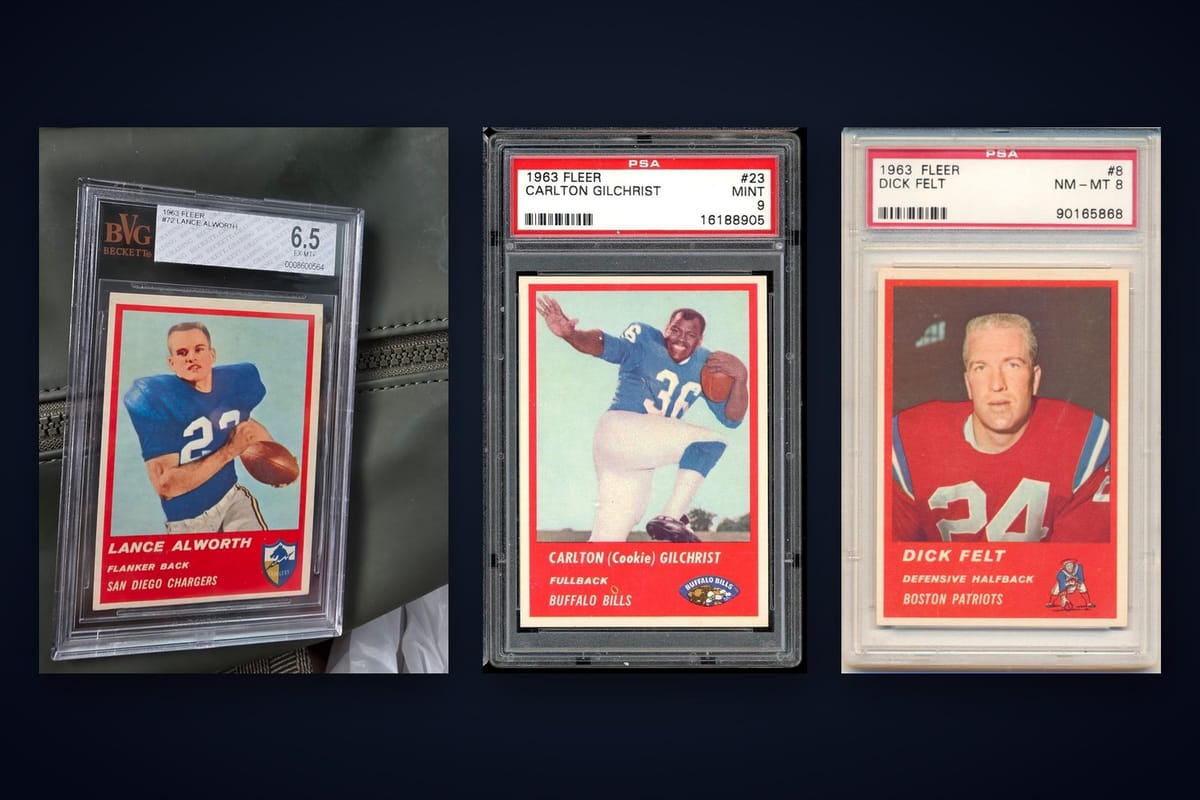
Lance Alworth #72 1963 Fleer |
$338.00 | $57,477 | 170.1× |
 |
Carlton Gilchrist #23 1963 Fleer |
$48.39 | $8,264 | 170.8× |
 |
Dick Felt #8 1963 Fleer |
$28.13 | $6,431 | 228.6× |
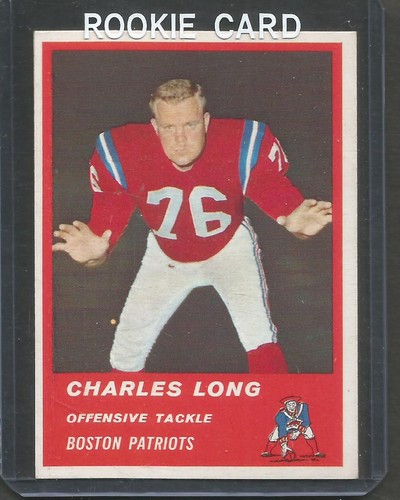 |
Charles Long #6 1963 Fleer |
$43.89 | $5,412 | 123.3× |
 |
Jack Kemp #24 1963 Fleer |
$31.08 | $5,290 | 170.2× |
 |
Fred Williamson #63 1963 Fleer |
$28.26 | $4,795 | 169.7× |
 |
George Blanda #36 1963 Fleer |
$26.82 | $3,725 | 138.9× |
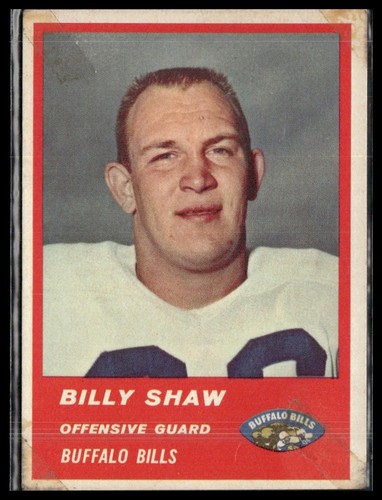 |
Billy Shaw #28 1963 Fleer |
$18.70 | $3,257 | 174.2× |
 |
Mike Stratton #32 1963 Fleer |
$28.90 | $3,200 | 110.7× |
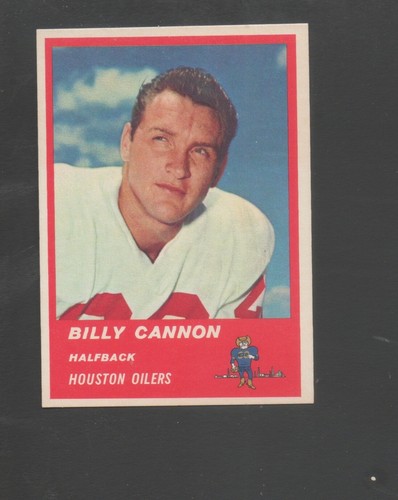 |
Billy Cannon #37 1963 Fleer |
$15.25 | $2,984 | 195.7× |
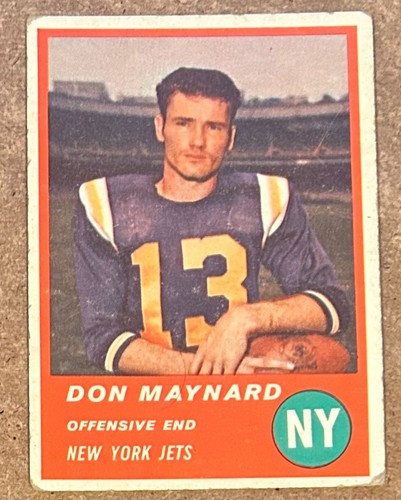 |
Don Maynard #15 1963 Fleer |
$17.19 | $2,947 | 171.4× |
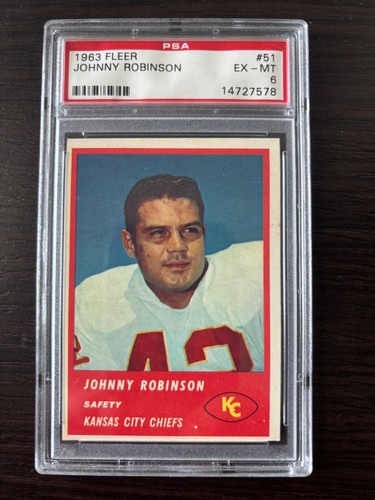 |
Johnny Robinson #51 1963 Fleer |
$17.04 | $2,853 | 167.4× |
Look up any card's current raw and graded value in Midpoint — and get an estimated grade before you pay to submit.
Table of Contents
- Section 1: 1963 Fleer Football Cards Value at a Glance
- Section 2: A 1963 Fleer Price Guide Method: Reading Values by Card Number
- Section 3: Most Valuable 1963 Fleer Cards: Dawson, Alworth and Buoniconti
- Section 4: Short Prints, the Checklist and the Red-Stripe Question
- Section 5: Condition, Centering and the 1963 Fleer PSA 10 Value Gap
- Section 6: 1963 Fleer Cards Worth Grading (and Those That Are Not)
- Section 7: Complete Sets, Partial Sets and Signed Cards
- Conclusion
- FAQ
Section 1: 1963 Fleer Football Cards Value at a Glance
If you want to understand 1963 Fleer football cards value, start with what the set is. Fleer's 1963 issue was a one-series, AFL-only release. Topps held the NFL market, so Fleer built its football cards around the upstart American Football League. That is why this set is the home of early cards for players who became AFL and Hall of Fame names.
Set identification basics
- Size: standard 2 1/2" x 3 1/2" cards.
- Checklist: generally listed as 88 player cards, plus a checklist card that collectors describe as unnumbered. Confirm the exact count against a current checklist.
- Format: a single series. There is no high-number series to hunt.
- Players: AFL teams only, so no NFL-team cards from this year.
The small checklist is good news for collectors. You can chase a complete set without the sprawl of a 500-card Topps issue.
Why the set carries a premium
Three drivers push values up. First, cards of Hall of Famers Len Dawson, Lance Alworth and Nick Buoniconti sit in a single compact set, and the Alworth and Buoniconti cards are generally listed as rookie cards. Second, the AFL's history gives the set lasting nostalgia. Third, cards from this era are hard to find in sharp condition, so the gap between average copies and top-graded copies is wide.
How to use the numbers in this guide
The table above lists raw and graded figures from the Midpoint database as of 2026-11-08. This post does not restate every row. Instead, it explains how to read those figures, why some cards trade at a premium, and where grading makes sense. Treat any single value as a snapshot. Vintage prices move on one or two strong auction results, especially in high grades.
One more point on search terms: a 1963 Fleer price guide can mean a printed book, a sold-comps database, or an app lookup. Each gives a slightly different number. Ours is anchored to the dated figures in the table.
Section 2: A 1963 Fleer Price Guide Method: Reading Values by Card Number
A good 1963 Fleer price guide organizes values by card number and grade. That lets you compare a raw copy against PSA 5, PSA 7, PSA 8 or a gem. Here is how to read those figures sensibly.
Raw versus graded values
Raw values describe ungraded cards, and they are noisy. One seller's "Near Mint" can be another's "Excellent." Graded values come from slabs, where a third-party grader has fixed the condition. Graded numbers are cleaner, but they only apply to cards that actually earn that grade.
When you compare the two in the table, ask: how likely is my card to land at that grade? A raw card priced near a PSA 7 figure is only a bargain if it would actually grade a 7.
Step-by-step: valuing a raw 1963 Fleer card
- Identify the card number and player from the front and back.
- Judge honestly: centering, corner sharpness, edge chipping, surface marks, print snow or stains.
- Find the nearest comparable grade in the table, then drop a tier if you are unsure.
- Check three to five recent sold listings of similarly conditioned copies, not asking prices.
- Adjust for eye appeal. A well-centered card with bright color commonly sells above a poorly centered card in the same grade.
Use sold listings, not asking prices
Asking prices on marketplaces can sit far above what cards actually fetch. Filter for completed or sold sales. For rare cards with few sales, widen your window and note the grade on each. Population matters too: when only a handful of copies exist in a grade, one sale can reset the market.
Watch for grade-tier cliffs
On vintage sets, the step from one grade to the next can be large. Moving up one tier at the top end typically costs far more than moving up one tier at the bottom. That is the engine behind the 1963 Fleer PSA 10 value discussion later in this guide.
To judge where your own card falls before you compare prices, a quick step-by-step pre-grading routine keeps you honest about corners and surface.
Section 3: Most Valuable 1963 Fleer Cards: Dawson, Alworth and Buoniconti
Asked which are the most valuable 1963 Fleer cards, most dealers point to the same trio of Hall of Famers, then to the scarce cards covered in the next section.
Len Dawson #47
Dawson is a Hall of Fame quarterback who led the Chiefs franchise through the AFL years and into Super Bowl IV. His #47 card is the quarterback headliner of the set and typically anchors any serious 1963 Fleer collection. Note that it is not his rookie card, since he had earlier cards. Quarterbacks carry a built-in demand premium, and Dawson's AFL-to-NFL legacy keeps interest steady across multiple collector groups. Check the table for the raw and graded figures as of 2026-11-08.
Lance Alworth #72
Alworth, nicknamed "Bambi," was among the AFL's signature stars and a Hall of Fame wide receiver. His #72 is generally listed as his rookie card and is a highly sought-after card in the set from buyers who care about on-field greatness and visual appeal. Wide receivers do not always draw QB-level premiums, but Alworth is an exception because of his reputation. Collectors frequently compare #72 and #47 head to head, so their relative values merit close attention in the table.
Nick Buoniconti #10
Buoniconti is a Hall of Fame linebacker whose career took him from the Patriots to the famed undefeated 1972 Dolphins. His #10 is a strong third anchor and is generally listed as his rookie card. Pay close attention to corners and edges on this card.
What separates these three
- Hall of Fame status: lasting demand, regardless of market cycles.
- Rookie status: Alworth's and Buoniconti's cards are generally listed as rookie cards, while Dawson's is a key early-career card rather than his first.
- Visual appeal: action and team-colored photography help strong copies stand out.
Beyond this trio, other Hall of Famers and star AFL names in the checklist trade at a premium to commons, but these three tend to set the ceiling. Use the table to rank them by raw and graded value rather than relying on reputation alone.
Section 4: Short Prints, the Checklist and the Red-Stripe Question
Scarcity can make an obscure player worth more than a famous one. In the 1963 Fleer set, three items are widely discussed by collectors: Charles Long #6, Bob Dougherty #64, and the unnumbered checklist.
Charles Long #6 and Bob Dougherty #64
These two cards are commonly cited as short prints, though you should verify that against a current checklist or population report. The player names will not excite a casual fan, but scarcity turns them into cards that complete-set builders must find. Because fewer copies reached collectors, finding them in high grade is harder, and sales are less frequent. When a card sells rarely, the price can swing widely from one sale to the next. For short prints in particular, build a range from multiple data points rather than trusting one comp. The table shows our dated figures.
The unnumbered checklist
Checklist cards were made to be used. Kids often marked them, folded them or tossed them. An unmarked checklist in crisp condition is therefore a legitimate condition rarity, even if it lacks a player's face. Inspect carefully for pencil or pen marks, since a marked checklist is graded and priced lower than a clean one.
Do red-stripe variations change price?
Collectors and auction listings sometimes distinguish 1963 Fleer cards by the presence or absence of a red stripe on the back. Whether that distinction moves price depends on the specific card and on what buyers are actually paying. We do not have a verified premium figure for it, so we are not going to invent one.
- Compare sold listings that describe the variation against ones that do not.
- Check if grading companies note the variation on the label.
- Treat any claimed premium as unproven until at least a few sold results support it.
For truly low-supply cards, understanding population data helps. Our guide to grading low population cards explains how thin populations affect pricing and risk.
Section 5: Condition, Centering and the 1963 Fleer PSA 10 Value Gap
Condition drives the 1963 Fleer PSA 10 value conversation more than anything else. Mid-century cards were cut and printed with period-era methods, printed on low-grade stock and often stored in shoeboxes. Perfect copies are few, and buyers pay for that.
The four grading factors
- Centering: border balance front to back. Off-center is a very common flaw in vintage cards of this era.
- Corners: sharpness. Even slight rounding drops a card a grade or more.
- Edges: chipping, especially along dark borders.
- Surface and print quality: creases, scratches, stains, print dots, and snow.
How PSA, SGC and BGS differ
PSA, SGC and BGS use different scales and weigh flaws differently. PSA uses a single number from 1 to 10. SGC uses its own numeric scale and weighting, and BGS gives subgrades for centering, corners, edges and surface. Because of this, the same card can earn different numbers, and each brand's slab can carry a different market premium. Our breakdown of grading scale differences by company explains what top grades mean at each firm.
Why the gem premium is so large
When a set is hard to find sharp, the few top-grade copies attract bidders who want the best example available. Registry-style collectors compete for them. As a result, the price difference between a mid-grade copy and a top-grade copy of the same card is often much larger than the difference between two mid-grade tiers. The table shows this pattern in our as-of 2026-11-08 figures.
Centering deserves special attention
Centering is the flaw you can measure before submitting. A card with sharp corners and clean surface can still be capped by lopsided borders. Our guide on how centering impacts card value shows the ratios that matter. Measure first, then decide.
Section 6: 1963 Fleer Cards Worth Grading (and Those That Are Not)
Deciding which 1963 Fleer cards are worth grading is an expected-value problem. You pay a fee, you wait, and you get a grade that may or may not beat the cost.
Strong candidates
- Dawson #47, Alworth #72, Buoniconti #10: demand is deep, and a slab adds liquidity and trust.
- Charles Long #6 and Bob Dougherty #64: scarcity makes authentication and grade verification valuable.
- An unmarked checklist: condition rarity that a slab can confirm.
- Any card that looks sharp and centered: because the gem premium is steep, an unusually clean common can still pay off.
Weak candidates
- Commons with soft corners, off-center borders or surface wear. Grading fees can exceed the value gain.
- Heavily creased cards that will grade low regardless.
- Cards where the table shows little raw-to-graded spread at the grade you expect.
A simple expected-value check
- Estimate the most likely grade honestly, then one tier lower.
- Look up both graded figures in the table.
- Subtract the grading fee, shipping and insurance.
- Compare the result with the raw value. If the difference is thin, sell raw.
Grading fees vary by company and service level, and they are typically higher for vintage cards or faster turnaround, so check current fee schedules. The gain has to clear that bar. Insurance affects the math too, which our post on card grade impact on insurance value covers.
Pre-screen with centering
Before you submit, measure borders. A tool like Midpoint measures centering to the millimeter and gives estimated PSA, BGS, CGC and TAG grades, so you can drop weak candidates before paying.

Section 7: Complete Sets, Partial Sets and Signed Cards
Many collectors ask about complete-set value rather than single cards. That is a fair question, but it has no single answer.
Why set values vary widely
A complete 88-card set plus checklist can mean very different things. A raw set of mixed-condition cards sits in a different tier from a set where every card carries a matching grade. The Hall of Fame cards and short prints do most of the work in the total, so which grade those key cards carry matters more than the other cards combined.
- Near Mint sets: rare and expensive, and typically assembled over years.
- Excellent-grade sets: the realistic target for most collectors, with solid eye appeal.
- Lower-grade sets: affordable entry, with corner wear and surface issues acceptable.
Building a set smartly
Buy the three key Hall of Fame cards and the short prints first, in the best grade you can afford, then fill commons in consistent condition. Mismatched sets are harder to sell as a unit. If you sell a partial set, many buyers prefer to bid on key cards individually, so consider splitting.
Autograph scarcity and premiums
Signed 1963 Fleer cards are scarce, particularly for players who have passed away, since no new signatures can be created. Short-print subjects signed on authentic cards are rarer still. However:
- Authentication is essential. Third-party certification protects value.
- Signature quality matters: bold, fully legible signatures on clean cards sell better.
- Signing can hurt the card's grade value. A signed card often sells as an autograph item, not as a condition-graded card.
We do not have premium figures for signed cards in our data, so compare certified sold examples directly.
Protect what you own
Once you own a valuable card, storage preserves value. See our guide on how to store valuable cards. For tracking your collection's value over time, Midpoint's portfolio feature helps.
Conclusion
The value of 1963 Fleer football cards comes down to a short list: Hall of Fame names and rookies (Dawson #47, Alworth #72, Buoniconti #10), genuine scarcity (Long #6, Dougherty #64, the clean unnumbered checklist), and condition. In a set this hard to find sharp, the gem premium is the dominant force, which is why one grade tier can mean a large jump in price.
Use the table for dated reference points, confirm with recent sold listings, and be skeptical of any claimed premium, including for red-stripe variations, that sold comps do not support. Grade the key Hall of Fame cards, short prints and any unusually clean card. Sell commons raw.
Before you pay a grading fee, measure your centering and get an estimated grade with Midpoint, which is free on iOS and Android. You can also try the free centering calculator for a quick check.
FAQ
Q: What are the most valuable 1963 Fleer football cards?
A: Cards of Len Dawson (#47), Lance Alworth (#72) and Nick Buoniconti (#10) lead the set, followed by scarce cards like Charles Long #6, Bob Dougherty #64 and a clean unnumbered checklist. See the table for figures as of 2026-11-08.
Q: How much is a 1963 Fleer Len Dawson card worth?
A: It depends heavily on grade. Raw and graded figures are in the table as of 2026-11-08. Always cross-check recent sold listings at the same grade, since high-grade copies can sell at a large premium. Note that #47 is not Dawson's rookie card.
Q: How much is a 1963 Fleer Lance Alworth rookie card worth?
A: Alworth's #72 is one of the set's top cards. Use the dated figures in the table for raw and graded values, and compare completed sales for your specific condition.
Q: What is the value of a 1963 Fleer Nick Buoniconti rookie card?
A: Buoniconti's #10 is a Hall of Fame rookie that trades at a premium to commons. Check the table as of 2026-11-08, and inspect corners and edges closely.
Q: How much is a complete 1963 Fleer football set worth?
A: There is no single number. Value depends on the grade of the whole set and, above all, the grade of the key Hall of Fame cards and short prints. Mixed-condition sets sit well below sets with consistent high grades.
Q: Are 1963 Fleer football short prints and red-stripe variations worth more?
A: Short prints such as Charles Long #6 and Bob Dougherty #64 are commonly cited as carrying a scarcity premium. For red-stripe variations, we have no verified premium, so confirm with sold listings that clearly identify the variation.
Free to start
Try the Midpoint app
Grade any card from a photo, see its raw and PSA 10 value, and track what your collection is worth — free.
Get it on iPhoneGet it on Android