1983 Star PSA 9 vs PSA 10 Value: Card-by-Card Price Gap
1983 Star PSA 9 vs PSA 10 value explained: why the PSA 10 premium varies by card, where centering decides the price, and when a PSA 9 is the smarter buy.

Estimated reading time: 9 min
Key Takeaways
- Bottom line: for most 1983 Star buyers a PSA 9 is the smarter buy. A PSA 10 only makes sense when you are chasing a registry set or a top-population trophy and can pay the premium.
- The PSA 10 premium is not one fixed multiple. It changes card by card with player demand, scarcity, registry competition and how often the card sells.
- Centering and print quality are common factors that separate a 9 from a 10 on vintage-style Star issues, so the gap can be wide on the cards that are hardest to find well centered.
- Grading a raw copy only pays off if your realistic odds of a 9 or 10 cover the fees, shipping, insurance and selling costs.
- The dated PSA 9 and PSA 10 values (as of 2026-09-04) are in the data table on this page. Use them, not asking prices or old sales.
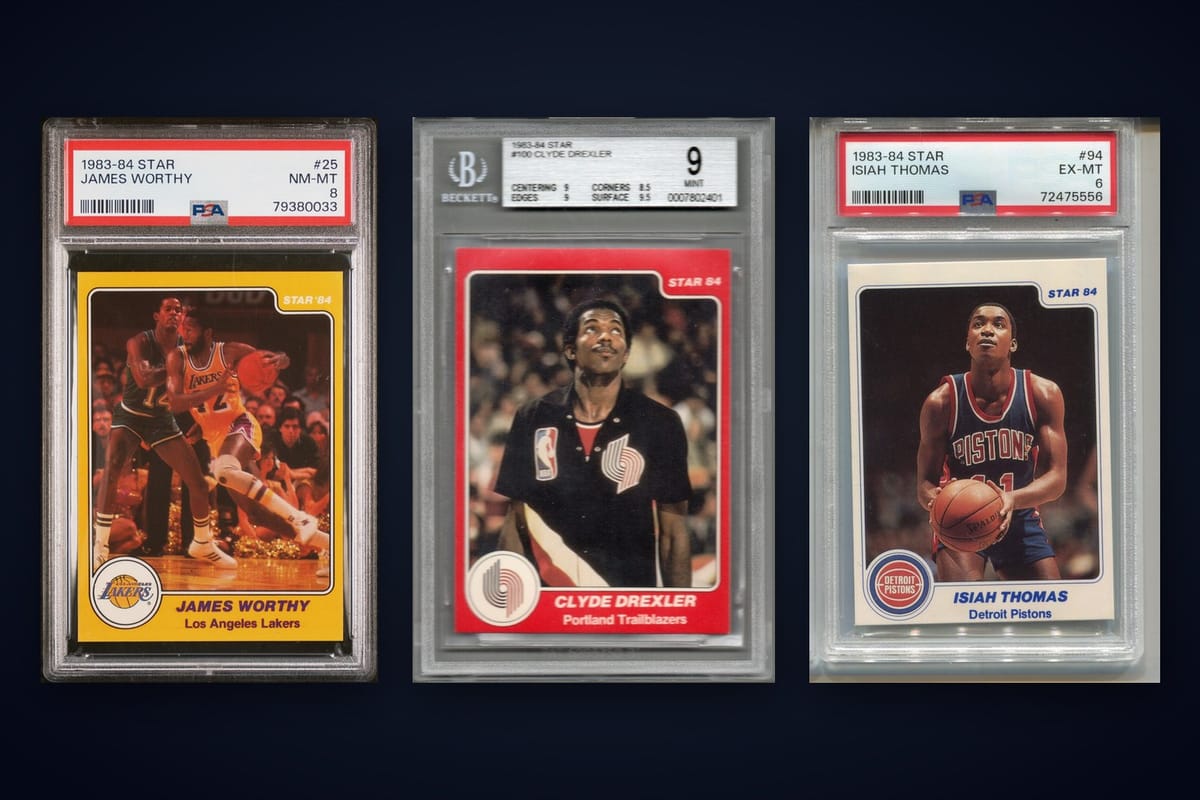
This guide covers 1983 Star PSA 9 vs PSA 10 value for the key basketball cards: Dominique Wilkins, James Worthy, Terry Cummings, Adrian Dantley and the other names collectors chase. The quick answer: a PSA 10 typically costs more than a PSA 9, but how much more depends on the card. The best-value purchase is often the PSA 9.
One note on method: I only use the PSA 9 and PSA 10 figures in the data table on this page, dated as of 2026-09-04. I don't quote prices from memory, because sale prices on these cards move and stale numbers mislead. Instead, this article shows you how to read the gap.
Card values — live data from Midpoint's card database, as of 2026-09-04. Prices move; Midpoint refreshes these daily.
| Card | Raw | PSA 10 | Gem premium | |
|---|---|---|---|---|
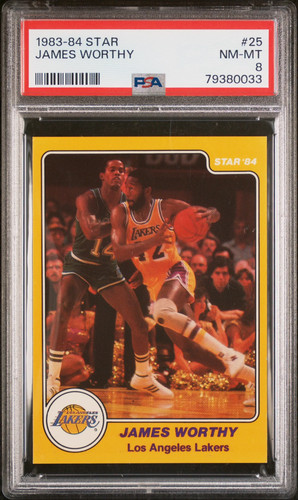 |
James Worthy #25 1983 Star |
$42.25 | $19,999 | 473.4× |
 |
Clyde Drexler #100 1983 Star |
$430.83 | $19,867 | 46.1× |
 |
Isiah Thomas #94 1983 Star |
$383.00 | $17,050 | 44.5× |
 |
Dominique Wilkins #263 1983 Star |
$1,053 | $11,944 | 11.4× |
 |
Rolando Blackman #50 1983 Star |
$150.00 | $10,189 | 67.9× |
 |
Magic Johnson #13 1983 Star |
$200.00 | $9,907 | 49.5× |
 |
Kurt Nimphius #56 1983 Star |
$109.50 | $7,606 | 69.5× |
 |
Mark Aguirre #49 1983 Star |
$102.50 | $7,116 | 69.4× |
 |
Bill Garnett #54 1983 Star |
$92.50 | $6,425 | 69.5× |
 |
Pat Cummings #51 1983 Star |
$82.54 | $5,646 | 68.4× |
 |
Kareem Abdul Jabbar #14 1983 Star |
$60.63 | $4,872 | 80.4× |
 |
Danny Ainge #27 1983 Star |
$59.90 | $2,706 | 45.2× |
Look up any card's current raw and graded value in Midpoint — and get an estimated grade before you pay to submit.
Quick Comparison: PSA 9 vs PSA 10 for 1983 Star Cards
| Dimension | PSA 9 (Mint) | PSA 10 (Gem Mint) |
|---|---|---|
| Price | Lower entry cost; the sensible value tier | Carries a premium that varies card by card |
| Centering (PSA guidelines) | Roughly 60/40 front tolerance | Roughly 55/45 front tolerance |
| Corners and edges | Minor wear or a tiny flaw can be allowed | Essentially sharp, clean and flaw-free |
| Print and surface | One minor print or surface issue may be tolerated | Only a very slight print imperfection is tolerated; surface marks usually keep a card out |
| Population | Larger pool, easier to find | Smaller pool on most cards, harder to find |
| Liquidity | Usually more comparable sales to price against | Fewer sales, so prices can swing on one auction |
| Best for | Collectors and players who want eye appeal per dollar | Registry builders and top-grade trophy hunters |
1983 Star PSA 9 vs PSA 10 Price Difference: Why It Varies
The PSA 9 vs PSA 10 price difference for 1983 Star cards is not a single rule of thumb. Compare the two columns in the data table card by card and you will see the premium differs from player to player. Four forces explain why.
- Player demand. Cards of Dominique Wilkins and James Worthy tend to draw more buyers at the top end than a lesser-known name, so a 10 competes for more bidders.
- Scarcity. If few copies grade a 10, that tier is thin. Even modest demand can push the price well above a 9.
- Registry competition. Set builders want the best grade for every slot. They may pay more for a 10 than a pure investor would, which can inflate the premium on cards they all need.
- Liquidity. A PSA 10 that sells rarely can print an unusually high or low price on a single sale, which makes the real gap hard to pin down.
This is why a 1983 Star PSA 10 premium can look modest on one card and steep on the next. Always read the premium as the 10 price relative to the 9 price for the same card, then ask whether that multiple is justified.
Use completed sales, not asking prices
The most common pricing mistake is mixing sources. Keep these straight:
- Completed sales show what buyers actually paid. They are the best evidence.
- Guide estimates are useful context but can lag the market.
- Asking prices show what sellers hope for, which is often higher than reality, especially on 10s.
- Old historical sales may predate a shift in demand or a population change.
The dated figures in the table are your anchor. Before buying, compare them against one or two very recent sales of the identical card, grade and variation.
Card-by-Card: Where the 9 to 10 Jump Matters Most
Not every card deserves the same strategy. Here is how the key names generally break down. Check each against the table for the current numbers.
- Dominique Wilkins: a marquee name with strong collector demand. The 10 may attract registry and trophy buyers, so the premium is worth scrutinizing against the 9 figure in the table.
- James Worthy: another high-demand card. Demand is likely deep at both grades, so a 9 is often an easier, cleaner entry point.
- Terry Cummings: a mid-tier name where a 10 premium can be harder to justify unless you need the top grade for a set.
- Adrian Dantley: a respected veteran, but the buyer pool at the top grade may be narrower, so a 10 can be more speculative.
Whichever card you consider, confirm the exact set, card number, variation and whether it is a rookie or All-Rookie issue. Star Company issued several related basketball products, and the wrong variation can swing value more than the grade does.
The cards where the gap is widest
Look at the multiple (PSA 10 price divided by PSA 9 price) for each row in the table. The cards with the highest multiples are often ones that combine star power with scarce 10s. On those, the 10 is a bet on scarcity and demand together. On cards with a smaller multiple, the premium for perfection is more reasonable, and a 10 may be fair value if you want the best copy.
PSA 9 vs PSA 10: What Separates the Grades
The dollar gap exists because the physical gap is real and hard to clear. A PSA 10 must clear every category at once.
- Centering. PSA's published guidelines allow tighter tolerance for a 10 than a 9 on the front. This is the most measurable factor, and the one you can check at home.
- Corner sharpness. Even a hint of softness under magnification can cap a card at a 9.
- Print defects. Print dots, roller lines and registration issues can occur on cards from this era and are a common reason a near-perfect card misses a 10.
- Surface flaws. Fine scratches, dimples or wax stains can drop a card a grade.
- Edges. Chipping or roughness along the borders is easy to spot and penalized.
- Original gloss. Dulled or uneven gloss can keep an otherwise sharp card out of the top tier.
Centering is a common reason would-be 10s fall short, so it is where you can improve your decision-making. Our guide on how centering impacts card value explains why, and the free centering calculator lets you measure your own copy in seconds.

Population Reports: How Scarcity Shapes the 10 Premium
Population counts are central to 1983 Star grading value. Each card has a PSA 9 population and a PSA 10 population, and the ratio between them tells you how rare the top grade is. I am not quoting counts here because they change as new submissions arrive. Pull the current PSA pop report for each card yourself.
- Low 10 population, high 9 population: the 10 is the scarce tier, which can support a bigger premium.
- Both populations small: prices are noisy and one sale can move the market. Be careful about paying a big premium.
- Growing 10 population: supply increases can soften the premium over time.
For more on how thin supply affects what to pay and what to submit, see our guide to card grading for low population cards.
Is Grading a Raw 1983 Star Card Worth It?
If you own a raw copy, the question is whether grading beats selling it ungraded. Work through the real costs before deciding:
- Grading fees (these vary by service tier, so check PSA's current fee schedule)
- Shipping and insurance both ways
- Marketplace fees and payment costs when you sell
- The chance of a lower grade than you hoped
Then weigh the outcomes. Estimate the odds of a 10, a 9 and an 8 or lower. If the expected value, using the 9 and 10 prices in the table, only barely beats your raw value after costs, the submission is not worth the risk. Most of the upside rides on a 10, and 10s are the hardest grade to hit.
Pre-screening raises your odds. Measure centering, check corners, edges and surface, and only submit cards that look like real contenders. Our step-by-step pre-grading guide walks through it, and Midpoint gives you an AI-estimated PSA, BGS, CGC and TAG grade before you pay to submit.
PSA vs BGS vs CGC vs Raw for 1983 Star Cards
PSA is the benchmark for this set, and PSA 9 and PSA 10 are the grades the market prices most clearly. Other holders can be priced differently, and the market does not treat a BGS or CGC grade as equal to the same PSA number. The scales also define their top grades differently, as explained in our breakdown of grading scale differences by company.
- Raw: cheapest, but you carry grade risk and the buyer's trust discount.
- PSA: generally the most liquid holder for this set, and the one the table reflects.
- BGS or CGC: sometimes cheaper to buy, but resale may lag a PSA of the same number. Cross-grading into PSA only makes sense if the price difference beats the fees and the risk of a lower grade.
A lower-cost holder can be a smart buy if you plan to keep the card. If you plan to flip, stick with PSA.
Which Should You Choose?
- You want the best value per dollar: buy the PSA 9. You get a strong copy at a lower price, and the gap to a 10 is often hard to see.
- You are building a registry set: a PSA 10 may be worth the premium, especially on cards with a smaller 9-to-10 multiple.
- You are investing: compare the premium to the 10 population. Avoid paying up where 10s are thin and sales are rare.
- You hold a raw copy: measure centering and inspect it first. Submit only if your odds of a 9 or 10 clear all costs.
- You are buying a mid-tier name like Cummings or Dantley: a 9 is usually the more rational purchase.
- You are protecting a slab: grade can affect insurance value, so see our guide to card grade impact on insurance value.
So, is a PSA 9 worth it for 1983 Star? For most buyers, yes. Pay for a 10 only when you have a specific reason: a set, a trophy, or a clear read on scarcity.
FAQ
How much is a 1983 Star PSA 9 worth?
It depends on the card. The PSA 9 values for Dominique Wilkins, James Worthy, Terry Cummings, Adrian Dantley and others are in the data table on this page, dated as of 2026-09-04. Always check the exact card number and variation, then confirm against recent completed sales.
How much is a 1983 Star PSA 10 worth?
Also card-specific. The table lists PSA 10 values as of 2026-09-04. PSA 10 prices can swing on a single sale because fewer copies trade, so verify with recent completed sales rather than asking prices.
Why is a PSA 10 1983 Star card worth so much more than a PSA 9?
A 10 must be essentially flawless in centering, corners, edges, surface and print, so far fewer copies qualify. Add player demand, registry competition and thin liquidity, and the top grade commands a premium that varies by card.
Which 1983 Star basketball cards are worth the most in PSA 9 and PSA 10?
Rank them using the PSA 9 and PSA 10 columns in the data table on this page. High-demand names such as Wilkins and Worthy are the ones collectors typically watch, but the table has the dated values.
Is it worth grading a raw 1983 Star card if it might receive a PSA 9 or PSA 10?
Only if your realistic odds of a 9 or 10 cover grading fees, shipping, insurance and selling costs. Measure centering and inspect the card first. A tool like Midpoint can estimate a grade before you submit.
What is the PSA population for 1983 Star cards in grades 9 and 10?
Counts change as cards are graded, so check PSA's pop report for each specific card. Compare the PSA 9 and PSA 10 populations: a small 10 population relative to the 9 can support a larger premium.
Free to start
Try the Midpoint app
Grade any card from a photo, see its raw and PSA 10 value, and track what your collection is worth — free.
Get it on iPhoneGet it on Android