2003 Ultimate Collection Basketball Cards Value Guide
2003 Ultimate Collection basketball cards value explained: LeBron, Kobe, Carmelo and Wade cards, raw vs PSA 10 gaps, and which are worth grading.

Estimated reading time: 11 min
Key Takeaways
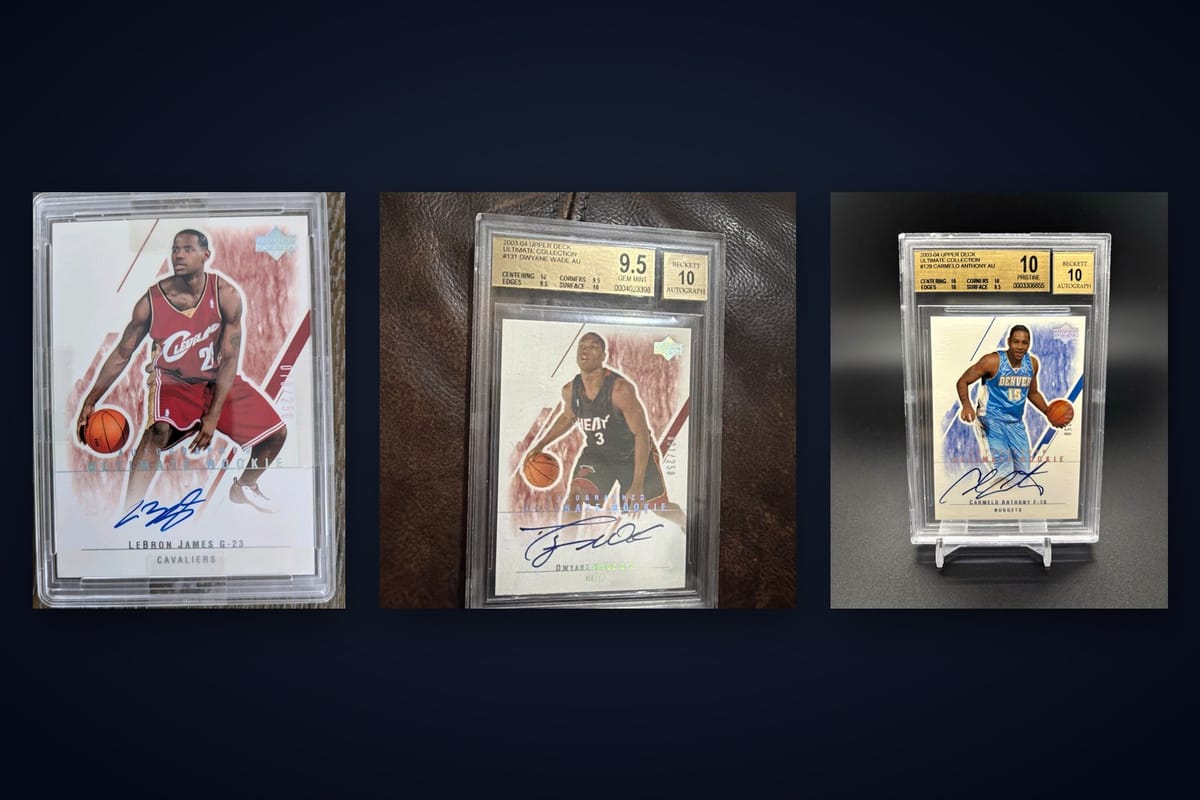
- The 2003 Ultimate Collection basketball cards value story is driven by the legendary 2003-04 rookie class, led by the LeBron James rookie autograph #127.
- This is a thick, premium, hit-driven product, so autographs, patches and low serial numbers matter far more than base cards.
- The gem premium (PSA 10 or BGS 9.5+ vs. raw) is large on premium-era cards, but thick cards with foil and patch windows are hard to grade high.
- Measure centering and inspect corners, edges and surface before paying $30+ per submission, and check live comps rather than relying on stale price lists.
Card values — live data from Midpoint's card database, as of 2026-11-08. Prices move; Midpoint refreshes these daily.
| Card | Raw | PSA 10 | Gem premium | |
|---|---|---|---|---|
 |
LeBron James [Autograph] #127 2003 Ultimate Collection |
— | $281,968 | — |
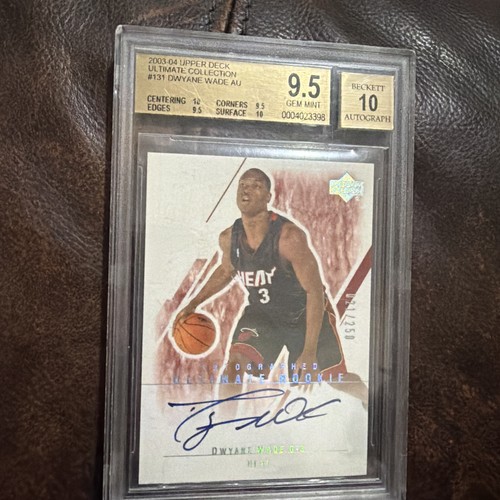 |
Dwyane Wade Autograph #131 2003 Ultimate Collection |
— | $7,655 | — |
 |
Carmelo Anthony Autograph #129 2003 Ultimate Collection |
— | $1,777 | — |
 |
Kobe Bryant [Limited] #45 2003 Ultimate Collection |
$84.99 | $1,475 | 17.4× |
 |
Kobe Bryant [Limited] #174 2003 Ultimate Collection |
$449.99 | $1,125 | 2.5× |
 |
Michael Jordan #10 2003 Ultimate Collection |
$121.40 | $600.00 | 4.9× |
 |
Michael Jordan #167 2003 Ultimate Collection |
$159.06 | $571.63 | 3.6× |
 |
Kobe Bryant #174 2003 Ultimate Collection |
$89.99 | $311.49 | 3.5× |
 |
Allen Iverson #82 2003 Ultimate Collection |
$7.82 | $228.50 | 29.2× |
 |
Kobe Bryant #45 2003 Ultimate Collection |
$53.00 | $208.23 | 3.9× |
 |
Larry Bird #7 2003 Ultimate Collection |
$5.50 | $188.61 | 34.3× |
 |
Larry Bird #165 2003 Ultimate Collection |
$10.66 | $82.18 | 7.7× |
Look up any card's current raw and graded value in Midpoint — and get an estimated grade before you pay to submit.
Table of Contents
- Section 1: What the 2003-04 Ultimate Collection Set Is
- Section 2: Most Valuable 2003 Ultimate Collection Cards
- Section 3: 2003 Ultimate Collection Price Guide and the PSA 10 Value Gap
- Section 4: Autographs, Patches, Parallels and Scarcity
- Section 5: Condition Factors on Thick Premium Cards
- Section 6: Which 2003 Ultimate Collection Cards Are Worth Grading
- Section 7: Sealed Boxes and Spotting a Valuable Card
- Conclusion
- FAQ
Section 1: What the 2003-04 Ultimate Collection Set Is
If you are researching 2003 Ultimate Collection basketball cards value, start with what the product actually is. Upper Deck's Ultimate Collection was a high-end, hit-focused release. It was not a pack-of-commons product. Collectors bought it for autographs, game-used memorabilia and serial-numbered cards.
The timing is why the 2003-04 edition still gets searched today. It landed in the rookie year of LeBron James, Carmelo Anthony, Dwyane Wade and Chris Bosh, one of the most celebrated draft classes in basketball card history.
Base set and checklist structure
The base set covers veterans and stars of the era, including Kobe Bryant. Rookies sit in a separate serial-numbered portion of the checklist, which is why LeBron's key card carries a higher number like #127. Confirm the exact checklist breakdown against a reliable checklist before relying on card numbers.
- Base cards: veterans and stars, generally the most affordable entry point.
- Rookie cards: numbered, premium cards with autographs and often jersey or patch pieces.
- Parallels and limited cards: lower print runs of select players, including Kobe Bryant.
How to use the live data
The data table that follows this section lists the app's figures as of 2026-11-08. Treat it as a snapshot. Prices for premium cards move with every high-profile sale, so use it to understand relative tiers: which cards sit at the top, which sit in the middle, and how big the gap is between raw and graded.
You can pull current raw vs. graded numbers for any card in the set with the lookup in Midpoint, which covers 250,000+ cards across every major sport.
Section 2: Most Valuable 2003 Ultimate Collection Cards
When collectors ask for the most valuable 2003 Ultimate Collection cards, the answer is consistent: rookie autographs first, star limiteds second, base cards a distant third.
LeBron James rookie autograph #127
The LeBron James rookie autograph is the headline card of the set and one of the most recognizable cards of its era. It is a rookie card, it is autographed, it is serial-numbered, and it features the most important player of the class. Few cards combine all four.
Things that move its price:
- Serial number: low numbers and special numbers (like #1 or a matching jersey number) can command premiums.
- Autograph quality: a bold, centered signature on the intended area beats a smudged or faded one.
- Grade and grader: a clean PSA or BGS slab is the standard for a card this expensive.
- Authenticity: because of the card's value, verify slab certification numbers directly with the grader.
Kobe Bryant limited cards
Kobe Bryant is not a rookie in this set, but his limited cards carry enormous demand. His value is driven by name power and scarcity, not rookie status. His base card sits far below the limiteds, so always confirm which version you hold.
Carmelo Anthony, Dwyane Wade and Chris Bosh
The other three rookies form the next tier. Their rookie autographs trade well below LeBron's, but they are the cards that give the set depth. The exact ordering among them depends on current sales, so check the table after Section 1 and a live lookup before buying or selling.
Rookie status is real here. These are true rookie cards in a premium product, which is why the answer to "are they rookie cards?" is yes for the numbered rookie portion, and no for veterans like Kobe.
Section 3: 2003 Ultimate Collection Price Guide and the PSA 10 Value Gap
A useful 2003 Ultimate Collection price guide separates cards into tiers instead of quoting a single number per player. Here is how to think about it.
The tiers
- Tier 1: LeBron James rookie autograph and the most elite limited cards.
- Tier 2: Kobe Bryant limiteds and the Wade, Anthony and Bosh rookie autographs.
- Tier 3: other rookie autographs and patch cards of lesser names.
- Tier 4: base cards of stars and veterans, where price is modest and condition sensitivity is high.
Understanding the gem premium
The gem premium is the price difference between a raw or mid-grade copy and a top-grade one. On expensive cards, the jump from PSA 9 to PSA 10, or from BGS 9 to BGS 9.5, can be dramatic because population is small and buyers want the best example.
The 2003 Ultimate Collection PSA 10 value is therefore not a simple multiple. It depends on how many 10s exist, how often they sell, and how much the card is worth to begin with. For rare, numbered cards the gap is often widest, because a single gem may sell only occasionally.
How the grades compare
- PSA 10: the market's benchmark gem, usually the highest-priced standard slab.
- PSA 9: a strong grade that often sells at a large discount to a 10 on premium cards.
- BGS 9.5: frequently valued near PSA 10 territory; BGS 10 (Pristine) is rarer and can exceed it.
- SGC and CGC: increasingly accepted, but usually priced differently than PSA and BGS for the same card.
For a deeper look at how scales differ, see this breakdown of grading scale differences by company. Always compare sold listings for the exact grader and grade, not asking prices.
Section 4: Autographs, Patches, Parallels and Scarcity
Scarcity is the engine behind this set. Understanding the layers of rarity helps you value a card quickly.
Autograph cards
Rookie autographs are the core of the checklist. On-card signatures are generally preferred to stickers, and the signature's placement, boldness and contrast against the design all affect appeal. A strong signature on a clean card can beat a higher-graded card with a weak one.
Game-used jersey and patch cards
Many cards include game-used material. The size, color and visual appeal of the piece matter. A multi-color patch with a visible logo or stitching usually draws more interest than a plain single-color swatch. Because the memorabilia sits in a window, the card is also harder to grade perfectly.
Serial numbering and low numbers
The stamped number tells you how scarce your specific card is. Remember:
- Lower print run = more scarce, all else equal.
- Low serial numbers (#1 to #10) and jersey-number matches often attract premiums.
- Parallels with other color treatments are scarcer than standard versions and can be worth much more than the base equivalent.
Population and the low-pop effect
When a card has only a handful of high grades, each sale can reset the market. Our guide to grading low-population cards explains how to weigh population reports before submitting.
Rule of thumb: scarcity multiplies the grade premium. A rare card in a top slab can far outsell the same card one grade lower.
Section 5: Condition Factors on Thick Premium Cards
Ultimate Collection cards are thick, layered and often foil-heavy. That makes them harder to grade than a standard base card. Here is what graders and buyers look at.
Centering
Centering is the first filter. Uneven borders are visible on the card and can cap the grade regardless of other attributes. Because many cards in this product have framed designs with foil or color borders, off-center cards are easy to spot. For more on why it matters, read how centering impacts card value.
Corners and edges
Thick stock shows wear quickly. Check every corner for softness or whitening, and look along the edges for chipping, especially on dark borders where white flecks stand out.
Surface and foil
Foil is prone to scratches, print lines and dimples. Tilt the card under light and look for hairlines. Surface flaws are among the most common reasons a card misses a gem grade.
Patch windows and autograph quality
- Patch window: look for gaps, lifting edges or cracking around the memorabilia.
- Autograph: look for fading, smearing, skipped ink or signature placement that crosses design elements.
- Card flex: thick cards can bend or crack from improper storage.
Storage matters long before grading. See this guide on how to store valuable cards to protect corners, surface and edges.
Because there are so many places for a flaw to hide, the realistic odds of a top grade are lower than on a flat card. That is a major input into the grading decision.
Section 6: Which 2003 Ultimate Collection Cards Are Worth Grading
Deciding which 2003 Ultimate Collection cards are worth grading comes down to the gap between raw and graded value, balanced against the cost and the odds of a good grade.
A simple decision framework
- Find the raw value and the value at the grade you realistically expect (PSA 8, 9 or 10).
- Subtract grading fees and shipping (budget $30+ per card at many tiers, more for higher-value services).
- Estimate the odds of hitting that grade based on centering, corners, edges and surface.
- Compare the expected net gain to the raw price.
Strong grading candidates
- Rookie autographs of the 2003 class (LeBron, Wade, Anthony, Bosh) with clean centering and surfaces.
- Kobe Bryant limited cards in sharp condition.
- Serial-numbered patch cards with crisp windows and strong signatures.
Weak grading candidates
- Base cards of lesser players, where the grading fee can exceed the value uplift.
- Any card with obvious centering problems, edge chipping or foil scratches.
Before you pay, pre-grade. Midpoint measures centering to the millimeter and gives an estimated PSA, BGS, CGC or TAG grade from centering, corners, edges and surface. Our walkthrough on how to pre-grade your card shows the process, and you can try the measurement tool below.
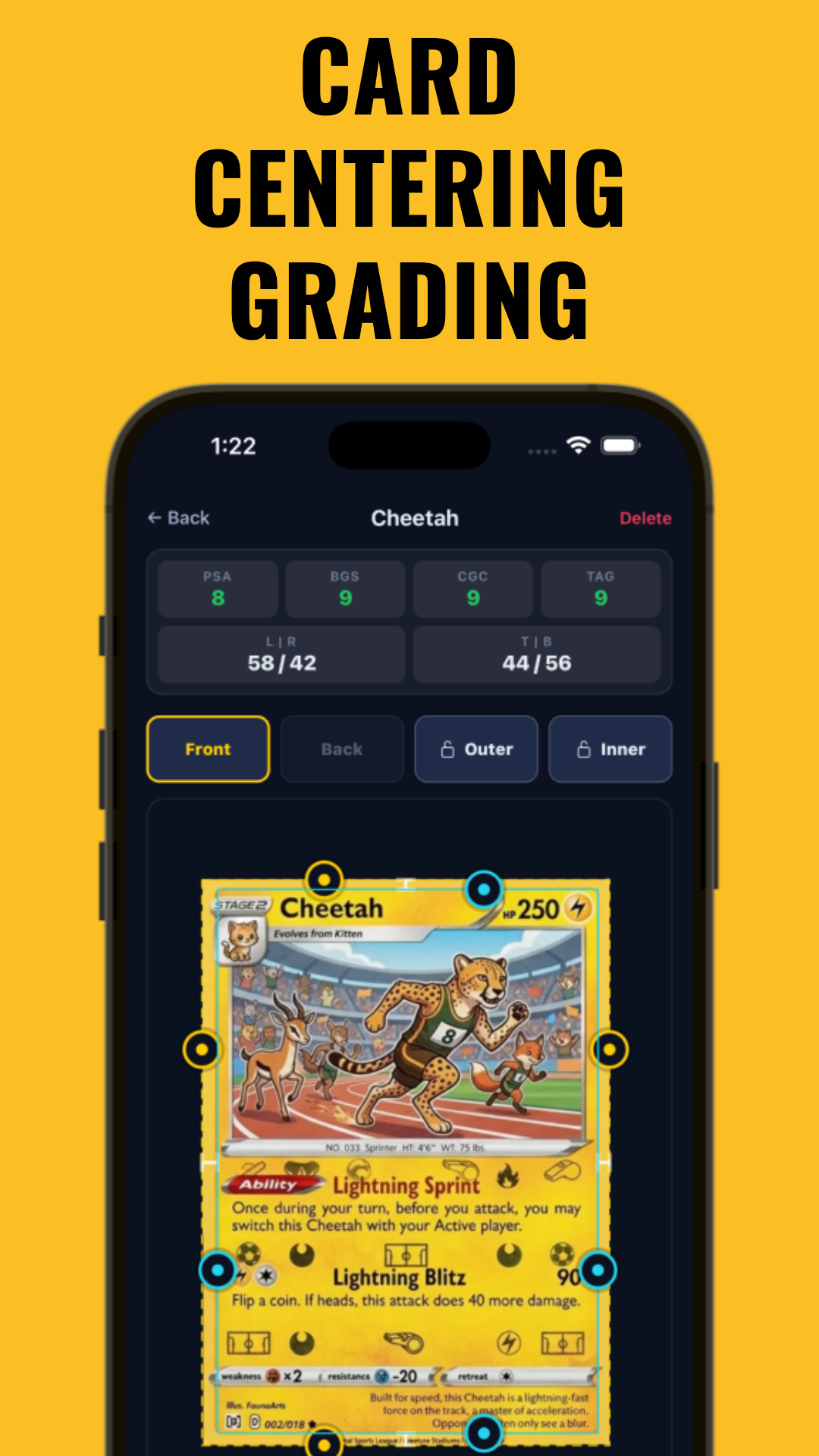
An estimate is not a guarantee, but it can screen out obvious non-starters and save you submission fees.
Section 7: Sealed Boxes and Spotting a Valuable Card
Sealed hobby box value
Sealed boxes of this product attract collectors because the set is hit-driven and the rookie class is iconic. Value depends on the original configuration (how many packs and cards per box, and the guaranteed hit types), the condition of the factory wrap, and the current market for the chase cards inside.
Be cautious. Resealed boxes are a real risk in the vintage-modern market, so buy from reputable sellers, check for tight factory wrap and original seals, and compare recent sold listings rather than asking prices. Opening a box is a gamble: the value of the box is the market's price for that chance, which can differ from the sum of what you pull.
How to tell if your card is rare or valuable
- Check the card number. Higher-numbered cards, like #127, are usually the numbered rookies rather than base cards.
- Look for a serial number stamped on the card and note its position in the run.
- Identify the player. The 2003 rookie class and Kobe Bryant lead demand.
- Look for an autograph or patch. These almost always outrank plain base cards.
- Inspect condition for centering, corners, edges, surface and signature quality.
- Look up sold comps for your exact card, grader and grade.
Track it over time
Once you know what you own, track it. Midpoint's portfolio tracking shows your collection's value over time, and if your cards are insured, see how card grade impacts insurance value.
Conclusion
The value of the 2003-04 Ultimate Collection basketball set is concentrated at the top. The LeBron James rookie autograph #127 anchors the market, with Kobe Bryant limiteds and the Wade, Anthony and Bosh rookie autographs forming the next tier. Base cards sit well below, and condition sensitivity is high across the board.
The gem premium is the main lever. A top PSA or BGS grade can multiply a card's value, but thick, foil-heavy, patch-window cards are difficult to grade high. Inspect carefully, measure centering, estimate realistic outcomes and compare current sold prices before you submit.
Ready to check your cards? Look up values, estimate grades and measure centering for free with Midpoint on iOS and Android.
FAQ
Q: What is the most valuable 2003 Upper Deck Ultimate Collection basketball card?
A: The LeBron James rookie autograph #127 is generally regarded as the most valuable card in the set, thanks to its combination of rookie status, autograph, serial numbering and player demand. Kobe Bryant limited cards and the other top rookie autographs follow.
Q: How much is a 2003 Ultimate Collection LeBron James autograph card worth?
A: It varies widely by serial number, autograph quality, grader and grade. Because prices move with each sale, check recent sold listings for your exact grade, or look up the card in Midpoint for current raw and graded figures.
Q: Are 2003 Ultimate Collection basketball cards rookie cards?
A: The numbered rookie portion of the checklist, including LeBron James, Carmelo Anthony, Dwyane Wade and Chris Bosh, consists of true rookie cards. Veterans such as Kobe Bryant are not rookies, so their value comes from star power and scarcity instead.
Q: How much is a Kobe Bryant 2003 Ultimate Collection card worth?
A: It depends on the version and grade. His limited cards are worth far more than his base card, and a high PSA or BGS grade adds a significant premium. Confirm which version you have, then compare sold comps at the same grade.
Q: What is the value of a sealed 2003 Ultimate Collection basketball hobby box?
A: Value depends on the original box configuration, the condition of the factory seal, and current prices for the chase cards inside. Watch for resealed boxes and use recent sold listings rather than asking prices to gauge the market.
Q: How can I tell if my 2003 Ultimate Collection basketball card is rare or valuable?
A: Check the card number, look for a serial number, an autograph or a game-used patch, and identify the player. Then inspect centering, corners, edges and surface, and compare sold prices for the exact grade.
Free to start
Try the Midpoint app
Grade any card from a photo, see its raw and PSA 10 value, and track what your collection is worth — free.
Get it on iPhoneGet it on Android