
2008 Topps Chrome PSA 9 vs PSA 10 Value: Is the Gap Real?
2008 Topps Chrome PSA 9 vs PSA 10 value explained: why the price gap varies card by card, where centering decides it, and when a PSA 9 is the smarter buy.

Estimated reading time: 9 min
Key Takeaways
- The 2008 Topps Chrome PSA 9 vs PSA 10 value gap has no fixed multiplier. It changes card by card, so work it out from each card's own PSA 9 and PSA 10 prices.
- The biggest 9-to-10 jumps tend to show up on high-demand rookies and key names, where collectors pay up for a flawless slab and centering often decides the grade.
- Bottom line: buy the PSA 9 when the premium is steep relative to the card's upside. Pay for the PSA 10 only on cards where the gap is modest or where you want the top-pop trophy copy.
- Only compare current sold prices, not asking prices, and check the PSA population before you pay a premium or submit a raw card.
This guide compares 2008 Topps Chrome PSA 9 vs PSA 10 value: what a Mint 9 is worth next to a Gem Mint 10, why the PSA 9 vs PSA 10 price difference for 2008 Topps Chrome is so uneven, and when a 9 is the smarter buy. The quick answer: the 2008 Topps Chrome PSA 10 premium is real, but it is not one number, and on many cards it is not worth paying.
The exact PSA 9 and PSA 10 values for individual cards are in the price table on this page, dated as of 2026-09-04. This article explains how to read them.
Card values — live data from Midpoint's card database, as of 2026-09-04. Prices move; Midpoint refreshes these daily.
| Card | Raw | PSA 10 | Gem premium | |
|---|---|---|---|---|
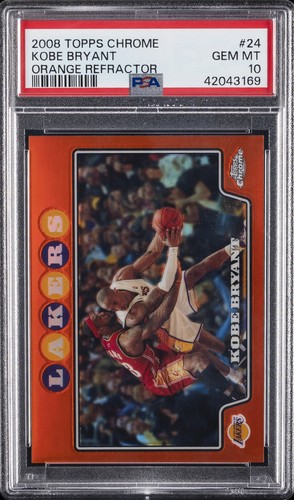 |
Kobe Bryant [Orange Refractor] #24 2008 Topps Chrome |
$2,500 | $15,984 | 6.4× |
 |
Kobe Bryant [Xfractor] #24 2008 Topps Chrome |
$6,500 | $13,300 | 2.1× |
 |
Kobe Bryant [Refractor] #24 2008 Topps Chrome |
$1,250 | $11,308 | 9.1× |
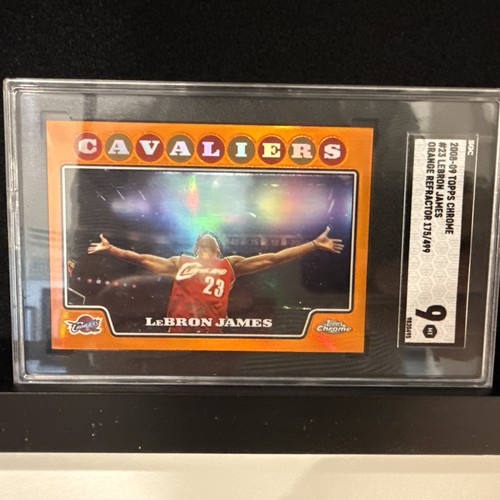 |
LeBron James [Orange Refractor] #23 2008 Topps Chrome |
$1,799 | $10,750 | 6× |
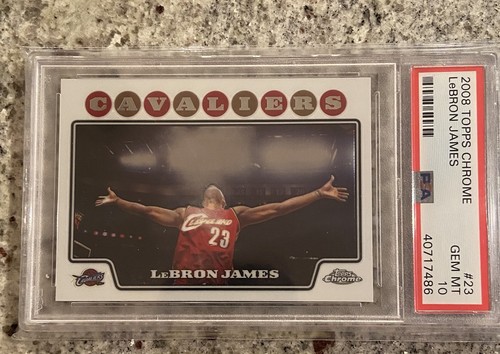 |
LeBron James [Xfractor] #23 2008 Topps Chrome |
$1,440 | $9,510 | 6.6× |
 |
LeBron James [Refractor] #23 2008 Topps Chrome |
$1,215 | $6,650 | 5.5× |
 |
Russell Westbrook [Gold Refractor] #184 2008 Topps Chrome |
$1,463 | $6,251 | 4.3× |
 |
Ray Allen [Gold Refractor] #20 2008 Topps Chrome |
$62.00 | $3,383 | 54.6× |
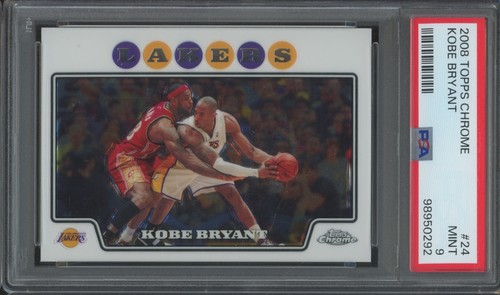 |
Kobe Bryant #24 2008 Topps Chrome |
$552.28 | $2,868 | 5.2× |
 |
LeBron James #23 2008 Topps Chrome |
$440.70 | $2,750 | 6.2× |
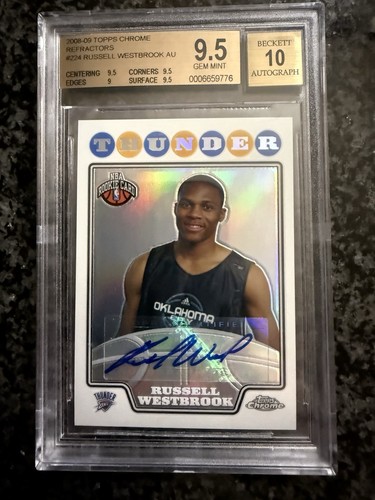 |
Russell Westbrook [Autograph Refractor] #224 2008 Topps Chrome |
$581.29 | $2,300 | 4× |
 |
Steve Nash [Gold Refractor] #13 2008 Topps Chrome |
$555.89 | $2,223 | 4× |
Look up any card's current raw and graded value in Midpoint — and get an estimated grade before you pay to submit.
Quick Comparison: PSA 9 vs PSA 10 for 2008 Topps Chrome
| Dimension | PSA 9 (Mint) | PSA 10 (Gem Mint) |
|---|---|---|
| Price | Lower entry cost, usually the value-friendly option | Higher price, with a premium that varies widely by card |
| Centering (front, per PSA's published standards) | About 60/40 or better | About 55/45 or better |
| Centering (back) | About 90/10 or better | About 75/25 or better |
| Surface | May show one minor flaw, such as a faint print line or light scratch | Essentially flawless under normal inspection |
| Corners and edges | Sharp, with very minor wear tolerated | Sharp and clean, with no visible wear |
| Scarcity | Typically more copies graded | Typically fewer copies, depending on the card's population |
| Liquidity | More sales, easier to price | Fewer sales on some cards, so prices can swing |
| Best for | Collectors and flippers who want value per dollar | Set builders, registry collectors, and high-conviction investors |
Check PSA's current grading standards before you rely on the centering figures, since PSA can update its published guidance.
How Big Is the PSA 10 Premium on 2008 Topps Chrome?
There is no universal multiplier. A PSA 10 is not always double a PSA 9, or triple, or any other set ratio. The gap depends on the specific card, its demand, and how many gem copies exist.
To measure the gap yourself, use the table on this page and do two simple calculations for any card:
- Dollar gap: PSA 10 value minus PSA 9 value. This is what you pay extra for the higher grade.
- Ratio: PSA 10 value divided by PSA 9 value. This shows how steep the premium is relative to the card.
A card with a large dollar gap but a small ratio may still be a fair buy at 10. A card with a small dollar gap but a big ratio is often a cheap card where the premium barely matters in absolute terms. Look at both before you decide.
Guide values vs completed sales vs asking prices
Not all price numbers are equal. For 2008 Topps Chrome grading value, rank your sources like this:
- Recent completed sales: the most reliable evidence of what buyers actually paid.
- Price guide estimates: useful as a benchmark, but they can lag the market or smooth over thin sales.
- Unsold asking prices: the least reliable. They show what sellers hope for, not what the market pays.
The values in this article's table are as of 2026-09-04. Treat them as a starting point and confirm against fresh sold listings before you buy or sell. Fees, shipping, and the selling venue also change what you actually net, as does market timing around player news, playoff runs, and Hall of Fame buzz.
Which 2008 Topps Chrome Cards Have the Biggest 9-to-10 Jump?
The widest gaps usually appear on cards that are both in demand and hard to grade as a 10. Collectors chase the top slab on marquee names, so the 10 gets bid up while the 9 trades more like a normal collectible.
The cards most often discussed in this set include:
- LeBron James: the headline name in basketball, with heavy collector demand across grades.
- Tom Brady: one of the most collected football names, and a consistent focus for gem-grade buyers.
- Matt Ryan: a key football rookie name from this class.
- Joey Votto: a well-known baseball name that draws set builders.
Look these names up in the table on this page and compare each card's 9 and 10 values using the dollar gap and ratio above. Don't assume the most famous name has the biggest ratio. Sometimes a lesser name with a thin gem population shows a steeper jump.
Base cards vs refractors, parallels, and numbered cards
The type of card changes the math:
- Base cards: usually the most graded, so gem copies are easier to find and the premium may be smaller.
- Refractors and colored parallels: the shiny surface shows scratches and print lines more easily, which can make a 10 tougher and the premium bigger.
- Short prints: fewer exist, so even a 9 can carry strong value.
- Autographs and serial-numbered cards: low print runs mean thin sales data. One or two sales can move the price, so the 9-to-10 gap can look erratic.
A refractor in PSA 9 can be worth more than a base card in PSA 10 on the same player, because the card type often matters more than the grade. Confirm with the table and recent sales rather than assuming.
Identify the exact card first
Before you compare any 9 to any 10, make sure you are looking at the same card. Check:
- The sport (basketball, football, baseball) and the card number on the back
- Whether it carries a rookie designation
- The refractor type or parallel color
- Serial numbering stamped on the card, if any
- Autograph status
A mismatch here is the most common reason people think they found a bargain or a rip-off.
PSA 9 vs PSA 10: What Separates Mint from Gem Mint
Since the price jump comes from one grade step, it helps to know what that step looks like. The difference is usually small to the naked eye and decisive under a loupe.
- Centering: PSA's published standards allow a Gem Mint 10 about 55/45 on the front and 75/25 on the back, while a Mint 9 allows about 60/40 front and 90/10 back. A card that is just slightly off-center can drop from a 10 to a 9 on this alone.
- Surface: Chrome stock shows fine scratches and print lines. A single faint line can be the difference between grades.
- Corners: a 10 needs sharp corners with no visible fraying or whitening. A 9 tolerates very minor imperfection.
- Edges: chips and roughness on the border edge are easy to see on glossy Chrome and can cap a card at 9.
This is why centering can decide so much of the 2008 Topps Chrome PSA 10 premium. If a card is cleanly centered, it has a shot at a 10. If it is not, no amount of clean surface will rescue it. For a deeper look, see how centering impacts card value and the breakdown of grading scale differences by company.
Population Reports and Gem Mint Scarcity
Price follows scarcity, and the PSA population report shows it. For any 2008 Topps Chrome card, compare how many copies PSA has graded at 9 against how many at 10.
- Low 10 population: a thin gem count supports a bigger premium, since buyers compete for few slabs.
- High 10 population: many gems mean supply can meet demand, which keeps the premium in check.
- Rising submissions: if more copies keep getting graded, a premium based on scarcity can erode over time.
A card with a low 10 population can look like a bargain at a 9 and a trap at a 10, or the reverse. Population alone does not set the price, since demand matters just as much, but it explains much of why the gap varies. If you are weighing a scarce card, read the guide to grading low population cards.
How to check recent sales and population
- Identify the exact card, including the card number and any parallel.
- Open PSA's population report and find that card's 9 and 10 counts.
- Search completed (sold) listings for both grades and ignore asking prices.
- Compare against the table on this page, dated as of 2026-09-04.
- Subtract fees and shipping to see your real net.
Is a PSA 9 Worth It for 2008 Topps Chrome?
For many collectors, yes. A PSA 9 is a high-quality card at a lower cost, and on cards with a steep 10 premium it is often the better value. The question is whether the extra you pay for a 10 buys you extra return.
A PSA 9 makes sense when:
- The ratio between the 10 and the 9 is steep and the dollar gap is large.
- You are buying to hold or display rather than to chase the top-pop slab.
- The 9 trades more often, so it is easier to resell.
- You would otherwise be paying a premium on a card with a growing 10 population.
A PSA 10 makes sense when:
- The dollar gap is small relative to your budget.
- The card is a key rookie or marquee name where gem copies hold demand.
- You are building a registry set or want the best copy.
Should you submit a raw card?
Grading costs money, and the 2008 Topps Chrome PSA 10 premium only pays off if your card actually grades a 10. Before you submit, measure centering and inspect corners, edges, and surface. If centering is already outside the 10 range, a 9 is the realistic outcome at best, so compare the 9 value to your total cost. A pre-grade check helps here: see how to pre-grade your card.
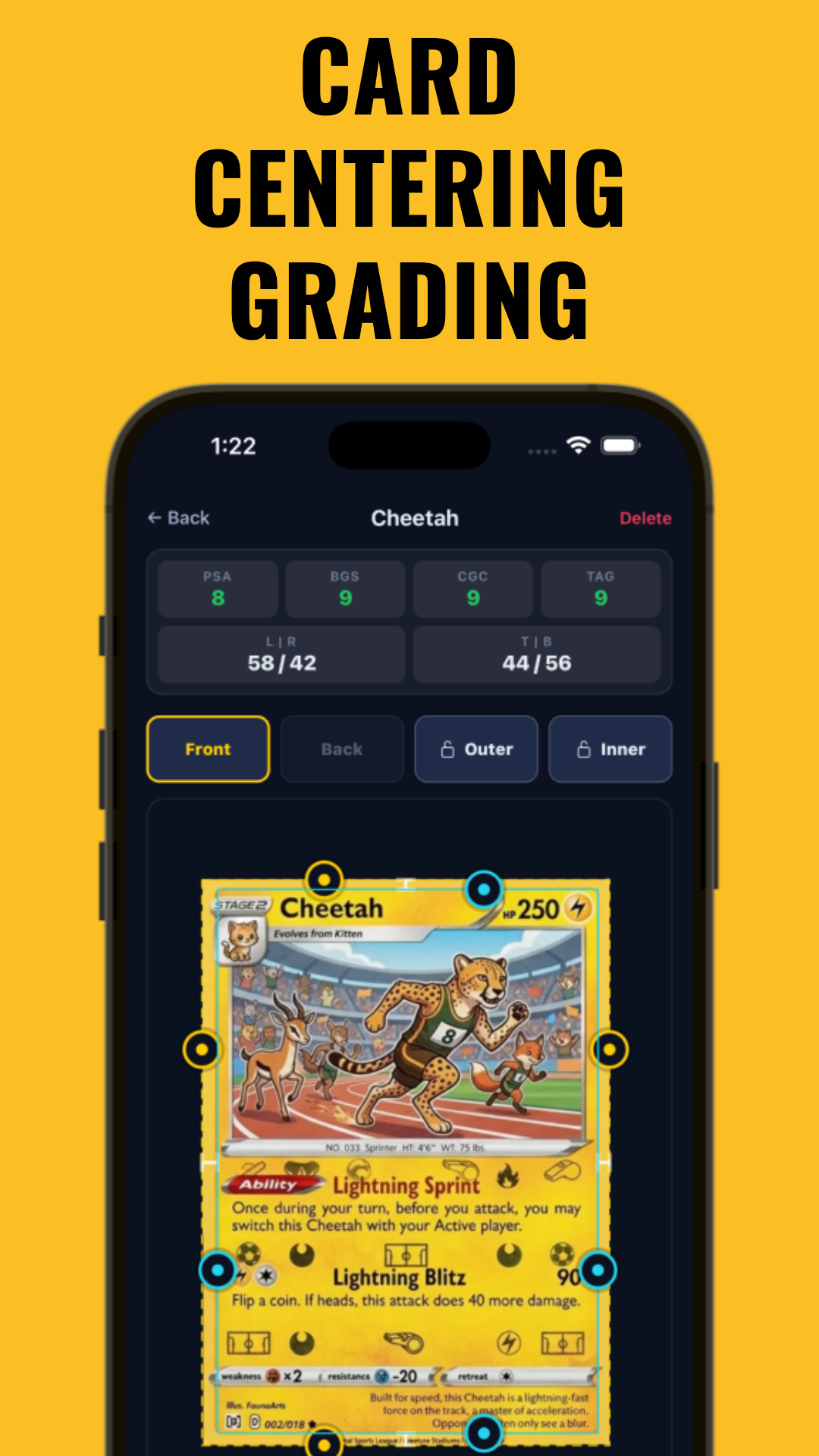
Midpoint lets you measure centering and get an estimated PSA, BGS, CGC, and TAG grade before you pay to submit, so you can see whether you are aiming at a 9 or a 10.
Which Should You Choose?
- Budget collector: choose the PSA 9. You get a sharp, slabbed card without paying a gem premium.
- Investor in key names: consider the PSA 10 on names like LeBron James or Tom Brady only if the premium is reasonable against recent sold prices and the 10 population is not ballooning.
- Set builder: mix grades. Use 9s for most of the set and spend on 10s only for the cards that matter most to you.
- Refractor and parallel hunter: weigh the card type first. A scarcer parallel in 9 can beat a base card in 10.
- Raw card owner deciding whether to grade: measure centering first. If it is clearly outside gem range, expect a 9 at best and run the numbers on that.
- Flipper: favor the grade with more completed sales, which is usually the 9, since it is easier to price and exit.
Whatever you choose, store it well so condition holds. See how to store valuable cards.
Bottom line: don't pay a PSA 10 premium on autopilot. Work out the dollar gap and ratio for the specific card, confirm it with sold prices, and take the 9 when the jump is steep.
FAQ
How much is a 2008 Topps Chrome PSA 9 worth?
It depends on the card. A base card of a lesser player is worth far less than a key rookie, refractor, or numbered card. Check the price table on this page (as of 2026-09-04) and confirm with recent sold listings for the exact card number and variation.
How much is a 2008 Topps Chrome PSA 10 worth?
Again, it varies by card. A PSA 10 carries a premium over the 9, but the size of that premium depends on demand, variation, and how many gem copies exist. Use the table on this page and verify with completed sales.
How much more is a PSA 10 worth than a PSA 9 for 2008 Topps Chrome?
There is no fixed multiplier. Calculate the dollar gap and the ratio for each card from its own 9 and 10 values. Cards with low gem populations and strong demand tend to show bigger jumps.
Which 2008 Topps Chrome cards are worth the most in PSA 9 or PSA 10?
Key names such as LeBron James, Tom Brady, Matt Ryan, and Joey Votto draw strong interest, along with refractors, short prints, autographs, and serial-numbered cards. Look each one up in the table on this page for its PSA 9 and PSA 10 values.
Is a 2008 Topps Chrome refractor PSA 9 worth more than a base card PSA 10?
Often it can be, because card type usually matters more than a one-step grade difference. Verify by comparing both values in the table and in recent sold listings for the same player.
How do I check recent sales and PSA population for a 2008 Topps Chrome card?
Identify the exact card by sport, card number, rookie status, parallel, and serial numbering. Then look up PSA's population report for the 9 and 10 counts and search completed sales for both grades. Ignore unsold asking prices, and use a card price lookup resource to compare raw and graded values.
Free to start
Try the Midpoint app
Grade any card from a photo, see its raw and PSA 10 value, and track what your collection is worth — free.
Get it on iPhoneGet it on Android


