2025 Panini Absolute Kaboom Vertical Football Cards Value
A value guide to 2025 Panini Absolute Kaboom vertical football cards: raw vs PSA 10 gaps, parallels, which cards are worth grading, and how to price them.

Estimated reading time: 11 min
Key Takeaways
- The 2025 Panini Absolute Kaboom vertical football cards value depends on four things: the player, the parallel (for example a base-level vertical, a numbered Gold, or a one-of-one), the grade, and the most recent completed sale.
- The real money is in the gem-premium gap, the difference between a raw card, a PSA 9 and a PSA 10. Submit only when that gap clearly beats grading fees and the risk of a miss.
- Use sold comps, not asking prices. Thin markets like numbered Kaboom parallels can swing sharply on a single sale.
- Centering and surface decide whether a Kaboom reaches a 10. Measure both before you pay to submit.
- Our prices and sale dates are pulled live in the table in this post and in Midpoint, and are stated as of 2026-09-04. This article deliberately avoids quoting numbers that aren't in that dataset.
Card values — live data from Midpoint's card database, as of 2026-09-04. Prices move; Midpoint refreshes these daily.
| Card | Raw | PSA 10 | Gem premium | |
|---|---|---|---|---|
 |
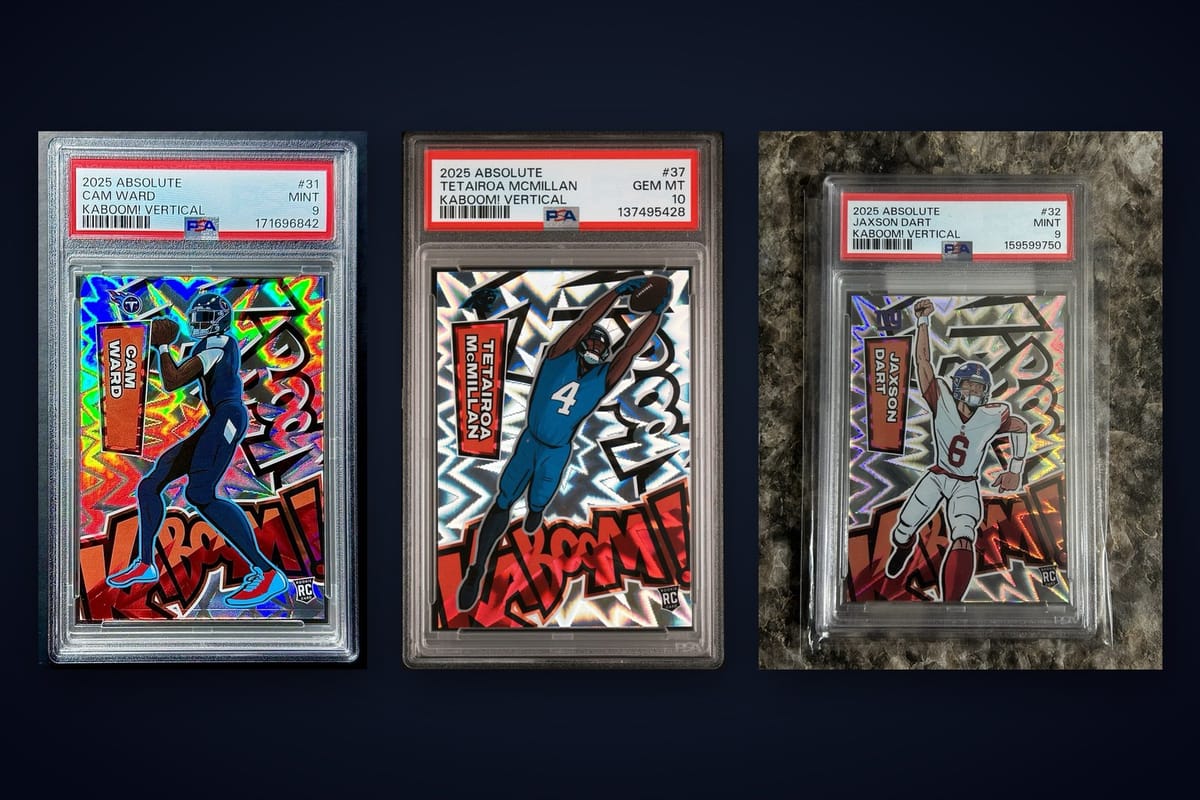
Cam Ward #31 2025 Panini Absolute Kaboom Vertical |
$3,059 | $12,362 | 4× |
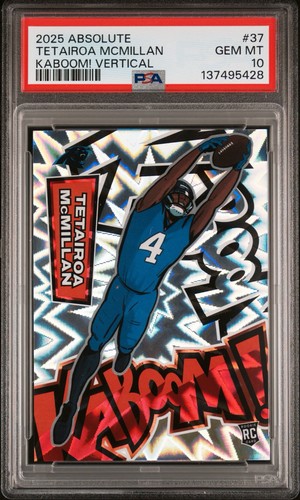 |
Tetairoa McMillan #37 2025 Panini Absolute Kaboom Vertical |
$1,300 | $10,799 | 8.3× |
 |
Jaxson Dart #32 2025 Panini Absolute Kaboom Vertical |
$4,525 | $10,625 | 2.4× |
 |
Shedeur Sanders #33 2025 Panini Absolute Kaboom Vertical |
$1,880 | $7,432 | 4× |
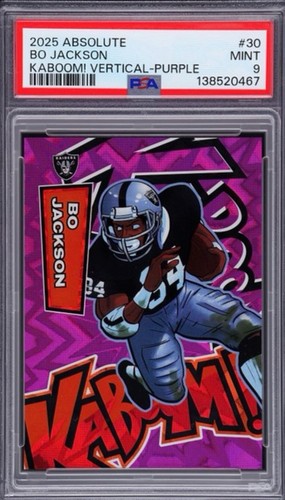 |
Bo Jackson #30 2025 Panini Absolute Kaboom Vertical |
$2,024 | $6,648 | 3.3× |
 |
Odell Beckham Jr. #26 2025 Panini Absolute Kaboom Vertical |
$1,625 | $6,611 | 4.1× |
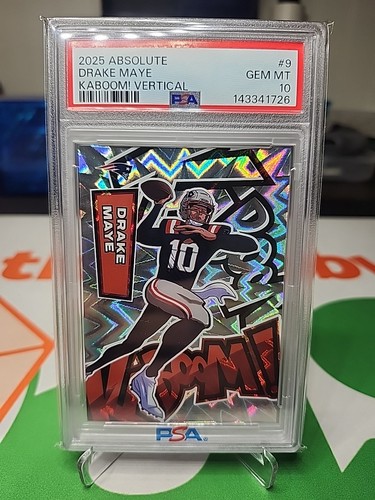 |
Drake Maye #9 2025 Panini Absolute Kaboom Vertical |
$2,801 | $6,500 | 2.3× |
 |
Dan Marino #13 2025 Panini Absolute Kaboom Vertical |
$1,616 | $6,412 | 4× |
 |
Tyler Shough #34 2025 Panini Absolute Kaboom Vertical |
$2,292 | $6,300 | 2.8× |
 |
Ashton Jeanty #35 2025 Panini Absolute Kaboom Vertical |
$1,516 | $6,154 | 4.1× |
 |
Puka Nacua #28 2025 Panini Absolute Kaboom Vertical |
$1,500 | $6,093 | 4.1× |
 |
J.J. McCarthy [Purple] #2 2025 Panini Absolute Kaboom Vertical |
— | $5,185 | — |
Look up any card's current raw and graded value in Midpoint — and get an estimated grade before you pay to submit.
Table of Contents
- Section 1: What Drives 2025 Panini Absolute Kaboom Vertical Football Cards Value
- Section 2: Vertical Kaboom Checklist and Parallels Explained
- Section 3: Most Valuable 2025 Panini Absolute Kaboom Vertical Cards
- Section 4: Price Guide Method: Completed Sales vs Asking Prices
- Section 5: PSA 10 Value and the Gem-Premium Gap
- Section 6: Which Vertical Kaboom Cards Are Worth Grading
- Section 7: Authenticity, Selling Tips and Fees
- Conclusion
- FAQ
Section 1: What Drives 2025 Panini Absolute Kaboom Vertical Football Cards Value
Kaboom is one of the most recognizable inserts in modern football cards. The comic-book explosion art and the scarcity of the cards keep collectors chasing them. The 2025 Panini Absolute Kaboom vertical football cards value comes from that visual appeal combined with limited supply and heavy demand for the best-known players.
Before looking at any single card, it helps to understand the levers that move price.
The four value levers
- Player: Star quarterbacks and headline rookies command the strongest demand. Role players and deep-bench veterans trade at a fraction of that.
- Parallel: A base-level vertical Kaboom, a Gold numbered to 10 and a one-of-one are completely different markets.
- Grade: A raw card, a PSA 9 and a PSA 10 can sit at very different price levels. See Section 5.
- Timing: Rookie hype, injuries, playoff runs and trades can move prices within days.
Why a price guide needs a date
A card price is a snapshot. A rookie who has a monster Sunday can reprice his cards quickly, and a quiet week can do the opposite. That is why every figure in the data table in this post is tied to a date: as of 2026-09-04. When you read any 2025 Panini Absolute Kaboom vertical price guide, including ours, check the date first and the number second.
What this guide does and doesn't do
We use only the figures in Midpoint's database, so the prose below explains how to interpret prices rather than repeating numbers that could go stale. If a number isn't in the table, we don't state it. For live raw and graded values across 250,000+ cards, you can look any Kaboom up in Midpoint.
Section 2: Vertical Kaboom Checklist and Parallels Explained
You can't value a card you can't identify. The vertical Kaboom subset is a compact checklist, mixing rookies and established veterans. Some sources cite it at around 44 cards, but always confirm the card count, card numbers and player names against Panini's official checklist before you buy, since checklist details can differ between sources.
Rookies vs veterans on the checklist
The checklist splits into two groups, and they price differently.
- Rookies: Prices ride on draft position, early playing time and highlight plays. They are often the most volatile and frequently the most expensive.
- Star veterans, especially quarterbacks: Demand is generally steadier, and prices tend to move less on any one week of games.
- Everyone else: Typically the best raw-card bargains, but also the weakest candidates for grading because the PSA 10 premium may not cover the costs.
Parallels and scarcity
Verify the exact parallel names and print runs against Panini's checklist. The three tiers below are the ones this guide tracks for the vertical set:
- Base-level vertical (Purple in our dataset): Generally the most available version of the vertical Kaboom and the best place to start if you want a card without paying for scarcity.
- Gold, numbered to 10: A true short print. With only ten copies, a handful of sales can define the market, so one sale is rarely a reliable price.
- Green, one-of-one: A single copy exists per player. There is no true comp, so value is whatever a determined buyer will pay.
Vertical vs horizontal Kaboom
Collectors often ask whether the vertical or horizontal layout is worth more. There is no universal rule. Compare the same player, the same parallel and the same grade across both layouts, and let completed sales decide. Never compare a vertical PSA 10 to a horizontal raw card; the grade gap will mislead you.
Scarcity cuts both ways. A rarer card has fewer comps, which makes it harder to price confidently and harder to sell quickly. For deeper thinking on thin markets, see our guide to grading low population cards.
Section 3: Most Valuable 2025 Panini Absolute Kaboom Vertical Cards
The most valuable 2025 Panini Absolute Kaboom vertical cards usually share the same profile: a marquee player, a scarce parallel and a high grade. Check the data table in this post for the current ranking by player, as of 2026-09-04. The framework below explains why the top of the list tends to look the way it does.
Why star quarterbacks and top rookies lead
Quarterbacks are among the most collected positions in football cards, and a deep pool of buyers chases them. Headline rookies add a speculation premium: collectors are buying the future career, not the current stat line.
That premium is also the risk. A rookie priced on hype can fall as quickly as it rose if the player struggles, gets benched or gets hurt. Veterans with established résumés often hold value better in a down week.
How to read the top of the table
- Look at the spread between raw and graded. A big gap suggests the market pays heavily for gem copies. A small gap suggests grading adds little.
- Look at sale recency. A price from months ago may not reflect today's market.
- Look at the parallel. Make sure two cards you compare are the same variant.
The one-of-one trap
A Green 1/1 can look like the most valuable card in the set on paper. In practice it may rarely trade, so a listed price may never have been tested by a real buyer. Treat one-of-one asking prices as opinions, not market values. The numbered Gold /10 parallel is a more realistic benchmark for scarcity-driven pricing because more copies exist and more sales are possible.
The table that follows this section shows each entry with its raw and graded figures. Use it as a starting point, then pull the latest sales before you buy or sell.
Section 4: Price Guide Method: Completed Sales vs Asking Prices
Any 2025 Panini Absolute Kaboom vertical price guide is only as good as the method behind it. The most common mistake collectors make is treating a listing price as a market price.
Why completed sales win
An asking price is what a seller hopes to get. A completed sale is what a buyer actually paid. For cards with thin trading, such as numbered Kaboom parallels, the gap between the two can be wide.
- Completed sales: Real transactions with a date, a grade and a price. Your primary source.
- Active listings: Useful for seeing competition and current asking levels, but not proof of value.
- Offers accepted (best offer): The listed price may not show the real sale price, so look for the accepted amount where it's visible.
How to build a reliable comp
Follow this simple process:
- Match the exact card number, player and parallel.
- Match the grade and grader (a PSA 10 is not a BGS 10 is not an SGC 10).
- Collect the three to five most recent sales, and note the dates.
- Throw out obvious outliers such as shill-looking sales, damaged listings or auctions that ended oddly.
- Check whether prices are trending up, flat or down before deciding.
Reading trends, not just points
One sale is a point. Three sales over a few weeks make a trend. If the last three sales stepped up each time, the market may be heating up; if they stepped down, waiting may pay. For rookies, line these moves up with the news cycle: games, injuries and depth-chart changes.
All the figures in this article's table are tied to 2026-09-04. If you are reading this long after that date, treat them as a historical reference and refresh your comps in Midpoint or on a sold-listings search before acting.
Section 5: PSA 10 Value and the Gem-Premium Gap
The 2025 Panini Absolute Kaboom vertical PSA 10 value is the number most collectors want first. It is also the number most likely to mislead if you read it alone. What matters is the gap between grades.
What the gem-premium gap is
The gem-premium gap is the difference in price between a gem-mint copy (PSA 10) and the next grade down (PSA 9), as well as the gap between a PSA 9 and a raw card. The wider the gap, the more the market rewards perfection.
- Wide gap: Grading a clean copy can be very profitable, but a miss costs you.
- Narrow gap: You can often skip grading and sell raw.
Comparing the major graders
PSA, BGS, CGC and SGC all grade differently, and their top grades are not equivalent. A BGS Pristine 10 or a CGC Pristine is a very different target from a standard 10. If you want to understand why the same card can price differently across slabs, read our breakdown of grading scale differences by company.
For football, PSA slabs usually draw the deepest buyer pool, which is why most collectors benchmark value against PSA 10 comps. Other graders can be a reasonable alternative if the card sells well in their holders.
The break-even test
Use this formula before submitting:
- Expected graded value = (chance of a 10 × PSA 10 price) + (chance of a 9 × PSA 9 price) + (chance of a lower grade × that grade's price).
- Net gain = expected graded value − raw value − grading fee (varies by grader and service level) − shipping and selling costs.
If the net gain is thin or negative, don't submit. Pull the raw and graded prices from the table above for your card and plug them in. Your honest estimate of the chance of a 10 is the piece that most determines success, and that comes from careful inspection of the card.
Section 6: Which Vertical Kaboom Cards Are Worth Grading
The 2025 Panini Absolute Kaboom vertical cards worth grading are the ones where a high grade multiplies the value and your copy has a real shot at it. Kaboom cards are visually busy, which can hide some flaws and expose others, so inspect carefully.
What graders look at
- Centering: Border balance front and back. Even small shifts can cap a grade, and PSA's 10 standard is tight on the front. See how centering impacts card value.
- Corners: Look for whitening or softness at all four corners.
- Edges: Chipping is common on dark or colored borders.
- Surface: Scratches, print lines, fingerprints, dimples and chrome-style finish flaws. Glossy modern stock shows defects under angled light.
- Print quality: Registration problems, dots or color fade can hold back an otherwise clean card.
Grade-worthiness checklist
- Is it a star, a top rookie or a scarce parallel? If not, grading rarely pays.
- Is the PSA 10 vs raw gap big enough in the table?
- Does the card measure well on centering?
- Is the surface clean under a bright light at several angles?
- Are the corners and edges sharp?
If you can answer yes to most of these, grading is worth a closer look. If not, sell raw or keep it.
Pre-grade before you pay
The cheapest mistake to avoid is a submission that returns a 7 or 8. Pre-grading narrows the odds. Midpoint measures centering to the millimeter and returns estimated PSA, BGS, CGC and TAG grades based on centering, corners, edges and surface. You can also follow our step-by-step pre-grading guide to do it yourself.

Section 7: Authenticity, Selling Tips and Fees
Valuable cards attract fakes and alterations. Protect yourself before you pay, and plan the sale before you list.
Spotting counterfeit or altered Kaboom cards
- Compare to known-good copies. Check the card number, font, foil pattern and logo placement against a verified image of the same card.
- Check the card stock. Fakes often feel too thin, too flexible or too glossy.
- Inspect the print. Blurry text, pixelation or off colors are red flags.
- Verify numbering on parallels. A Gold /10 should show its serial number clearly and consistently. Be cautious of numbering that looks stamped or misaligned.
- Beware trimmed or recolored cards. Altered edges or touched-up color can turn a nice-looking card into an ungradable one.
- Buy graded or from trusted sellers when the price is high, and verify the slab's certification number on the grader's website.
Raw or graded: how to choose when selling
Sell raw when the gem-premium gap is small, your copy has visible flaws or you want a quick sale. Grade first when the premium is large and your copy measures and inspects well. Remember that grading takes time, and prices can move while your card is in the queue.
Timing and fees
- Timing: Rookies often peak on hype and cool when attention shifts. Selling into strong games or playoff runs can help, while selling into an injury news cycle can hurt.
- Marketplace fees: Platforms charge selling fees, payment processing fees and sometimes promotional listing fees. Check the current fee schedule on your platform and subtract it from your expected proceeds.
- Shipping and insurance: Factor them in, especially for high-value slabs. See our guide on how card grade affects insurance value.
- Storage: Protect cards while you wait for the right moment to sell. Our storage guide covers the basics.
Track what you hold in Midpoint's portfolio view to see your collection's value over time and decide when to sell with data instead of guesswork.
Conclusion
The 2025 Panini Absolute Kaboom vertical football cards value comes down to a few repeatable checks. Identify the exact card and parallel. Compare it to completed sales with matching grades. Study the gap between raw, PSA 9 and PSA 10. Only then decide whether to grade, hold or sell.
The most valuable vertical Kaboom cards pair star power and scarcity, but that is also where prices are most volatile and comps are thinnest. Treat any single number, including those in our table, as a dated snapshot (as of 2026-09-04), and refresh it before you act.
When you're ready to find out which of your Kabooms deserve a slab, measure centering and estimate grades with Midpoint before you pay grading fees. It's free on iOS and Android, and you can also try the free centering calculator for a quick check.
FAQ
Q: How much is a 2025 Panini Absolute Kaboom vertical card worth?
A: It depends on the player, parallel and grade. Raw and graded values for specific entries are in the data table in this post, as of 2026-09-04. Check recent completed sales for your exact card before buying or selling, because prices move with player performance and market demand.
Q: What is the most valuable 2025 Panini Absolute Kaboom vertical card?
A: Generally the most valuable cards combine a star quarterback or top rookie with a scarce parallel and a high grade. Rank them using the table's current figures. Treat one-of-one Green cards cautiously, since they rarely trade and their asking prices may not reflect real sales.
Q: Are vertical or horizontal Kaboom cards worth more?
A: There is no universal answer. Compare the same player, parallel and grade across both layouts using completed sales. Mixing grades or parallels in the comparison will give a misleading result.
Q: How much is a 2025 Absolute Kaboom Gold numbered to 10 worth?
A: Gold /10 cards are scarce and trade infrequently, so a single sale can reset the market. Look at the latest completed sales for that exact player and grade, and note the sale date. Don't rely on asking prices alone.
Q: What is the value of a 2025 Panini Absolute Kaboom vertical card in PSA 10?
A: PSA 10 values vary widely by player and parallel. Check the table for the PSA 10 figure for your card, then compare it to the PSA 9 and raw prices. The gap between those grades tells you whether grading is likely to pay off after fees.
Q: How many 2025 Panini Absolute Kaboom vertical cards are there?
A: Some sources cite the vertical checklist at around 44 cards, mixing rookies and veterans. Confirm the count, card numbers and players against Panini's official checklist, as sources can differ.
Free to start
Try the Midpoint app
Grade any card from a photo, see its raw and PSA 10 value, and track what your collection is worth — free.
Get it on iPhoneGet it on Android