
Barry Sanders Cards Worth Money: Top Rookies to Grade
Barry Sanders cards worth money: which rookies and rare parallels lead, raw vs PSA 10 value logic, and which are worth grading before you submit.

Estimated reading time: 12 min
Key Takeaways
- Barry Sanders cards worth money fall into two groups: the 1989 rookies that most collectors chase (Score #257, Topps Traded #83T, Pro Set #494, Police Oscar Mayer #11) and the scarce, high-end cards (autographs, low-numbered parallels, one-of-ones, 1998 Metal Universe Gem Masters).
- The gap between a raw card and a PSA 10 is driven by condition, so centering, corners, edges, and surface decide whether grading pays off.
- Always price the exact card and grade using completed sales, not asking prices or headline numbers.
- Pre-grading with a tool like Midpoint before you pay a grading fee helps you submit only the copies with a real shot at a top grade.
Card values — live data from Midpoint's card database, as of 2026-10-31. Prices move; Midpoint refreshes these daily.
| Card | Raw | PSA 10 | Gem premium | |
|---|---|---|---|---|
 |
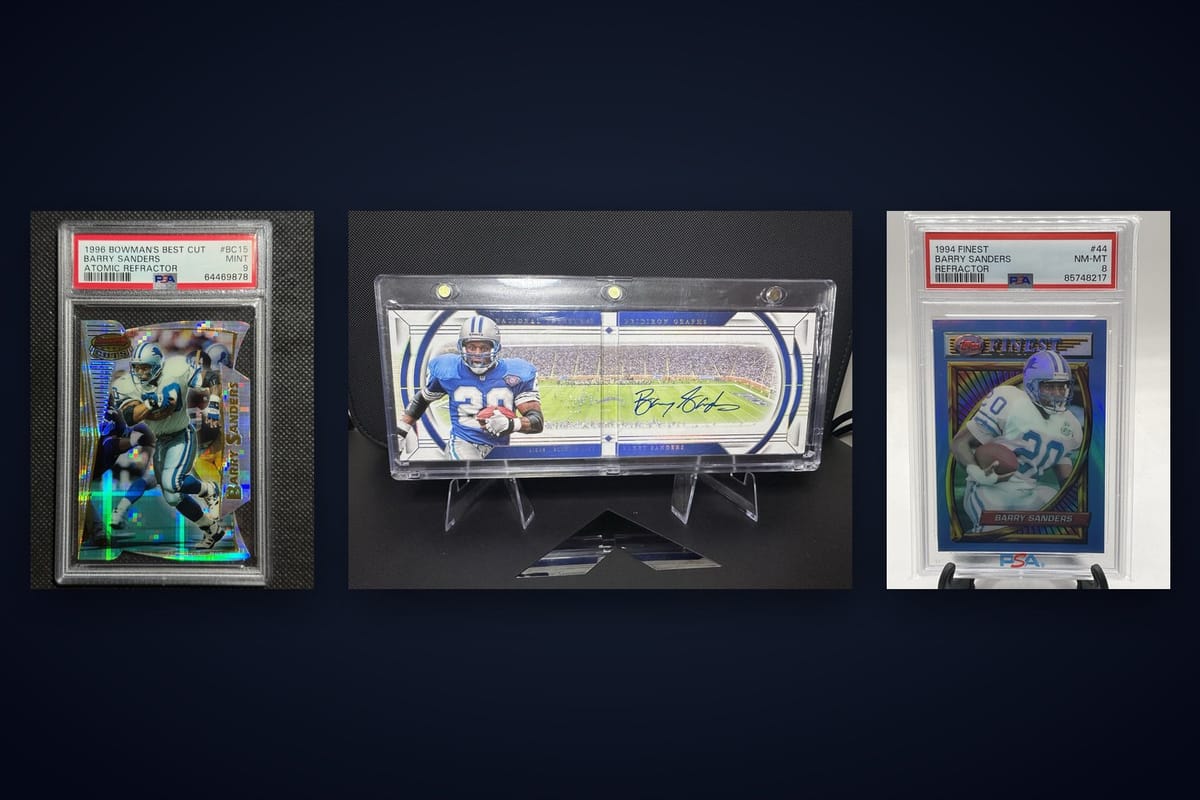
Barry Sanders [Atomic Refractor] #BC15 1996 Bowman's Best Cuts |
$630.67 | $15,549 | 24.7× |
 |
Barry Sanders #11 2025 Panini National Treasures Gridiron Graphs |
$2,213 | $9,731 | 4.4× |
 |
Barry Sanders [Refractor] #44 1994 Topps Finest |
$880.00 | $7,262 | 8.3× |
 |
Barry Sanders [Refractor] #25 1999 Topps Chrome |
$295.79 | $6,392 | 21.6× |
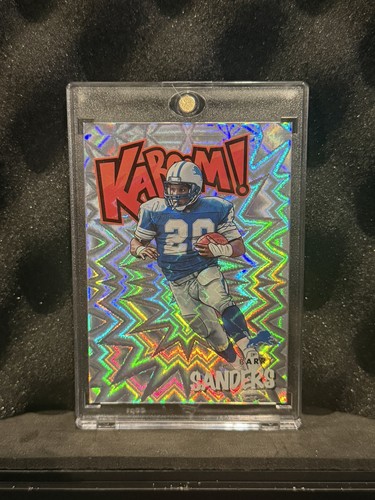 |
Barry Sanders #K8 2021 Panini Absolute Kaboom |
$928.39 | $5,775 | 6.2× |
 |
Barry Sanders [Black Pandora] #DT-14 2021 Panini Donruss Optic Downtown |
$456.02 | $5,640 | 12.4× |
 |
Barry Sanders [Atomic Refractor] #70 1997 Bowman's Best |
$299.99 | $5,020 | 16.7× |
 |
Barry Sanders [Gold] #BA 2003 SP Authentic Sign of the Times |
— | $4,530 | — |
 |
Barry Sanders 1996 Pinnacle Laser View Inscriptions Autographs |
$152.50 | $4,307 | 28.2× |
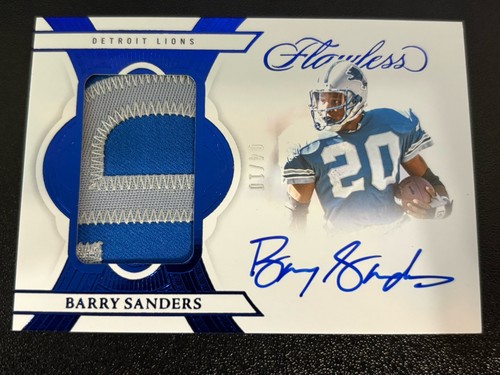 |
Barry Sanders #10 2025 Panini Flawless Patch Autograph |
$835.50 | $3,710 | 4.4× |
 |
Barry Sanders #HOCA-BS 2025 Topps Chrome Hall of Chrome Autograph |
$762.50 | $3,470 | 4.6× |
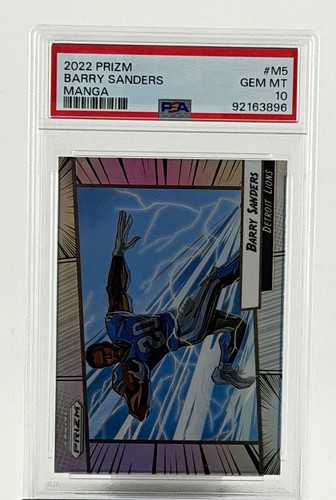 |
Barry Sanders #M-5 2022 Panini Prizm Manga |
$910.00 | $3,350 | 3.7× |
Look up any card's current raw and graded value in Midpoint — and get an estimated grade before you pay to submit.
Table of Contents
- Section 1: Which Barry Sanders Cards Are Worth Money
- Section 2: The 1989 Score #257 Rookie Card
- Section 3: Other 1989 Rookies: Topps Traded, Pro Set, and Police
- Section 4: The Most Valuable Barry Sanders Cards at the High End
- Section 5: Barry Sanders PSA 10 and How Condition Drives Value
- Section 6: Best Barry Sanders Cards to Grade
- Section 7: Identifying, Pricing, and Selling Your Cards
- Conclusion
- FAQ
Section 1: Which Barry Sanders Cards Are Worth Money
If you want to know which Barry Sanders cards are worth money, start with one rule: value follows scarcity, demand, and condition, in that order. Sanders is a Hall of Fame running back whose Detroit Lions career made him one of the most beloved players in football history. Demand for his cards has never really disappeared.
That demand is concentrated on a small set of cards. Most of what turns up in a shoebox is common base cards from the 1990s, which are plentiful and usually modest in value, especially raw.
The tiers of Sanders cards
- Tier 1, the 1989 rookies: Score #257, Topps Traded #83T, Pro Set #494, and Police Oscar Mayer #11. These carry the strongest Barry Sanders rookie card value.
- Tier 2, premium and scarce issues: autographs, serial-numbered parallels, one-of-ones, and inserts such as the 1998 Metal Universe Gem Masters.
- Tier 3, everything else: base cards, commons, and mass-produced inserts from the 1990s, which rarely justify grading fees.
How to use the data in this guide
The table above shows raw and graded values pulled from Midpoint's database as of 2026-10-31. Card prices move constantly, so treat any figure as a snapshot, not a promise. I deliberately avoid quoting numbers beyond that table, because a price from a random blog post goes stale fast and can mislead a sale or a submission.
What you can rely on is the structure of the market: the Score rookie is the most commonly traded benchmark, graded copies generally sell at a premium to raw, and the highest dollar amounts usually come from autographs and truly scarce parallels, not from base cards.
A quick note on the mindset
Collectors who do well with Sanders cards pick specific cards, verify them, and wait for the right copy. Buying a dozen random 1990s cards rarely works. Buying one clean, well-centered rookie in a respected holder often does.
Section 2: The 1989 Score #257 Rookie Card
The 1989 Score #257 Barry Sanders is the rookie card most people mean when they search for Barry Sanders rookie card value. It is widely available, instantly recognizable, and heavily graded, which makes it the market's reference point.
Why Score is the benchmark
Because so many copies exist, prices are easy to find and compare. You can usually find recent sales for raw copies, PSA 8, PSA 9, and PSA 10. That liquidity is a feature: you can sell quickly and price accurately.
The downside is the same abundance. A large population means a high-grade copy does not carry the scarcity premium of a truly short-printed card. The Barry Sanders PSA 10 of this card is valuable largely because a perfect copy is hard to find, not because the card itself is rare.
How the grades typically step up
- Raw: the lowest and most variable price, because condition is unverified. Buyers discount heavily for visible flaws.
- PSA 8: a solid, affordable entry into graded, and often the grade where cost and quality balance best for a collector.
- PSA 9: a noticeable premium over PSA 8 for a near-mint copy.
- PSA 10: typically the largest jump, since a gem copy is far scarcer than the grades below it.
For the exact figures at each level, check the data table above, which reflects values as of 2026-10-31.
What hurts this card in grading
1989 Score cards can suffer from off-center borders, soft corners, and print dots or snow in the image. Edge chipping can also show easily on this card. Before submitting, look closely at the corners and the front-to-back centering, since a card that looks fine at arm's length can fail under magnification. Our guide on how centering impacts card value explains why a few millimeters can separate a PSA 10 from a PSA 8.
Section 3: Other 1989 Rookies: Topps Traded, Pro Set, and Police
Score gets the headlines, but three other 1989 releases belong in any discussion of the most valuable Barry Sanders cards. Each has a different personality and a different collector base.
1989 Topps Traded #83T
Topps is one of the longest-established names in football cards, and the Traded set carries the Topps brand into Sanders' rookie year. Collectors who want a "classic Topps" rookie often favor this card. Midpoint's data table lists its values by grade as of 2026-10-31. Check the grade you actually own, not the headline number.
1989 Pro Set #494
Pro Set was a major release of the era and has its own loyal audience. Its production quality differs from Score and Topps, so the flaws you look for may differ too. Check edges and surface carefully, since a clean copy deserves attention. Verify the card number (#494) and look for any variations that affect value before you list or grade it.
1989 Police Oscar Mayer #11
This is the oddball of the group. The Police Oscar Mayer set was a promotional, regionally distributed issue rather than a standard retail product, so it can be harder to find than the mainstream rookies, particularly in sharp condition. Promotional and safety-style sets also tend to have cutting and centering quirks that can make top grades tougher.
- Scarcity matters: fewer available copies can mean stronger interest for sharp examples.
- Condition can be harder: perforated or cut-edge cards often have rough borders.
- Demand is narrower: fewer buyers can mean less predictable pricing, so check recent sales carefully.
Which rookie is worth the most?
It depends on the grade and the moment. The answer to "which Barry Sanders rookie card is worth the most" should come from the data table and recent sold listings, matching the same grade. Compare like with like: a PSA 9 Score against a PSA 9 Topps Traded, never a raw card against a graded one.
Section 4: The Most Valuable Barry Sanders Cards at the High End
The highest-dollar Sanders cards are rarely 1989 base rookies. They are cards where scarcity is built in: signed items, serial-numbered parallels, and one-of-ones.
Autographs
Authenticated signed cards appeal to many collectors. A certified on-card autograph from a respected brand generally commands far more than a standard base card. Authentication is critical: look for a PSA/DNA, BGS, or JSA authentication, or a manufacturer-certified signature from the original product.
- On-card autos are usually preferred over sticker autos.
- Certification from a trusted grader protects your resale value.
- Signed rookies and vintage-era signed cards sit in their own price tier, separate from standard graded rookies.
Low-numbered parallels and one-of-ones
A card numbered to /10, /5, or 1/1 is rare by definition. Prices for these cards are driven by who is bidding that week, so there may be few sales to benchmark. A one-of-one is worth what two serious collectors will pay on the day.
1998 Metal Universe Gem Masters
The 1998 Metal Universe Gem Masters is considered a scarce insert in the hobby, and its eye-catching design has made it a sought-after card for 1990s football collectors. Because sales are infrequent, pricing is thin, and condition can have a large effect on what a buyer will pay. If you own or are considering one, insist on authentication and compare any sale to actual completed comps, not ask-price listings.
What to check before paying a premium
- Is the serial number legible and consistent with the set's checklist?
- Is the card in a reputable grading holder, and does the cert number verify online?
- Are there recent sales of the exact card, or only similar ones?
When comps are rare, patience and verification matter more than speed. Our guide to grading low population cards covers how population reports affect value on scarce issues.
Section 5: Barry Sanders PSA 10 and How Condition Drives Value
A Barry Sanders PSA 10 is the target for many submitters, and it is where condition has its biggest impact on price. The same card in a 10 versus an 8 can differ dramatically in value, which is why understanding the four grading pillars matters.
The four things graders examine
- Centering: how evenly the borders sit on the front and back. This is a common reason strong-looking cards miss a 10.
- Corners: sharp points versus softness, fraying, or dings.
- Edges: white chipping along the border, especially on dark or colored edges.
- Surface: scratches, print lines, stains, dents, or print defects such as dots and snow.
Why PSA 10 is not the same as perfect
Each company defines its top grades differently. PSA 10 permits a small amount of centering offset, while BGS and others weigh subgrades differently. Our breakdown of grading scale differences by company explains what top grades really mean and why a card can earn a different number at each grader.
How to check centering yourself
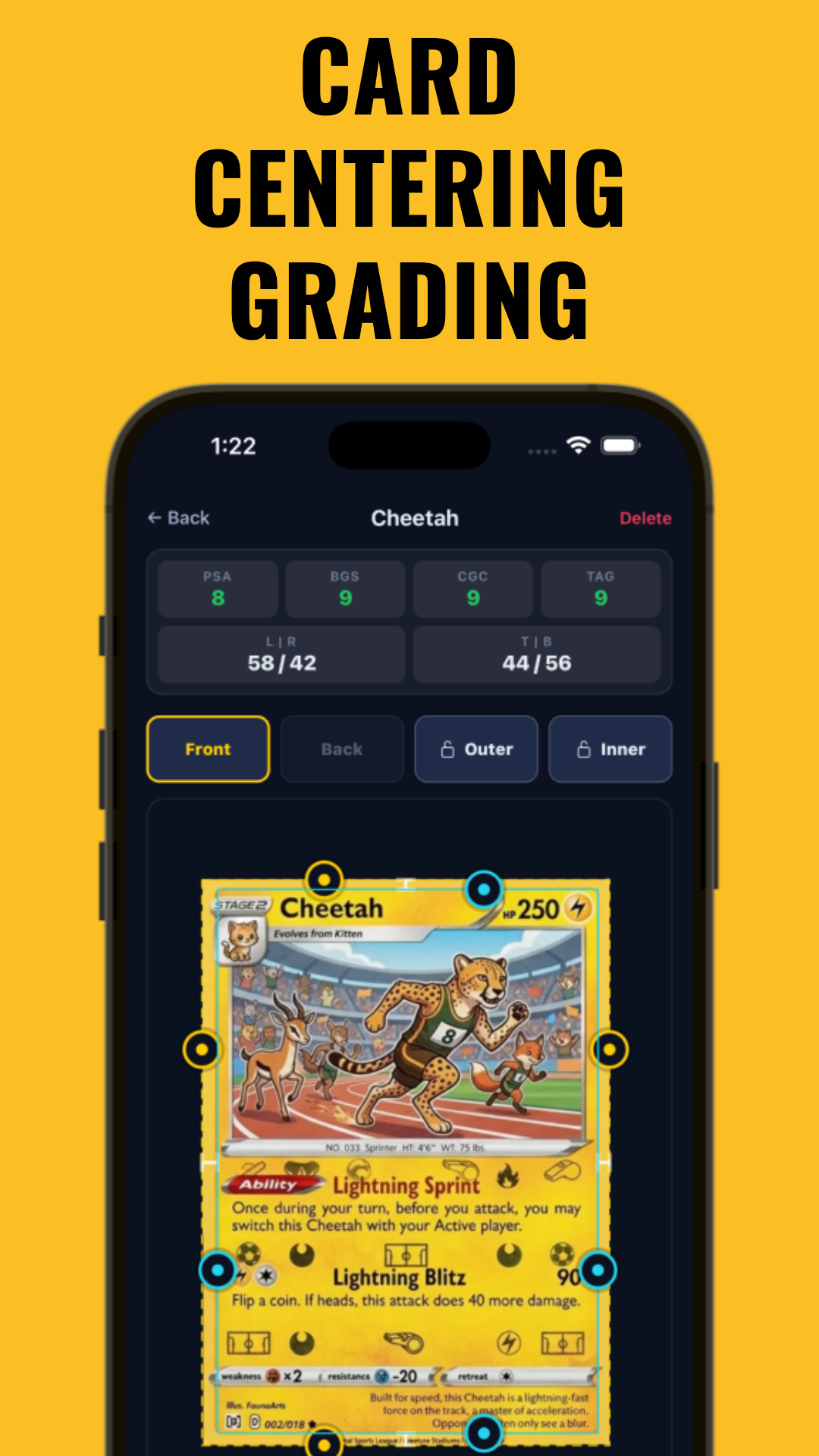
Measure the border on each side of the front and calculate the ratio, such as 55/45 left-to-right. You can do this by eye, but a tool is more accurate. Midpoint measures centering to the millimeter and estimates PSA, BGS, CGC, and TAG grades, so you can judge a copy before you pay.
Raw versus graded
A raw card's price reflects buyer uncertainty. Graded cards remove that uncertainty, so buyers often pay more. But grading only makes sense when the expected graded value minus the grading cost, shipping, and time beats what you could sell the raw card for. This matters most for common Sanders cards, where the premium rarely covers the fee.
Section 6: Best Barry Sanders Cards to Grade
Not every card deserves a slab. The best Barry Sanders cards to grade are those where a high grade creates a big jump in value and your specific copy has a realistic shot at it.
Strong grading candidates
- 1989 Score #257 with clean centering and sharp corners: the most liquid card, with clear prices at PSA 8, 9, and 10.
- 1989 Topps Traded #83T: a classic brand where a clean copy can bring a premium.
- 1989 Pro Set #494: worth grading only if the edges and surface are exceptional.
- 1989 Police Oscar Mayer #11: worth considering when the cut is clean, since sharp examples can be harder to find.
- Autographs and scarce inserts: grade or authenticate these to secure trust and resale value.
Cards to skip
Common 1990s base cards, damaged rookies, and cards with obvious creases or heavy off-centering are usually poor candidates. Grading fees plus shipping can wipe out the premium.
A simple pre-grading workflow
- Inspect under bright light at an angle to catch surface scratches and print lines.
- Measure centering on the front and back with the free centering calculator.
- Estimate the grade with an AI tool such as Midpoint, which analyzes centering, corners, edges, and surface.
- Compare the likely graded value from the data table with your total cost.
- Submit only the winners.
For a fuller walkthrough, see our step-by-step guide to pre-grading your card.
Section 7: Identifying, Pricing, and Selling Your Cards
Before you can decide whether you own Barry Sanders cards worth money, you need to know precisely what you hold. Many collectors mix up similar cards and misprice them.
How to identify a Barry Sanders card
- Year: printed on the card, usually in the copyright line on the back.
- Set name: Score, Topps Traded, Pro Set, Police Oscar Mayer, Metal Universe, and so on.
- Card number: for example #257 for Score, #83T for Topps Traded, #494 for Pro Set, and #11 for Police Oscar Mayer.
- Rookie designation: look for an RC mark or confirm it is the player's first-year issue.
- Parallel and numbering: check for serial numbers such as 12/25, or a distinct foil or color treatment.
- Autograph details: note whether it is on-card, a sticker, or a cut, and whether it is certified.
How to check recent sold prices
Search the exact year, set, and card number, then filter to completed or sold listings. Match the grade and grader exactly. Ignore asking prices, and look at several sales to see the trend. Midpoint's lookup shows raw versus graded values across more than 1.5 million cards, which helps you benchmark quickly.
Where and how to sell
- Online auctions: broad reach, but platform fees and shipping reduce your net.
- Fixed-price marketplaces: more control over price, but slower sales.
- Card shows and local shops: faster cash, usually at a dealer discount.
- Auction houses: best suited to high-end autographs and rare parallels.
Grading, authentication, fees, and auction format all affect your final return. A well-photographed graded card with a verifiable cert number and a strong end time often does better than a vague raw listing. Protect value in the meantime by following our guide on how to store valuable cards.
Conclusion
Barry Sanders cards worth money are not a mystery once you sort them into tiers. The 1989 rookies, including Score #257, Topps Traded #83T, Pro Set #494, and Police Oscar Mayer #11, anchor the market. Autographs, serial-numbered parallels, one-of-ones, and the 1998 Metal Universe Gem Masters sit at the top for scarcity. Everything else is typically a modest-value base card.
Condition is the multiplier. A sharp, well-centered copy that earns a PSA 9 or PSA 10 can sell at a large premium over a raw one, but only if the numbers work after fees. Identify your card precisely, compare completed sales at the same grade, and grade selectively.
If you are weighing a submission, try Midpoint to measure centering, estimate PSA, BGS, CGC, and TAG grades, and look up current values before you spend on grading. It is free on iOS and Android.
FAQ
Q: How much is a Barry Sanders rookie card worth?
A: It depends on which rookie and which grade. The main 1989 rookies are Score #257, Topps Traded #83T, Pro Set #494, and Police Oscar Mayer #11. Raw copies sell for less than graded ones, and PSA 10s command the biggest premium. Check the data table above (as of 2026-10-31) and recent sold listings for the exact card and grade.
Q: What is the most valuable Barry Sanders card?
The most valuable cards are typically scarce ones: certified autographs, low-numbered parallels, one-of-ones, and the 1998 Metal Universe Gem Masters. Base rookies are more common, so they usually trade below these rarities, although high-grade rookies can still be valuable.
Q: How much is a 1989 Score Barry Sanders rookie card worth?
The 1989 Score #257 is the most widely traded Sanders rookie. Value generally rises from raw to PSA 8, PSA 9, and PSA 10, with the biggest jump typically at PSA 10. See the table above for figures as of 2026-10-31 and verify with completed sales.
Q: Which Barry Sanders rookie card is worth the most?
It varies by grade and market timing. Compare the Score, Topps Traded, Pro Set, and Police Oscar Mayer rookies at the same grade using the data table and sold listings. Scarcer or better-presented copies can outperform the more common ones.
Q: Are Barry Sanders cards worth collecting?
Yes, for many collectors. Sanders is a Hall of Fame player with lasting demand, and his 1989 rookies are well-known hobby staples. As with any card, focus on condition and verified comps instead of assuming every card is valuable.
Q: How do I know if my Barry Sanders card is valuable?
Identify the year, set, card number, rookie status, and any parallel or autograph details. Then check completed sales for that exact card and grade, and inspect centering, corners, edges, and surface. A tool like Midpoint can measure centering and estimate a grade before you decide to submit.
Free to start
Try the Midpoint app
Grade any card from a photo, see its raw and PSA 10 value, and track what your collection is worth — free.
Get it on iPhoneGet it on Android


