
Football Card Prices Rising November 2026: 10 Moves to Make
Football card prices rising November 2026: the risers to watch, how to verify a price jump, and when to buy, hold, sell or grade. Data as of 2026-11-05.

Estimated reading time: 9 min
Key Takeaways
- Football card prices rising in November 2026 are concentrated in a few names: franchise veterans (Brady, Allen, Burrow, Mahomes) and young quarterbacks (Williams, Maye), plus a fresh rookie class.
- The table above shows raw and PSA 10 values and 30-day moves as of 2026-11-05. Read it as a snapshot, not a forecast.
- A real price increase shows up in many recent sold listings, not one outlier sale.
- Centering and condition decide whether a raw card is worth grading, so check before you pay for submission.
Football card prices rising in November 2026 is a story about momentum, scarcity and timing. Football season feeds the hobby every week: a big game, a starting-quarterback announcement or an injury report can move a card's price within days. This guide covers the football card market in November 2026, the trending football cards worth your attention, and how to tell football cards going up in value from short-lived spikes.
We use only the figures in our own database, as of 2026-11-05. We don't invent prices or predict where they go. The table above ranks the 30-day movers with raw and PSA 10 values. Below, we explain what drives each group and what to do about it.
30-day price movers — live data from Midpoint's card database, as of 2026-11-05. Prices move; Midpoint refreshes these daily.
| Card | Raw | PSA 10 | 30-day | |
|---|---|---|---|---|
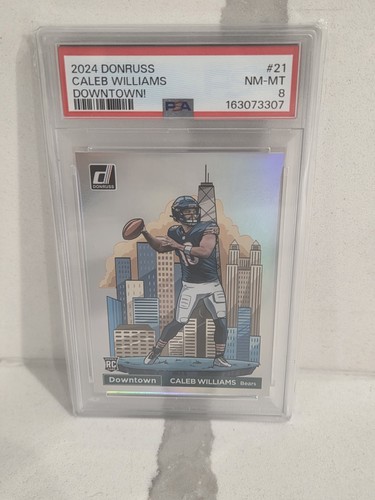 |
Caleb Williams #21 2024 Panini Donruss Downtown |
$1,052 | $3,393 | +13.9% |
 |
Ben Roethlisberger #23 2025 Panini Phoenix Color Blast |
$167.75 | $404.00 | +7% |
 |
Bart Starr #119 1957 Topps |
$611.91 | $131,172 | +5% |
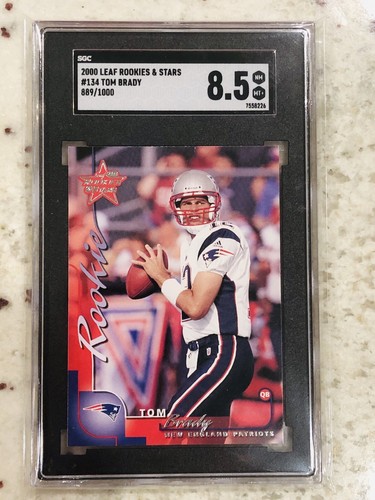 |
Tom Brady #134 2000 Leaf Rookies & Stars |
$1,354 | $17,200 | +1.1% |
 |
Joe Burrow [Gold] #4 2023 Panini Absolute Kaboom Horizontal |
$5,500 | — | 0% |
 |
Kirk Cousins #ANI-KCS 2024 Panini Luminance Animation |
$62.37 | $231.63 | 0% |
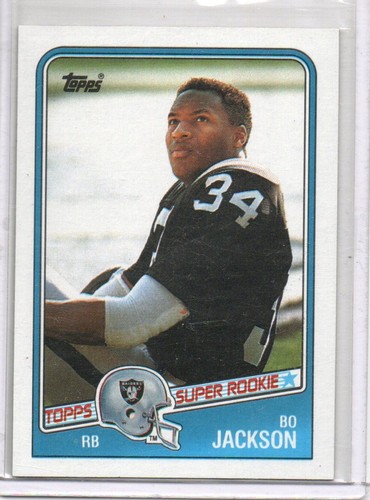 |
Bo Jackson #327 1988 Topps |
$15.88 | $3,168 | 0% |
 |
Russ Jackson #56 1959 Topps CFL |
$21.50 | $4,216 | 0% |
 |
Angelo Mosca #72 1959 Topps CFL |
$12.27 | $2,513 | 0% |
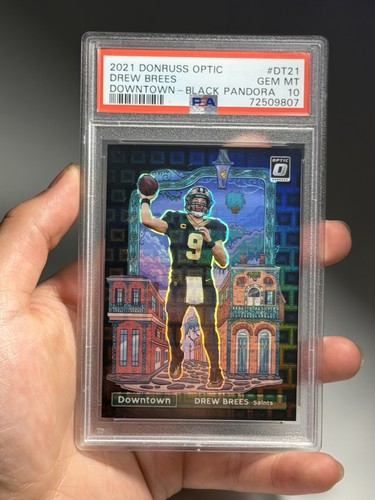 |
Drew Brees [Black Pandora] #DT-21 2021 Panini Donruss Optic Downtown |
$455.00 | $2,700 | 0% |
 |
Michael Vick [Autograph] #157 2001 Playoff Contenders |
$270.00 | $1,725 | 0% |
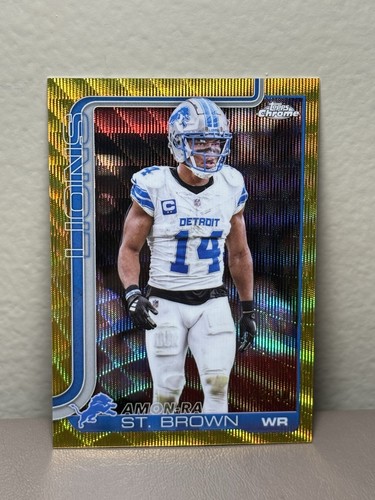 |
Amon-Ra St. Brown [Gold Refractor] #98 2025 Topps Chrome |
$62.50 | $305.19 | 0% |
Look up any card's current raw and graded value in Midpoint — and get an estimated grade before you pay to submit.
1. Tom Brady Cards: The Legacy Anchor
Tom Brady is the clearest example of a card market that isn't driven by weekly performance. He is retired, so his cards move on nostalgia, long-term demand and the supply of top-graded copies. That makes his price moves slower and usually stickier than a current player's.
When Brady cards show up among the risers in the table, check these first:
- Which card: his rookie and key vintage-era cards behave very differently from modern parallels.
- Raw vs PSA 10: a gap that keeps widening usually means collectors are paying a premium for top grades.
- Volume: a legacy card that rises on thin sales is easier to push around than one with steady daily sales.
Legacy cards tend to reward patience over flipping, though that is a pattern, not a guarantee.
2. Josh Allen Cards: Established Star Demand
Josh Allen sits in a sweet spot for collectors. He is a proven, high-profile quarterback with a long-term collecting base. Cards of players like this tend to climb on awards talk, playoff positioning and big national-TV games.
Look at his key rookie cards and numbered parallels in the table. Compare the raw price to the PSA 10 price. If the graded premium is large, the raw copy may be the better value, but only if it can actually grade well.
3. Joe Burrow Cards: Health and Availability Drive the Price
Joe Burrow cards are a good lesson in how injuries and availability affect the football card market. A healthy, productive stretch tends to lift prices, while injury news can cool them quickly.
If you're considering a Burrow card after a recent jump:
- Check whether the rise followed a specific game or announcement. Event-driven spikes can fade.
- Look at sold prices over the last several weeks, not just the last few days.
- Decide your horizon. Long-term holders can look past short injury dips. Short-term traders can't.
4. Patrick Mahomes Cards: The Blue-Chip Benchmark
Patrick Mahomes is the benchmark modern football card. His cards often act as a gauge for the whole football segment, so when his prices move, collectors notice.
His market is deep, with many sales per week across raw and graded copies. That depth makes the price signal more reliable than for thinly traded cards. It also means a rise tends to be more broad-based and less about a single buyer.
Treat the 30-day change in the table as a sign of momentum, then confirm it against recent eBay sold listings before acting.
5. Caleb Williams Cards: Young-Quarterback Hype Cycle
Caleb Williams was the first overall pick in the 2024 NFL Draft, and his cards carry high expectations. Young-quarterback cards are the most sensitive to news: breakout games, team success and starting-role headlines can all swing prices.
Why cards like his rise:
- Scarcity of top grades: modern chrome-style cards can be hard to find in PSA 10, so top-graded copies often carry a premium.
- Narrative: a strong game can make a card trend overnight.
- Early-career pricing: prices can overshoot expectations in either direction.
If you buy into a hype cycle, set a price ceiling in advance and stick to it.
6. Drake Maye Cards: Team Success Moves the Market
Drake Maye belongs in the same young-quarterback group, but his price story is tied closely to team success. Winning teams get more national attention, and national attention can lift card demand.
Check the table for his raw and PSA 10 values as of 2026-11-05. Then compare them with what recent buyers actually paid. A big gap between asking prices and sold prices is a warning sign that the market hasn't yet accepted the new level.
7. The 2026 Rookie Class: Mendoza, Reese and Bailey
The 2026 rookie-card market is where football cards going up in value can be most dramatic, and most risky. Names like Fernando Mendoza, Arvell Reese and David Bailey are drawing early attention. Jaxson Dart, a 2025 rookie, is a reminder of how quickly a young player's card prices can respond to on-field news.
Rookie cards are priced on projection, not results. That means:
- Prices can jump on a single breakout game, draft-night buzz or a starting-role announcement.
- Prices can drop just as fast when a player's role changes or an injury hits.
- Early supply is limited, so small buying waves can move prices more than they do for veterans.
If you want exposure, spread your buys across several players rather than betting on one name. Prefer cards with a deep pool of recent sales.
8. The 2026 Topps Chrome Football Release: Supply Is the Wildcard
The 2026 Topps Chrome Football release is a major factor for rookie-card values, so check the current release date and status. New supply tends to cool early rookie prices as more copies reach the market. Hobby and jumbo box prices also set the cost of chasing these cards raw. Check current box pricing before you plan any purchase, since we don't quote those figures here.
Practical ways to handle release timing:
- Buy ahead only if the price is fair. Pre-release rookie cards can carry hype premiums.
- Watch the first weeks after release. Prices often settle once supply becomes clear.
- Focus on veterans if you want less release risk. New sets matter less for Brady or Mahomes than for a rookie.
9. How to Verify a Football Card Price Increase
A price move in a table is a lead, not proof. Before you trust any of the football card prices rising in November 2026, run this checklist:
- Check sold listings, not asking prices. Filter eBay to completed and sold items.
- Match the exact card. Set, card number, parallel and grade must all match.
- Look at volume. One sale is an anecdote. Several sales at a similar price is a trend.
- Compare against the 30-day window. A move that began weeks ago is different from one that began yesterday.
- Look for the catalyst. A named game, award or announcement makes a rise easier to explain.
In Midpoint, you can look up a card and compare raw and graded values across a large card database, then track your own collection's value over time. Midpoint is free on iOS and Android.
10. Raw vs Graded, and When to Grade
When prices rise, the raw-versus-graded decision gets sharper. A PSA 10 can carry a large premium over a raw copy, but grading costs money and carries risk. Only a card that actually earns the top grade captures that premium.
Centering is often what decides it. A card that looks clean can still fail on centering. Learn how centering impacts card value, and follow a simple step-by-step pre-grade process before you submit.

Midpoint measures centering and estimates PSA, BGS, CGC and TAG grades, so you can check before paying grading fees on a card. Grading companies use different scales, so it helps to understand how the scales differ by company.
- Grade it: raw copy looks sharp, centering is close to even and the PSA 10 premium is large.
- Sell raw: centering is off or corners show wear, and the raw price already looks strong.
- Buy graded: you want certainty and the premium is reasonable.
11. Market Risks: Volatility, Populations and Sustainability
Not every riser stays up. Rising prices can reverse, and some football cards will be declining while others climb. Keep these risks in mind:
- Volatility: player-driven prices swing with performance, health and team results.
- Population reports: as more copies get graded, top-grade scarcity can fall and prices can soften. See our guide to grading low-population cards.
- Print runs: numbered and short-print cards behave differently from base cards.
- Comparison to the wider market: football gains don't automatically mean the whole sports-card market is rising, so don't assume one lifts the other.
If a card has climbed fast on thin volume, treat the price as fragile.
12. Buy, Hold, Sell or Grade: A Simple Timing Plan
Use the table as a starting point, then match your move to your goal.
- Buy: choose cards with steady sales volume and a clear catalyst, and avoid chasing a one-day spike.
- Hold: long-term legacy cards like Brady and blue-chip stars like Mahomes suit patient collectors.
- Sell: consider selling a card that has jumped well past its recent sold range, especially a hype-driven rookie.
- Grade: only submit cards that pre-grade well. Protect them properly afterwards with our guide to storing valuable cards.
Track what you own so you can see your gains and losses clearly. Midpoint's portfolio tracking shows your collection's value over time.
Conclusion
Football card prices rising in November 2026 reflect a mix of legacy demand, young-quarterback hype and a rookie class still finding its footing. The table above gives you the data as of 2026-11-05. Your edge comes from checking sold prices, understanding the catalyst, and grading only cards that earn it.
Before you buy or submit, measure your card. Try Midpoint for centering checks and grade estimates, or use the free centering calculator for a quick look.
FAQ
Q: Which football cards are rising in price in November 2026?
A: The table above lists the biggest 30-day movers with raw and PSA 10 values as of 2026-11-05. Collectors are watching veteran stars like Tom Brady, Josh Allen, Joe Burrow and Patrick Mahomes, young quarterbacks like Caleb Williams and Drake Maye, and rookies like Fernando Mendoza, Arvell Reese and David Bailey.
Q: What football cards are worth buying before the 2026 Topps Chrome release?
A: Cards with deep sales volume and less exposure to new supply, such as established veterans, carry less release risk than rookie cards. If you buy rookies, avoid paying a hype premium and spread your buys across several players. Check current hobby and jumbo box prices to judge the cost of chasing cards raw.
Q: Why are Caleb Williams, Joe Burrow, Tom Brady, and Patrick Mahomes cards increasing in value?
A: The drivers differ. Williams is tied to young-quarterback hype and performance. Burrow reflects availability and health. Brady is driven by legacy demand and scarce top grades. Mahomes benefits from a deep, steady blue-chip market. Confirm each rise with recent sold listings.
Q: Are football card prices going up or down in November 2026?
A: It depends on the card. Some are rising while others are flat or falling, so check the 30-day changes in the table rather than assuming the whole market moves together.
Q: How can I tell whether a football card price increase is real and sustainable?
A: Check sold listings for the exact card and grade, look for several sales at a similar price, and identify a clear catalyst. A rise on one or two sales, or on thin volume, is fragile.
Q: Should I buy raw or graded football cards when prices are rising?
A: Graded cards offer certainty at a premium. Raw cards can be better value if they have strong centering and condition and are likely to grade well. Pre-grade first with a tool like Midpoint so you only pay for grading when the upside justifies it.
Free to start
Try the Midpoint app
Grade any card from a photo, see its raw and PSA 10 value, and track what your collection is worth — free.
Get it on iPhoneGet it on Android


