Minimum Centering for Gem Mint Cards: PSA, CGC, BGS, SGC & TAG Standards Explained
Discover the minimum centering for gem mint cards. Compare PSA, CGC, BGS, SGC & TAG standards. Learn requirements, grading tips, and measurement methods.

Estimated reading time: 13 min
Key Takeaways
- The minimum centering for gem mint cards varies by grading company—know the exact front and back tolerances for PSA, CGC, BGS, SGC, and TAG.
- PSA typically requires 55/45 centering or better on the front for a 10, while CGC and BGS have similar or slightly stricter requirements for their highest grades.
- Back centering standards are more lenient, generally up to 75/25 for most graders at the gem mint level.
- Measuring centering accurately is essential—digital tools like Midpoint can help you avoid costly grading surprises.
- Other gem mint requirements (corners, edges, surface) are equally strict—centering alone won't guarantee a perfect grade.
Table of Contents
- Section 1: What Is Minimum Centering for Gem Mint Cards?
- Section 2: PSA Centering Standards for Gem Mint Cards
- Section 3: CGC, BGS, SGC & TAG Centering Requirements
- Section 4: How to Measure Centering Accurately
- Section 5: Front vs Back Centering—Common Confusions
- Section 6: Other Gem Mint Requirements Beyond Centering
- Conclusion
- FAQ
Section 1: What Is Minimum Centering for Gem Mint Cards?
Defining Gem Mint Centering
When collectors ask about the minimum centering for gem mint cards, they're seeking the precise tolerance a card must meet to have a shot at a PSA 10, CGC 10, BGS 10, or equivalent. Centering refers to how evenly the printed image is positioned within the card’s borders—both left-to-right and top-to-bottom. Even a card in perfect shape with a slight image shift can lose its eligibility for a gem mint grade, making centering a critical criteria in the hobby. For a comprehensive overview of centering and its role in grading, see Card Centering: The Definitive Guide for Grading and Collectors.
- Front centering is usually stricter than back.
- Grading companies set numerical thresholds (e.g., 55/45), meaning one border can be up to X% larger than the opposite.
- These standards differ by grader and sometimes by sport vs. TCG.
For example, a 55/45 standard means the larger border can be at most 55% of the width, and the smaller at least 45%. If you have a 100mm wide card, the left and right borders combined must equal 100mm, and neither can be less than 45mm or more than 55mm. The same applies vertically.
Why Centering Matters
Centering is a highly visible flaw. Even slight off-centering can demote a card from gem mint, affecting value. For instance, a modern PSA 10 Pokémon card might sell for significantly more than a PSA 9 with 60/40 centering—demonstrating the financial impact of small centering differences. For a deeper dive into how centering impacts price, see How Centering Impacts Card Value: A Detailed Guide.
The Grading Landscape
There’s no single "universally accepted" minimum centering for all gem mint cards. Instead, each grader—PSA, BGS, CGC, SGC, TAG—publishes its own centering standards (sometimes with exceptions or ambiguity). Always check the latest guidelines before submitting. The tolerances can change, and some graders update their rules for certain sets or card types. For example, vintage cards may have slightly different criteria than modern printings, and TCG cards are almost always held to modern standards with minimal tolerance for print defects.
Section 2: PSA Centering Standards for Gem Mint Cards
PSA 10 Centering Requirements
For decades, PSA centering standards have set the hobby benchmark. For a PSA 10 GEM MT:
- Front: Minimum 55/45 or better on both axes (left/right and top/bottom).
- Back: Minimum 75/25 or better on both axes.
In practical terms, the image can be shifted so that one border is up to 55% of the total width, the other 45%—but no more. On the back, there’s more leeway. For example, if a card is 63mm wide, the left border must be at least 28.35mm (45%), and the right no more than 34.65mm (55%). This tiny difference can be the deciding factor between a 10 and a 9.
It’s also important to note that PSA applies these standards to both axes. If your card is 55/45 left/right but 60/40 top/bottom, it will not qualify for a PSA 10, regardless of how perfect other factors (corners, surface) may be.
55/45 vs 60/40: The Ongoing Confusion
Many collectors mistakenly believe 60/40 is acceptable for PSA 10. According to PSA’s published standards, 60/40 is the cutoff for PSA 9. Only 55/45 or better (on the front) qualifies for a PSA 10, as confirmed in PSA’s published standards. Always measure both axes, as a card can be 55/45 left/right but 60/40 top/bottom and thus ineligible for a 10.
The confusion often arises from community discussions and outdated references. PSA's public documentation states: for a gem mint 10, centering must be 55/45 or better. When in doubt, refer directly to PSA's grading standards for the latest specifics. Some cards do slip through the cracks, but submitting a card worse than 55/45 is not recommended if you are seeking a 10.
PSA’s Approach to Tolerances and Exceptions
PSA may occasionally allow very minor centering flaws if all other aspects are flawless, but this is rare and not to be counted on. The 55/45 rule is the practical minimum. For more on PSA’s full grading philosophy, see their official FAQ.
For extremely valuable vintage cards (pre-1980s), PSA graders may exercise a bit of discretion in unusual circumstances, but for modern cards (especially TCG), the standards are strictly enforced. Exceptions are not the rule and should not be relied upon when submitting cards for grading.
It's also worth noting that PSA does not use subgrades (unlike BGS), so centering alone can immediately cap a card's maximum possible grade.
Section 3: CGC, BGS, SGC & TAG Centering Requirements
CGC Centering Standards
CGC centering standards are among the strictest. CGC grades both trading cards and comics, but for TCG and sports cards, the centering criteria are as follows:
- CGC 10 (Pristine): 50/50 centering, with only minor allowance for printing tolerance (often quoted as 55/45 front, 75/25 back max for "Gem Mint").
- CGC 9.5 (Gem Mint): 55/45 front, 75/25 back.
CGC’s documentation is more explicit for Pristine than for Gem Mint. Most cards must meet 55/45 on the front for a 9.5, and only 50/50 for Pristine. Achieving a CGC 10 is extremely rare—many cards that would earn PSA 10 or BGS 9.5 may not meet the 50/50 requirement and will be capped at 9.5.
This strictness makes CGC 10s especially valuable, particularly for modern Pokémon, Magic: The Gathering, and other TCG cards, where print alignment is tightly controlled but not always perfect.
BGS Centering Requirements
BGS centering requirements are similar but introduce subgrades for centering, corners, edges, and surface. This allows for a more nuanced assessment:
- BGS 10 (Black Label): 50/50 on both axes (with almost no tolerance). Every subgrade must be a 10 for Black Label.
- BGS 9.5 (Gem Mint): 55/45 front, 60/40 back.
- BGS 9: 60/40 front, 65/35 back.
Because BGS averages subgrades, a card with one slightly weaker centering subgrade can sometimes still earn a 9.5 overall if other categories are flawless, but not a Black Label. For example, a card with 55/45 centering (9.5 subgrade), perfect corners (10), edges (10), and surface (10) may average to a 9.5 or even a 10 (Gold Label), depending on the specific combination.
For collectors targeting a BGS Black Label, only truly perfect centering across both axes will make the cut. These are rare and often command the highest premiums in the hobby, especially for modern TCGs and ultra-modern sports cards.
SGC and TAG Grading Centering
SGC centering standards for a 10 (Gem Mint) match PSA: 55/45 front, 75/25 back. TAG grading centering uses a digital, AI-based approach but aligns closely with 55/45 for gem mint and 50/50 for pristine, though published documentation is less detailed—always check for updates.
- SGC 10: 55/45 front, 75/25 back
- TAG 10: 55/45 front, 75/25 back (generally), with digital measurement
TAG uses computer vision to measure centering with high precision. This removes grader subjectivity but means the standards are applied without exception—if your card is a fraction of a percent outside the range, it will not receive a 10. For collectors, this can be both reassuring and nerve-wracking, especially when high-value cards are at stake.
For a hands-on look at how AI is changing centering evaluation, see AI-Focused Comparison: How AI Transforms Card Centering Analysis.
Which Grader Is Most Lenient?
For modern cards, SGC and PSA are generally considered more forgiving on centering for a 10. CGC and BGS are stricter, especially for their highest (pristine) grades. TAG’s automated system means there's no subjectivity, but the standards are tight. Always confirm with each grader’s latest public documentation.
For example, if you have a card with 56/44 front centering and 76/24 back centering, PSA and SGC would likely issue a 9, while CGC and BGS would be even stricter. A TAG scan would instantly flag the precise centering ratio, letting you know if your card is eligible for a 10 before you submit. For a comprehensive breakdown of how each grader's standards compare, see our Card Grading Centering Standards: PSA, BGS, CGC, SGC & TAG Compared. For a direct comparison of PSA, BGS, CGC, and SGC grading, check out Card Grade Comparisons: PSA vs BGS vs CGC vs SGC Explained.
Section 4: How to Measure Centering Accurately
Manual Methods
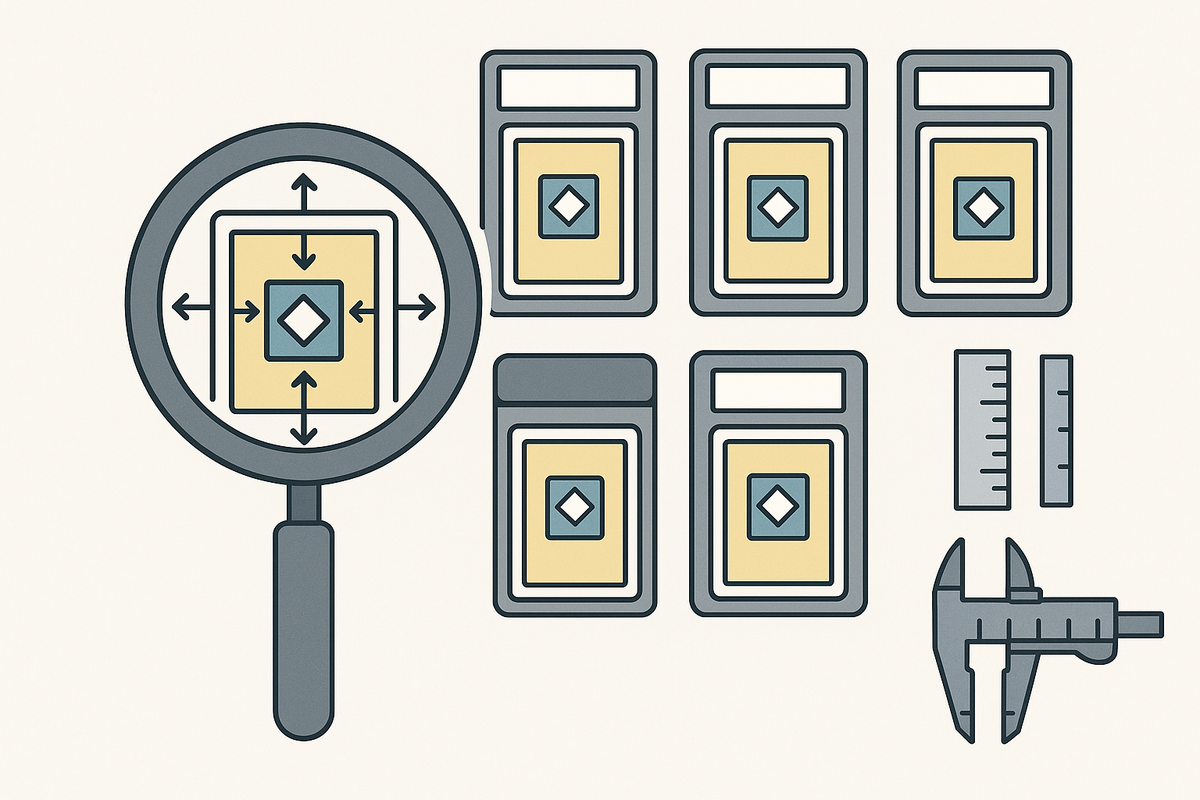
Historically, collectors used rulers, calipers, or even the "eyeball test" to estimate centering. Manual measurement involves:
- Measuring the distance from the image edge to the border on each side (left, right, top, bottom).
- Calculating the centering ratio: (smaller border ÷ total width) vs (larger border ÷ total width).
- Comparing these ratios to grader standards (e.g., 55/45).
This process is prone to error, especially on cards with uneven borders or where print shifts are subtle. For a step-by-step breakdown, consult How to Measure Card Centering: Step-by-Step Precision Guide.
For example, suppose your card is 63mm wide, and the left border is 27mm and the right border is 36mm. The ratio would be 27/63 (42.9%) for the smaller side and 36/63 (57.1%) for the larger side, which would not meet the 55/45 standard for a PSA 10. Even a 1mm measuring error could change the outcome, so accuracy is crucial.
Digital Tools and Apps
Modern collectors increasingly rely on digital card centering tools. Midpoint is a leading app that lets you upload a scan or photo and instantly measures centering down to the millimeter. It outputs estimated grades for PSA, BGS, CGC, and TAG, removing all guesswork before you spend $30+ on grading fees.
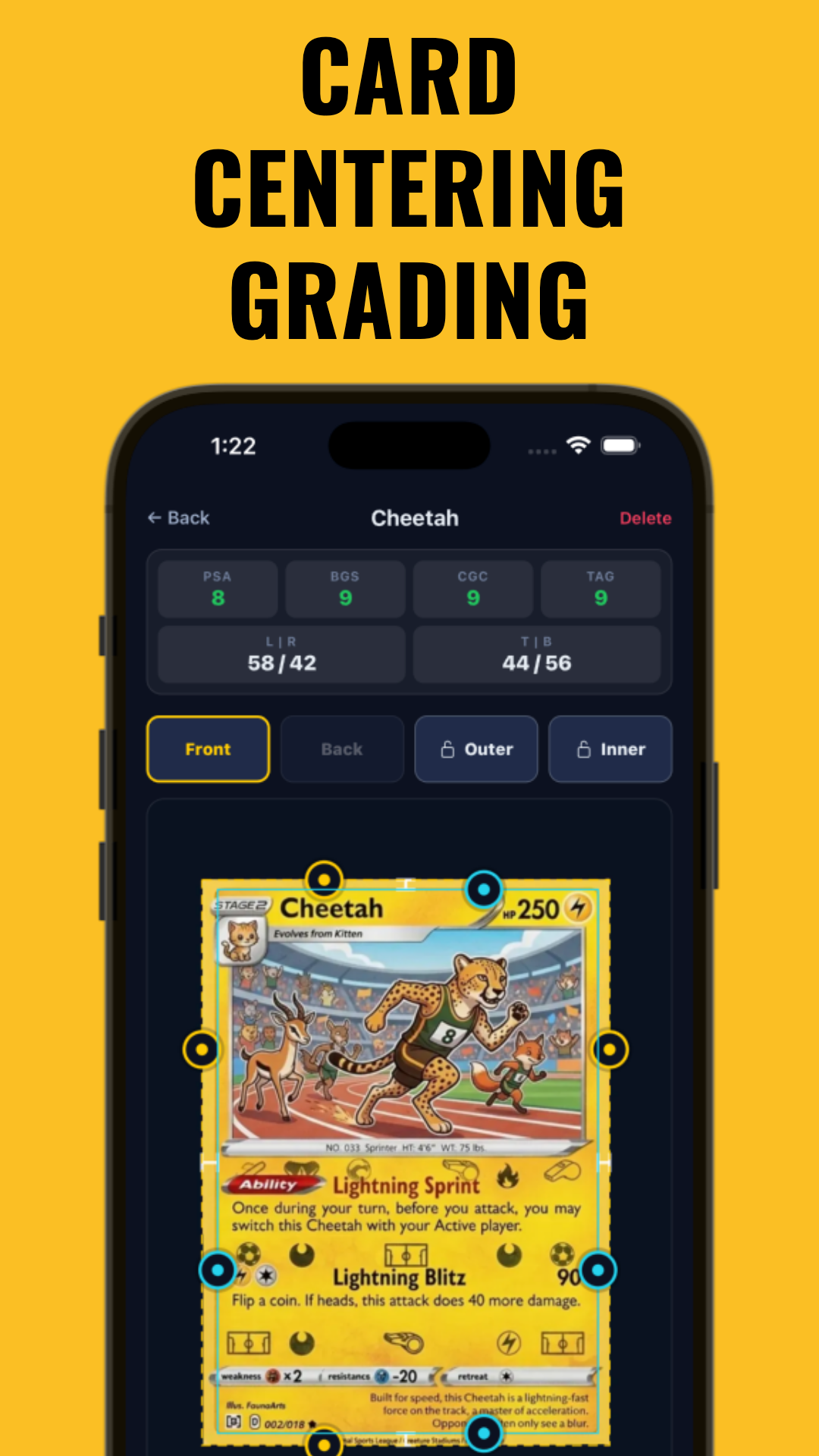
With Midpoint, you simply upload a high-resolution scan or a well-lit photo, align the digital guides to the card borders, and the tool automatically calculates centering percentages for both axes. The results are displayed instantly, with color-coded feedback indicating whether your card meets PSA, CGC, BGS, SGC, or TAG standards. This process eliminates subjective guesswork and helps you avoid sending cards that are almost certain to miss the grade you want.
Midpoint also offers features such as batch analysis for multiple cards, integration with pre-grading checklists, and the ability to export results for record-keeping or sharing with other collectors. For serious submitters, this can save both time and grading fees.
Best Practices for Accurate Measurement
- Scan or photograph cards at high resolution, with borders clearly visible. A resolution of at least 600 dpi is recommended for precision.
- Use digital measurement for consistency. Manual tools are prone to human error, while digital solutions maintain repeatable accuracy.
- Double-check both axes (left/right and top/bottom). It’s not uncommon for a card to be well-centered horizontally but off vertically.
- Record your results to compare against grading company standards. Keeping a digital or physical log helps track which cards are ready for submission and which may need to be sold raw or held for future grading.
When using digital tools like Midpoint, take care to align the guides as precisely as possible with the printed image, not just the physical edges of the card. Some cards have natural border variations or print shifts, so always check both axes and verify your measurements before making a grading decision.
Section 5: Front vs Back Centering—Common Confusions
Why the Front Matters More
All major graders place more weight on the front centering of a card. Even if the back is off-center, as long as it meets the more generous threshold (typically 75/25), the card may still qualify for a gem mint grade if the front is within the stricter limit.
This makes sense from a collector's perspective: the front is what is displayed and most visible in slabs. A perfectly centered back with an off-centered front rarely impresses buyers or graders. For this reason, always prioritize front centering when pre-grading or assessing cards for purchase.
Understanding the Numbers
- Front minimum: 55/45 for most gem mint designations (except Pristine, which is stricter).
- Back minimum: 75/25 for PSA, SGC, and TAG; 60/40 or 65/35 for BGS; up to 75/25 for CGC.
For example: A card with 56/44 front centering and 80/20 back centering can only get a PSA 9, not a 10.
Another common source of confusion is the misconception that slight back off-centering is ignored. In reality, the back is always measured, and if it exceeds the published standards (such as 76/24), the card will be capped at a 9 regardless of perfect front centering.
Sports Cards vs TCGs (Pokémon, Magic, etc.)
Most graders apply the same centering tolerance to sports cards and TCGs; however, older sports cards with notorious print issues may get very slight leniency, especially in vintage grading. For Pokémon and modern TCGs, no exceptions are made—the 55/45 (front) and 75/25 (back) rules are the standard for gem mint.
In vintage sets (pre-1980s), graders may acknowledge that certain production issues make perfect centering nearly impossible. In such cases, a card that technically misses 55/45 by a percent or two may still achieve a high grade if it is otherwise flawless and the centering is typical for the era. For modern cards, these exceptions do not apply, and strict adherence to the standards is the norm.
If you're grading Pokémon cards in particular, explore our step-by-step guide to using a centering tool for Pokémon cards for practical examples. This guide walks through using digital overlays, adjusting for unique Pokémon border styles, and ensuring your card is truly gem mint candidate before you submit.
For a detailed look at how centering standards differ for older cards, see our complete guide to centering standards for vintage cards.
Section 6: Other Gem Mint Requirements Beyond Centering
What Else Must Be Perfect?
Even if a card meets the minimum centering for gem mint cards, it can still fall short if other aspects aren’t flawless. Graders also scrutinize:
- Corners: Must be razor-sharp, with no whitening or dings. Even one slightly blunted corner can drop a card from a 10 to a 9 or lower.
- Edges: No chipping, wear, or print defects. Modern cards are especially susceptible to edge chipping from factory cutting or handling.
- Surface: Free of scratches, print lines, stains, or clouding. Use magnification and bright, angled lighting to check for hidden flaws.
For a gem mint (10), all areas must be virtually perfect. One minor flaw in any category typically relegates the card to a 9 grade or lower. For example, a card with perfect centering but a faint print line on the surface is likely to receive a 9 from PSA or CGC, or a lower subgrade from BGS.
Some graders, like BGS and CGC, explicitly score each subcategory. This means that a card with 10 centering but 9 surface, 9 corners, and 9.5 edges could average to a 9 overall. PSA and SGC do not use subgrades, but their graders will still visually assess all categories and assign the final grade accordingly.
Gem Mint vs Pristine: The Next Level
The difference between gem mint and pristine is most stark in centering. For example:
- Gem Mint (10): 55/45 front centering is allowed (PSA, SGC, CGC 9.5, BGS 9.5).
- Pristine (BGS Black Label/CGC 10): Requires 50/50 or better—essentially perfect centering.
Pristine grades are rare and can carry a significant premium due to these unforgiving centering tolerances. For instance, a CGC 10 or BGS Black Label can sell for considerably more than a standard PSA 10 or BGS 9.5, especially in the ultra-modern TCG market.
Achieving a pristine grade not only requires perfect centering but also flawless corners, edges, and surface. Any flaw immediately disqualifies the card. For collectors, this means that even cards pulled fresh from packs are rarely pristine candidates, and pre-grading is essential.
Don't Neglect Pre-Grading
Before sending cards for grading, pre-grade all aspects—centering, corners, edges, and surface. Utilize digital tools or follow a step-by-step pre-grading guide to avoid disappointment and wasted grading fees. Midpoint’s instant multi-grader estimates can be a game-changer for your process.
To pre-grade effectively:
- Use a bright, diffused light and a jeweler’s loupe (10x or higher) to inspect corners and edges for wear.
- Check surface for print lines by tilting the card under a strong light source.
- Use a digital centering tool for precise measurements.
- Compare your findings to the published standards for each grader.
- Set aside cards that do not meet ALL gem mint requirements or consider submitting to a more lenient grader if borderline.
Proper pre-grading can save significant money in grading fees and boost your odds of securing top grades on your most valuable cards.
Conclusion
Understanding the minimum centering for gem mint cards is essential for any collector aiming for top grades and maximum card value. With grading companies like PSA, CGC, BGS, SGC, and TAG each setting their own centering standards—usually 55/45 front, 75/25 back for gem mint, and even stricter for pristine—it pays to measure with precision before you submit. The difference between a 10 and a 9 can be millimeters, but the impact on value is significant.
To streamline your preparation, try Midpoint for instant, accurate centering analysis and multi-grader estimates. For more tips on maximizing your grading success, read our practical guide to estimating your card's grade before sending it in.
In summary: Always check the latest standards for your chosen grader, measure centering on both axes, and don’t neglect corners, edges, or surface quality. The gem mint cutoffs are strict—but with the right preparation and digital tools, you can maximize your grading ROI and avoid costly surprises.
FAQ
Q: What is the minimum centering for a PSA 10 gem mint card?
A: For a PSA 10, the minimum is 55/45 on the front and 75/25 on the back, measured on both axes. Anything worse drops the card to a 9. Use a digital tool for best accuracy; even a 1% error can impact your grade.
Q: Is 55/45 or 60/40 the correct centering standard for PSA 10?
A: 55/45 is the correct standard for PSA 10. 60/40 is the cutoff for PSA 9. Both axes (left/right and top/bottom) must be 55/45 or better for a 10. Many cards with one axis at 60/40 will be graded as a 9, not a 10.
Q: What is the back centering requirement for a gem mint card?
A: Most graders require 75/25 or better on the back for gem mint (PSA, SGC, TAG, CGC). BGS is stricter, often requiring 60/40 for 9.5. For pristine grades, the back may need to be 50/50 to 60/40 depending on the grader.
Q: How do I measure card centering accurately for grading?
A: Measure the image-to-border distances on both axes, calculate the ratios, and compare to grading standards. Digital tools like Midpoint provide instant, accurate centering percentages and grading estimates. For manual measurements, use a ruler or calipers and double-check your math. Always measure both front and back.
Q: Can a card still get a 10 if the centering is perfect but corners or surface are flawed?
A: No. All aspects—centering, corners, edges, surface—must meet gem mint standards for a 10. A flaw in any area will lower the grade, even if centering is perfect. Use pre-grading checklists to catch these issues before submitting.
Q: What are the centering standards for CGC 10 versus PSA 10?
A: CGC 10 (Pristine) requires 50/50 centering, while PSA 10 allows 55/45. CGC 9.5 (Gem Mint) matches PSA 10 at 55/45 front, 75/25 back. This makes CGC 10s significantly rarer and more valuable than PSA 10s for most modern cards.
Free to start
Try the Midpoint app
Grade any card from a photo, see its raw and PSA 10 value, and track what your collection is worth — free.
Get it on iPhoneGet it on Android