PCG Promos Pokemon Cards Value: Raw vs PSA 10 Guide
PCG Promos Pokemon cards value explained: the most valuable cards, raw vs PSA 10 gaps, and which PCG Promos are worth grading before you submit.

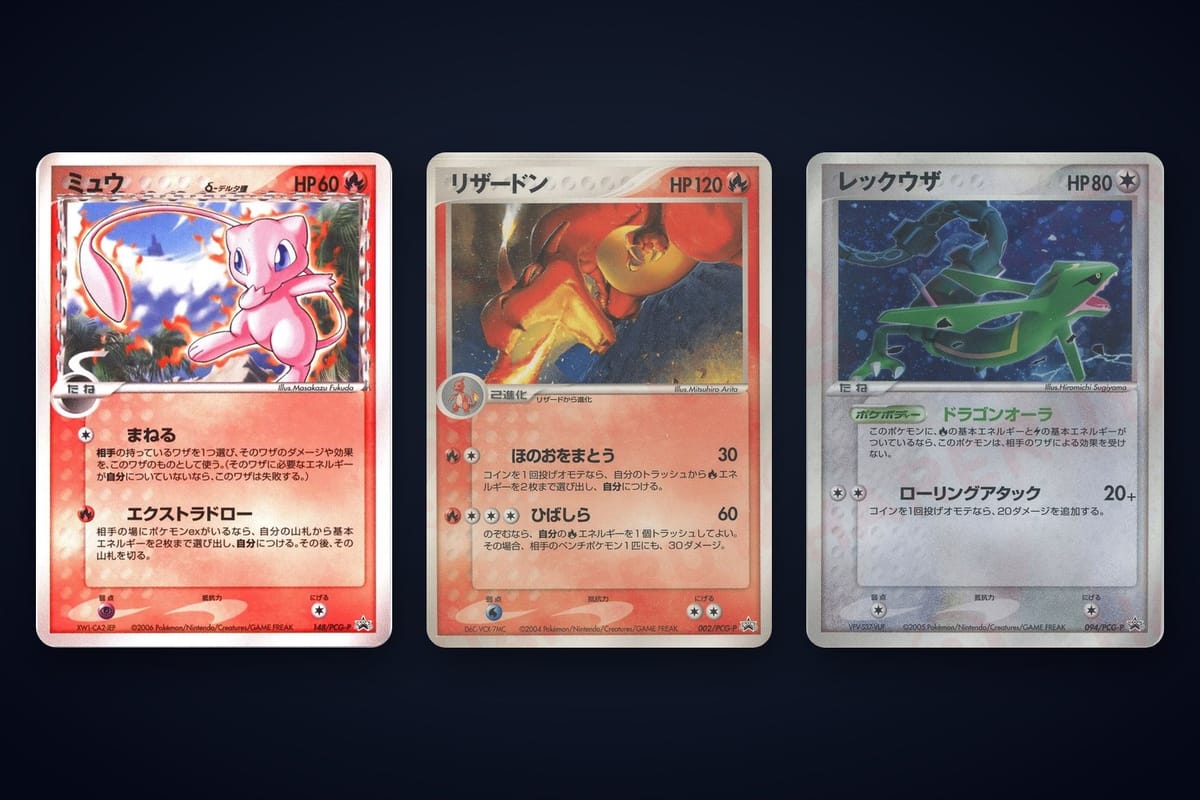
Estimated reading time: 11 min
Key Takeaways
- PCG Promos Pokemon cards value is driven by exact collector number, Japanese printing, condition, and graded population, not by the Pokémon's popularity alone.
- The names that dominate any PCG Promos price guide are Deoxys #18/PCG-P, PokéPark's Pikachu #043/PCG-P, and Charizard #2/PCG-P.
- The gap between raw and PSA 10 is where most of the money is, but only a small share of raw copies will typically reach a 10.
- Use completed sales, not asking prices, and measure centering before paying a grading fee.
- Prices in this guide come from the Midpoint database as of 2026-10-25 and are shown in the data table, not restated in the text.
Card values — live data from Midpoint's card database, as of 2026-10-25. Prices move; Midpoint refreshes these daily.
| Card | Raw | PSA 10 | Gem premium | |
|---|---|---|---|---|
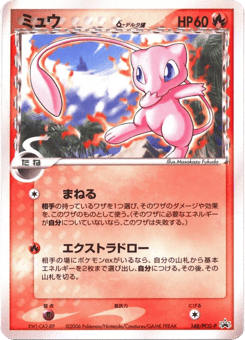 |
ミュウδ-デルタ種 #148/PCG-P PCG Promos (2003) |
$3,061 | $17,686 | 5.8× |
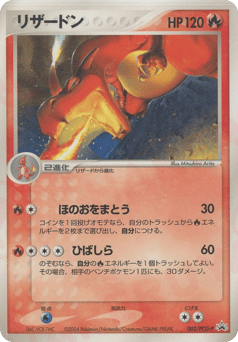 |
リザードン #002/PCG-P PCG Promos (2003) |
$1,594 | $8,120 | 5.1× |
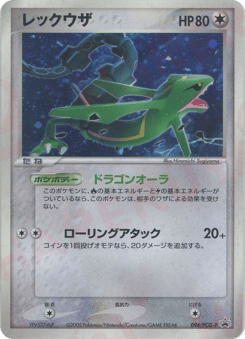 |
レックウザ #094/PCG-P PCG Promos (2003) |
$765.29 | $7,426 | 9.7× |
 |
ピカチュウ #153/PCG-P PCG Promos (2003) |
$765.29 | $5,900 | 7.7× |
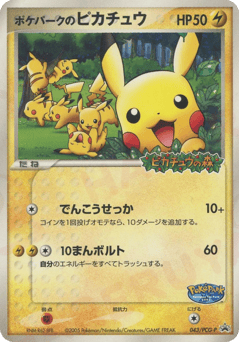 |
ポケパークのピカチュウ #043/PCG-P PCG Promos (2003) |
$956.61 | $5,262 | 5.5× |
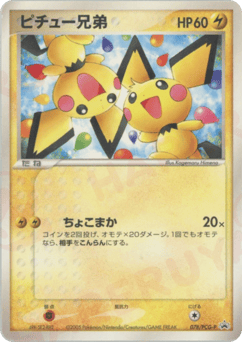 |
ピチュー兄弟 #078/PCG-P PCG Promos (2003) |
$382.64 | $5,100 | 13.3× |
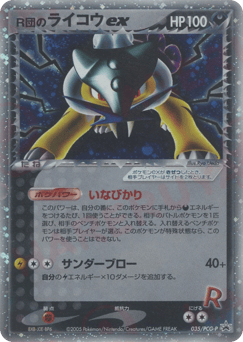 |
R団のライコウex #035/PCG-P PCG Promos (2003) |
$956.61 | $4,850 | 5.1× |
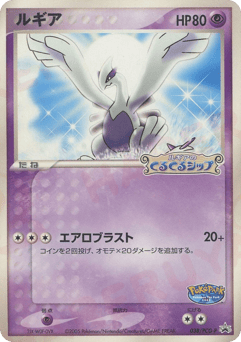 |
ルギア #038/PCG-P PCG Promos (2003) |
$446.42 | $4,439 | 9.9× |
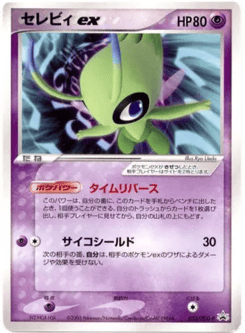 |
セレビィex #052/PCG-P PCG Promos (2003) |
$765.29 | $3,655 | 4.8× |
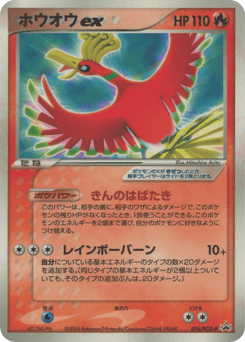 |
ホウオウex #076/PCG-P PCG Promos (2003) |
$127.55 | $2,954 | 23.2× |
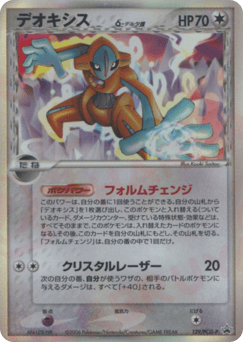 |
デオキシスδ-デルタ種 #129/PCG-P PCG Promos (2003) |
$318.87 | $2,847 | 8.9× |
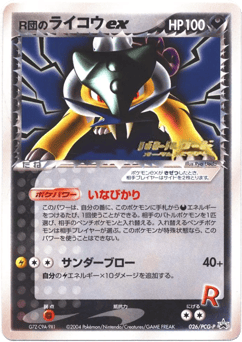 |
R団のライコウex #026/PCG-P PCG Promos (2003) |
— | $2,464 | — |
Look up any card's current raw and graded value in Midpoint — and get an estimated grade before you pay to submit.
Table of Contents
- Section 1: PCG Promos Set Overview and Why It Matters
- Section 2: PCG Promos Price Guide: Reading Raw Values Correctly
- Section 3: Most Valuable PCG Promos Cards
- Section 4: PCG Promos PSA 10 Value and the Gem-Premium Gap
- Section 5: How Card Identity Changes Value
- Section 6: PCG Promos Cards Worth Grading: A Decision Framework
- Section 7: Checking, Protecting, and Selling Your PCG Promo
- Conclusion
- FAQ
Section 1: PCG Promos Set Overview and Why It Matters
If you are researching PCG Promos Pokemon cards value, start by understanding what the set actually is. PCG Promos are Japanese promotional cards from the Pokémon Card Game "PCG" era, which sits in the EX-era window of Pokémon history. Every card carries a collector number ending in /PCG-P, for example 018/PCG-P or 043/PCG-P.
What "PCG-P" Tells You
The "P" stands for promo. These cards were not pulled from regular booster packs the way main-set cards were. They were handed out through events, magazines, tournaments, store campaigns, and tie-ins. That distribution style is the reason the set is hard to price from memory. Two cards in the same set can have very different supply.
- Language: Japanese printing, so comparable sales must be Japanese too.
- Numbering: The collector number is your fingerprint. Always match it exactly.
- Era context: Cards from the EX period can have print quality and card stock issues that make high grades difficult.
Why Collectors Chase This Set
Promos from this period combine nostalgia, limited distribution, and strong characters. Deoxys, Pikachu, and Charizard each carry a built-in fanbase well beyond Japanese-set specialists. That crossover demand is likely a major reason a handful of cards pull away from the rest of the set.
How This Guide Handles Numbers
A data table follows this section with raw and graded values as of 2026-10-25, pulled from Midpoint's database. I refer to specific entries by name below rather than repeating the table in prose. For total set size and the full checklist, verify against the card database for your exact number, since promo lists can include variants that casual lists skip.
One rule applies throughout: values move. A figure is a snapshot, and the method for reading it matters more than any single number.
Section 2: PCG Promos Price Guide: Reading Raw Values Correctly
A useful PCG Promos price guide is less about memorizing numbers and more about knowing what a number represents. Use the table above as your reference point, then apply the checks below.
Raw Value Is a Condition Range, Not One Price
"Raw" means ungraded, and raw cards span a wide spread. The same card can sell very differently depending on condition tier:
- Near mint (NM): clean surface, sharp corners, no whitening you can see at arm's length. This is the benchmark most price trackers quote.
- Lightly played (LP): minor edge wear or small surface marks. Expect a discount to NM.
- Played and damaged: creases, bends, water damage, or heavy whitening. These sell at steep discounts, and buyers often treat them as filler or space-holders.
When a listing says "NM" it is the seller's opinion. Compare photos, not labels.
Sold Data Beats Asking Prices
Rare Japanese promos attract aspirational listings. A seller can ask any figure, and it can sit unsold for months. Only completed sales tell you what a buyer actually paid. Look at the last several sales, discard outliers (a bidding war, a mislabeled card, an obvious shill), and note the date range.
Price History and Trend Matter
Thin-market cards can swing on a single sale. For a card that trades only a few times a quarter, one high sale does not set a new market. Check whether the trend is rising, flat, or falling over several months, and favor the median of recent sales over the highest one.
A Simple Raw-Pricing Workflow
- Confirm the exact number (for example #18/PCG-P).
- Confirm it is the Japanese printing.
- Grade the condition honestly, then pull sold comps in the same tier.
- Cross-check against the as-of 2026-10-25 figures in the table.
If you track a collection, Midpoint's card lookup and portfolio tracking keeps raw and graded values in one place so you can watch changes over time instead of re-searching each card.
Section 3: Most Valuable PCG Promos Cards
Three cards anchor almost every discussion of the most valuable PCG Promos cards. Their exact raw and graded figures as of 2026-10-25 are in the table; here is why each one commands attention.
Deoxys #18/PCG-P
Deoxys #18/PCG-P is the card collectors usually name first when asked about this set's top end. Deoxys was a marquee Pokémon of the EX era, and as a promo its supply is likely limited compared with main-set cards. Questions like "how much is Deoxys 18/PCG-P worth" come down to condition and grade: raw copies and professionally graded copies trade in very different ranges, so compare within the same tier.
PokéPark's Pikachu #043/PCG-P
PokéPark's Pikachu #043/PCG-P benefits from the most recognizable character in the franchise combined with a distinctive event tie-in. Pikachu demand is broad, spanning Japanese specialists, vintage collectors, and casual fans. That wider buyer pool can support value even when supply is not tiny. When checking PokéPark's Pikachu 043/PCG-P sales, make sure the comp is the same numbered card and not a different Pikachu promo.
Charizard #2/PCG-P
Charizard #2/PCG-P rides one of the most reliable demand engines in the hobby. Charizard cards tend to hold attention across every era. Verify the printing details on your copy and compare only against identical listings.
Why Not Every Famous Pokémon Wins
- Distribution: a card handed out widely is easier to find than one tied to a narrow event.
- Survival rate: promos were often given to kids, so clean copies can be scarcer than print runs imply.
- Buyer overlap: characters that appeal beyond Japanese-set collectors tend to hold value better.
Lower-tier PCG Promos still have collector demand, but the three names above are where the biggest raw and graded figures concentrate. Treat the table as your ranking, and recheck it before any buy or sell decision.
Section 4: PCG Promos PSA 10 Value and the Gem-Premium Gap
PCG Promos PSA 10 value is the number everyone wants, and it is also the one most easily misread. A PSA 10 is not a slightly better raw card. It sits in a different market with its own buyers.
What the Gem Premium Is
The gem premium is the difference between a card's raw value and its PSA 10 value. For older Japanese promos, the gap can be large because gem copies are hard to produce. Compare the raw and graded columns in the table for each card to see how wide the gap is on specific entries.
- PSA 9 vs PSA 10: the step from 9 to 10 is often much larger than the step from 8 to 9.
- Graded vs ungraded: even a PSA 7 or 8 can outsell a raw near-mint copy, because the slab removes condition doubt.
- Other companies: BGS, CGC, and TAG slabs price on their own scales. See our breakdown of grading scale differences by company before comparing a CGC 10 to a PSA 10.
Why Gem Copies Are Difficult on EX-Era Promos
Older promos commonly show issues that cap grades:
- Centering: off-center borders are a frequent reason a card misses a 10.
- Print lines and surface marks: especially visible on holofoil.
- Edge whitening: tiny chips along the borders can show up quickly and limit the grade.
Population Matters
A high PSA 10 value assumes the 10 is scarce. If many gem copies enter the market, the premium can compress. Low-pop cards behave differently from high-pop ones; our guide to grading low population cards explains how scarcity interacts with price.
The Practical Takeaway
Do not price your raw card at the PSA 10 figure. Price it at the raw figure for its true condition, then treat the gem premium as an upside you only earn if the card survives grading. Multiply the PSA 10 figure by your realistic chance of a 10, not by hope.
Section 5: How Card Identity Changes Value
Before you compare any prices, confirm what you are holding. Many "my card is worth a fortune" moments end when the identity check fails.
The Five Identity Checks
- Exact set: PCG Promos is not the same as a main PCG expansion. The /PCG-P suffix is the giveaway.
- Collector number: #18/PCG-P and #043/PCG-P are different cards with different markets.
- Japanese printing: English cards of the same Pokémon are a separate product with separate pricing.
- Holofoil or non-holo: check how your copy catches light. Finish can change both desirability and price.
- Artwork and variant: a similar illustration may exist across sets, and only one is the PCG promo.
Event Distribution Effects
Promos tied to a particular event, venue, or campaign can carry extra collector appeal. PokéPark's Pikachu #043/PCG-P is a good example: the name itself signals a specific tie-in, and buyers search for it that way. Cards with a clear origin story are easier to market and often hold interest better than anonymous promos.
Condition Is Part of Identity
Two copies of the same card are not the same product. A pack-fresh copy and a played copy might both be correctly identified and still sit in wildly different price tiers. This is why graded comps are so useful: the slab fixes the condition variable.
Common Mistakes
- Searching only the Pokémon name and grabbing the highest result.
- Mixing English and Japanese sales in one comp set.
- Ignoring the collector number and comparing a different promo of the same character.
- Using a PSA 10 sale to value a card with visible edge wear.
Fix identity first, condition second, price third. Skipping that order is how collectors overpay and under-sell.
Section 6: PCG Promos Cards Worth Grading: A Decision Framework
The question "are PCG Promos cards worth grading" has a clear answer pattern: it depends on the gap between raw and graded value, and on your realistic odds of a high grade.
The Break-Even Test
Grading fees vary by company and service level, and shipping, insurance, and turnaround time add to that. Check current fee schedules, then run this check:
- Take the likely graded value at the grade you can realistically expect (not the best case).
- Subtract the raw value and all submission costs.
- If what remains is thin or negative, skip grading.
For the top-tier cards in the table, the graded premium can justify a submission even at modest grades. For lower-value promos, fees can swallow the upside.
Start With Centering
Centering is the fastest filter. If the borders are visibly lopsided, a top grade is unlikely no matter how clean the surface looks. Our guide to how centering impacts card value shows why this one factor can decide the outcome.
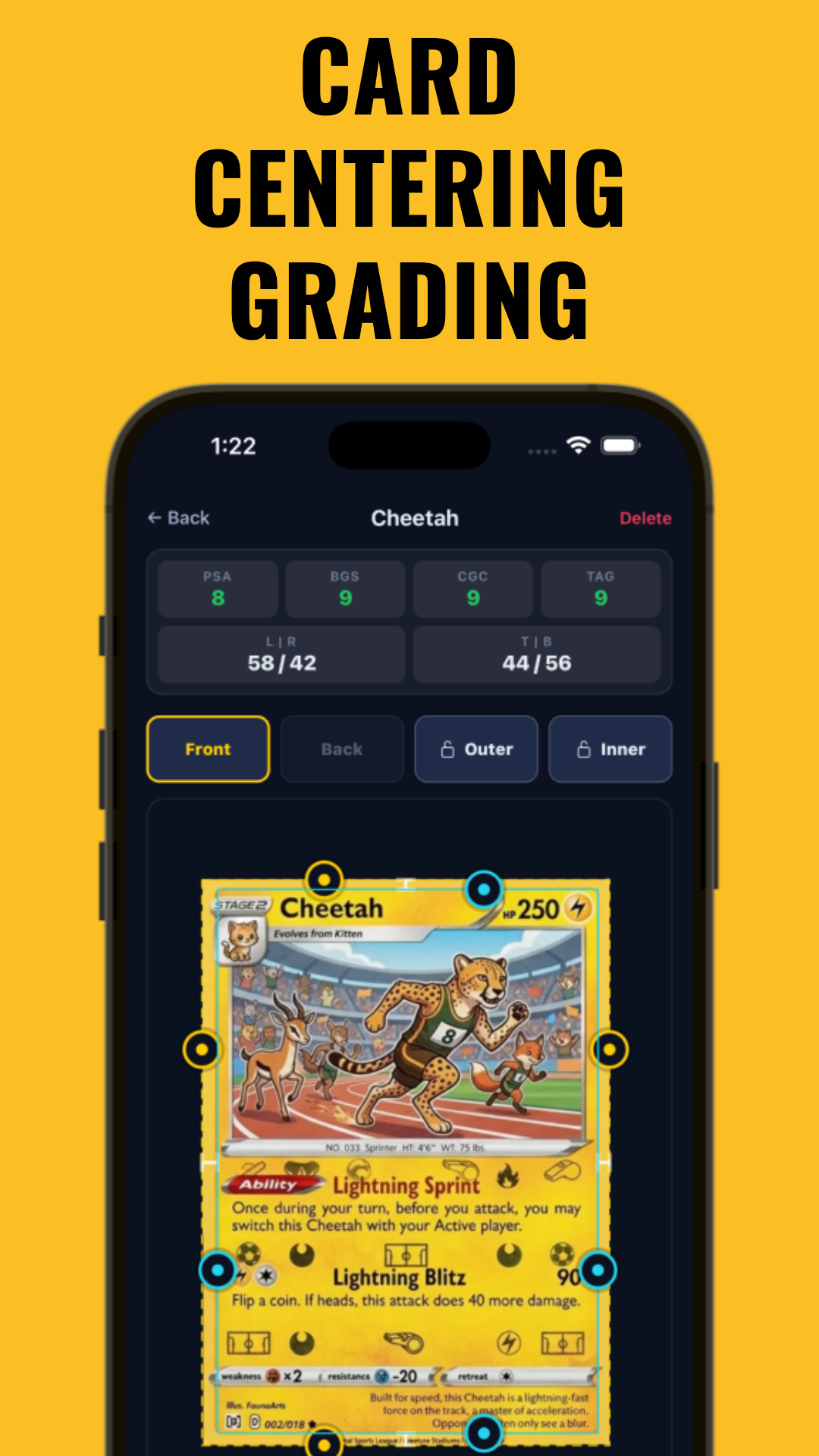
Midpoint measures centering down to the millimeter and gives an estimated PSA, BGS, CGC, or TAG grade from centering, corners, edges, and surface before you pay to submit.
Grade-by-Grade Strategy
- Likely 9 to 10: grade it. The gem premium is the point.
- Likely 7 to 8: grade only if the card is a top-tier name where even mid grades carry a strong premium over raw.
- Likely 6 or below: usually sell raw or keep it, unless authentication or protection is your goal.
Other Reasons to Grade
Grading also authenticates and protects. High-value Japanese promos can attract counterfeits, and a slab reassures buyers. A graded holder can also help with insurance documentation; see our guide on card grade impact on insurance value.
Section 7: Checking, Protecting, and Selling Your PCG Promo
Once you know the identity and likely grade, the last step is acting on it. Here is a repeatable process for checking value and deciding what to do.
How to Check a PCG Promo's Value
- Read the number: find the collector number printed on the card (for example 043/PCG-P).
- Match the printing: confirm Japanese, and confirm finish.
- Assess condition: inspect corners, edges, surface, and centering under good light. Our step-by-step pre-grading guide walks through it.
- Pull completed sales: use sold listings in the same condition or grade tier.
- Cross-reference: compare with the as-of 2026-10-25 figures for raw and graded copies in the table.
Protect What You Have
Value can vanish with one bad habit. Sleeve the card, use a rigid holder, and keep it away from humidity and sunlight. If a card might be worth grading, avoid handling the surface. Our collector's guide to storing valuable cards covers sleeves, toploaders, and storage environments in detail.
Selling Smart
- Raw sale: photograph front and back, show corners and edges, and disclose flaws. Buyers pay more when nothing is hidden.
- Graded sale: list the grade, certification number, and clear slab images.
- Timing: thin-market promos can take time to sell. Price against recent sold comps, not the highest ask you saw.
Track the Collection
If you hold several promos, log them so you can see total value over time and spot when a card's trend changes. Midpoint's portfolio tracking is built for that, and the app is free on iOS and Android.
Conclusion
PCG Promos Pokemon cards value comes down to a clear sequence: identify the exact card, grade your condition honestly, compare completed sales, and weigh the raw versus graded gap against realistic grading odds. Deoxys #18/PCG-P, PokéPark's Pikachu #043/PCG-P, and Charizard #2/PCG-P are the names that define the top of the set, and the table shows their raw and graded figures as of 2026-10-25.
Do not let a PSA 10 headline price drive your decision. Measure centering first, estimate the grade, run the break-even math, and only then submit. If you want a fast, free read on whether a card is worth sending in, try Midpoint before you spend on grading.
FAQ
Q: How much are PCG Promo Pokémon cards worth?
A: It varies widely by card and condition. A few cards at the top of the set, such as Deoxys #18/PCG-P, PokéPark's Pikachu #043/PCG-P, and Charizard #2/PCG-P, sit well above the rest. Check the data table for raw and graded figures as of 2026-10-25, and confirm with recent completed sales.
Q: What is the most valuable PCG Promo card?
A: The leading candidates are Deoxys #18/PCG-P, PokéPark's Pikachu #043/PCG-P, and Charizard #2/PCG-P. Which ranks first depends on condition and grade, so compare the same tier across the table.
Q: How much is Deoxys 18/PCG-P worth?
A: Its value depends on whether it is raw or graded and on the grade. Refer to the table's as-of 2026-10-25 raw and graded figures, then compare against sold listings for the same condition and Japanese printing.
Q: How much is PokéPark's Pikachu 043/PCG-P worth?
A: Look up the exact number 043/PCG-P and match condition or grade. The table lists raw and graded values as of 2026-10-25. Broad Pikachu demand supports interest, but only same-card completed sales are valid comps.
Q: Are PCG Promo Pokémon cards rare?
A: Many are scarcer than main-set cards because they were distributed through events and campaigns rather than packs. Rarity still varies by card, and clean high-grade copies are harder to find than the cards themselves.
Q: Should I grade my PCG Promo Pokémon card?
A: Grade it if the likely graded value, at a realistic grade, exceeds the raw value plus fees by a comfortable margin. Check centering, corners, edges, and surface first. If the card looks like a 9 or 10 candidate, grading is usually worth considering. If it is clearly worn, selling raw is often smarter.
Free to start
Try the Midpoint app
Grade any card from a photo, see its raw and PSA 10 value, and track what your collection is worth — free.
Get it on iPhoneGet it on Android