
Travis Hunter Cards Worth Money: Which to Grade vs Keep Raw
Which Travis Hunter cards are worth money? Compare rookie card value, raw vs PSA 10, top parallels and the best Travis Hunter cards to grade.

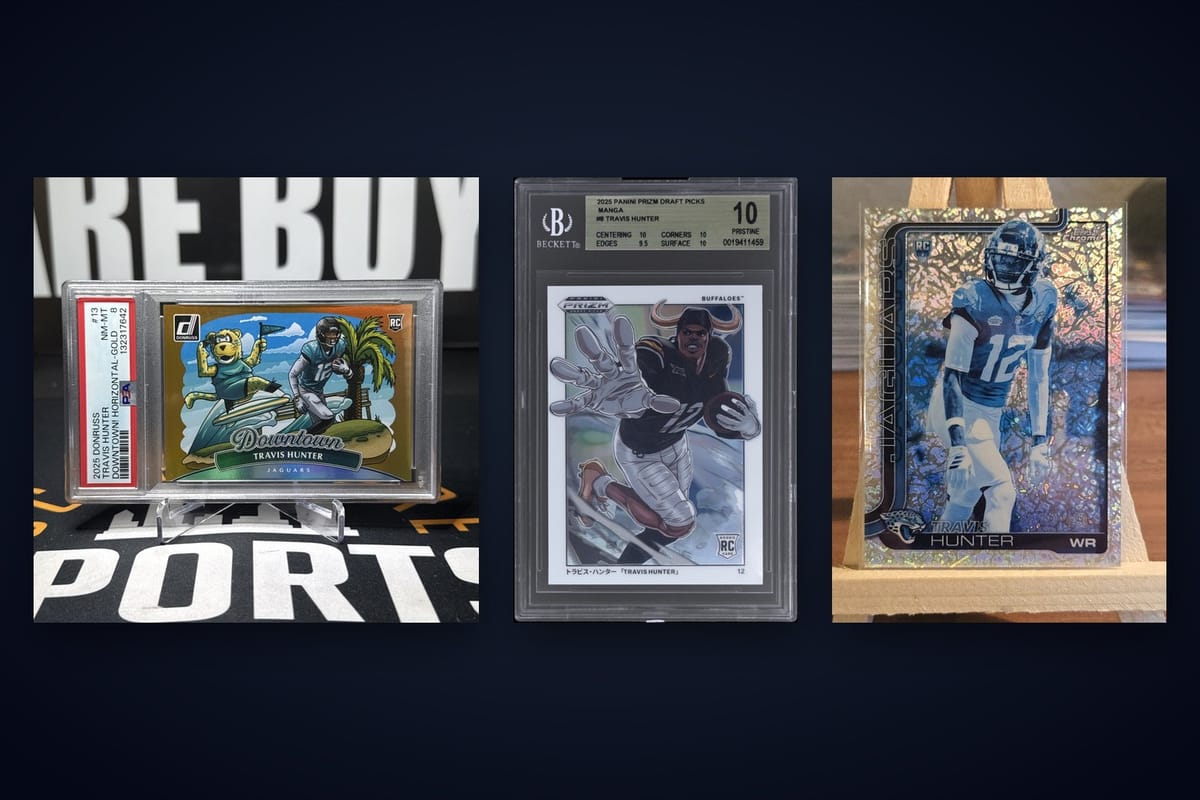
Estimated reading time: 11 min
Key Takeaways
- Travis Hunter cards worth money fall into clear tiers: serial-numbered parallels, autographs and patch autographs sit at the top, while base rookies are mostly worth grading only if they can reach a PSA 10.
- The 2025 Panini Prizm #301 is the benchmark Travis Hunter rookie card value to track, because it is the most-traded mainstream rookie.
- Raw and PSA 10 prices can sit far apart. The gap, not the raw price, decides whether grading pays off.
- Centering is the first filter. A card that is visibly off-center rarely earns a 10, so measure before you submit.
- Always price from completed sales, not asking prices, and re-check often because a two-way NFL player's market can move quickly.
Card values — live data from Midpoint's card database, as of 2026-09-04. Prices move; Midpoint refreshes these daily.
| Card | Raw | PSA 10 | Gem premium | |
|---|---|---|---|---|
 |
Travis Hunter [Gold] #13 2025 Panini Donruss Downtown |
$5,307 | $5,969 | 1.1× |
 |
Travis Hunter #8 2025 Panini Prizm Draft Picks Manga |
$1,275 | $5,391 | 4.2× |
 |
Travis Hunter [Frozenfractor] #332 2025 Topps Chrome |
$830.00 | $3,772 | 4.5× |
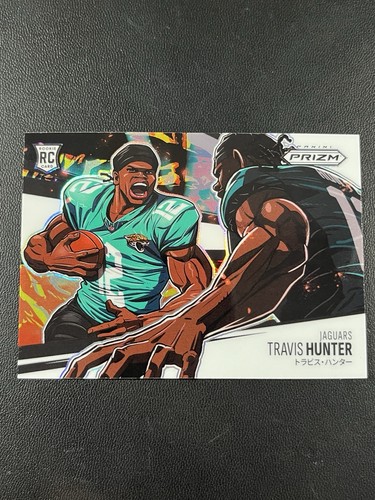 |
Travis Hunter #12 2025 Panini Prizm Manga Horizontal |
$1,844 | $3,500 | 1.9× |
 |
Travis Hunter [Black Pandora] #13 2025 Panini Donruss Optic Downtown |
$2,241 | $3,075 | 1.4× |
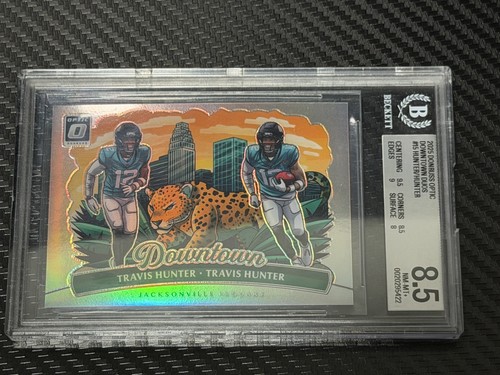 |
Travis Hunter / Travis Hunter #15 2025 Panini Donruss Optic Downtown Duo |
$816.88 | $3,053 | 3.7× |
 |
Travis Hunter #TECMO-17 2025 Topps Chrome Tecmo |
$771.39 | $2,979 | 3.9× |
 |
Travis Hunter #KAI-9 2025 Topps Chrome Kaiju |
$1,400 | $2,688 | 1.9× |
 |
Travis Hunter #2 2025 Panini Flawless Rookie Dual Patch Autograph |
$512.50 | $2,340 | 4.6× |
 |
Travis Hunter #36 2025 Panini Absolute Kaboom Vertical |
$831.00 | $2,213 | 2.7× |
 |
Shedeur Sanders / Travis Hunter #2 2025 Panini Prizm Draft Picks Color Blast Dual |
$465.00 | $1,990 | 4.3× |
 |
Travis Hunter [White Pandora] #21 2025 Panini Donruss Optic Uptown |
— | $1,925 | — |
Look up any card's current raw and graded value in Midpoint — and get an estimated grade before you pay to submit.
Table of Contents
- Section 1: Which Travis Hunter Cards Are Worth Money?
- Section 2: Travis Hunter Rookie Card Value and the True Rookie
- Section 3: The Most Valuable Travis Hunter Cards
- Section 4: Set-by-Set Comparison
- Section 5: Travis Hunter PSA 10 vs Raw
- Section 6: Best Travis Hunter Cards to Grade
- Section 7: How to Identify, Verify and Sell Your Card
- Section 8: Market Outlook and Investment Risk
- Conclusion
- FAQ
Section 1: Which Travis Hunter Cards Are Worth Money?
Travis Hunter is the rare player whose cards attract both football collectors and hobby speculators. He won the Heisman at Colorado, went second overall to the Jaguars in the 2025 NFL Draft, and plays both receiver and cornerback. That two-way story is exactly why Travis Hunter cards worth money is such a common search.
Not every card carrying his name is valuable, though. Value concentrates in a handful of places.
The value tiers
- Top tier: one-of-ones, low-numbered parallels, rookie autographs and patch autographs.
- Middle tier: mid-numbered color parallels, case-hit inserts and key rookie parallels in high grades.
- Entry tier: base rookies, common inserts and unnumbered parallels. These are worth grading only when the copy is flawless.
Use completed sales, not asking prices
An asking price is a wish. A completed sale is a fact. When you check any card, look at what actually sold, how many sold, and over what time window. A single sale can be an outlier, so look for a cluster of sales and use the median.
The data table that follows this section shows raw and graded values pulled from Midpoint's database as of 2026-09-04. Use it as your baseline. Then compare against your own recent sold listings before you buy, sell or submit anything.
Why prices move fast
Hunter is a young, high-profile player. Game performance, injuries, and headlines can all push demand. That means any price you read, including the table, is a snapshot rather than a promise.
Section 2: Travis Hunter Rookie Card Value and the True Rookie
The question most buyers ask first is what the Travis Hunter rookie card value is. The answer depends on which rookie you mean, so start by defining it.
What counts as a true rookie card?
Hobby convention treats a card as an NFL rookie when it is from a licensed set released after the draft and shows the player in an NFL uniform (or the set is clearly branded as his rookie year). Pre-draft college and prospect cards, such as Colorado-era issues, are usually called prospect cards, not true rookies. They can still carry value, but they trade as a separate market.
- True rookies: 2025 Panini Prizm, Donruss, Donruss Optic, Select, Topps Chrome, National Treasures and similar flagship releases.
- Prospect cards: college-uniform issues from earlier years.
- Instant and special releases: limited print-run products like Panini Instant, which are rookies but follow their own pricing logic.
The 2025 Panini Prizm #301
The 2025 Panini Prizm #301 is the card most collectors mean when they say Hunter's rookie. Prizm is the market's default football rookie product, so its base card and Silver parallel set the reference points for comparison.
To value it, separate three states:
- Raw: ungraded, priced by condition you can see.
- PSA 9: a strong copy with a small flaw.
- PSA 10: the premium grade, which usually carries a noticeable multiple over PSA 9.
Check the table after Section 1 for the current raw, PSA 9 and PSA 10 figures in Midpoint's database. The pattern to watch is the spread between those three. A wide spread favors grading, while a narrow one means you should keep the card raw.
Section 3: The Most Valuable Travis Hunter Cards
When people search for the most valuable Travis Hunter cards, they usually want the ceiling of the market. It is set by scarcity and by what the card is.
One-of-ones and Superfractors
Every major brand has a 1/1 chase. In Topps Chrome that is the Superfractor, while Panini Prizm uses the Black Finite style one-of-one. A single copy means a single buyer, so these cards trade rarely and their prices are volatile. Treat any listing you see as a data point, not a standard.
Autographs and patch autographs
Rookie autographs are the backbone of the high-end market. The most sought-after are:
- Rookie patch autographs (RPAs): a jersey or patch swatch plus an on-card signature, often serial-numbered.
- On-card autographs from premium products like National Treasures, which collectors generally prefer to sticker autographs.
- NFL shield patches, where the swatch features the league shield. These often command a premium within a patch set.
Low-numbered parallels
Serial numbers matter. A card numbered to /10 or /25 is far scarcer than one numbered to /199, and scarcity usually drives price. Colors that match his team, such as teal-themed parallels for the Jaguars, can attract extra interest from team collectors.
Case hits
Insert families such as Downtown and Color Blast are known as case hits because they are extremely rare in packs, often appearing far less than once per case. Their rarity and striking designs make them some of the most desirable non-autograph cards in any set. Their market is thinner, so verify with several recent sales.
The takeaway: autographs and serial-numbered cards lead, and case hits follow. Base cards trail them.
Section 4: Set-by-Set Comparison
Each product has a different audience, print run and grading history. Here is how the main Travis Hunter rookie cards compare in practice.
Panini Prizm
The market standard. Prizm has the deepest buyer pool, which means easier selling and more reliable sold data. Silver Prizms and numbered color parallels are the staple chase cards.
Donruss and Donruss Optic
Donruss offers the Rated Rookie label, which collectors love. Optic uses a chrome-style finish and has Holo and numbered parallels. Optic's Rated Rookie is a frequent grading submission because the surface photographs well and can hold high grades when centered.
Topps Chrome
Topps Chrome offers Refractors and the 1/1 Superfractor. After years of Panini dominance, Topps' return to football has drawn collector attention to Chrome, and refractor-style parallels are popular grading targets.
Select
Select is known for tiered Concourse, Premier Level and Field Level cards. The tiers create built-in scarcity differences, so confirm which tier you hold.
National Treasures
The premium high-end brand, famous for patch autographs and low print runs. Expect a small number of cards and high prices per sale.
Panini Instant
Instant cards are printed to order, with a public print run. They are often cheaper entry points, but a large print run limits upside.
Case hits compared with base cards
The difference between a base card and a Downtown or Color Blast is usually enormous, because the base card has thousands of copies and the insert has a tiny fraction of that. Refractors, Silvers and color parallels sit in between. Use the table after Section 1 to see how Midpoint's data ranks specific entries.
Section 5: Travis Hunter PSA 10 vs Raw
A Travis Hunter PSA 10 is the grade most buyers pay up for. The premium over raw reflects scarcity: only copies with sharp corners, clean surfaces and good centering earn it.
What PSA actually checks
- Centering: PSA 10 generally requires roughly 55/45 or better on the front and 75/25 on the back.
- Corners: sharp and free of white touches.
- Edges: no chipping, which is common on dark-bordered cards.
- Surface: no scratches, print lines, fingerprints or dimples. Chrome and Prizm finishes show flaws easily.
PSA vs BGS vs SGC
Each company grades differently. PSA is the market leader for resale value. BGS offers subgrades and a Black Label for a perfect set of subgrades. SGC is popular for speed and value. For a breakdown of how the top grades differ, see this guide on grading scale differences by company.
Why centering decides so many outcomes
Prizm and Chrome cards are known for being off-center, because borders are thin and cutting varies. A card can look perfect and still miss a 10 on centering alone. Our deep dive on how centering impacts card value explains the math.
Reading the gap
Compare the raw value to the PSA 9 and PSA 10 values in the table. If PSA 9 barely beats raw after you factor in grading fees, only a likely 10 justifies submitting. If the PSA 10 premium is large, a high-probability candidate can be worth the grading fee and the wait.
Section 6: Best Travis Hunter Cards to Grade
The best Travis Hunter cards to grade are not necessarily the most expensive ones. They are the cards where the value jump from raw to graded exceeds your total cost, and where your copy is likely to hit the target grade.
A simple decision framework
- Step 1: Look up the raw, PSA 9 and PSA 10 values.
- Step 2: Subtract grading fees, shipping and insurance from the likely graded value.
- Step 3: Estimate your odds of a 10 honestly. Multiply that chance by the PSA 10 value, and the remaining chance by the PSA 9 value (or lower).
- Step 4: Submit only if the expected result beats keeping the card raw.
Strong candidates
- Prizm #301 base and Silver: high demand and a deep buyer pool make a PSA 10 easy to sell.
- Donruss Optic Rated Rookie and Holo: clean surfaces and strong collector appeal.
- Numbered color parallels: grading protects scarce cards and adds liquidity.
- Topps Chrome Refractors: popular and well-suited to slabs.
Cards to leave raw
Skip grading when the card is visibly off-center, has surface lines, or is a common base card whose graded premium does not cover the fee. Grading a flawed copy often means paying to lock in a 7 or 8.
Pre-grade before you pay
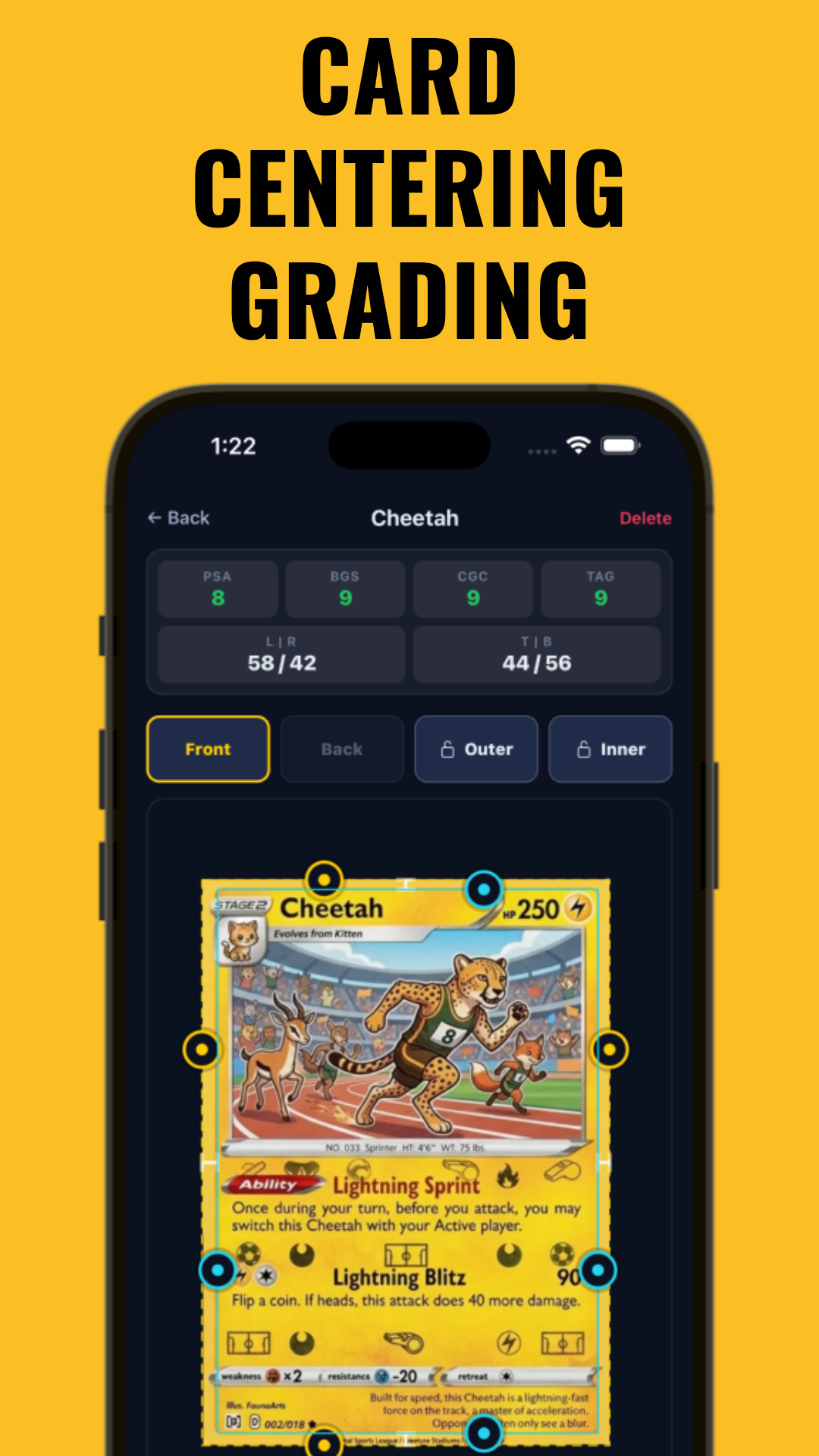
This is where a measuring tool saves money. Midpoint lets you scan a card and measure centering to the millimeter, then gives an estimated PSA, BGS, CGC and TAG grade before you submit. For a step-by-step approach, follow our guide to pre-grading your card.
Section 7: How to Identify, Verify and Sell Your Card
Before you can value a card, you have to identify it precisely. Two Hunter cards that look similar can be worth very different amounts.
Read the card back and front
- Year and manufacturer: found in the copyright line and logo (Panini, Topps).
- Set name: Prizm, Donruss, Optic, Chrome, Select, National Treasures or Instant.
- Card number: the Prizm rookie is #301, so a number mismatch signals a different card.
- Parallel: identify by color, finish and pattern. Compare against a checklist.
- Serial number: stamped as, for example, 12/25. The denominator tells you the print run.
- Autograph or memorabilia: on-card or sticker signature, plus patch or jersey swatch details.
Verify the value
Check several sources and weigh them against each other:
- eBay sold listings: filter to completed sales for the exact card and grade.
- Auction house results: useful for high-end autographs and 1/1s.
- Price guides and marketplaces: good for trend lines, but confirm against sales.
- Midpoint: look up raw vs graded values across over 1.5 million cards, then track what you own over time. The Midpoint app is free on iOS and Android.
Where to sell
Raw base cards sell well in bulk or on eBay. Graded PSA 10s do best on eBay or in auctions. High-end autographs and patches often justify a consignment auction. Match the venue to the card's price level and fees.
Protect what you keep
A flawless card can lose value from a single mishandled moment. Sleeve, top-load and store properly, as covered in our guide to storing valuable cards.
Section 8: Market Outlook and Investment Risk
Are Travis Hunter cards worth money in the long run? No one can promise that, and anyone who does is guessing. What you can do is understand the forces at work.
What could push values up
- Two-way production: a player who contributes on offense and defense is a genuine novelty and a marketing story.
- Early-career demand: demand for young players often peaks around their first big moments.
- Scarcity: low-numbered cards and high-grade copies cannot be reprinted.
- Collector crossover: Heisman history and a large fan base widen the buyer pool.
What could push values down
- Injury or slow production: football is physical, and a two-way role adds wear.
- Hype cycles: rookie prices can run ahead of performance.
- Print runs: abundant base cards and big grade populations limit upside. Our guide to grading low population cards shows why scarcity at a given grade matters.
A sensible approach
- Buy only what you would be happy to hold if the price stalls.
- Prefer high-grade copies of key rookies over many ungraded commons.
- Diversify across a few sets rather than concentrating in one parallel.
- Track your collection's value over time so you can sell into strength.
Treat cards as a hobby first and a store of value second. That mindset keeps you from overpaying at the top.
Conclusion
The Travis Hunter cards worth the most money are the scarce ones: autographs, patch autographs, one-of-ones, low-numbered parallels and case hits. The 2025 Panini Prizm #301 remains the key mainstream rookie to track, and a Travis Hunter PSA 10 can carry a large premium over raw, but only when the copy truly earns it.
Before you grade, check recent completed sales, compare the raw, PSA 9 and PSA 10 spread in the table above (values as of 2026-09-04), and measure centering honestly. A card that is off-center on the front is rarely a good grading bet.
To take the guesswork out, try Midpoint to measure centering, get an estimated grade and look up values before you spend on submission. You can also use the free centering calculator for a quick check.
FAQ
Q: How much is a Travis Hunter rookie card worth?
A: It depends on the set, parallel, serial number and grade. Base rookies sit at the low end, while numbered parallels, autographs and patch autographs sit far higher. See the table in this post for Midpoint's raw and graded values as of 2026-09-04, and confirm against recent completed sales.
Q: What is Travis Hunter's most valuable card?
A: The most valuable cards are typically one-of-ones, Superfractors, low-numbered parallels, and rookie autographs or patch autographs. Because 1/1s trade rarely, check recent auction results rather than relying on one listing.
Q: What is Travis Hunter's true rookie card?
A: A true rookie is a licensed NFL-era card from a 2025 release such as Panini Prizm, Donruss, Donruss Optic, Topps Chrome, Select or National Treasures. College-era cards are generally treated as prospect cards, not true rookies.
Q: How much is the 2025 Panini Prizm Travis Hunter #301 worth?
A: Value varies by raw, PSA 9 and PSA 10 condition, and the PSA 10 usually commands a clear premium. Check the data table above for Midpoint's figures as of 2026-09-04 and compare them with eBay sold listings.
Q: Are Travis Hunter cards a good investment?
A: There are no guarantees. His two-way role and scarcity support demand, but injuries, hype cycles and large print runs are real risks. Favor high-grade key rookies and scarce parallels, and only spend what you are comfortable holding.
Q: How do I find the value of my Travis Hunter card?
A: Identify the year, set, card number, parallel and serial number. Then compare eBay sold listings, auction results and price guides for that exact card and grade. A card lookup in Midpoint shows raw vs graded values and lets you track your collection over time.
Free to start
Try the Midpoint app
Grade any card from a photo, see its raw and PSA 10 value, and track what your collection is worth — free.
Get it on iPhoneGet it on Android


