1958 Topps Baseball Cards Value: Price Guide by Grade
1958 Topps baseball cards value explained: most valuable cards, raw vs graded gaps, PSA 10 premiums, and which cards are worth grading before you submit.

Estimated reading time: 11 min
Key Takeaways
- 1958 Topps baseball cards value is driven by three things: the player (Mantle, Mays, Aaron, Williams, Koufax, Clemente), the card number, and above all the condition.
- The gap between a raw, played copy and a high-grade slab is enormous on this set, so the gem premium matters more than the base price.
- Not every card is worth grading. Stars and key rookies like Maris #47 and Cepeda #343 usually justify the fee; commons rarely do unless they are razor sharp.
- Centering, corners, print defects, stains and rubber-band damage decide the grade. Check them before you pay to submit.
- Always verify any price against recent completed sales. Use Midpoint's database (figures as of 2026-11-22) as a reference point, not a final answer.
Card values — live data from Midpoint's card database, as of 2026-11-22. Prices move; Midpoint refreshes these daily.
| Card | Raw | PSA 10 | Gem premium | |
|---|---|---|---|---|
 |
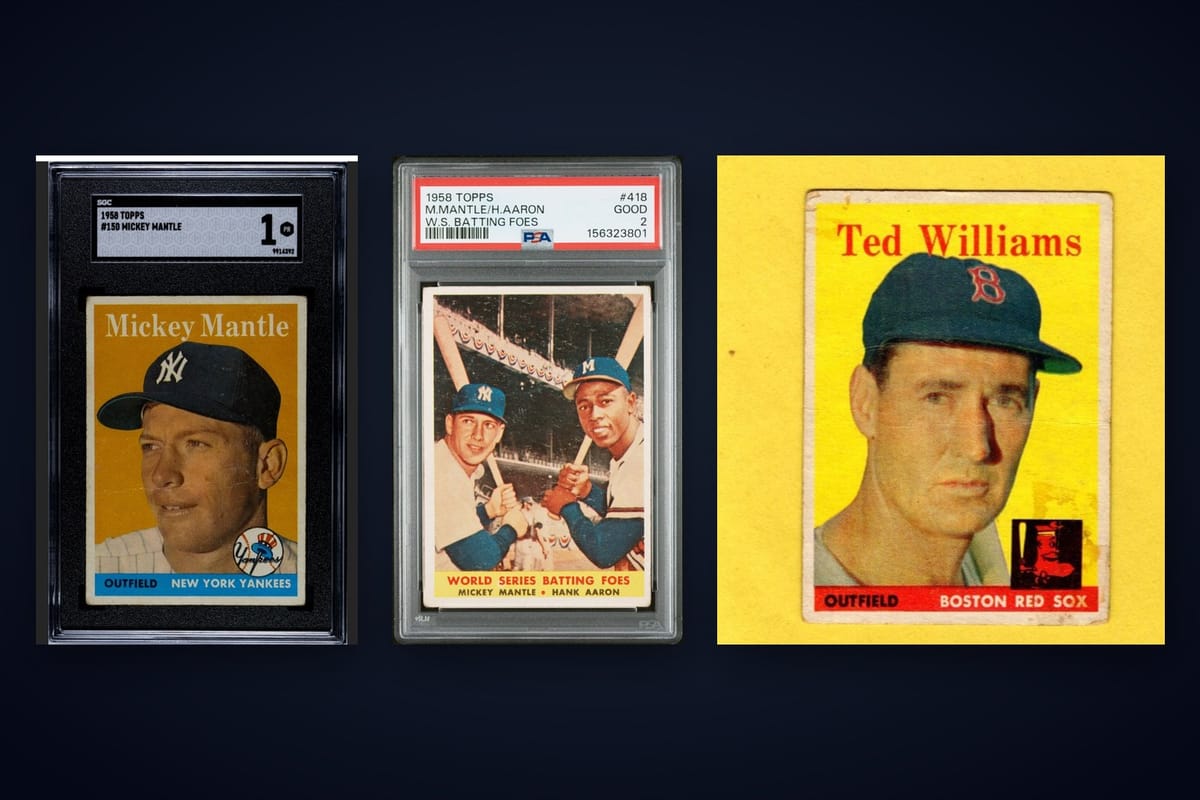
Mickey Mantle #150 1958 Topps |
$435.11 | $146,408 | 336.5× |
 |
World Series Batting Foes #418 1958 Topps |
$179.75 | $70,560 | 392.6× |
 |
Ted Williams #1 1958 Topps |
$113.21 | $55,947 | 494.2× |
 |
Hank Aaron [Yellow] #30 1958 Topps |
$259.25 | $48,897 | 188.6× |
 |
Sandy Koufax #187 1958 Topps |
$82.90 | $44,458 | 536.3× |
 |
Bob Clemente [Yellow] #52 1958 Topps |
$216.97 | $43,572 | 200.8× |
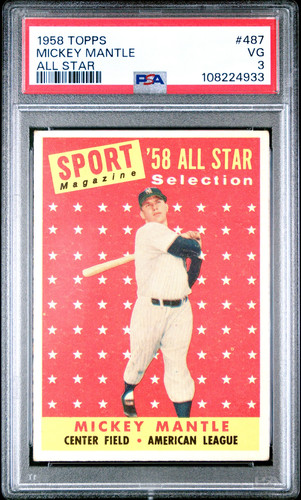 |
Mickey Mantle: All Star #487 1958 Topps |
$166.07 | $32,372 | 194.9× |
 |
Bob Clemente [White] #52 1958 Topps |
$148.18 | $29,811 | 201.2× |
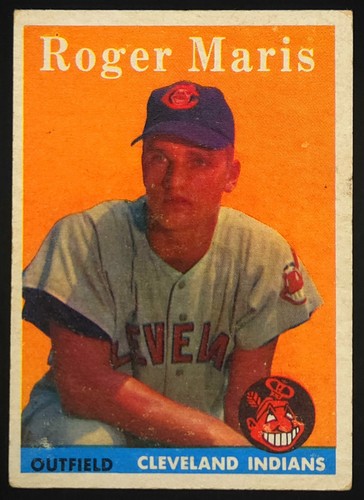 |
Roger Maris #47 1958 Topps |
$142.25 | $28,026 | 197× |
 |
Hank Aaron [White] #30 1958 Topps |
$143.75 | $24,434 | 170× |
 |
Willie Mays #5 1958 Topps |
$91.00 | $18,743 | 206× |
 |
Al Kaline [Yellow] #70 1958 Topps |
$84.21 | $16,005 | 190.1× |
Look up any card's current raw and graded value in Midpoint — and get an estimated grade before you pay to submit.
Table of Contents
- Section 1: How 1958 Topps Baseball Cards Value Works
- Section 2: Most Valuable 1958 Topps Cards
- Section 3: Rookies, Key Cards and Subsets Worth Knowing
- Section 4: The Gem Premium and 1958 Topps PSA 10 Value
- Section 5: What Condition Issues Cost You
- Section 6: 1958 Topps Cards Worth Grading (and Those That Are Not)
- Section 7: Authenticating, Appraising and Selling Your Cards
- Conclusion
- FAQ
Section 1: How 1958 Topps Baseball Cards Value Works
If you are searching for 1958 Topps baseball cards value, start with the structure of the set. It is a 494-card release issued in multiple series, and it includes team cards, combo cards and All-Star subsets alongside the base player cards. Each of those categories prices differently.
For exact numbers on specific cards, use Midpoint's card lookup, which lists entries from its database as of 2026-11-22. This guide explains what sits behind those numbers.
The four value drivers
- Player: Hall of Famers and icons carry the set. A Mickey Mantle will always out-price a role player in the same condition.
- Card number and type: Base star cards, rookies, All-Star cards and combo cards each have their own demand.
- Grade: A PSA 2 and a PSA 8 of the same card can be in completely different price universes.
- Eye appeal: Two cards with the same grade can sell for different amounts if one is better centered or has cleaner color.
Why this set is condition sensitive
The 1958 issue is nearly seventy years old. Most copies were handled, flipped, stored with rubber bands or stuffed in shoeboxes. That means sharp, well-centered, clean copies are scarce, and the market pays a steep premium for them.
That scarcity is the reason a price guide for this set is really a price guide by grade. A single number for "a 1958 Topps Mantle" is almost meaningless without the condition attached.
How to use any 1958 Topps price guide
Treat every guide as a starting point. Check the grade, confirm the exact card number, and compare against recent sold listings rather than asking prices. Midpoint's card lookup shows raw versus graded values across more than 1.5 million cards, which makes the gap between grades easy to see on one screen.
Section 2: Most Valuable 1958 Topps Cards
When collectors ask about the most valuable 1958 Topps cards, the answer is led by a handful of superstar names. These are the cards that anchor the set and attract the deepest bidding in every grade.
The big six star cards
- Mickey Mantle #150: The flagship card of the set and the one most buyers want first. It tends to lead any ranking of the most valuable 1958 Topps cards.
- Willie Mays #5: An early-number card in the first series, which may mean it often shows more edge wear than later numbers.
- Hank Aaron #30: A cornerstone Hall of Fame card with steady demand across all grades.
- Ted Williams #1: The very first card in the set. Number-one cards often sat on top of the stack and commonly suffer corner and surface damage, so high grades can be harder to find.
- Sandy Koufax #187: A pre-peak Dodgers Koufax that attracts both team and pitcher collectors.
- Roberto Clemente #52: A perennial favorite with strong collector crossover.
Why low numbers matter
Low-numbered cards such as #1 and #5 were often at the outer edges of their stacks or bundles, where rubber bands, packaging and handling can hit them first. That is a reason a Williams #1 or Mays #5 in a high grade can be tougher to source than their raw popularity suggests.
Where to check exact figures
For specific values on these cards, refer to Midpoint's card lookup. The database lists raw and graded values side by side, as of 2026-11-22, so you can see how much the market pays at each step up the grade ladder.
One practical note: do not compare a Mantle to a Clemente by headline price alone. Compare them in the same grade, because population and condition rarity differ for every card number.
Section 3: Rookies, Key Cards and Subsets Worth Knowing
Beyond the headline stars, several cards in the set pull far above their weight because of rookie status, subset appeal or crossover demand from other collecting areas.
Key rookie and notable cards
- Roger Maris #47: Maris's first Topps card. Interest in his 1961 home run chase and his later career keeps demand steady, and it is a classic entry point for collectors who cannot afford a Mantle.
- Orlando Cepeda #343: Cepeda's rookie card from a later series. High-number cards from later series can be tougher to find in top condition, which can amplify the grade premium.
Subsets and combo cards
The 1958 set includes All-Star cards, combo cards and team cards. Two are especially notable because Mantle appears on them:
- Mantle/Aaron World Series Batting Foes #418: A combo card pairing two of the biggest names in the set. It gives you two Hall of Famers on one card.
- Mickey Mantle All-Star #487: A Mantle card that is not the base #150, often more approachable in price while still carrying the name.
Subset cards like these often sell at a discount to the main Mantle but at a premium to ordinary commons. They are good targets for collectors who want a Mantle presence without chasing #150.
Team cards and commons
Team cards are checklist-style cards, and some can be marked or filled in by previous owners, so condition and clean checklists matter. Commons are the bulk of the set. Most are inexpensive in low and mid grades, but a sharp, centered copy in a high grade can still bring a respectable premium because so few survived in that condition.
If you are completing a set, the common cards are where patience pays off. Buy the best condition you can afford on the stars, and accept mid-grade copies on the rest.
Section 4: The Gem Premium and 1958 Topps PSA 10 Value
The central question in any 1958 Topps price guide is how much extra the market pays as the grade climbs. That jump is what collectors call the gem premium, and for vintage sets like this one it is dramatic.
Raw versus graded
An ungraded card is a question mark. The buyer has to guess at centering, surface and corners, and discounts accordingly. A graded card removes much of that uncertainty, so the same card often sells for more once it is encapsulated, because authenticity and condition are verified.
In general, the progression looks like this:
- PSA 1 to PSA 3: Affordable entry point. Creases, rounded corners and surface wear are visible, but the card is authentic and displayable.
- PSA 4 to PSA 6: The "nice looking" tier for most collectors, with moderate wear.
- PSA 7 to PSA 8: Sharp corners, strong color and good centering. Prices step up sharply here.
- PSA 9 and PSA 10: True gem territory, where prices can leap by multiples from the grade below.
What a PSA 10 means for this set
A 1958 Topps PSA 10 value is hard to pin down because PSA 10 examples of this vintage are exceptionally rare. For many cards in the set, a PSA 10 may not exist at all or may have appeared only a handful of times. When a card trades, the sale can reset the market. Midpoint's database tracks the graded values it has on file, as of 2026-11-22, but treat any single top-grade comp with caution.
Thin markets, volatile prices
With only a few high-grade copies on record, one auction can swing the "price." Look at multiple sales, the grade of each, and the date. For a deeper look at how rarity changes the equation, see this guide on card grading for low population cards.
Section 5: What Condition Issues Cost You
Condition is where most of the money is won or lost with 1958 Topps. Graders examine centering, corners, edges and surface, and each flaw can cap the grade.
Centering
Off-center printing is common on cards from this era. A card with a lopsided border can be limited to a lower grade even if everything else is clean. Measuring your centering before submission tells you whether a card has any chance at the top tier. Our guide on how centering impacts card value breaks down the ratios graders use.
Corners, edges and surface
- Corners: Rounded or frayed corners are the most common flaw and a quick way to drop several grades.
- Edges: Chipping on the borders shows up clearly against the set's design.
- Surface wear: Scuffs, gloss loss and scratches reduce eye appeal.
- Print defects: Print dots, snow and registration issues can affect the grade even on an otherwise clean card.
Damage that sinks value
Some problems do more than lower a grade. Stains, creases, writing, tape residue and rubber-band damage can reduce a card to a low grade or lead to a "qualified" or altered-card designation. Rubber-band marks often appear as indentations along the edges, particularly on cards that sat at the top or bottom of a bundle.
Altered cards, such as those with trimmed edges or touched-up corners, are a real concern in vintage. Graders look for these, and a card flagged as altered loses much of its value.
Storage matters from here on
If you have a clean copy, keep it that way. Proper sleeves and holders prevent new damage. See how to store valuable cards for a practical setup.
Section 6: 1958 Topps Cards Worth Grading (and Those That Are Not)
Deciding whether 1958 Topps cards worth grading applies to your collection is a math problem. Grading fees vary by company and service level, and typically start around $30 or more per card. That cost only makes sense if grading lifts the card's value by more than the fee, plus shipping and time.
Strong grading candidates
- Star cards: Mantle #150, Mays #5, Aaron #30, Williams #1, Koufax #187 and Clemente #52 are almost always worth grading if they are authentic and reasonably clean.
- Key rookies: Maris #47 and Cepeda #343 carry enough demand that a graded label typically adds meaningful value.
- Mantle subsets: #418 and #487 deserve a look if corners and surface hold up.
- Sharp commons: Only if the card looks near-mint, centered and clean. A true gem common can be worth the fee.
Cards to skip
Heavily creased, stained or trimmed cards are usually better sold raw, or kept for the collection. Slabbing a damaged common costs more than it returns. For cards with obvious problems, a low grade will not offset the fee.
Pre-grade before you pay
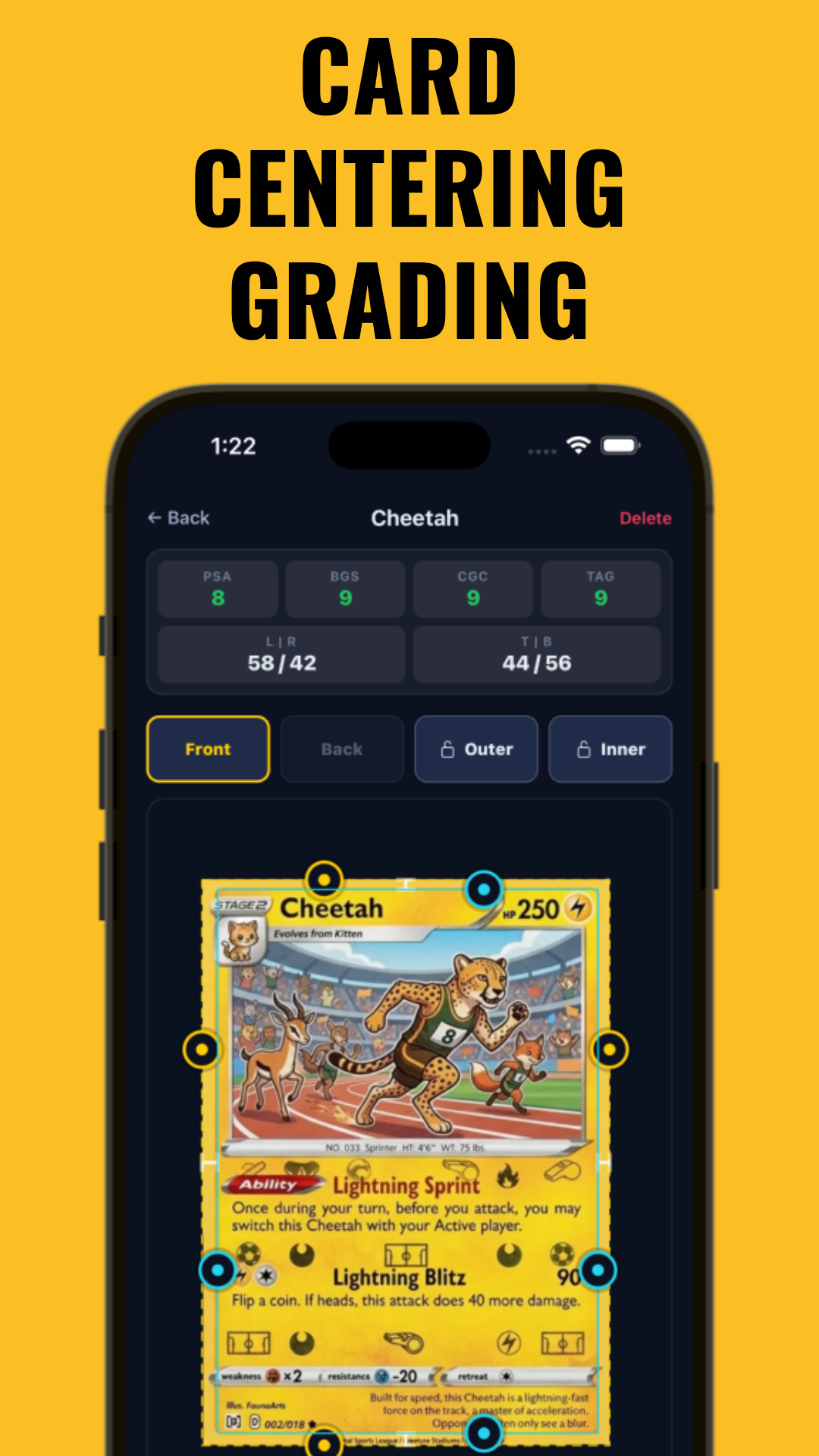
The smartest step is to estimate the grade first. Inspect corners and surface under good light, then measure centering. Midpoint gives you an AI-estimated PSA, BGS, CGC or TAG grade from centering, corners, edges and surface, so you can judge whether a submission makes sense before spending money. Our step-by-step pre-grading guide shows the process.
A simple decision rule
- Look up the raw value and the value at your estimated grade.
- Subtract grading fee, shipping and insurance.
- If the net gain is clearly positive, submit. If it is marginal, hold or sell raw.
Because different companies use different scales, also review grading scale differences by company before choosing where to send.
Section 7: Authenticating, Appraising and Selling Your Cards
Once you know what you have, the next steps are verifying it and getting paid fairly. High-value vintage attracts counterfeits and altered cards, so diligence matters.
How to identify an authentic 1958 Topps card
- Match the card number, player and team to a trusted checklist. The set runs 494 cards, so anything outside that range is not part of the base set.
- Check the series: Cards from different series have different scarcity, and number placement can hint at which series a card came from.
- Study the design: Compare typography, color and photo quality against a verified copy. Reprints and counterfeits often show blurry text or the wrong card stock feel.
- Inspect the edges: Trimmed cards often look slightly too small or have unnaturally smooth edges.
For high-value cards, a grading company's authentication is the strongest protection for both buyer and seller.
Appraising with completed sales
Asking prices are opinions; completed sales are facts. Search for sold listings that match the same card number and grade, and note the date. Use several comps, not one. Midpoint's card lookup consolidates raw and graded values so you can anchor your expectations before you list.
Where to sell
- Auction houses: Best for high-end graded stars where specialist bidders compete.
- Online marketplaces: Good reach for mid-grade cards and commons. Photograph the card well, front and back.
- Local shops and shows: Quick, often at a discount to full market value.
Track and insure what you keep
If you hold a collection, track its value over time and understand how grade affects replacement cost. Midpoint's portfolio tracking shows your collection's value across time, and the guide on card grade impact on insurance value explains how to document it. You can start free with Midpoint on iOS or Android.
Conclusion
Understanding 1958 Topps baseball cards value comes down to knowing which cards drive the market and how much each grade adds. The Mantle #150, Mays #5, Aaron #30, Williams #1, Koufax #187 and Clemente #52 lead the set, with Maris #47, Cepeda #343 and the Mantle subsets #418 and #487 offering strong alternatives.
The gem premium is the biggest lever. A clean, well-centered copy can be worth many times a played one, while a PSA 10 is so scarce that its price can be hard to establish. That is why measuring centering and estimating a grade before you submit saves money.
Compare recent sold prices, verify authenticity, store your cards properly and only grade the ones where the math works. With Midpoint's database figures as of 2026-11-22 as a reference point, you can make those calls with far more confidence.
FAQ
Q: How much are 1958 Topps baseball cards worth?
A: It depends almost entirely on the player and the grade. Commons in low grades are inexpensive, while star cards and high-grade copies command large premiums. Check Midpoint's card lookup or recent sold listings for the exact card and grade you own.
Q: What is the most valuable 1958 Topps baseball card?
The Mickey Mantle #150 is generally the headline card of the set, followed by other star cards such as Willie Mays #5, Hank Aaron #30 and Ted Williams #1. Exact ranking shifts by grade, so compare cards in the same condition.
Q: How much is a 1958 Topps Mickey Mantle card worth?
A: Value varies widely by condition. A low-grade copy is far cheaper than a high-grade one, and the premium generally rises steeply in the higher grades. Mantle also appears on #418 (with Aaron) and #487 (All-Star), which price differently from #150.
Q: How much is a 1958 Topps Roger Maris rookie card worth?
A: The Maris #47 is his first Topps card and holds solid demand, but its price depends on grade like every card in the set. Look up current raw and graded values and compare against sold comps before buying or selling.
Q: Are 1958 Topps baseball cards worth getting graded?
A: Stars, key rookies and sharp, well-centered cards usually are. Heavily damaged or common cards often are not, because a fee of $30 or more can exceed the value gained. Pre-grade first to estimate the likely result.
Q: What 1958 Topps baseball cards are worth money?
A: Beyond the big six stars (Mantle, Mays, Aaron, Williams, Koufax, Clemente), look at Maris #47, Cepeda #343, Mantle/Aaron World Series Batting Foes #418 and Mickey Mantle All-Star #487. Any card in exceptional condition can also carry a premium.
Free to start
Try the Midpoint app
Grade any card from a photo, see its raw and PSA 10 value, and track what your collection is worth — free.
Get it on iPhoneGet it on Android