Back Centering Pokémon: The Complete Guide to Card Centering for Grading
Learn how to measure back centering on Pokémon cards, what graders look for, and how centering impacts PSA, CGC, and vintage card grades.


Estimated reading time: 15 min
Key Takeaways
- Back centering on Pokémon and other TCGs is a crucial grading factor—distinct from front centering and overall card condition.
- Major grading companies (PSA, CGC, BGS) have specific centering standards for both front and back, with the back usually judged more leniently.
- Understanding centering ratios (e.g., 50/50, 60/40) and how to measure borders empowers collectors to pre-grade accurately.
- Tools like Midpoint and manual methods help identify cards with strong grading potential.
- Common centering issues—diamond cut, diagonal shift, uneven borders—can lower a card’s grade, even with flawless surfaces or corners.
Table of Contents
- Section 1: What Is Centering? Defining the Basics for Card Grading
- Section 2: Understanding Centering Ratios (50/50, 60/40, 75/25) & How to Read Them
- Section 3: Pokémon Card Centering—Front vs Back
- Section 4: Grading Standards—PSA, CGC, BGS, and How They Treat Back Centering
- Section 5: Measuring Card Centering—Tools, Techniques, and Practical Examples
- Section 6: Centering Across Card Types: Sports, MTG, One Piece, Vintage & More
- Section 7: Common Centering Mistakes & What Really Counts
- Section 8: How to Pre-Grade and Maximize Your Card’s Value
- Conclusion
- FAQ
Section 1: What Is Centering? Defining the Basics for Card Grading
What Does Card Centering Mean?
Card centering refers to the alignment of the printed artwork and borders on a trading card relative to its physical edges. In simple terms, it measures how evenly the design is placed within the card's cutout. Perfect centering means identical border widths on all sides; off-centered cards have noticeably uneven borders—either top-to-bottom, left-to-right, or diagonally.
- Front centering: The alignment of the artwork and border on the card’s front face.
- Back centering: The alignment on the card’s reverse, often judged separately and differently by graders.
Why Centering Matters (Beyond Card Condition)
Centering is a major factor in how to grade Pokémon cards and sports cards. Even flawless corners, edges, and surfaces can't compensate for bad centering—a severely off-center card is unlikely to receive a Gem Mint (PSA 10, BGS 10, CGC 10) regardless of its other qualities. For vintage card centering especially, off-center cuts are common and can make high-grade examples scarce and valuable.
Centering vs. Card Condition
It’s important to distinguish centering from overall condition. Condition includes surface scratches, whitening, print lines, and bends, while centering is strictly about border alignment. A card can have perfect centering and still be damaged, or be pristine but off-center.
- Centering = measured and objective (can be quantified)
- Condition = subjective and visual (surface, edges, corners)
Section 2: Understanding Centering Ratios (50/50, 60/40, 75/25) & How to Read Them
What Are Centering Ratios?
Centering ratios express the proportional widths of opposite borders as percentages. They help quantify how close to perfectly centered a card is. For example, "50/50" means both borders are identical; "60/40" means one side is 60% of the combined width, the other 40%.
- 50/50: Perfect centering; equal borders.
- 55/45 or 60/40: Slightly off-center, but often within tolerance for top grades.
- 75/25: Noticeably off-center; rarely acceptable for high grades.
How Are Ratios Calculated?
Measure the width of each border (in mm or pixels). Add both widths together, then divide each border width by the total to get the percentage. Example: If the left border is 2mm and the right is 3mm, total is 5mm. Left is 40% (2/5), right is 60% (3/5), so centering is 60/40.
Interpreting Centering Ratios for Grading
Grading companies set cutoff ratios for each grade. For example, PSA allows up to 60/40 on the front for a 10, but up to 75/25 on the back. Most collectors use 60/40 as a general guideline for high grades. For more detail, see How to Measure Card Centering: Step-by-Step Precision Guide.
Section 3: Pokémon Card Centering—Front vs Back
Pokémon Card Borders: Yellow and Blue
Pokémon cards feature a distinct yellow border on the front and a blue border on the back. Both are judged for centering, but the front border is more visually prominent and often weighs more heavily in grading. Back centering Pokémon cards is still important, but grading standards are more lenient.
- Front (yellow border): Main area for centering assessment; strictest standards for PSA 10.
- Back (blue border): Visually less obvious, but can still affect grading, especially for severe shifts.
Front Centering vs Back Centering: What Graders Look For
For most grading companies, the front centering receives the bulk of scrutiny. PSA, CGC, and BGS all publish explicit tolerances. For instance, a PSA 10 Pokémon card must have front centering within 60/40, but up to 75/25 is allowed on the back. However, a severely off-center back (past 75/25) can still prevent a card from getting a 10.
Why Back Centering Matters (and When It Doesn’t)
Collectors often overlook back centering Pokémon cards, but graders do not. While a minor back shift may not hurt a grade, extreme examples (like 80/20) can drop a PSA 10 to a 9. Some graders also consider diamond cuts and diagonal shifts on the back as flaws. For a deeper dive into centering’s impact, see How Centering Impacts Card Value: A Detailed Guide.
Section 4: Grading Standards—PSA, CGC, BGS, and How They Treat Back Centering
PSA Centering Standards
- PSA 10 (Gem Mint): Front 60/40 or better; back 75/25 or better.
- PSA 9 (Mint): Front 65/35 or better; back 90/10 or better.
- PSA 8 (NM-MT): Front 70/30; back not specified (usually 90/10 or better).
Back centering Pokémon cards can be more off-center than the front and still earn a 10, but egregious misalignment or visible diamond cuts can drop the grade.
CGC and BGS Centering Standards
- CGC 10: Centering must be 55/45 or better on the front, 75/25 or better on the back.
- BGS (Beckett): Centering subgrade is averaged between front and back. BGS 10 requires 50/50 to 55/45 front, 60/40 or better back.
BGS weighs back centering more heavily than PSA or CGC, especially for subgrades. For vintage card centering, some leniency is given due to old printing methods.
Other Graders: ACE, TAG, and SGC
ACE and TAG use digital measurement tools for precise centering analysis. SGC follows similar standards to PSA but places more emphasis on overall eye appeal. For all, severe back centering issues—such as diamond cuts or diagonal shifts—are considered flaws.
For a comprehensive comparison of card grading centering standards across PSA, BGS, CGC, SGC, and TAG, see our detailed guide.
Section 5: Measuring Card Centering—Tools, Techniques, and Practical Examples
Manual Methods: Ruler, Calipers, and DIY Techniques
Collectors can measure centering at home with a transparent ruler, digital calipers, or printable overlays. Measure each border’s width (in mm) and compare the left/right (or top/bottom) ratios. For digital collectors, scanning the card and using image software to count pixels is another method.
- Measure left/right and top/bottom borders separately.
- Calculate the ratio as explained in Section 2.
Why Use a Card Centering Tool?
Manual measurements can be accurate but may be slow and prone to human error. Digital tools like Midpoint automate the process, using AI to detect edges and instantly calculate centering ratios for Pokémon, sports, MTG, One Piece, and vintage cards. This can help ensure precision down to the millimeter.
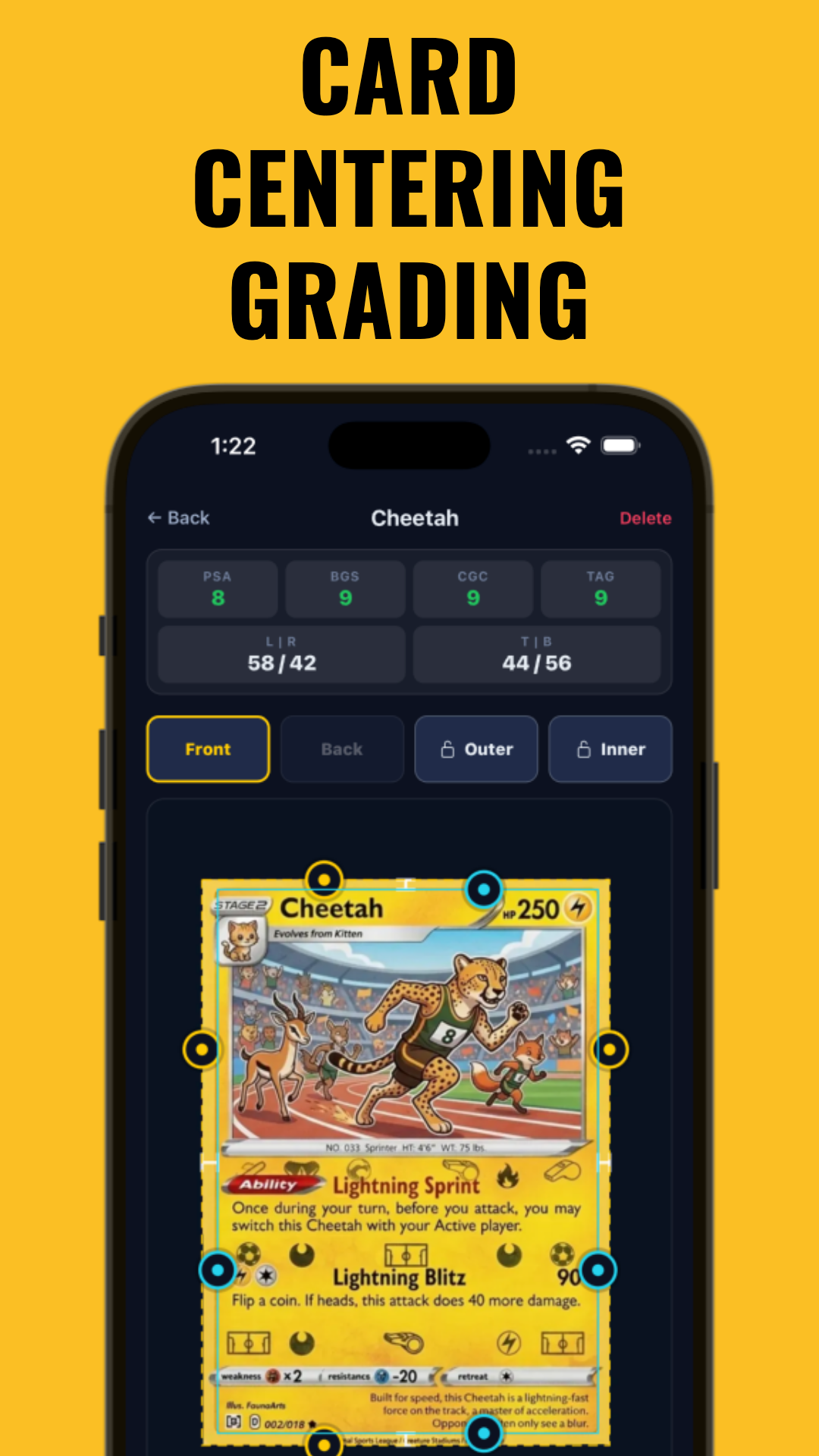
Step-by-Step: Measuring Back Centering Pokémon Cards
- Place the card face down (back up) on a flat surface.
- Measure the blue border on all four sides.
- Check both left/right and top/bottom for evenness.
- Use a tool or app to verify if the centering is within PSA/CGC standards.
See the guide How to Use a Centering Tool for Pokémon Cards for a detailed walkthrough.
Section 6: Centering Across Card Types: Sports, MTG, One Piece, Vintage & More
Sports Card Centering: Unique Challenges
Sports cards, especially vintage era, often suffer from poor centering due to old printing and cutting technology. Collectors prize 50/50 examples, but even 60/40 can be uncommon for 1950s or 60s cards. Grading companies are sometimes more lenient with vintage card centering—especially pre-1980.
- Modern sports cards: Tighter tolerances (similar to TCGs).
- Vintage: More tolerance for off-center, but still a critical grading factor.
MTG Card Centering: Magic’s Border Issues
Magic: The Gathering (MTG) cards have a distinct black border (or white for some sets), and centering is known to be inconsistent for early sets—Alpha, Beta, and Unlimited. MTG card centering is judged similarly to Pokémon, but front centering is even more visually obvious due to the dark border. Back centering is usually less scrutinized unless extremely off.
One Piece and Yu-Gi-Oh Card Centering
One Piece and Yu-Gi-Oh cards have thinner borders, making small centering shifts more noticeable. Modern production is more consistent, but collectors should still check both front and back. Grading companies apply the same ratio standards as Pokémon—60/40 or 55/45 front; up to 75/25 back for top grades.
For a practical grading workflow, see How to Pre-Grade Your Card: A Step-by-Step Guide.
For a comprehensive overview of centering differences across Pokémon, sports, and other card types, see Card Centering by Type: The Complete Guide for Pokemon, Sports, and More.
Section 7: Common Centering Mistakes & What Really Counts
Diagonal Shift and Diamond Cut
Diagonal shift occurs when centering is off both vertically and horizontally, sometimes resulting in a “diamond cut”—where the card’s border is noticeably thicker at one corner. Diamond cuts are often penalized by graders, even if front or back ratios are technically within tolerance.
- Diamond cut: Borders appear slanted; corners are mismatched.
- Diagonal shift: Borders are uneven on both axes, affecting eye appeal.
Uneven Borders on Pokémon Backs
Back centering on Pokémon cards is often overlooked by collectors but is checked by graders. A card with a very thin blue border on one side and thick on the other may fail to get a Gem Mint grade, even if the front looks perfect. Always check both sides before submitting.
Misreading Measurements & Human Error
Common pitfalls include measuring only the front, using inconsistent tools, or eyeballing instead of using precise methods. Manual errors can cause collectors to overestimate a card’s grade potential—potentially wasting grading fees on cards that can’t make PSA 10.
AI-powered apps (like AI-Focused Comparison: How AI Transforms Card Centering Analysis) can help reduce human error in centering calculations.
Section 8: How to Pre-Grade and Maximize Your Card’s Value
Why Pre-Grading Matters
With grading fees often exceeding $30 per card, it’s important to estimate whether your card can achieve a top grade. Pre-grading with precise centering measurements filters out cards unlikely to achieve a PSA 10 or BGS Black Label, protecting your investment.
Best Practices for Accurate Pre-Grading
- Clean your card (no dust or fingerprints) before measuring.
- Use a transparent ruler, calipers, or a digital tool for accuracy.
- Measure all borders—front and back—before deciding to submit.
- Compare ratios to published grading standards for your card type.
Using Technology to Your Advantage
Apps like Midpoint provide instant centering ratios for Pokémon, sports, Magic, and more, removing guesswork from the process. For collectors with many cards, digital bulk upload features can screen many cards quickly, saving both time and grading expenses.
For a deeper look at pre-grading strategy, see Estimate Your Card: A Practical Guide Before Grading.
Conclusion
Mastering back centering Pokémon cards—and centering for all trading and sports cards—is a vital skill for collectors aiming for top grades and maximum value. Accurately measuring both front and back centering, understanding grading company standards, and using digital tools like Midpoint can save you time and money, ensuring you submit only the best candidates for grading. Whether you collect Pokémon, MTG, sports, One Piece, or vintage cards, centering remains a critical, quantifiable part of the grading equation. For further learning, explore our guides on accurate card grading estimates and step-by-step measuring techniques to refine your eye and boost your collection’s value.
FAQ
Q: Does back centering matter for a PSA 10 Pokémon card?
A: Yes, back centering matters. PSA allows back centering up to 75/25 for a PSA 10, but extremely off-center backs can still prevent a 10, especially if the misalignment is visually obvious or includes a diamond cut.
Q: What is considered good back centering on Pokémon cards?
A: Good back centering for Pokémon cards is typically 75/25 or better (meaning the narrower border is at least 25% of the total width). For higher certainty, aim for closer to 60/40 or better.
Q: How do you measure Pokémon card centering on the back?
A: Measure the width of the blue border on all four sides using a ruler or digital tool. Calculate left/right and top/bottom ratios, and compare to grading standards (e.g., 75/25 for PSA 10).
Q: What centering ratio is acceptable for PSA 10 on the back?
A: PSA allows up to 75/25 centering on the back for a PSA 10 grade. The front must be 60/40 or better.
Q: Is front centering or back centering more important for Pokémon cards?
A: Front centering is more important and has stricter standards, but back centering is still checked and can affect the final grade if badly off.
Q: Can a Pokémon card still get a 10 with bad back centering?
A: A card can get a 10 with some back centering issues (up to 75/25), but extreme misalignment or additional flaws like diamond cuts will likely result in a lower grade.
Free to start
Try the Midpoint app
Grade any card from a photo, see its raw and PSA 10 value, and track what your collection is worth — free.
Get it on iPhoneGet it on Android